
Best Bid/No-Bid Analysis Tools for Government Contractors (September 2026)

Akash Mandavilli
CEO and Co-Founder of GovEagle
About the author
Akash is a 2x founder with previous experience in AI from Meta and federal sales from IBM. Akash holds a dual-degree from Johns Hopkins University in Economics and Computer Science.
Most government contractors don’t lose because their proposals fall short; they lose because they bid on work they were never positioned to win. Chasing every RFP drains proposal teams, pulls focus from real opportunities, and lowers win rates across the pipeline. High-performing GovCon teams rely on bid/no-bid analysis software to score each solicitation against actual capabilities, past performance, and competitive posture before committing people and budget. In this guide, we compare the tools that help contractors qualify pursuits early, walk away from poor fits, and concentrate effort on bids where they enter with a clear advantage, linking opportunity scoring directly to proposal work without forcing teams into new systems.
TLDR:
- Bid/no-bid tools assess RFP fit and probability of win (pWin) against your capabilities before you commit proposal resources.
- Top tools extract Sections C, L, and M automatically and generate compliance matrices.
- Security matters: FedRAMP Moderate or equivalent security controls and CMMC-aligned practices are often required when handling CUI data.
- Some modern solutions connect bid analysis to proposal execution with native Word integration and SharePoint access.
- Automated amendment tracking prevents teams from qualifying against outdated RFP requirements.
What Are Bid/No-Bid Analysis Tools for Government Contractors?
Bid/no-bid analysis tools help government contractors decide which RFPs to pursue before committing proposal resources. These tools assess whether an opportunity matches your technical capabilities, past performance, and competitive standing.
Government contractors work within finite proposal budgets. These tools calculate probability of win (pWin) by analyzing technical fit, incumbent position, competition, and capability gaps to identify pursuits with the strongest pWin. The result is better resource allocation and higher win rates by concentrating effort where you hold real competitive advantages.
How We Ranked Bid/No-Bid Analysis Tools
We ranked tools based on their ability to help government contractors make pursuit decisions quickly without sacrificing compliance accuracy.
RFP shredding accuracy determines whether your analysis starts with complete requirements or requires manual gap-filling. Tools that extract Sections C, L, and M automatically and generate compliance matrices without rigid tagging structures scored highest.
Integration depth matters. Most pursuits fail, so connecting directly to SharePoint, Box, or CRM systems lets you assess opportunities against actual past performance data. We favored solutions that work inside Microsoft Office instead of forcing teams into separate web portals.
Security compliance separates viable options from non-starters for defense contractors handling CUI. We assessed FedRAMP status, CMMC compliance support, and GCC High availability. Tools lacking government-grade security cannot serve most GovCon teams, regardless of analytical features.
We also considered competitive intelligence capabilities and amendment tracking. Automated amendment identification improves opportunity qualification accuracy before you commit proposal resources.
GovEagle
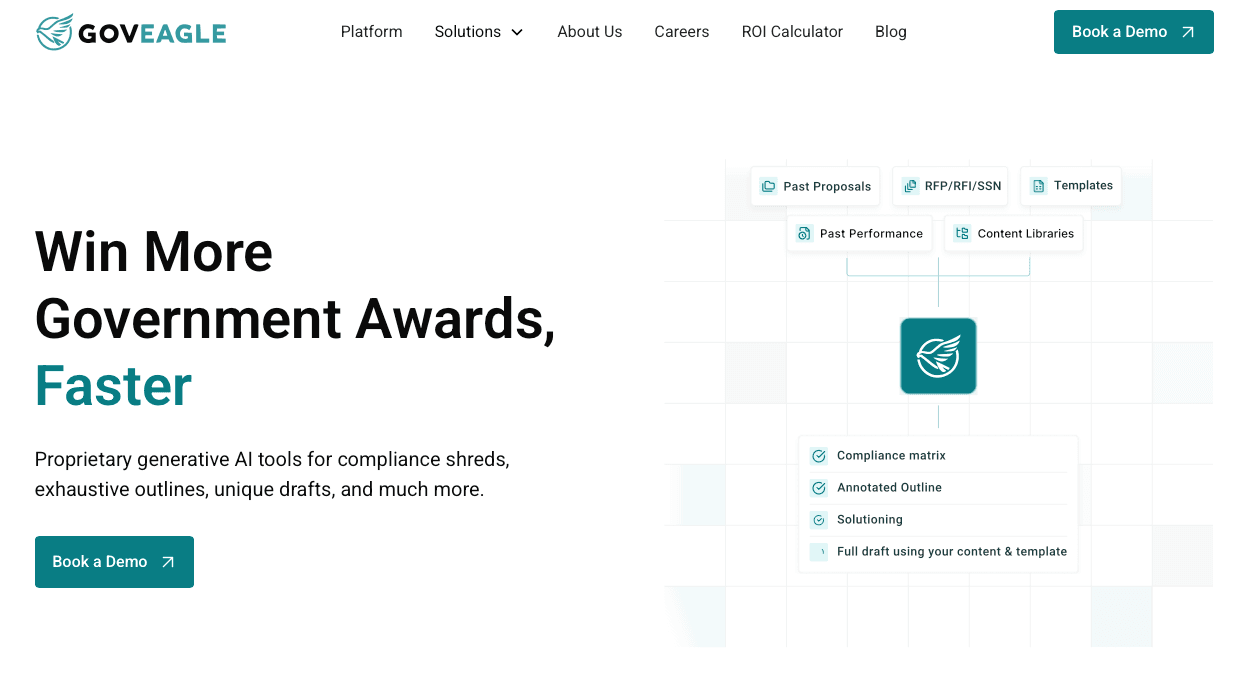
GovEagle runs bid/no-bid analysis using AI that scores RFP requirements against your past performance and capabilities. The tool produces opportunity assessments that show competitive positioning before you allocate proposal resources. Additionally, the tool calculates pWin by searching for capability gaps, analyzing competitors, and understanding set aside qualifications.
What GovEagle Offers
- Capability and gap analysis that ranks past performance contracts against PWS task areas
- Teaming partner identification when capability gaps appear
- Capture deck automation that populates planning documents with RFP intelligence and win themes
- Compliance matrix generation that extracts Sections C, L, and M requirements and exports to Excel using your existing templates
Good for: Services contractors handling compliance-heavy federal RFPs with short deadlines, particularly firms scaling bid volume without adding proposal headcount.
Bottom line: We connect bid decision support with end-to-end proposal execution in one tool, backed by FedRAMP Moderate Equivalency and native Microsoft Office integration that works with your existing templates.
GovSignals
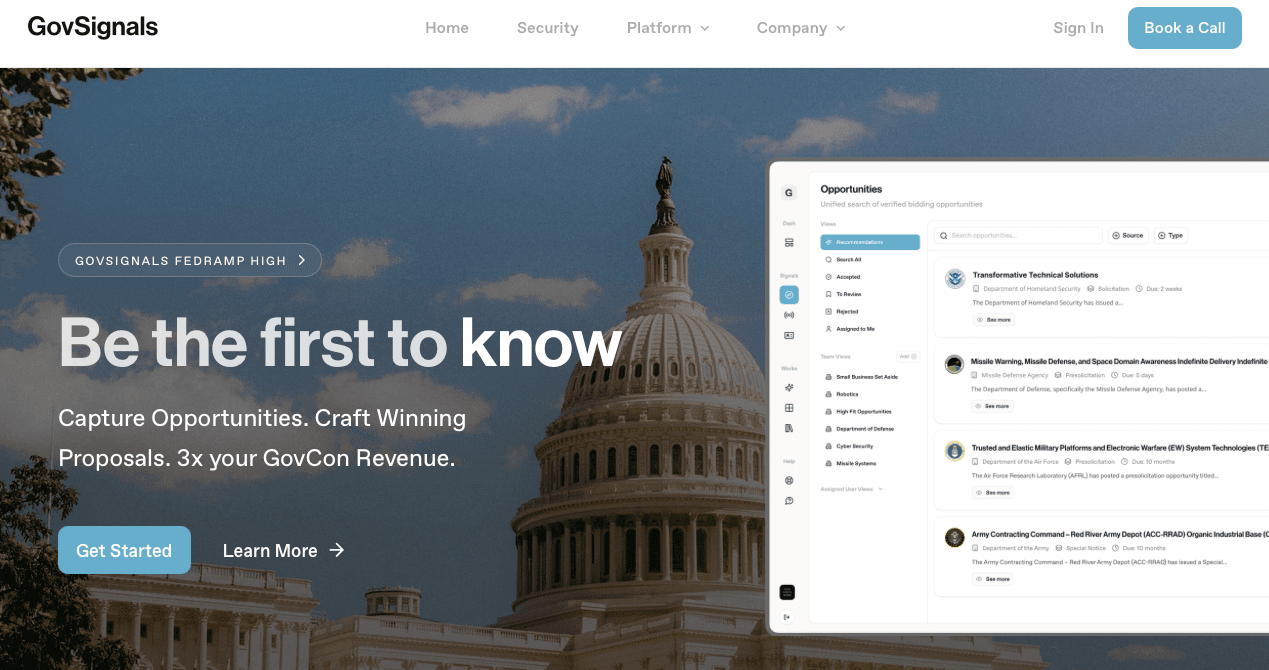
GovSignals specializes in market intelligence and opportunity analysis for government contractors, with bid/no-bid support built around competitive intelligence instead of proposal execution.
What They Offer
- Market intelligence and opportunity tracking across federal contracts
- Competitive analysis to support pursuit decisions
- Government contracting data aggregation from multiple sources
- Bid opportunity evaluation based on historical win patterns
Good for: Teams that need market intelligence and competitive data to inform go/no-go decisions.
Limitation: Compliance matrices must be built within their system only, blocking template reuse and forcing teams to abandon existing organizational formats.
Rohirrim

Rohirrim provides AI-assisted proposal support with basic opportunity evaluation capabilities through a conversational interface.
What They Offer
- AI chat interface for opportunity assessment and proposal content generation
- Document analysis for RFP evaluation
- Basic opportunity qualification support
Good for: Teams who prefer conversational AI interfaces for open-ended opportunity evaluation.
Limitation: Lacks structured workflows for compliance matrices and relies on pre-trained methodologies instead of adapting to company-specific processes. Requires data ingestion instead of direct integration with existing content repositories.
Get GovCon capture and proposal insights in your inbox.
GovDash

GovDash offers business development capabilities with bid/no-bid evaluation features as part of a broader solution covering pipeline management through proposal development.
What They Offer
- Business development pipeline management with opportunity scoring
- Proposal project management capabilities
- Past performance library management
Good for: Organizations seeking an all-in-one business development solution who can invest time in configuration and work primarily within a web interface.
Limitation: Templates often need manual reworking. Requires creating a separate Past Performance Library instead of connecting to existing repositories.
Procurement Sciences

Procurement Sciences offers government contracting tools with opportunity assessment capabilities for federal contractors assessing pursuit decisions.
What They Offer
- Government contracting opportunity intelligence with bid opportunity analysis features
- Market research capabilities with pursuit decision support tools
Good for: Organizations seeking a single-vendor solution that combines market intelligence with bid evaluation.
Limitation: Lacks purpose-built workflows for compliance matrices.
Vultron
Vultron offers AI-powered proposal development tools with basic opportunity evaluation capabilities.
What They Offer
- AI-driven proposal content generation with RFP analysis
- Opportunity assessment features for pursuit decisions
- Response automation tools
Good for: Teams who need proposal drafting automation with light opportunity assessment.
Limitation: FedRAMP authorization and CMMC compliance are not publicly listed. Confirm suitability for CUI handling and required environments before use. SharePoint integration availability should be validated with the vendor.
Why GovEagle Is the Best Bid/No-Bid Analysis Tool
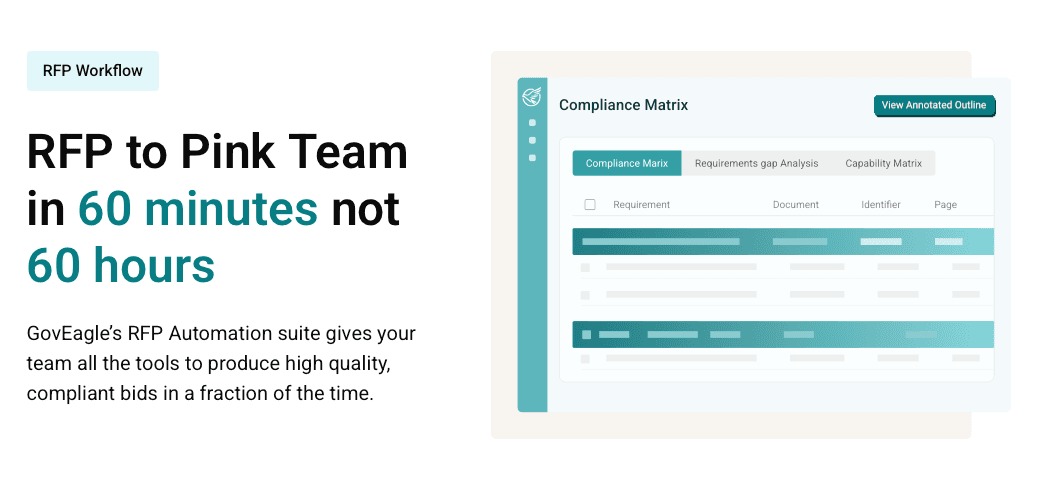
GovEagle connects bid/no-bid analysis directly to proposal execution. Capability gap assessments automatically generate teaming partner recommendations and populate capture decks. That intelligence flows into compliance matrices and annotated outlines without system switching.
Many teams go live within a week through SharePoint, Box, and Egnyte integrations. Our Word add-in lets proposal managers assign tasks inside documents that sync with capture intelligence.
We maintain FedRAMP-aligned Moderate security controls (often described as “Moderate Equivalent”) and support GCC High environments. Zero-retention policies keep your proprietary data yours.
The workflow matches how proposal teams operate: capability assessment, teaming gap identification, and compliance matrices that export to existing templates.
FAQs
How do I choose the right bid/no-bid analysis tool for my organization?
Start by assessing your security requirements (FedRAMP, CMMC, CUI handling), then assess how the tool connects to your existing content repositories like SharePoint or Box. Select tools that work inside Microsoft Office if your team already uses Word for proposals, and verify the tool provides structured compliance workflows instead of just market intelligence or drafting features.
Which bid/no-bid tool works best for defense contractors handling CUI?
GovEagle offers FedRAMP Moderate Equivalency and supports GCC High environments with zero-retention policies for proprietary data. GovSignals states FedRAMP High Authorization. Vultron does not publicly list FedRAMP authorization or CMMC certification. Verify security posture against your CUI requirements before use.
Can I use my existing proposal templates with these tools?
GovEagle generates compliance matrices that export to Excel using your current templates without reworking, and the Word add-in adapts to your existing formats. GovSignals requires building matrices within their system only, blocking template reuse, while GovDash templates often need substantial manual reworking before use.
What's the difference between tools focused on market intelligence versus proposal execution?
Market intelligence tools like GovSignals provide competitive data and opportunity tracking to inform pursuit decisions but may lack comprehensive proposal development capabilities. Proposal execution tools like GovEagle connect bid/no-bid analysis directly to compliance matrices, capture decks, and drafting workflows, covering the complete capture-to-submission process in one system.
How quickly can my team start using a bid/no-bid analysis tool?
GovEagle teams go live within one week through direct SharePoint, Box, and other integrations that require no data migration. Tools requiring separate past performance libraries, rigid tagging structures, or extensive upfront configuration typically need months of setup before your team can run meaningful opportunity assessments.
Final thoughts on government contractor pursuit decisions
Strong pursuit decisions start long before drafting begins. Contractors need bid/no-bid analysis that pulls directly from real past performance, accounts for competitive position, and feeds cleanly into proposal work without forcing teams to jump between tools. Bid/no-bid analysis software should support how proposal teams already operate: inside Word, tied to SharePoint, and aligned with existing templates and review processes. GovEagle was built for that reality, connecting opportunity scoring to compliance matrices, capture planning, and task assignment in one continuous workflow backed by FedRAMP Moderate Equivalency. The result is fewer wasted bids, better use of proposal resources, and more focus on pursuits where teams enter with a true advantage.