
Shipley Proposal Lifecycle Guide: 2026

Akash Mandavilli
CEO and Co-Founder of GovEagle
About the author
Akash is a 2x founder with previous experience in AI from Meta and federal sales from IBM. Akash holds a dual-degree from Johns Hopkins University in Economics and Computer Science.
GovEagle is not affiliated with, sponsored by, certified by, or otherwise associated with Shipley Associates.
Your team likely uses Shipley capture templates and runs some version of Pink and Red Team reviews. That is standard across GovCon. The real question is how much of the Shipley process actually survives when capture budgets shrink and proposal timelines drop from twelve weeks to six. Most teams adapt on the fly, cutting steps without always knowing the impact on win probability. This breakdown maps the full lifecycle, where compression usually happens, and which activities truly influence outcomes, along with how modern proposal support tools fit into that reality.
TLDR:
- Shipley's 7-phase lifecycle covers federal market research through post-submittal activities, with win probability typically highest before RFP release.
- The 96-step process serves as a customizable checklist; adapt steps based on opportunity size and complexity.
- Color team reviews at 60-70% completion leave enough runway to act on feedback before final submission.
- Capture planning 6-12 months pre-RFP lets you shape requirements and build agency relationships early.
- Some modern GovCon proposal support tools automate compliance matrices, capture decks, and color team scoring while aligning with Shipley workflow.
Get GovCon capture and proposal insights in your inbox.
Understanding the Shipley Process for Government Contractors

Codified by Shipley Associates in the late 1990s, the Shipley process gave GovCon teams a repeatable lifecycle for winning federal contracts, from early market segmentation through post-submittal activities.
Its staying power comes from broad industry adoption. Shipley is an Association of Proposal Management Professionals (APMP) Approved Training Organization, and Shipley fluency is widely cited as a baseline competency across capture and proposal development roles in the GovCon industry. For proposal managers and BD directors, the framework gives each phase a common structure, language, and sequence.
The 7 Phases of the Shipley Business Development Lifecycle
Most people associate Shipley with proposal writing. The reality is that proposals are just one phase of a much longer government contracting business development lifecycle.
| Phase | Focus | Key Activities |
|---|---|---|
| 1. Market Segmentation | Identify target markets | Agency research, market analysis, opportunity forecasting |
| 2. Long-Term Positioning | Build early customer and market position | Customer engagement, account positioning, relationship building |
| 3. Opportunity Assessment | Qualify and select opportunities | Bid/no-bid analysis, customer profile, competitive assessment |
| 4. Capture/Opportunity Planning | Shape the deal before release | Capture strategy, win themes, teaming, customer visits |
| 5. Proposal Planning | Prepare the proposal effort | Proposal kickoff planning, outlines, schedules, storyboards |
| 6. Proposal Development | Develop and refine the response | Writing, reviews, compliance checks, production |
| 7. Post-Submittal Activities | Support evaluation and follow-through | Oral presentations, discussions, negotiations, lessons learned |
Each phase has defined decision gates where leadership decides whether to continue pursuing an opportunity. The bid/no-bid decision in Phase 3 is among the most consequential calls a BD team makes. Teams that skip this gate often burn resources on unwinnable contracts.
Win probability drops sharply when teams engage late. Shipley's influence curve shows that your ability to shape requirements falls steeply once an RFP is released. By Phase 4, the customer's requirements are largely locked, and late entrants are mostly reacting instead of shaping the competition.
Breaking Down the Shipley 96-Step Process
The 96 steps aren't meant to intimidate. They're a catalog of every Capture and Proposal (C&P) activity a team might perform across the seven-phase lifecycle, documented so nothing falls through the cracks.
Not every pursuit needs all 96 steps. A small task order against an existing vehicle warrants a much lighter touch than a major IDIQ recompete. Experienced capture managers treat the 96 steps as a checklist to pull from, selecting the activities that match the opportunity's size, complexity, and competitive risk. The goal is thoroughness where it counts, not bureaucracy for its own sake. Chevo, a federal management consulting firm, cut proposal prep time by 40% by tightening exactly this kind of selective execution: running the right Shipley activities at the right phase without expanding scope on every bid.
The Shipley Capture Planning Process
Capture planning is where contracts are won or lost long before the RFP arrives. Research consistently shows that a significant share of customers already have a preferred vendor in mind before proposals are submitted, often a majority. That gap closes fast once the RFP drops. A structured federal capture planning process maps the pre-RFP activities that give your team the best chance of shaping requirements before they're locked.
What a Capture Plan Covers
A structured capture plan typically includes:
- Customer profile and key decision-makers mapped to known priorities and buying history
- Competitive analysis with ghosting strategies tied to specific weaknesses, including black hat analysis of anticipated competitor approaches
- Win themes and discriminators grounded in agency pain points
- Teaming partner evaluation aligned to capability gaps
- Gap analysis connected to anticipated requirements
From Capture to Proposal
Good capture work feeds directly into the proposal: win themes in proposal volumes become section narratives, competitor weaknesses become ghosting fodder, and gap analysis surfaces teaming needs in time to act. For example, if capture intelligence reveals the agency is frustrated with incumbent transition delays, the win theme becomes "zero-disruption onboarding," so the Technical Approach section leads with your phased transition plan and supporting past performance instead of opening with staffing charts. The capture finding drives the section structure, not the RFP outline alone.
Shipley Color Team Reviews Explained
Color team reviews are structured checkpoints built into the proposal timeline, each with a defined purpose and moment in the lifecycle where it does the most good.
The Color Team Sequence
| Review | Timing | Purpose |
|---|---|---|
| Blue Team | Pre-RFP | Validates capture strategy and win themes |
| Pink Team | ~30% draft | Checks structure, compliance, and approach |
| Red Team | ~70% draft | Independent evaluation aligned to customer evaluation criteria |
| Green Team | Near final | Reviews pricing strategy and cost volume alignment |
| Gold Team | Final review | Executive sign-off before submission |
| White Team | Post-submission | Scores and debriefs the completed proposal |
Adapting for Smaller Teams
Few teams run all six reviews on every bid. Smaller contractors often collapse Pink and Red into a single mid-cycle review, or skip Green entirely on firm-fixed-price work with limited cost narrative. Some defense contractors report strengthening proposal discipline through tighter, more structured reviews without compromising output quality, a useful model for teams working through the same tradeoff.
The Red Team review carries the most weight. It should include reviewers who were not involved in writing, ideally people who can approximate how a government evaluator reads the proposal. If your Red Team members are also your writers, you are grading your own homework.
Timing matters as much as participation. Run the Red Team at 60-70% completion so writers have enough time to act on feedback before the Gold Team locks the document.
Bid No-Bid Decisions Using the Shipley Method
A no-bid decision made well is as valuable as a winning proposal. Shipley structures the go/no-go evaluation around five weighted factors:
- Pwin estimate based on incumbent status and relationship depth with the customer
- Capability and past performance alignment to the stated requirements
- Competitive positioning relative to known or anticipated bidders
- Pricing viability given the estimated contract budget
- Strategic fit with longer-term growth goals for your firm
Score each factor objectively against your firm's threshold. If Pwin falls short, passing frees your team's capacity for opportunities where you can actually win.
Core Shipley Templates and Tools
Shipley publishes several core reference guides that most BD teams keep close at hand throughout a pursuit.
- Shipley Proposal Guide: the primary reference for proposal strategy, writing, and review standards
- Shipley Capture Guide: covers pre-RFP positioning, customer profiling, and competitive strategy
- Business Development Lifecycle Guide: maps the full 96-step process with phase-by-phase activity guidance
- Proposal Writer Playbook: a tactical companion focused on writing mechanics and section development
Beyond the guidebooks, teams rely on repeatable templates. A capture plan template typically structures your customer profile, competitive analysis, win themes, and gap assessment in one document. Compliance matrix templates translate RFP requirements into trackable rows, and proposal outline templates pre-map sections to relevant RFP instructions.
Review checklists round out the toolkit. Pink Team and Red Team checklists give evaluators consistent criteria to score against, keeping feedback actionable instead of subjective.
Applying Shipley Best Practices to Proposal Writing
Good capture work sets the stage. Writing well is what closes the deal.
Shipley's approach to proposal writing starts with a simple rule: write to the evaluator, not about yourself. Every section should answer the question the customer is actually asking, grounded in their stated priorities instead of your firm's internal talking points.
Core Writing Principles
- Lead with the customer's problem before presenting your solution, so evaluators see their world reflected back to them before reading your answer.
- Anchor win themes to specific evaluation criteria, not general company strengths.
- Use discriminators to separate your approach from the competition on dimensions that matter to the agency.
- Write action captions for every graphic so visuals carry independent meaning without requiring the surrounding text.
- Plan each section with a storyboard before drafting, mapping theme statements to supporting proof points.
The storyboard step gets skipped most often under deadline pressure. A brief section plan keeps the narrative coherent and evaluation criteria visible throughout.
"Features tell, benefits sell. Always answer the evaluator’s question: what does this mean for the agency?"
How AI and Automation Are Reshaping Shipley Workflows
AI applied to GovCon proposals speeds up the parts of Shipley that eat hours without adding strategic value.
Compliance shredding, requirement extraction, and cross-referencing Sections L and M are mechanical tasks. A trained proposal manager can do them, but spending a full day on each one pulls attention away from win themes and discriminators. AI in GovCon proposal workflows can cut that work from hours to minutes.
The same logic applies to first-draft generation. AI trained on existing GovCon proposals and past performance narratives can produce a structured draft suitable for Pink Team review in hours, giving writers something to sharpen. Gap analysis works the same way: AI cross-matches solicitation requirements against your capability library and flags where past performance falls short, surfacing teaming conversations earlier.
Where teams go wrong is treating AI output as final. Compliance matrices need human verification. Draft sections need strategic shaping. Color team reviews still require independent judgment. AI compresses the timeline between Shipley phases. It does not replace them. GovEagle's compliance matrix generation and annotated outline automation are built around exactly that distinction: handling the mechanical extraction so your team focuses on win themes and discriminators.
Accelerating Government Proposal Development with GovEagle
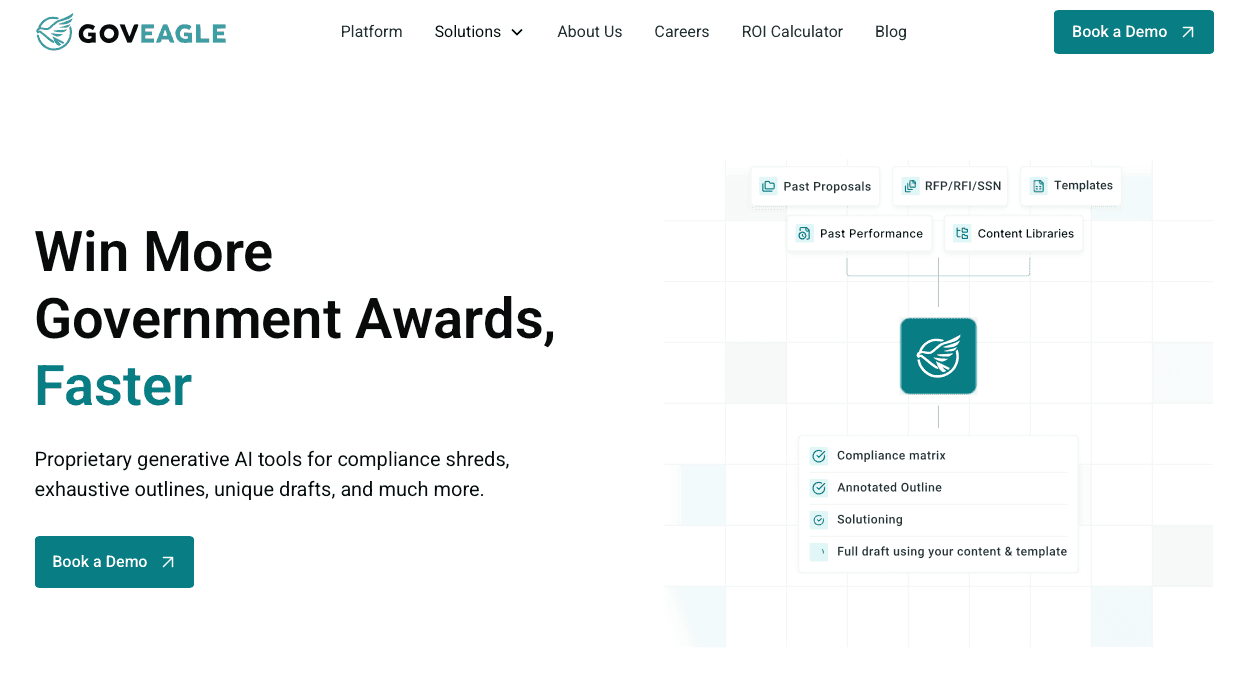
Every Shipley phase carries administrative overhead that pulls your capture and proposal team away from strategy. GovEagle is purpose-built to compress that overhead without cutting corners on compliance or quality.
The alignment is direct. Capture deck automation builds pursuit documents, so your team enters the proposal phase with win themes and gap analysis already documented. Compliance matrix generation processes Sections C, L, and M in minutes, outputting directly to Excel in your team's existing format. The annotated outline drops into Word with requirements pre-mapped to sections, giving writers a compliant starting structure from day one.
Color team reviews benefit too. GovEagle's automated compliance and quality review generates push-button reports that simulate evaluator scoring, so your Red Team walks in with data. Amendment tracking flags every solicitation change and updates the matrix automatically, removing the manual re-shredding that typically derails late-cycle reviews.
GovEagle’s workflows are built around Shipley-aligned practices. Workflows mirror actual GovCon proposal workflows, as shown in Chevo's proposal prep case study. If your team runs Shipley and needs to move faster, see what GovEagle can do.
FAQs
How long does a Shipley capture plan take to build before an RFP drops?
Most teams invest 6 to 12 months in capture planning before RFP release to shape customer requirements, build agency relationships, and develop win themes that feed directly into the proposal when drafting begins.
What is the minimum number of color team reviews needed for a compliant proposal?
Pink Team at ~30% and Red Team at 60-70% are the minimum. See the Color Team section for full timing guidance.
Can small GovCon teams implement the full Shipley 96-step process?
Small teams should treat the 96 steps as a menu, not a mandate, selecting activities that match opportunity size and risk while focusing capture investment on top-priority pursuits instead of spreading resources across every bid.
What skills should a modern capture manager have?
Modern capture managers need a blend of market intelligence, relationship development, and process discipline grounded in Shipley and APMP competencies. Core skills include: running structured bid/no-bid analysis against objective criteria; building and maintaining customer profiles that map decision-makers to known priorities; developing win themes and discriminators tied to specific evaluation criteria instead of general company strengths; leading teaming partner assessments aligned to capability gaps; and translating capture strategy into proposal-ready artifacts (storyboards, section outlines, and compliance matrices) before the RFP drops. Increasingly, capture managers are also expected to work alongside AI-assisted capture tools, using automated pipeline intelligence and requirement extraction to compress the pre-RFP window without sacrificing strategic depth.
How do I reduce time to proposal across multiple simultaneous pursuits?
Reducing cycle time across concurrent bids requires standardization at the process level, beyond faster writing alone. The highest-impact changes are: maintaining a reusable content library of past performance write-ups, capability narratives, and management approach sections that writers can pull from instead of drafting from scratch; templatizing compliance matrix and outline generation so kickoff artifacts are ready within hours of RFP release, not days; running a standing qualification gate so the team only enters full proposal development on bids that clear your Pwin threshold; and using amendment tracking automation to catch solicitation changes without re-shredding documents manually. Teams that compress proposal timelines most effectively front-load the standardization work in capture so the proposal phase is refinement, not reconstruction.
How do I scale a proposal function without scaling headcount at the same rate?
Scaling proposal volume without proportional headcount growth requires moving repeatable mechanical work off the proposal manager's plate entirely. Compliance matrix generation, requirement extraction from Sections C, L, and M, outline creation, and amendment tracking are all tasks that consume hours of senior staff time but follow deterministic rules; they are exactly the work proposal automation handles well. Reusable content libraries reduce per-bid writing time on standard sections. Standardized color team checklists mean reviewers spend less time calibrating and more time scoring. The model that scales is one where proposal managers own strategy, win themes, and review quality while automated tooling owns document structure, compliance tracking, and change management. APMP research consistently points to process standardization and content reuse as the primary drivers of proposal capacity growth independent of headcount.
Final Thoughts on the Shipley Proposal Process
Understanding the Shipley process gives GovCon teams a clear path from early capture through final submission without losing control of compliance or review rigor. The pressure comes when timelines overlap and early-phase work gets compressed into the proposal window. That is where GovEagle comes into play, handling compliance extraction, outline generation, and amendment tracking so teams can move faster without cutting critical steps. With the right GovCon proposal support in place, teams can run stronger Red Teams, keep capture intent intact, and submit with confidence even under tighter deadlines.