
GSA Schedule Contracts: What GSA Means for Federal Contractors (September 2026)

Akash Mandavilli
CEO and Co-Founder of GovEagle
About the author
Akash is a 2x founder with previous experience in AI from Meta and federal sales from IBM. Akash holds a dual-degree from Johns Hopkins University in Economics and Computer Science.
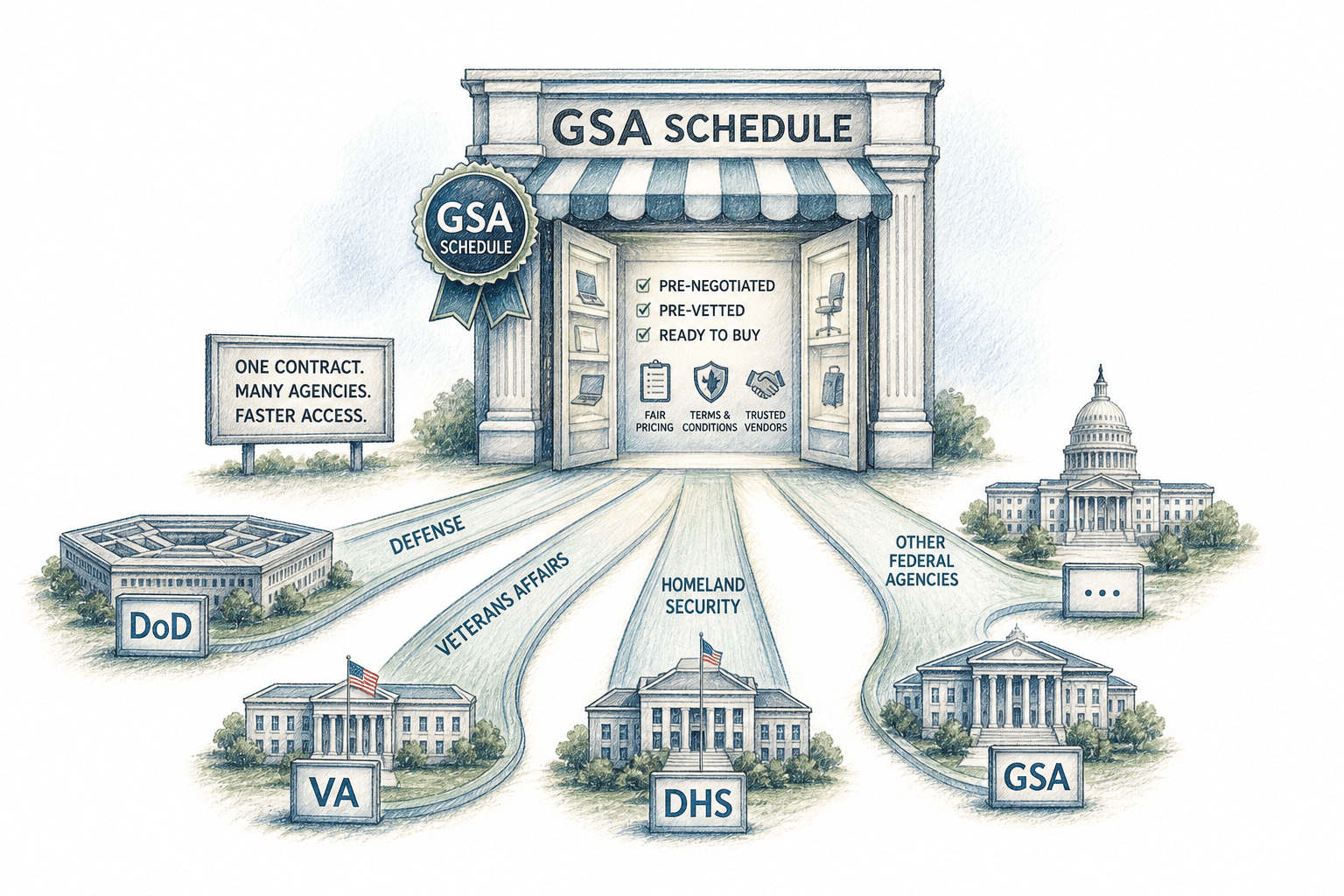
A GSA contract holder is a commercial company that has been awarded a GSA Multiple Award Schedule (MAS) contract and is pre-approved to sell products or services directly to federal agencies under pre-negotiated terms. That status is issued by the General Services Administration, the independent federal agency that manages government-wide acquisition vehicles supporting over $110 billion in goods and services in FY2024. The agency oversees the GSA Schedule program, which provides pre-negotiated contracts that federal agencies use to purchase products and services through simplified ordering procedures under FAR Part 8.4 instead of running full standalone procurements. For contractors, earning Schedule status opens doors to agency customers across every cabinet-level department while shortening the sales cycle through pre-cleared pricing and terms. Building a working knowledge of GSA's programs, vehicles, and acquisition structures is foundational to any contractor seeking to grow a sustainable federal business.
TLDR:
- The General Services Administration is an independent federal agency that oversees government-wide acquisition programs supporting over $110 billion in goods and services in FY2024, including the GSA Multiple Award Schedule program.
- GSA obtains products and services across categories including IT services, professional consulting, office furniture, laboratory equipment, telecommunications, and facilities management for federal agencies.
- GSA Schedule contracts allow federal agencies to buy from approximately 14,579 pre-approved vendors (FY2025) using simplified competition procedures under FAR Part 8.4 instead of running full standalone procurements.
- The agency manages three core service areas: federal procurement through GSA Schedules, civilian real estate portfolio management, and shared services like fleet management and telecommunications.
- GovEagle automates GSA proposal compliance matrices and annotated outlines, reducing first-draft time from days to hours.
What Does GSA Stand For?
The General Services Administration (GSA) is the federal agency that provides shared services to the government and oversees acquisition programs that support over $110 billion in FY2024 in annual federal purchasing. This definition dominates in federal contracting, business sales, and public sector contexts.
For government contractors, GSA represents the primary gateway to simplified federal procurement. The agency operates as both a service provider to federal offices and a procurement intermediary that connects vetted commercial vendors with government buyers. Understanding GSA's structure, programs, and acquisition vehicles is fundamental for any contractor seeking to build a sustainable federal business. From small businesses pursuing their first Schedule contract to large firms managing multiple contract vehicles, GSA touches nearly every corner of the federal marketplace.
General Services Administration: The Federal Agency Behind Government Operations
The General Services Administration operates as an independent federal agency created in 1949 to support the basic functioning of government offices across the United States. GSA consolidates administrative and day-to-day services that federal agencies need to carry out their missions.
The agency manages three core service areas. First, it handles federal procurement through GSA Schedules, which are pre-negotiated contracts that agencies use to buy everything from office supplies to IT services. Second, it oversees the government's civilian real estate portfolio, including building leasing, construction, and property disposal. Third, it provides shared services like fleet management, telecommunications, and travel coordination.
GSA's Public Buildings Service maintains approximately 359 million square feet of workspace across around 8,500 properties, per a December 2025 GAO report. The Federal Acquisition Service provides government-wide acquisition solutions used by dozens of federal agencies and authorized state and local buyers.
GSA obtains products and services across a wide range of categories that federal agencies need daily. IT services and solutions represent the largest category, including cloud computing, cybersecurity, software development, and technical support. Professional services cover management consulting, financial advisory, engineering, and program support. Office and building supplies range from furniture and equipment to maintenance services. Laboratory and scientific equipment serves research agencies. Telecommunications services connect federal offices nationwide. Facilities management covers construction, renovation, maintenance, and building operations for government properties.
| GSA Schedule Category | Description | Typical Federal Buyers | Common Use Cases |
|---|---|---|---|
| Information Technology | Cloud computing services, cybersecurity solutions, software development, IT infrastructure, technical support, and enterprise systems integration | DOD, DHS, VA, HHS, all agencies with technology needs | Cloud migration projects, cybersecurity assessments, custom software development, IT modernization initiatives |
| Professional Services | Management consulting, financial advisory, program management, strategic planning, human capital services, and business process improvement | GSA, OMB, Treasury, agency program offices | Organizational transformation, financial audits, program evaluation, strategic planning support |
| Facilities | Architecture and engineering services, construction management, facility maintenance, environmental remediation, and building modernization | GSA Public Buildings Service, DOD installations, VA medical centers | Building renovations, construction oversight, facility condition assessments, HVAC system upgrades |
| Transportation and Logistics Services | Freight and shipping services, warehousing, distribution, supply chain management, and transportation management systems | DOD, GSA, USPS, agencies with distribution operations | Freight forwarding, warehouse operations, supply chain optimization, last-mile delivery services |
| Office and Business Solutions (MAS Office Category) | Office furniture, equipment, supplies, print services, document management, and workplace solutions | All federal agencies, VA facilities, federal courthouses | Office relocations, ergonomic furniture procurement, printing services, records management |
| Scientific Equipment and Services (MAS Scientific Category) | Laboratory equipment, research instruments, calibration services, scientific software, and technical support | NIH, CDC, EPA, USDA research facilities, national laboratories | Lab equipment procurement, instrument calibration, research facility setup, scientific data analysis |
The scale of GSA's procurement operations makes it one of the most important pathways for federal contractors. The agency processes billions in transactions annually through its Federal Acquisition Service, connecting approximately 14,579 contract holders (FY2025) with federal buyers. For agencies, this translates to faster procurement cycles and pre-vetted vendors. For contractors, it means access to a customer base that includes every cabinet-level department, independent agencies, and authorized state and local governments.
GSA Schedule Contract: Pros and Cons
| Advantages | Disadvantages |
|---|---|
| Access to 20,000+ pre-vetted agency buyers across every federal department | 6 to 12 month application timeline before first order is possible |
| Simplified FAR Part 8.4 ordering cuts procurement cycles from months to weeks | Price Reduction Clause requires contractors to disclose a Basis of Award (BOA) customer and maintain pricing at least as favorable as that BOA customer (unless the contract is subject to Transactional Data Reporting (TDR)) |
| Eligibility for state and local cooperative purchasing expands total addressable market | 0.75% Industrial Funding Fee applied to all Schedule sales reduces net margin |
| Pre-negotiated terms and conditions eliminate lengthy contract negotiations per order | High competition among 20,000+ Schedule holders means a contract does not guarantee sales |
| GSA marketing resources (GSA Advantage!, eBuy) provide built-in discovery channels | Ongoing compliance obligations including sales reporting, modification management, and annual SAM.gov renewal |
The steps below walk through how contractors typically apply for and win a Schedule contract, covering eligibility, pricing submission, and award negotiation.
Beyond the Schedule program, GSA operates several other acquisition vehicles that contractors should know. The Multiple Award Schedule (MAS) program consolidated 24 separate schedules into a single contract vehicle in 2019, making it easier for contractors to offer multiple categories under one agreement. Government-Wide Acquisition Contracts (GWACs) provide pre-competed vehicles for IT solutions, including STARS III. For professional services, GSA's primary vehicle is OASIS+, a multi-agency contract that replaced the legacy OASIS program. Legacy OASIS ordering periods closed in late 2024 and task order management ended February 28, 2025. The Federal Strategic Sourcing Initiative (FSSI) historically negotiated blanket purchase agreements for commonly purchased items; much of that function has since been absorbed into GSA category management and Best-in-Class vehicles, so contractors should confirm whether a specific FSSI agreement remains active before pursuing it. Each vehicle serves different procurement needs and contractor capabilities.
GSA Schedules and Contracts: Simplifying Government Procurement
GSA Schedules function as pre-negotiated purchasing agreements between the federal government and commercial suppliers. These IDIQ contracts set pricing, terms, and conditions up front, allowing federal agencies to purchase approved products and services using simplified competition procedures under FAR Part 8.4 instead of running full standalone procurements.
The system works like a vetted vendor catalog. Once a contractor wins a GSA Schedule contract, agencies can place orders through simplified competition procedures among Schedule holders. This bypasses the traditional RFP cycle that requires months of proposal development, evaluation, and award negotiation.
Approximately 14,579 contractors hold GSA Schedule agreements (FY2025) across categories ranging from IT services and professional consulting to office furniture and laboratory equipment. Agencies spent $50.6 billion through Schedule contracts in FY2025 (per FEDSched), making the MAS program one of the largest procurement pathways in federal buying.
For contractors, obtaining GSA Schedule status opens doors to agency customers while shortening the sales cycle. For agencies, Schedules deliver competitive pricing backed by the government's buying power without the administrative burden of full-scale procurements.
The most common GSA Schedule categories for contractors include Professional Services (Schedule 00CORP), which covers management consulting, financial services, and program support; Information Technology (Schedule 70, now part of MAS), covering software, cloud services, cybersecurity, and IT support; Facilities and Construction (Schedule 00BLDG), which includes architecture, engineering, and construction management; and Logistics and Transportation (Schedule 00LOGW), covering warehousing, distribution, and transportation services. Each category has specific eligibility requirements and pricing structures built to meet agency needs.
How to Get a GSA Schedule Contract: Step-by-Step
- Register on SAM.gov. Active registration in the System for Award Management (SAM.gov) is a hard prerequisite for submitting a GSA Schedule offer. Registration is free, must be renewed annually, and must remain active throughout the contract period to receive any federal payments.
- Identify the right Schedule and SIN. Contractors select the applicable Multiple Award Schedule (MAS) category and the Special Item Number(s) that align with their specific products or services. Choosing the correct SIN determines which agency buyers will find your listing on GSA Advantage! and which RFQs you are eligible to receive.
- Complete Pathways to Success training and the Readiness Assessment. GSA requires all offerors to complete the Pathways to Success training module and the MAS Readiness Assessment before submitting an offer. Both are available through the GSA Vendor Support Center and must be finished before the eOffer submission is accepted.
- Prepare your offer package. The core documents required include a current commercial price list, financial statements for the prior two years, a minimum of three past performance references, and a company narrative describing your business and relevant experience. Incomplete packages are a leading cause of delays during the government review cycle.
- Submit via the GSA eOffer portal. All GSA Schedule offers are submitted electronically through the eOffer system at https://eoffer.gsa.gov. The portal guides applicants through each required section and tracks the status of the submission after it is received by a GSA Contracting Officer.
- Negotiate with a GSA Contracting Officer. A GSA CO will review your pricing against the Price Reduction Clause to confirm government rates are at least as favorable as those offered to your most-favored commercial customer. The CO may request a Best and Final Offer (BAFO) before finalizing terms. Note: As of MAS Solicitation Refresh 31 (April 2, 2026), Transactional Data Reporting (TDR) is mandatory for all MAS Special Item Numbers, replacing the Price Reduction Clause for most contract holders.
- Award and onboarding. The full process averages 6 to 12 months from application to contract award. Upon award, contractors must list their products and services on GSA Advantage! and are obligated to pay the Industrial Funding Fee of 0.75% on all Schedule sales reported through the FAS Sales Reporting Portal (SRP).
Benefits include access to a pre-qualified buyer base across federal agencies, simplified ordering procedures that shorten sales cycles, the ability to market directly to federal decision-makers, and eligibility for state and local cooperative purchasing programs. Contractors must maintain compliance with reporting requirements, honor pricing commitments, and pay the Industrial Funding Fee (currently 0.75% of sales).
Federal agencies use GSA Schedules under FAR Part 8.4, which governs Federal Supply Schedules. When an agency identifies a need, contracting officers can issue a Request for Quotation (RFQ) to Schedule holders in the relevant category instead of conducting a full FAR Part 15 negotiated procurement. Agencies must provide reasonable opportunity to respond to all Schedule holders who can meet the requirement, though they can limit competition based on specific criteria.
FAR 8.405-1 and 8.405-2 set out three ordering tiers. At or below the micro-purchase threshold, ordering activities may place an order with any Schedule contractor without soliciting a specific number of quotes. Above the micro-purchase threshold but at or below the simplified acquisition threshold (SAT), ordering activities must issue an RFQ to at least three Schedule contractors. For orders exceeding the SAT, contracting officers must post the requirement on GSA eBuy or provide the RFQ to as many Schedule contractors as practicable to reasonably secure quotes from at least three. This tiered structure cuts procurement timelines from months to weeks while maintaining competition and best-value principles.
Example Agency Use Cases:
- A VA medical center needing cybersecurity assessment services issues an RFQ on GSA eBuy to IT Schedule holders under SIN 54151S, receives quotes within 10 days, and awards an order within 3 weeks, compared to 4 to 6 months under a standalone FAR Part 15 procurement.
- A Department of Agriculture regional office buys ergonomic office furniture directly from a Schedule holder for $8,000, below the $10,000 micro-purchase threshold, without requiring competition among multiple vendors.
- A DHS program office needing program management support solicits at least three Schedule 00CORP holders under FAR 8.405-2, reviews quotes on a best-value basis, and awards within 45 days.
How GovEagle Simplifies the GSA Contract Process for Federal Contractors
When you're pursuing GSA Schedule contracts or responding to federal RFPs issued through GSA, the compliance requirements can bog down your proposal team for weeks. We built GovEagle to cut through that timeline.
Our AI analyzes solicitation documents and creates compliance matrices in Excel that track every requirement from Sections C, L, and M. Instead of manually shredding RFPs and building tracking spreadsheets, you get structured requirement matrices in minutes that align with federal procurement standards.
The annotated proposal outline feature pulls relevant past performance and boilerplate content directly into a Word document organized by RFP sections. This gives your writers a compliant structure and pre-populated starting content, reducing first-draft time from days to hours.
For contractors managing multiple GSA opportunities at once, our semantic search pulls reusable content from your knowledge base without manual keyword hunting. When amendments drop, we automatically flag changes and update your compliance tracking so nothing falls through the cracks.
FAQs
What are the eligibility requirements for getting a GSA Schedule contract?
To qualify for a GSA Schedule contract, contractors must show at least two years in business (though GSA's Startup Springboard program allows companies with less than two years of experience to apply with alternative documentation if they qualify under the FASt Lane pathway (which is restricted to IT Category SINs and requires assignment to an IT Category contracting officer)), provide financial statements proving fiscal stability, submit detailed pricing that complies with the Price Reduction Clause, and provide past performance references. Contractors must also be registered in SAM.gov and maintain an active registration throughout the contract period.
SAM.gov (System for Award Management) registration at sam.gov is required before submitting a GSA Schedule offer and must stay active for the life of the contract. Registration is free and must be renewed annually. A lapsed registration can result in order holds that interrupt contract payments, making timely renewal a practical priority for any active Schedule holder. As part of the SAM.gov registration process, contractors obtain a Unique Entity Identifier (UEI), which replaced the legacy DUNS number as the standard entity identifier across federal procurement.
How long does it take to get a GSA Schedule contract?
The process typically requires 6-12 months from initial application to contract award, including documentation preparation, pricing negotiations, and government review cycles. Using a proposal automation tool or GSA-specialist consultant for document prep can cut preparation time by several weeks.
What are the main benefits of holding a GSA Schedule contract?
GSA Schedule contracts provide contractors with direct access to federal agency buyers, simplified procurement procedures that shorten sales cycles from months to weeks, pre-negotiated terms that remove lengthy contract negotiations, and eligibility to participate in state and local cooperative purchasing programs. Schedule holders also benefit from GSA's marketing support and the credibility that comes with being a pre-vetted government supplier.
Can state and local governments buy through GSA Schedules?
State, local, tribal, and territorial governments can purchase through GSA Schedules under two distinct programs: Cooperative Purchasing and Disaster Purchasing. Cooperative Purchasing allows eligible non-federal entities to buy IT, security, and law enforcement products and services under certain eligible Special Item Numbers outside of any declared emergency, making those SINs available for routine agency needs. Under the Disaster Purchasing program, state and local entities can access any GSA Schedule to acquire supplies and services in direct response to a presidentially declared disaster or emergency.
Final Thoughts on GSA and Federal Contracting
Understanding the GSA meaning in federal contracting is critical for government contractors pursuing opportunities through the General Services Administration. GSA is one of the most important procurement pathways in federal buying, with the agency managing over $110 billion in goods and services in FY2024 through programs like the Multiple Award Schedule. For contractors, gaining access to GSA Schedule contracts opens doors to federal agency customers while shortening the sales cycle through pre-negotiated terms and simplified ordering procedures.