
GWAC Meaning: What Are Government-Wide Acquisition Contracts? (September 2026)

Akash Mandavilli
CEO and Co-Founder of GovEagle
About the author
Akash is a 2x founder with previous experience in AI from Meta and federal sales from IBM. Akash holds a dual-degree from Johns Hopkins University in Economics and Computer Science.

You might have heard about GSA GWAC contracts like Alliant 3 or Polaris and wondered if they're worth the multi-year effort it takes to win a seat. Here's what matters: a GWAC seat gives you the ability to compete for task orders across dozens of agencies without running a new full competition each time. But roughly 10% of seat holders capture most of the spending, so the award itself doesn't drive revenue. What drives revenue is how fast you can turn around compliant task order proposals when opportunities drop.
TLDR:
- GWACs are multiple-award IDIQ contracts competed at the master contract level that let agencies issue task orders to vetted IT vendors without running a new full and open competition each time.
- Winning a GWAC seat grants access but doesn't guarantee revenue; 10% of contractors capture most spending.
- Major GWACs include Alliant 3, Polaris, SEWP, and 8(a) STARS III, each with different scope and eligibility.
- Task orders require fast, compliant responses on tight deadlines to convert GWAC access into actual revenue.
- GovCon-focused proposal automation platforms can generate compliance matrices directly from RFP Sections L and M, map requirements to proposal volumes, and accelerate task order response timelines.
What Is a GWAC (Government-Wide Acquisition Contract)?
A Government-Wide Acquisition Contract (GWAC) is a pre-competed, multiple-award IDIQ contract that gives federal agencies access to vetted IT vendors and solutions. Instead of running a full competition every time an agency needs IT services, they can issue task orders against an existing GWAC, saving months of paperwork and review.
GWACs are managed by designated federal agencies acting as executive agents. These agents handle the vetting of contractors, run the initial competition, and award the base contract. Once you hold a GWAC seat, you're eligible to compete for task orders across multiple agencies without repeating the full and open competition process.
The scope is almost always IT-focused, covering federal mission systems, cybersecurity under federal compliance frameworks (e.g., RMF, FedRAMP), cloud modernization initiatives, and cleared IT staffing. Agencies benefit from accelerated procurement timelines under FAR Part 16 and pre-negotiated contract terms. Contractors gain access to a broader pipeline of opportunities with lower barriers to entry once awarded.
How GWACs Work: The IDIQ Contract Structure
GWACs are built on the IDIQ framework (Indefinite Delivery, Indefinite Quantity). The government commits to a fixed contract period, often five years with option periods, but doesn't lock in exact quantities or delivery schedules upfront. Instead, agencies issue individual task orders when they need work done.
Each GWAC includes a minimum guarantee, a small dollar amount that gives contractors at least some revenue over the contract life. Beyond that floor, there is no guaranteed ceiling on how much work you can win under the contract. The parent GWAC sets the rules, pricing structures, and contract terms. Task orders inherit those terms but define the actual scope, timeline, and funding.
You're competing twice. First, you compete for the GWAC seat itself, a multi-year effort requiring past performance and technical capabilities. Once awarded, you compete again for each task order released under that vehicle. The parent contract gets you in the door. Task orders deliver the revenue.
GWAC vs. IDIQ vs. MAC: Understanding Contract Vehicle Types
Not every IDIQ is government-wide. A standard IDIQ might be single-agency, limited to one command, or tied to a single program office. GWACs are IDIQs with broader authority. They're set up by one agency for government-wide use with an executive agent designated by the Office of Management and Budget to operate the vehicle.
Multi-Agency Contracts (MACs) fall between the two. A MAC allows multiple agencies to use the contract, but it doesn't require OMB designation or government-wide authority. GSA Schedules function as MACs, offering cross-agency access without the executive agent structure.
When chasing task orders, knowing whether the parent contract is a GWAC, MAC, or single-agency IDIQ tells you the size of your potential customer base. GWACs offer the widest reach. Single-agency IDIQs offer deeper relationships with one buyer. MACs split the difference, giving you access to select agencies without full government-wide exposure.
Major GWACs: Alliant 3, Polaris, SEWP, CIO-SP3, and 8(a) STARS III
The federal government operates several major GWACs, each with different scope and eligibility. GSA's Alliant 3 issued its Notice to Proceed for Phase I awards on March 10, 2026, opening a new generation of integrated IT solutions contracts. The Polaris GWAC Women-Owned Small Business Pool received its NTP on March 9, 2026, creating dedicated capacity for WOSB contractors.
NASA's SEWP (Solutions for Enterprise-Wide Procurement) focuses on IT products and hardware. NIH NITAAC's CIO-SP3 covers IT services and solutions for health and civilian agencies. GSA's 8(a) STARS III restricts competition to small disadvantaged businesses certified under the 8(a) program.
When deciding which GWACs to pursue, match your technical capabilities and size status to each vehicle's scope.
| GWAC | Executive Agent | Primary Scope | Eligibility | Key Details |
|---|---|---|---|---|
| Alliant 3 | GSA | Integrated IT solutions, cloud services, enterprise systems | All business sizes, phased award structure | Phase I awards issued March 2026, covers civilian and defense agencies |
| Polaris WOSB Pool | GSA | IT solutions with dedicated WOSB capacity | Women-Owned Small Business certified contractors | NTP issued March 2026, set-aside pool within broader Polaris vehicle |
| SEWP | NASA | IT products, hardware, technology procurement | All business sizes | Product-focused instead of services, strong hardware and equipment offerings |
| CIO-SP3 | NIH NITAAC | IT services and solutions for health and civilian missions | All business sizes | Health IT focus, supports NIH and other civilian agencies |
| 8(a) STARS III | GSA | IT services for small disadvantaged businesses | SBA 8(a) program certified firms only | Set-aside vehicle, requires active 8(a) certification to compete |
Is OASIS a GWAC? Understanding GSA's OASIS and OASIS+ Contracts
OASIS is not a GWAC. GWACs are primarily used for IT products and services and align with FAR Part 39, while OASIS and OASIS+ are Multi-Agency Contracts designed for professional services. The distinction matters when deciding which vehicles to pursue based on your service offerings.
OASIS+ replaced the original OASIS contract and provides access to professional services across six domains: management and advisory, technical and engineering, intelligence services, environmental services, facilities services, and R&D. If your firm offers consulting, engineering, or mission support that falls outside pure IT, OASIS+ is the contract vehicle to target.
The confusion arises because both GWACs and OASIS use the multiple-award IDIQ structure and both offer government-wide access. But scope separates them. If an agency needs cybersecurity implementation or cloud migration, they'll use a GWAC like Alliant 3. If they need professional services aligned to federal mission support, such as program management, engineering services, or environmental compliance under federal regulations, they’ll turn to OASIS+.
Get GovCon capture and proposal insights in your inbox.
Which Executive Agents Manage Your Target GWACs?
The Office of Management and Budget designates three federal agencies as executive agents for IT GWACs: GSA, NASA, and NIH. Each operates distinct contract vehicles and manages the full lifecycle from initial competition through task order oversight.
GSA runs the broadest portfolio for GovCon firms, including Alliant 3, Polaris, and the 8(a) STARS III contracts. These vehicles cover integrated IT solutions, cloud services, and enterprise systems across civilian and defense agencies. NASA's Solutions for Enterprise-Wide Procurement (SEWP) handles IT products, hardware, and tech procurement. NIH's National Information Technology Acquisition and Assessment Center (NITAAC) runs CIO-SP3 and related vehicles focused on IT services for health and civilian missions.
When you pursue a GWAC seat, you respond to the executive agent's solicitation and work under their contract terms. Each agency publishes vehicle-specific guides, requirements, and processes on their respective GWAC program websites.
Using the GSA GWAC Dashboard for Competitive Intelligence

GSA publishes a GWAC sales dashboard that tracks obligated sales and task order activity for 8(a) STARS III, Alliant 2, and VETS 2. The dashboard breaks down spending by agency, bureau, and prime contractor.
For capture managers, this is your competitive intelligence. You can identify which agencies are the heaviest users of each vehicle, spot spending trends, and see which contractors dominate specific customer segments. Before pursuing a task order, review the dashboard to understand the agency's buying behavior and identify which primes are already active in that space.
Why GovCon Firms Pursue GWAC Seats
GWACs can reduce procurement timelines compared to full and open competitions. Agencies avoid running a new full and open competition because contractors are already vetted through the parent award, letting program offices move from requirement to task order solicitation faster.
For agencies, contract access fees are typically under 1% of task order value. These fees fund the executive agent's contract administration while agencies gain access to pre-negotiated rates and terms across dozens of qualified vendors.
GovCon firms benefit from reduced pursuit costs once awarded a seat. You're competing against a defined pool instead of an open market, and your technical qualifications are already accepted. The multiple-award structure spreads work across many primes, creating teaming opportunities and subcontracting pathways even if you don't win every task order yourself.
How GovCon Firms Win GWAC Task Orders after Award
Holding a GWAC seat doesn't guarantee revenue. Research shows that roughly 10% of contractors on any given GWAC capture the majority of spending, leaving many prime holders with minimal task order wins. The award is access, not income.
Winning task orders requires the same disciplined capture approach you'd apply to any competitive procurement. Start with pre-RFP capture activities. Agency program offices and contracting officers need to understand your capabilities before a task order statement of work is finalized. If you're not engaging customers early, competitors already are.
Invest in your proposal resources. Task orders under GWACs still require compliant, compelling responses, often on tight deadlines. Teams that can turn around proposals in days win more work. Strategic targeting matters too. Chase opportunities aligned with your past performance and technical strengths instead of bidding everything posted. Selectivity improves win rates and conserves limited B&P budgets.
How GovEagle Accelerates GWAC Task Order Responses
Winning a GWAC seat opens doors, but task order success depends on your ability to respond fast without sacrificing quality or compliance. Most task orders arrive with compressed timelines, and agencies expect fully compliant proposals that cover every requirement in the statement of work.
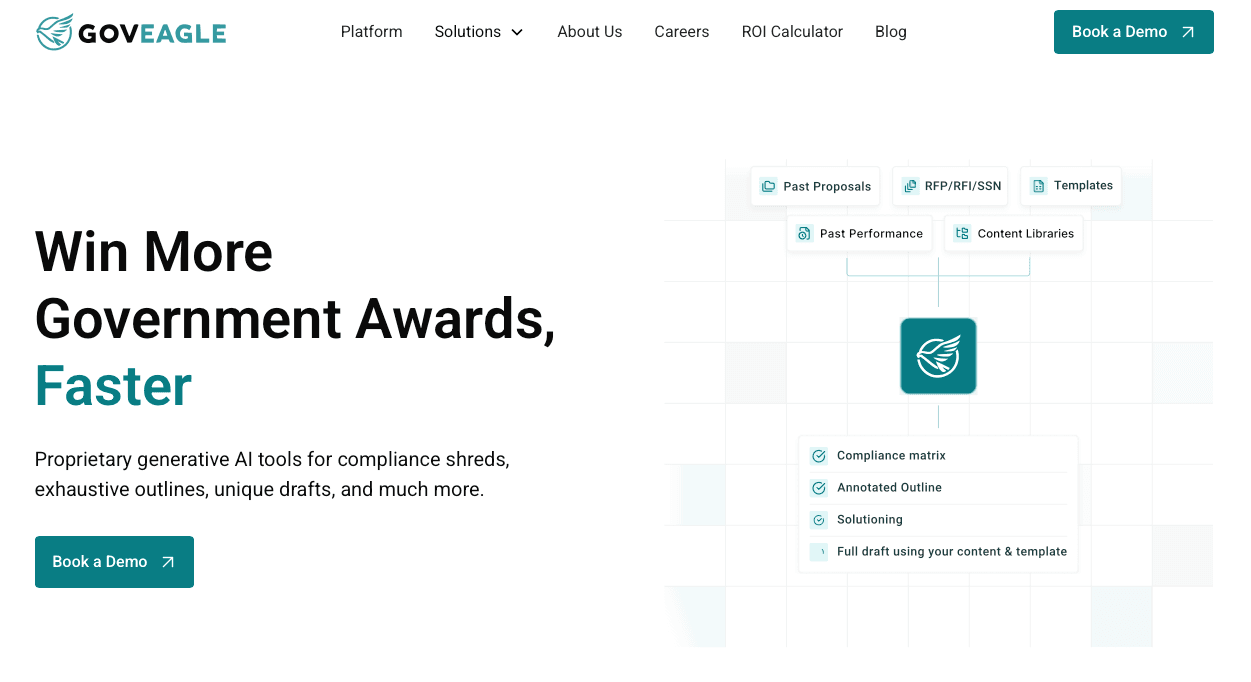
GovEagle helps GWAC contractors scale their task order capture without adding headcount. Our automated compliance matrix generation pulls requirements from task order RFPs in minutes. Requirement tracking maps every line item to your proposal sections, preventing gaps that disqualify submissions. AI-assisted drafting generates compliant first-draft content aligned to Sections L and M, including past performance and technical narratives required for federal proposal evaluation.
GovCon firms using GovEagle pursue more task orders with their existing teams and submit higher-quality proposals on tight deadlines. When you're competing against other GWAC seat holders for the same work, speed and compliance give you the edge.
FAQs
What's the difference between a GWAC and a regular IDIQ contract?
A GWAC is an IDIQ contract with government-wide authority, managed by a designated executive agent (GSA, NASA, or NIH) and available to all federal agencies. Regular IDIQs are typically single-agency or program-specific vehicles with limited scope.
Can my company compete for task orders on multiple GWACs simultaneously?
Yes, if you hold seats on multiple GWACs, you can compete for task orders across all of them. Many contractors pursue vehicles like Alliant 3, OASIS+, and 8(a) STARS III in parallel to maximize their addressable market and diversify their pipeline.
How long does it typically take to respond to a GWAC task order RFP?
Most task orders arrive with 7-14 day response windows, though some agencies compress timelines to 3-5 days for urgent requirements. Your ability to produce compliant proposals quickly directly impacts how many opportunities you can pursue.
Final Thoughts on Winning with GWACs
At its core, a GSA GWAC gives you access to task order competitions across federal agencies. But access alone does not drive revenue. You’re competing against other seat holders on every bid, and success depends on how quickly and accurately your team can respond when opportunities drop. Teams that move faster with fully compliant proposals win more work. Tools like GovEagle help you keep pace by organizing requirements, building compliance matrices, and supporting faster turnaround without adding headcount.