
How Are Proposals Written? A Complete Guide for September 2026

GovEagle is not affiliated with, sponsored by, certified by, or otherwise associated with Shipley Associates.
A technically strong proposal can still lose in federal contracting if compliance, pricing realism, or evaluation alignment are weak. Many teams focus on the question "how are proposals written" only from a writing perspective. Government proposals are scored against structured criteria defined in Sections L and M, instead of just narrative quality. Winning teams follow disciplined GovCon workflows. They extract requirements into compliance matrices, build outlines tied to evaluation factors, and run formal color team reviews to validate technical, management, and cost volumes before submission.
TLDR:
- Most federal proposals are organized into volumes defined by Section L instructions, typically including Technical, Management, Past Performance, and Cost volumes.
- Compliance matrices map every RFP requirement to your response, helping prevent common compliance errors that can lead to rejection or scoring penalties.
- Write your executive summary last after drafting all sections to condense the full narrative into one focused page.
- Government contractors using modern tools can considerably reduce proposal preparation time while maintaining compliance workflows.
- Extracting requirements from the RFP before writing helps reduce missed criteria and potential scoring penalties.
Get GovCon capture and proposal insights in your inbox.
Understanding Government Contract Proposal Types
Government contracting proposals follow structured acquisition pathways defined by the Federal Acquisition Regulation (FAR) and agency-specific supplements. With top unrestricted federal opportunities valued at over $463 billion in FY 2025 and similar high-value contracts expected in FY 2026, understanding these structured pathways is critical for capturing major awards.
Most responses fall into three primary categories: Requests for Proposals (RFPs), Requests for Information (RFIs), and Requests for Quotations (RFQs).
RFP responses typically require full technical, management, and cost volumes aligned to Section L instructions and considered under Section M criteria. RFQs often focus more heavily on pricing and past performance, while RFIs support market research and pre-solicitation positioning.
Contractors must also distinguish between prime proposals, subcontractor proposals, and task order responses under IDIQ vehicles such as GWACs or Multiple Award Schedules. Each format introduces unique compliance expectations, review timelines, and evaluation weighting that directly influence proposal structure and development workflow.
What Every GovCon Proposal Must Include
There is no standard proposal template in GovCon. Structure is designated by the solicitation: Section L (instructions) and Section M (evaluation criteria) in an RFP or RFQ. These define exactly what volumes, formats, and content are required.
Contractors must build proposals by mapping directly to these requirements. Depending on the procurement, this typically includes technical, management, past performance, and cost volumes, along with any required attachments.
Executive summaries are optional unless requested and should only support (not replace) compliance with Section L.
For RFIs, GovCon responses are usually lighter, often requiring a capability statement aligned to what the agency explicitly requests.
Bottom line: In GovCon, proposals are not written from a generic structure, they are engineered for compliance and scored against Section M.
The Step-by-Step Proposal Writing Process
Proposal writing follows a predictable sequence. Each stage builds on the previous one, reducing errors and missed requirements when deadlines tighten.
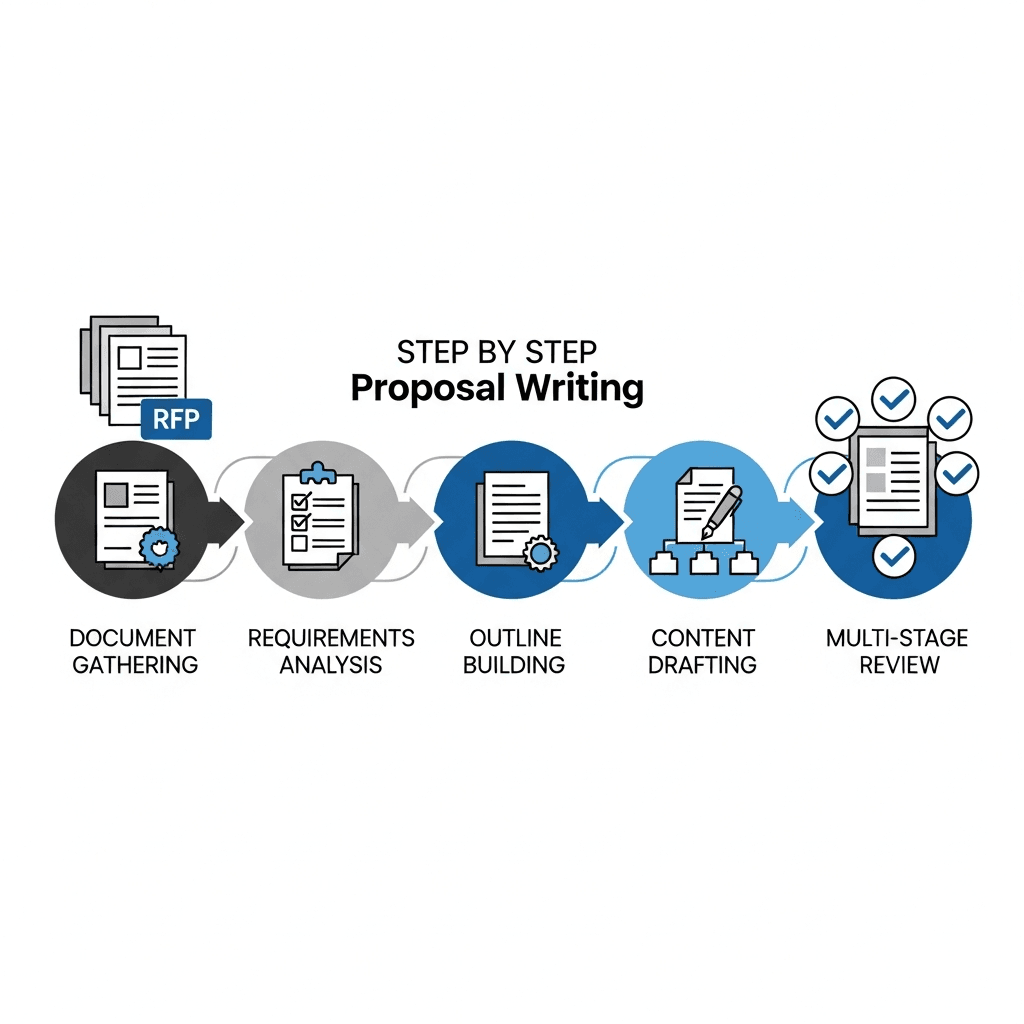
Start by gathering all source documents. Read the RFP or solicitation cover to cover, noting evaluation criteria, submission requirements, and due dates. Extract every requirement into a compliance matrix so nothing slips through.
Next, analyze what evaluators want. Identify decision criteria, scoring factors, and hot buttons in the solicitation language. Research the issuing agency or organization to understand priorities and pain points your solution solves.
Build your outline based on required sections from the solicitation using AI proposal writing tools. Map each requirement to a specific section where you'll respond. Draft content section by section, writing the executive summary last after you know exactly what story your proposal tells.
Schedule reviews at multiple stages to catch issues early and refine your narrative before submission.
Applying the Shipley Proposal Process in GovCon
Many federal contractors structure proposal development around the Shipley methodology, which focuses on disciplined capture planning, solution alignment, and gated reviews. The Shipley model frames proposal writing as a continuation of capture strategy instead of a standalone writing exercise.
Proposal teams begin by validating win themes identified during capture, confirming customer hot buttons, and aligning discriminators to evaluation factors. Content planning focuses on annotated outlines, storyboard development, and structured content assignments tied directly to solicitation requirements.
Shipley-style workflows also place emphasis on early executive involvement, color team reviews, and continuous validation against evaluation criteria. This approach reduces the risk of late-stage rewrites and improves proposal cohesion under tight submission deadlines.
Building Compliance Matrices and Section Mapping
Write your executive summary after drafting all other sections. This approach lets you condense the full narrative into a focused overview that decision makers often read first to understand the proposal’s overall value before reviewing detailed sections.
Front-load your value proposition in the opening sentence, then summarize the problem, your solution, key benefits, and total cost. Keep it to one page. Use concrete numbers and outcomes instead of vague claims, and mirror RFP terminology when applicable.
Answer three questions in sequence: what problem exists, how you will solve it, and why you are qualified to deliver. Allocate two to three sentences per question so evaluators grasp your offer within sixty seconds.
Structuring Technical and Management Volumes
Federal proposal volumes must align precisely with solicitation structure. Technical volumes describe the proposed approach to meeting performance objectives, often organized around task areas, capability demonstrations, or risk mitigation strategies.
Management volumes are built around program governance, staffing plans, subcontractor integration, and quality assurance processes. Evaluators look for realistic execution frameworks supported by organizational charts, responsibility matrices, and transition plans.
Strong GovCon proposals also integrate win themes and discriminators throughout narrative content, reinforcing how the proposed solution reduces performance risk, improves mission outcomes, or accelerates schedule delivery. Federal contractors that focus on building AI, data and cybersecurity talent pipelines gain an advantage in winning contracts, as agencies focus on contractors with proven success in providing cleared experts who show readiness.
Developing Cost Volumes and Pricing Narratives
Government cost proposals require detailed pricing realism supported by documented assumptions. Contractors must separate direct labor, fringe, overhead, general and administrative expenses, and fee structures in accordance with solicitation instructions.
Pricing narratives explain basis of estimate methodologies, escalation assumptions, and resource allocation logic. For cost-reimbursable or hybrid contract types, evaluators pay close attention to indirect rate structures and cost realism models closely.
Well-structured cost volumes also take care of compliance with Service Contract Act requirements, subcontractor pricing transparency, and risk allocation strategies that show financial responsibility and execution credibility.
Executing Color Team Reviews in Government Proposals
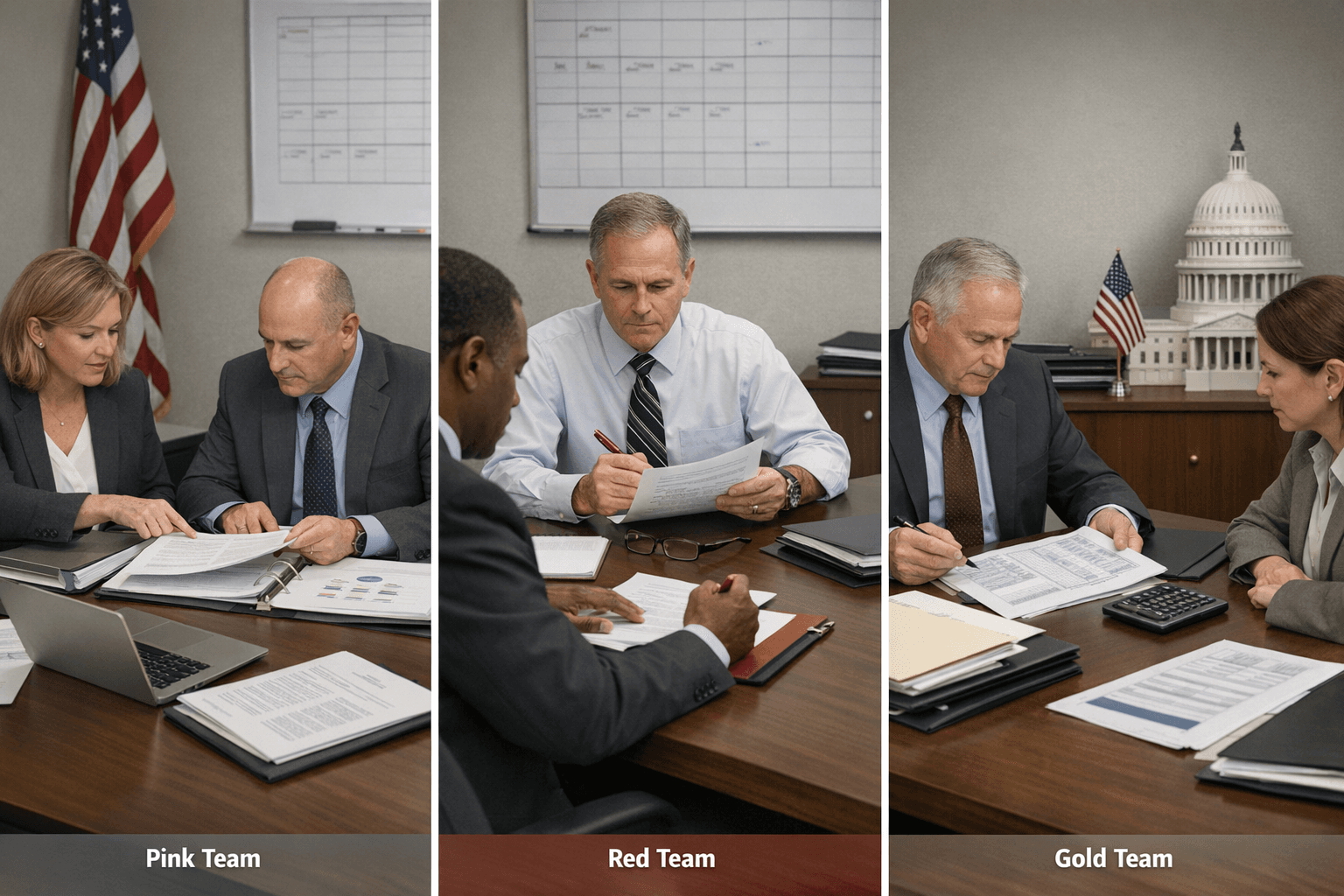
Formal review cycles are central to GovCon proposal quality control. Shipley-aligned teams conduct structured reviews such as Pink Team for content validation, Red Team for evaluator perspective scoring, and Gold Team for executive approval.
Each review stage focuses on specific objectives. Pink Team confirms solution alignment and requirement coverage. Red Team pays close attention to proposal persuasiveness and scoring strength. Gold Team focuses on pricing realism, compliance completeness, and submission readiness.
Scheduling these reviews early reduces rework pressure and allows proposal managers to resolve technical inconsistencies before final production.
Best Practices for Proposal Formatting and Presentation
Formatting determines whether evaluators read your proposal thoroughly or skim past critical points. Evaluators review large volumes of proposals under time constraints, so clear formatting and visual hierarchy help them quickly locate content tied to evaluation criteria.
Use headers and subheaders to break sections into scannable chunks. Evaluators often review dozens of proposals under tight deadlines, so clear visual hierarchy guides them to scoring criteria quickly. Apply consistent fonts and sizes throughout. Limit body text to 11 or 12-point type in standard faces like Arial or Times New Roman.
Build white space into every page through margins, line spacing, and paragraph breaks. Dense text blocks discourage reading and hide key messages.
Review, Revision, and Quality Control Strategies
Multi-stage reviews catch errors single readers miss. Schedule at least three review cycles before submission: compliance verification, content quality, and final production.
| Review Stage | What to Check | Reviewer Role | Period of Performance / Schedule |
|---|---|---|---|
| Compliance Verification | Page limits, font requirements, file format, submission method, required sections, compliance matrix alignment | Proposal Manager or Contracts Specialist | 72 hours before deadline |
| Content Quality | Requirement responses, technical accuracy, solution alignment, win themes, discriminators, past performance relevance | Subject Matter Experts and Capture Manager | 96 hours before deadline |
| Editorial Review | Grammar, spelling, punctuation, formatting consistency, readability, tone, terminology | Technical Writer or Editor | 48 hours before deadline |
| Final Production | PDF conversion, bookmarks, table of contents, page numbers, file naming, volume assembly | Proposal Coordinator | 24 hours before deadline |
Start compliance reviews by checking every requirement against your response using your matrix. Verify page limits, font requirements, and submission format specifications. Assign one reviewer solely to this task since content evaluators often overlook technical violations.
Conduct peer reviews by bringing in team members unfamiliar with the draft. Fresh eyes spot logic gaps and unclear statements that writers close to the content overlook. Ask reviewers to score sections against evaluation criteria as if they were the selection committee to verify responses align with requirements.
Review for clarity and conciseness to make sure evaluators can quickly validate compliance and assess strengths against Section M criteria.
Using AI to Accelerate GovCon Proposal Development
Artificial intelligence is reshaping proposal workflows by reducing manual requirement extraction and accelerating first-draft creation. Modern GovCon teams use AI to generate compliance matrices, build annotated outlines, and identify gaps in past performance alignment.
Automated content assistance allows subject matter experts to focus on solution strategy instead of administrative formatting tasks. AI-driven review tools can also flag missing requirements, inconsistent terminology, and formatting risks before submission deadlines.
When integrated correctly, these technologies support faster turnaround on task order proposals and improve consistency across large proposal libraries.
How GovEagle Improves Government Proposal Outcomes
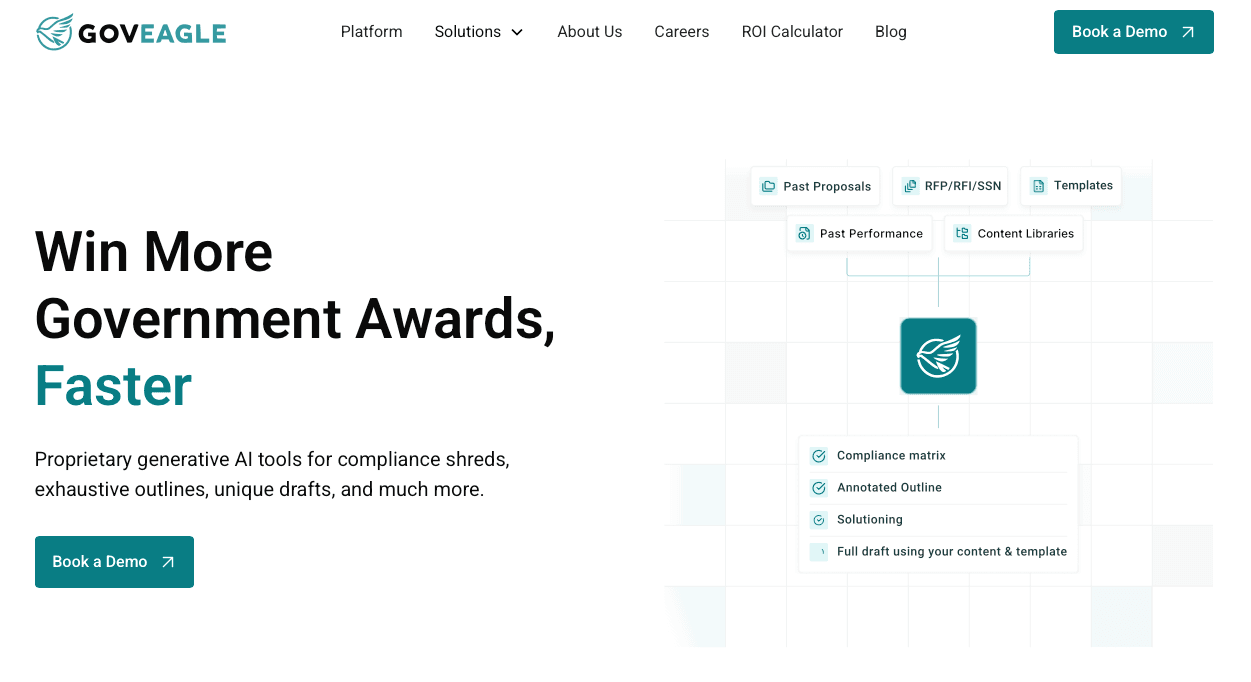
GovEagle is designed for federal proposal environments, aligning AI automation with GovCon workflows such as Shipley-style capture and color team reviews. It extracts requirements from complex solicitations and generates structured compliance matrices within minutes.
Proposal teams can automatically produce annotated outlines tied to Section L and M criteria, empowering faster content assignment and reducing coordination overhead across distributed teams. Built-in drafting assistance pre-populates narrative sections using approved past performance references and capability statements.
GovEagle also supports secure collaboration within controlled environments, including AWS GovCloud deployments and integration with Microsoft GCC High ecosystems. These capabilities help contractors accelerate proposal development while maintaining compliance with government security expectations.
FAQs
What's the difference between solicited and unsolicited business proposals?
Solicited proposals respond to a specific RFP or RFI request and follow strict submission guidelines, while unsolicited proposals pitch your services proactively when no formal request exists and require more flexibility in structure.
How do I build a compliance matrix without missing requirements?
Extract every requirement from the RFP line by line, then map each to a specific response section in your proposal using a spreadsheet that tracks requirement number, description, location, and compliance status for verification before submission.
What should I include in a proposal budget to make it credible?
Break costs into clear categories (labor, materials, equipment, overhead) with unit costs and quantities shown, explain every line item by tying it to a specific deliverable, and display fully burdened labor rates with fringe and indirect costs separated.
Final Thoughts on the Proposal Writing Process
Successful federal proposals are built on structured processes, not last-minute writing. When teams ask how are proposals written well enough to win competitive government contracts, the answer usually comes down to process. Contractors that apply proven GovCon models improve compliance, reduce risk, and strengthen evaluator alignment. Tools like GovEagle help teams execute these workflows faster by automating requirement tracking, generating compliant outlines, and supporting structured reviews. This allows for stronger submissions, lower proposal costs, and improved win rates over time.