
Performance-Based Acquisition: What Evaluators Actually Score in Your Proposal in September 2026

Akash Mandavilli
CEO and Co-Founder of GovEagle
About the author
Akash is a 2x founder with previous experience in AI from Meta and federal sales from IBM. Akash holds a dual-degree from Johns Hopkins University in Economics and Computer Science.

You'll notice performance-based acquisition solicitations skip the usual task lists and labor categories. Instead, they define what success looks like, set objective measurement thresholds, and outline how the government will monitor your performance after award. Your proposal needs to respond differently because the government assesses your ability to meet performance standards against competitors still writing task-based responses.
TLDR:
- Performance-based acquisition defines outcomes and metrics instead of tasks, with FAR 37.601 calling for a PWS, measurable performance standards, and the method of assessing performance, plus performance incentives where appropriate.
- Your technical volume must map quantified past results (like "98.2% uptime documented through QASP surveillance reports") to each PWS performance threshold.
- FAR 37.102 directs agencies to use performance-based acquisition methods for service contracts to the maximum extent practicable, so Section C review is a practical gate-review step for identifying PWS outcomes, performance standards, and performance assessment methods.
- Evaluation panels score proven outcome delivery, not proposed processes, making quantified past performance your strongest discriminator.
- Automated proposal platforms like GovEagle extract PWS outcomes, performance standards, and QASP requirements directly from Sections C, L, and M, then map them to your technical response structure for compliance validation.
What Performance-Based Requirements Mean for Your Proposal Response
When Section C includes a Performance Work Statement, it defines required outcomes without prescribing your execution methods. Your proposal is assessed based on your ability to deliver measurable results, not on staffing plans or task procedures.
Core Elements of Performance-Based Acquisitions That Drive Compliance Risk
FAR 37.601 states that performance-based service contracts shall include a PWS, measurable performance standards, and the method of assessing contractor performance against those standards, and performance incentives where appropriate. Missing any of these in your technical volume or failing to respond to them creates immediate evaluation risk.
| PBA Element | FAR Reference | What It Defines | Required Proposal Response | Evaluation Risk if Not Taken Care Of |
|---|---|---|---|---|
| Performance Work Statement (PWS) | FAR 37.601 | Required outcomes and objectives without prescribing methods, staffing levels, or procedures | Technical approach must map your delivery methodology to each PWS outcome and support it with quantified past results using identical measurement units | Evaluators score understanding of requirements as insufficient; compliance matrix gaps against PWS outcomes trigger direct point deductions |
| Measurable Performance Standards | FAR 37.601 | Quantifiable thresholds such as "95% first-call resolution within four hours" or "99% system availability during business hours" | Past performance volume must cite contracts where you met or exceeded each standard, measured the same way the PWS specifies | Capability statements substituted for documented results receive lower technical scores; evaluators cannot verify outcome delivery without cited data |
| Performance Assessment Method | FAR 37.601 | Government procedures for monitoring contractor performance post-award, including inspection methods and surveillance frequencies | Quality control section must show internal monitoring processes that detect and correct deficiencies before government surveillance does | Failing to take care of the assessment method signals post-award compliance risk and leaves a scored evaluation factor unanswered |
| Quality Assurance Surveillance Plan (QASP) | FAR 37.604 | Inspection methods (periodic reviews, random sampling, government stakeholder feedback mechanisms), surveillance frequencies, and Acceptable Quality Levels that trigger corrective action | Reference each QASP requirement explicitly and detail an internal audit program that operates at a higher frequency than government surveillance | Unanswered QASP requirements leave scored evaluation criteria incomplete and raise questions about post-award quality management readiness |
| Acceptable Quality Level (AQL) | FAR 37.604 / QASP | Minimum performance threshold the government will accept before initiating corrective action or applying incentive penalties | Show historical performance exceeding the AQL by a documented margin on prior contracts to signal a performance buffer against non-compliance | Proposals that only promise to meet the AQL without a documented historical buffer face higher performance risk ratings from evaluation panels |
| Statement of Objectives (SOO) | FAR 37.602-1 | High-level performance objectives that allow offerors to propose their own PWS, performance standards, and quality plan | Balance proposed metrics against your documented past performance; use historical results to anchor proposed thresholds at realistic levels with risk margin built in | Proposing performance standards above your documented past performance creates post-award corrective action exposure and may undercut your technical credibility |
| Section M Evaluation Criteria | FAR 15.304 | Factors and subfactors panels use to score technical approach, past performance, and quality control against the PWS | Build a cross-reference matrix tracing every PWS outcome and performance standard to a specific response paragraph and page number in your proposal | Traceability gaps lower technical understanding scores and can trigger evaluation clarification requests that consume limited proposal revision time |
Performance Work Statement in Section C
The PWS defines required outcomes without specifying methods, staffing levels, or procedures. Section C will describe what must be accomplished, not how to accomplish it. Your technical approach must respond to each outcome requirement while explaining your delivery methodology.
Measurable Performance Standards with Objective Thresholds
These standards are typically defined in Section C alongside PWS outcomes. They define acceptable performance using quantifiable metrics: "Resolve 95% of service requests within four hours as measured through government-approved systems and QASP surveillance reporting" or "Maintain 99% system availability during business hours."
"We maintained 98.2% system uptime across 47 locations for three consecutive years on our DHS contract (GS-00F-XXX), documented through monthly QASP surveillance reports" carries more weight in the evaluation than "We will implement validated monitoring systems to achieve required uptime."
Performance Assessment and QASP Requirements
The QASP sets out how the Government may monitor contractor performance post-award. It specifies inspection methods (periodic reviews, random sampling, government stakeholder feedback mechanisms), surveillance frequencies (weekly, monthly, quarterly), and Acceptable Quality Levels that trigger corrective action.
If the QASP requires monthly performance reports, your proposal should detail weekly internal audits. If the AQL threshold is 90%, show how your documented past performance at 96% provides a buffer against non-compliance risk.
Building Your Technical Response around PWS Performance Standards

Performance standards must be objective, quantifiable, and verifiable for FAR compliance.
"Meet defined service performance thresholds aligned to PWS requirements" fails compliance review when not tied to measurable standards. "Resolve 95% of service requests within four hours as measured through government-approved ticketing systems and QASP surveillance reports" passes.
If the PWS requires 98% on-time delivery, search your contracts for delivery tracking data. If you maintained 98.7% on-time delivery on three previous contracts, you have strong past performance evidence. If your best historical result is 93%, you face performance risk that should inform your bid decision.
When responding to Statement of Objectives solicitations, balance ambition against risk in your proposed metrics. Aggressive thresholds signal capability but create post-award compliance exposure. Use your documented past performance to support proposed standards. If you've maintained 98% stakeholder satisfaction scores documented through CPARS or contract-level performance evaluations, proposing 95% shows both proven capability and a built-in performance buffer against risk.
Understanding QASP Requirements during Proposal Development
A Quality Assurance Surveillance Plan sets out inspection and surveillance procedures the Government may use to measure contractor performance post-award. It assigns surveillance responsibilities (Contracting Officer Representative (COR), technical monitors, and designated government stakeholders), sets review frequencies (daily, weekly, monthly), and outlines government responses to deficiencies.
Each performance standard connects to an Acceptable Quality Level, the minimum threshold before corrective action begins. A 95% AQL tolerates occasional failures but triggers remediation if your performance drops below this point. Your proposal should reference these thresholds while detailing internal quality controls that exceed government surveillance expectations.
If random sampling is specified, describe your internal audit program that catches deficiencies before government surveillance does.
Responding to Performance-Based Evaluation Criteria in Section M
Section M evaluation criteria reveal how panels will score your technical approach. Performance-based solicitations typically include factors like "ability to meet performance standards," "quality control approach," or "past performance delivering similar outcomes."
When evaluation criteria state "ability to meet performance standards," the panel scores your documented track record, not your promises. Your past performance volume should map previous contract outcomes to each PWS performance standard using identical measurement units. If the PWS requires 95% first-call resolution, cite contracts where you achieved 97% FCR, measured the same way.
Structure your quality control process to show how you'll detect approaching AQL thresholds and implement corrective action before government surveillance catches deficiencies. Evaluation panels assign higher technical scores to proposals that show proactive quality management over reactive compliance.
Get GovCon capture and proposal insights in your inbox.
FAR Part 37.6 Compliance during Gate Reviews
Your capture team should review Section C during gate 0 to identify PWS outcomes, performance standards, and performance assessment methods, including any QASP references. Even if the solicitation doesn't explicitly label itself as performance-based, the presence of performance-based elements creates PBA compliance requirements for your response.
Review Section B pricing structure during capture to understand how performance links to payment.
During compliance review, verify your technical approach responds to all identified performance thresholds. Create a cross-reference matrix mapping each PWS outcome and performance standard to your response paragraph. Evaluators check this traceability when scoring understanding of requirements.
Structuring Your Technical Approach around Outcome Delivery
Performance-based evaluation panels favor contractors who prove outcome delivery over credential lists. Your technical approach should connect your methodology to required results through documented past performance.
Start each technical approach section by referencing the PWS outcome it tackles. "Section C requires maintaining 98% system availability during business hours. Our monitoring architecture and incident response procedures delivered 99.1% availability across 47 locations on our DHS contract (GS-00F-XXX) from 2021-2024, documented through monthly QASP surveillance reports."
Detail your quality control processes with the same level of specificity. Describe validation procedures, error-checking protocols, and internal audit frequencies. Then cite historical results these processes produced on previous contracts. "Our three-tier review process caught 99.7% of defects before client delivery on our DoD contract, reducing government surveillance findings to 0.3% across 2,847 deliverables."
Accelerating Compliance Review for Performance-Based Responses
GovEagle's automated review verifies alignment between your technical approach and performance-based evaluation criteria before color team reviews begin. The system checks that every PWS outcome has a corresponding response paragraph, every performance standard references supporting past performance data, and every QASP requirement connects to your quality control process.
The compliance review identifies gaps where your technical approach describes tasks instead of outcomes. If Section C requires "95% on-time delivery" and your draft states "We will implement project management procedures to meet delivery schedules," the review flags this as insufficient. Performance-based responses need quantified past results: "We maintained 97.3% on-time delivery across 847 task orders on our DHS contract, documented through monthly QASP reports."
Cross-reference matrix creation maps every RFP requirement to your response paragraph and page number. For performance-based solicitations, this matrix proves you've responded to each outcome threshold, measurement method, and surveillance specification. The government sometimes requests these matrices during evaluation, and internal quality reviews require them before submission.
The semantic search finds relevant past performance across your proposal library using the same measurement units specified in Section C. If the PWS requires "first-call resolution rates," GovEagle surfaces previous proposals and contract documents containing FCR metrics, service request resolution metrics and performance data aligned to PWS measurement criteria, and ticket resolution data that support your technical approach.
This eliminates hours of manual compliance checks, reduces reviewer workload, and makes sure that no performance requirement is missed before submission.
How GovEagle Automates Performance-Based Proposal Development
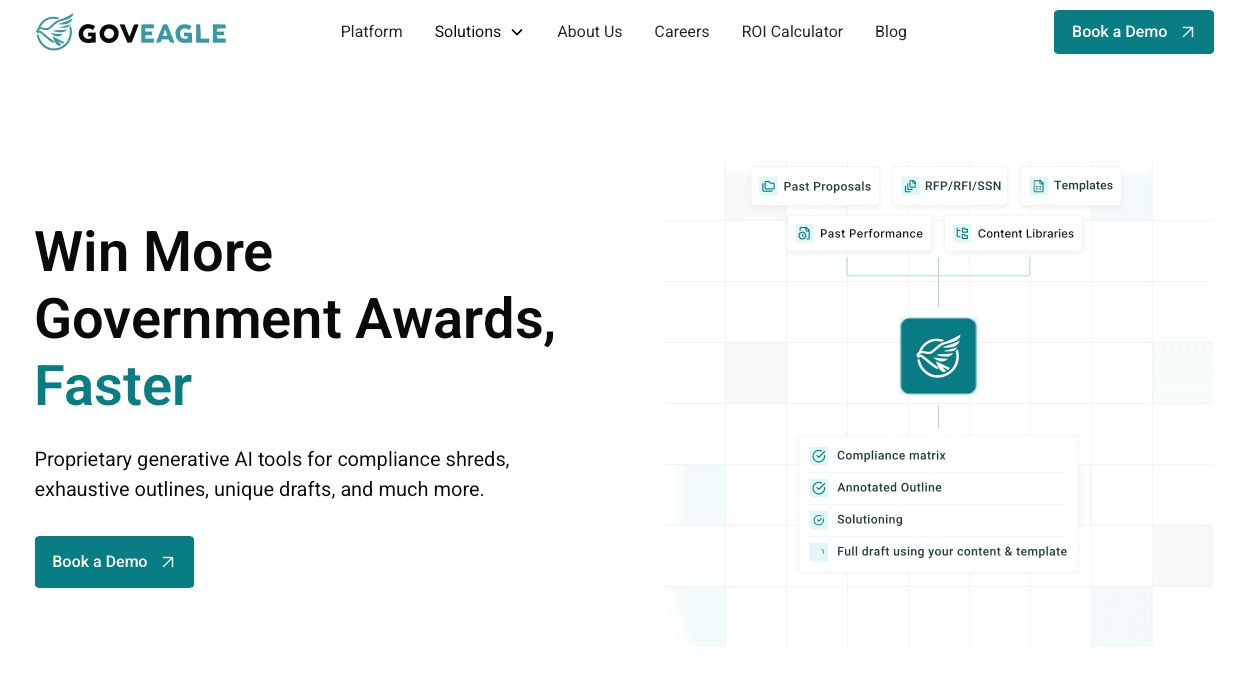
Performance-based solicitations create distinct compliance challenges your team faces under tight deadlines. You must extract every outcome requirement from Section C, map measurable standards across your technical approach, and trace performance assessment methods, including any QASP surveillance requirements, through your quality plan. Missing a single performance threshold during compliance review risks evaluation failure.
GovEagle automates requirement extraction from performance-based solicitations in minutes. The compliance matrix tool pulls PWS outcomes, performance standards, and QASP specifications from Sections C, L, and M, identifying performance objectives the way an experienced proposal manager would. You receive a complete Excel matrix that captures outcome requirements, measurement criteria, and surveillance specifications without manual document parsing.
Writers see which past performance examples and quality control processes apply to each threshold. The outline flags where you need quantified results instead of capability statements.
FAQs
What is the main difference between a PWS and a traditional SOW for proposal development?
A PWS defines required outcomes and performance objectives without prescribing methods, while a SOW provides detailed task instructions. Your proposal strategy changes from proving capability to execute prescribed tasks (SOW response) to proving you can deliver measurable results with quantified past performance (PWS response). Evaluation panels score documented outcome delivery aligned to PWS metrics, not proposed processes or methodologies
What contract elements does FAR 37.601 require in performance-based service contracts?
Under FAR 37.601, performance-based service contracts shall include a Performance Work Statement, measurable performance standards and the method of assessing performance against those standards, and performance incentives where appropriate. FAR 37.604 covers Quality Assurance Surveillance Plans, which the Government may prepare or may ask offerors to propose for the Government’s consideration.
How should I price performance-based contracts differently than labor-hour contracts?
Build quality assurance costs into your base price, including labor hours for internal audits, performance tracking, corrective action, and QASP report preparation. These costs don't appear in traditional labor-hour contracts where the government assumes process risk. Use your past performance data to support proposed metrics and price buffers for AQL thresholds. If you've historically achieved 98% performance, pricing for a 95% standard provides risk margin.
Final Thoughts on Building Winning Performance-Based Proposals
Performance-based acquisition demands proving outcome delivery instead of listing credentials. Your past performance volume should quantify results that match PWS metrics using identical measurement units. Your technical approach needs explicit connections between your quality control processes and each performance standard. Map the surveillance methods first, then build your compliance strategy around them. GovEagle extracts these requirements in minutes so you can focus on differentiation instead of compliance hunting.