
What Does a Capture Manager Do? Complete Guide for September 2026

Akash Mandavilli
CEO and Co-Founder of GovEagle
About the author
Akash is a 2x founder with previous experience in AI from Meta and federal sales from IBM. Akash holds a dual-degree from Johns Hopkins University in Economics and Computer Science.

GovEagle is not affiliated with, sponsored by, certified by, or otherwise associated with Shipley Associates.
A capture manager often decides whether a company submits a bid that simply meets requirements or one that actually wins. Long before an RFP appears, this role shapes the outcome by building relationships inside target agencies, recruiting the right teaming partners, and gathering competitive intelligence that guides pricing, staffing, and technical approach. When these steps are weak or skipped, even teams with strong past performance lose to competitors with deeper customer insight. Many firms now rely on tools that assist with early pursuit analysis and capability gap reviews, such as this capture management support software, so capture managers can spend more time with customers and less time sorting through qualification data.
TLDR:
- Capture managers typically lead contract pursuits from early opportunity qualification through proposal submission.
- They develop win strategies, build customer relationships, and coordinate teaming partners.
- The role differs from BD (fills pipeline) and proposal managers (writes documents post-RFP).
- Average salary is about $137,000, ranging from roughly $87,000 for junior roles to about $200,000 for senior positions depending on experience and geography.
- Some modern tools automate capture analysis and gap identification, reducing manual qualification work to minutes.
What Is a Capture Manager?

A capture manager owns the pursuit of a specific contract opportunity. In government contracting, this person typically leads the effort from opportunity qualification and bid decision through proposal submission, coordinating activities that increase win probability.
The role sits between business development and proposal management. While BD identifies opportunities, the capture manager develops the competitive strategy, builds relationships with the customer and teaming partners, shapes the solution, and gathers intelligence for a winning response. They guide pricing, technical approach, past performance positioning, and key personnel selection decisions.
Capture managers are strategic leaders who determine whether your company submits a compliant proposal or a winning one.
Core Responsibilities of a Capture Manager
Capture managers run competitive intelligence to understand who you're bidding against and how to stand out. They build relationships with the customer agency before the RFP drops, learning priorities that inform your technical approach.
They identify and recruit teaming partners when gaps exist in your capability set. This involves vetting potential subs, negotiating teaming agreements, and confirming each partner brings strength to the pursuit.
Strategy development is central to the role. Capture managers create bid strategies that position your company's past performance, technical solution, and key personnel as the best fit.
Cross-functional coordination pulls in technical SMEs to shape the solution, works with pricing analysts on cost strategy, and briefs executive leadership on major decisions.
Capture Manager vs Business Development Manager
Business development managers track multiple opportunities across agencies, qualify leads, and maintain a pipeline of potential contracts. Their focus spans many pursuits at once, identifying where your company should compete.
Capture managers narrow in. When BD qualifies an opportunity and your company commits to pursuing it, a capture manager takes ownership of that single pursuit. They dedicate full attention to developing the win strategy, building customer relationships, and positioning your team for that specific contract.
The handoff happens at the bid/no-bid decision. BD says "this is worth pursuing," then capture steps in to run the pursuit. BD fills the funnel. Capture converts opportunities into wins.
Capture Manager vs Proposal Manager
Capture managers primarily work before the RFP releases, while proposal managers focus on activities after the solicitation is issued. That timeline split defines the core difference between these roles.
During capture, the manager focuses on competitive positioning by gathering customer intelligence, understanding agency pain points, shaping requirements through pre-RFP discussions, and developing discriminators that set your bid apart. They build the foundation for your proposal narrative.
Once the solicitation drops, proposal managers take control. They lead document production, assign writing tasks to technical SMEs, manage compliance matrices, run color team reviews, and confirm every requirement gets covered.
The capture manager asks "how do we position ourselves to win?" The proposal manager asks "how do we translate that strategy into a winning document?"
In smaller organizations, one person often wears both hats.
| Role | Timeline | Primary Focus | Key Responsibilities |
|---|---|---|---|
| Business Development Manager | Continuous pipeline management | Opportunity identification and qualification | Track multiple pursuits across agencies, maintain customer relationships, qualify leads, build pipeline, hand off qualified opportunities at bid decision |
| Capture Manager | Often begins 12-24 months before RFP and continues through proposal submission | Win strategy and competitive positioning | Develop win themes, gather competitive intelligence, recruit teaming partners, shape customer requirements, build solution discriminators, create pricing strategy |
| Proposal Manager | RFP release through submission | Compliant document production | Manage writing assignments, maintain compliance matrices, coordinate SME contributions, run color team reviews, deliver final proposal package |
How to Become a Capture Manager
Most capture managers enter the role after 5 to 10 years in business development, proposal management, or program management. The transition requires familiarity with government procurement processes, particularly FAR regulations and agency-specific buying patterns.
Relationship building separates effective capture managers from the rest. You need to cultivate contacts within customer agencies, understand their mission challenges, and build trust before the RFP releases.
Technical knowledge matters too. Capture managers in defense contracting need different domain expertise than those pursuing civilian IT services contracts. Your background should align with the agencies and mission areas your company targets.
Capture Manager Certification Programs
Professional certification validates capture expertise through structured training in methodologies that many firms develop informally. Two programs lead the field.
The Capture Management Institute offers the Certified Capture Manager credential. This program requires completion of coursework covering capture planning, competitive intelligence gathering, teaming strategy, and government procurement processes. Candidates must pass a final exam after completing the training modules.
APMP (Association of Proposal Management Professionals) provides the Capture Practitioner Certification (CPC). This credential focuses on repeatable capture and proposal processes. APMP requires documented experience hours and exam passage.
Both certifications teach frameworks like the Shipley Capture Management Process, which standardizes how teams move from opportunity identification through proposal handoff.
Capture Manager Salary and Compensation
Capture manager compensation averages $137,294, with salaries spanning $87,000 to over $235,000 based on experience and geography. Junior roles typically earn $87,000 to $110,000, while professionals with 5 to 8 years command $120,000 to $150,000. Senior capture managers earn $163,500 to $199,988 managing high-value pursuits across multiple opportunities. Regions with strong federal contracting activity (such as the Washington, DC metro area, Northern Virginia, Maryland, California, and Texas) often offer higher compensation. Large prime contractors generally pay more than small businesses, particularly for roles focused on IDIQ vehicles or major single-award contracts.
The Capture Management Process
The capture process begins 12 to 24 months before the RFP releases. Early qualification determines whether the opportunity matches your past performance, capabilities, and growth objectives.
Capture planning maps customer priorities, competitive positioning, and solution gaps. Gate reviews at this stage determine whether to pursue or pass on the opportunity based on probability of win calculations.
Customer engagement runs throughout the cycle. You build relationships with agency stakeholders, learning their mission needs and budget limitations. This intelligence informs your technical approach and pricing.
Solution development defines your offering. You recruit teaming partners, assign key personnel, and build discriminators designed to outmaneuver competitors.
Proposal transition occurs at RFP release. The capture manager transfers strategy, intelligence, and win themes to the proposal team with documented customer insights.
Common Challenges Capture Managers Face
Late capture starts create the biggest problem for capture managers. When teams begin pursuing an opportunity after RFP release, customer preferences are already set and early engagement creates competitive advantage. Win probability typically drops without time to shape requirements or build agency relationships.
Insufficient customer intelligence forces guesswork instead of facts. Without direct customer contact, you can't position discriminators that solve actual pain points or verify your solution fits their day-to-day needs.
Resource constraints pit capture managers against billable work for SME time. Getting technical staff to contribute becomes difficult when leadership treats capture as overhead instead of revenue generation.
Internal alignment fails without clear gates and decision authority across BD, technical teams, and executives. Gate reviews, executive sponsors per pursuit, and documented accountability structures solve these issues.
Critical Skills for Capture Manager Success
Strategic thinking separates strong capture managers from average ones. You need to assess win probability, balance risk against resource investment, and anticipate competitor moves before the RFP drops. This requires seeing the full competitive picture, including your internal capabilities and external factors.
Customer relationship management goes beyond networking. You must build trust with agency stakeholders, understand their mission challenges, and position your company as a credible solution provider months before solicitation release.
Competitive analysis requires gathering intelligence on incumbent contractors, likely competitors, and their past performance records. You assess their strengths, price points, and relationships to identify where your bid can gain advantage.
Proposal strategy development bridges capture and proposal execution. You translate customer intelligence into win themes, discriminators, and solution positioning that writers can execute.
How GovEagle Supports Capture Managers
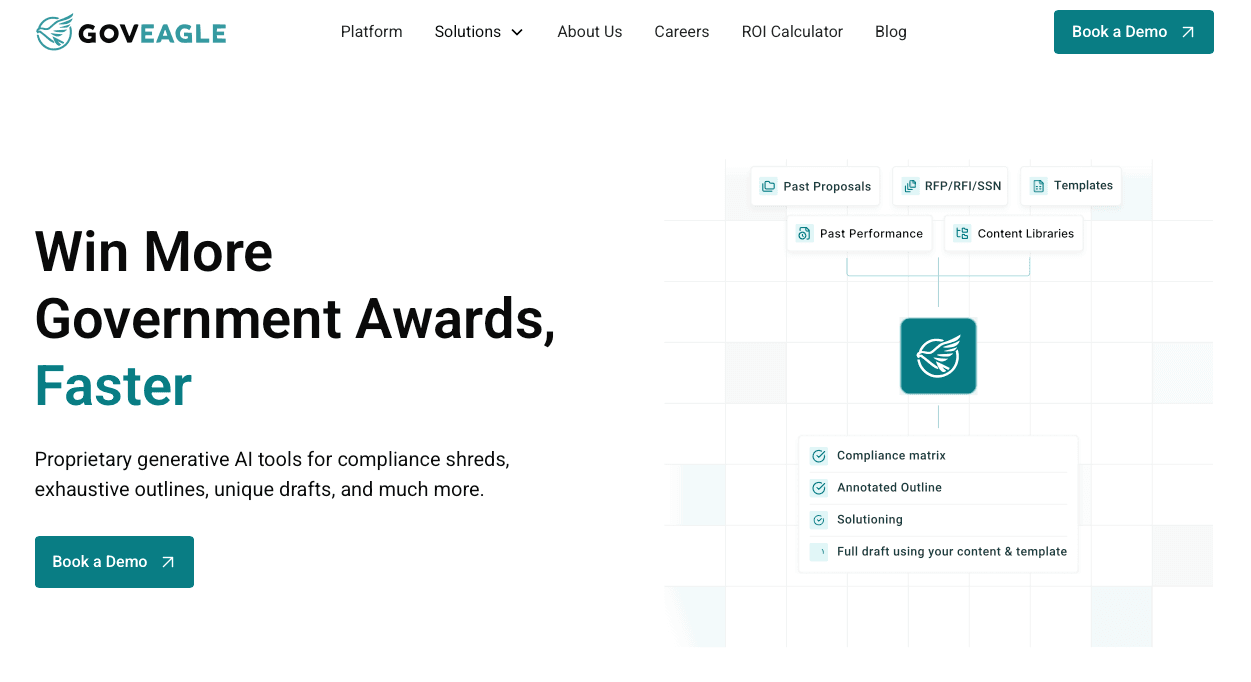
We built GovEagle to handle the administrative work that pulls capture managers away from customer meetings and strategy sessions.
Automated bid/no-bid analysis scores opportunities in minutes. The system reviews RFP requirements against your past performance and capabilities, producing qualification scores that inform gate decisions without manual spreadsheet analysis.
Capability gap analysis cross-references solicitation tasks against your company's strengths, flagging where you need teaming partners. Win themes and competitive intelligence you add flow directly into proposal development, so your capture work carries through to the final submission.
Solution brainstorming generates technical approach ideas based on customer requirements and your offerings, accelerating strategy sessions.
FAQs
What's the difference between a capture manager's timeline and a proposal manager's timeline?
Capture managers work 12-24 months before RFP release, focusing on customer relationships, competitive positioning, and solution development. Proposal managers take over at RFP release, managing document production, compliance matrices, and color team reviews through submission.
Can a small GovCon firm afford capture managers without dedicated BD staff?
Smaller firms often combine capture and proposal responsibilities in one role or have senior leadership perform capture functions for high-priority pursuits. Tools like GovEagle's automated bid/no-bid analysis and capability gap assessment reduce the administrative workload, allowing one person to handle both strategic capture activities and proposal execution.
What certifications matter most for capture manager career advancement?
The Certified Capture Manager credential from the Capture Management Institute and APMP's Capture Practitioner Certification (CPC) provide strong industry recognition. Both programs teach repeatable methodologies like the Shipley Capture Management Process and require passing exams, with APMP also requiring documented experience hours.
Final Thoughts on the Capture Management Function
Winning federal contracts rarely begins when the RFP is released. It starts months earlier with a capture manager shaping the opportunity through customer relationships, competitive intelligence, and a clear win strategy that guides the entire pursuit. Companies that treat capture as a structured discipline, with defined gates between business development, capture, and proposal, consistently improve their probability of win and avoid wasting resources on low-fit bids. Many teams now support this process with tools that help capture managers qualify opportunities, surface capability gaps, and organize pursuit intelligence in one place, such as GovEagle, giving capture teams better insight before proposal writing ever begins.