
Compliance Matrix Guide: How to Build One in September 2026
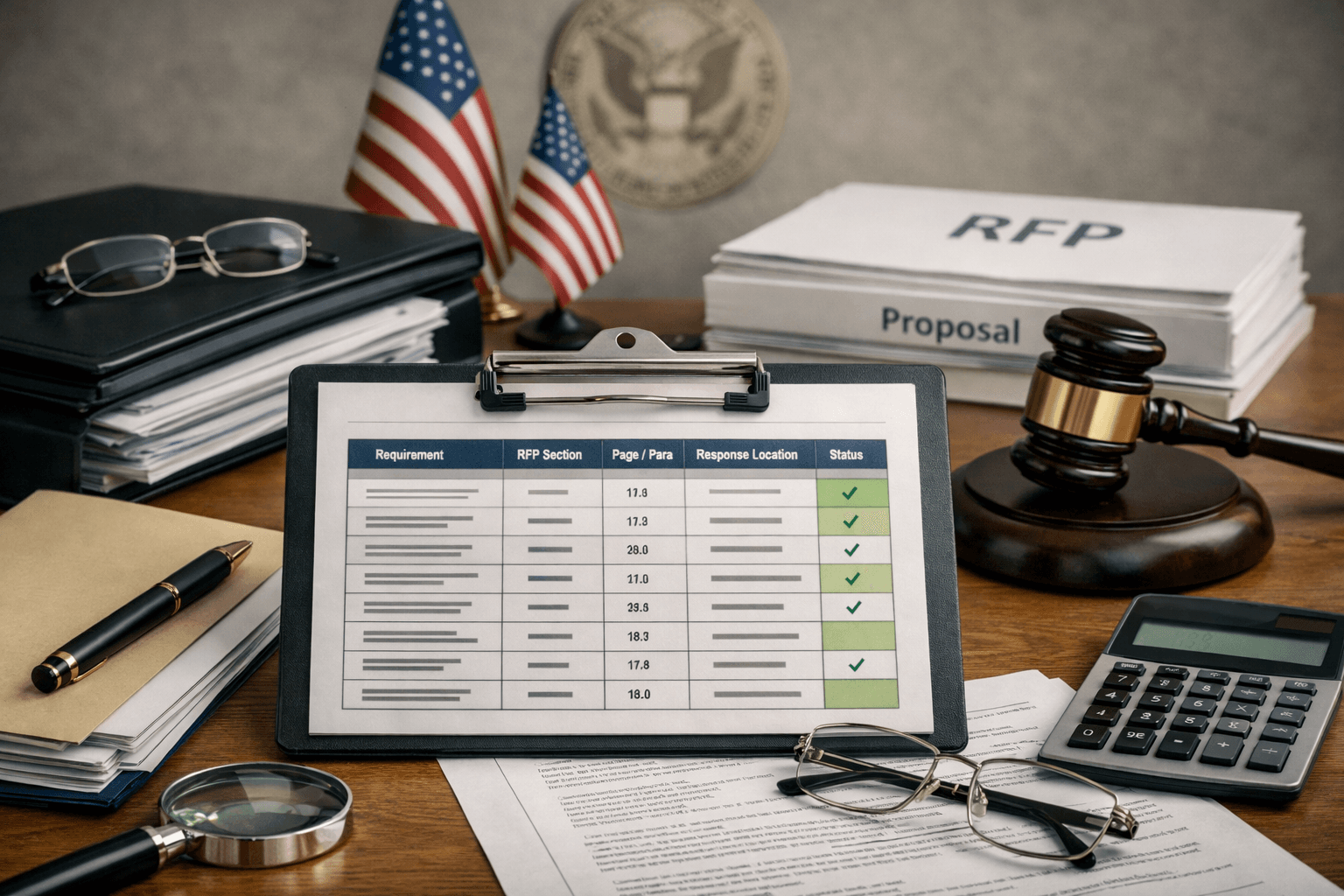
You’re three days into building a compliance matrix for a major IDIQ proposal when the contracting officer releases Amendment 0003. Now your team needs to compare the updated RFP against your existing matrix, identify what changed, adjust response locations, and notify writers across multiple sections. This process can quickly consume valuable time late in the proposal cycle. Today, teams are turning to modern tools that scan amendments, update compliance matrices automatically, and pinpoint exactly where new requirements or language changes appear without requiring a manual review of hundreds of rows.
TLDR:
- A compliance matrix maps each RFP requirement to where it is mentioned in your proposal, with clear citations.
- Manual matrix creation can take days, and missed requirements, especially in attachments, can lead to disqualification.
- AI-driven extraction can build complete matrices in minutes from Sections L, M, and C.
- AI-supported tools generate Excel-ready matrices that align with existing templates and update automatically when amendments are released.
- Keeping your matrix current throughout amendments and reviews helps maintain alignment between requirements and final submission content.
What Is a Compliance Matrix?
A compliance matrix is a structured table used in government contracting to map each RFP requirement to where it is mentioned in your proposal. Each row includes the requirement text, its source location in the solicitation, and the corresponding section in your response.

In GovCon, this document functions as a record of compliance. Evaluators may determine a proposal is non-compliant if it misses requirements or does not clearly indicate where responses are located. A well-developed matrix reduces that risk by creating a direct link between every requirement and your supporting content.
Most matrices include columns for requirement text, RFP citation (section and page), response location, and status. Many teams also include ownership and notes to support internal coordination during proposal development.
Compliance Matrices in Federal Contracting
Proposal compliance matrices are standard in federal contracting. They map requirements from Sections L, M, and C to specific response locations across volumes. These are fundamental for IDIQs and complex proposals where hundreds of requirements must be tracked.
In practice, GovCon teams typically build a single compliance matrix focused on proposal requirements. This matrix is used throughout the proposal lifecycle to track instructions, evaluation criteria, and performance requirements, making sure that each one is taken care of and clearly mapped to the correct response location.
In some cases, contractors may also track requirements related to frameworks such as NIST 800-171, CMMC, or FAR clauses as part of internal preparation or supporting documentation. However, within the proposal process itself, teams generally rely on a single, centralized compliance matrix aligned to the RFP.
Core Components of an Effective Compliance Matrix
An effective GovCon compliance matrix includes seven core elements that support tracking from RFP review through final submission:
- Requirement ID: A unique identifier aligned to the RFP structure for easy reference during reviews.
- Source reference: The exact RFP location, including section, paragraph, and page number.
- Requirement text: The full language copied directly from the solicitation to avoid misinterpretation.
- Response location: The proposal volume, section, and page where the requirement is mentioned.
- Responsible party: The assigned owner for drafting or reviewing the response.
- Status tracking: Progress indicators such as not started, in progress, drafted, or reviewed.
- Notes: Internal comments, dependencies, or clarifications from shred sessions and reviews.
| Component | Description | GovCon Example |
|---|---|---|
| Requirement ID | A unique identifier that mirrors the RFP section structure and allows teams to reference specific requirements during kickoff meetings, shred sessions, and color team reviews. | L.3.2.1-1, M.2.4-3, C.5.1.2-2 |
| Source Reference | The exact location in the solicitation document where the requirement appears, including section number, paragraph identifier, and page number for quick validation. | Section L.3.2.1, Para (a), Page 47 |
| Requirement Text | The complete requirement language copied verbatim from the RFP to prevent misinterpretation of obligation terms like shall, must, will, and should. | The offeror shall provide a staffing plan that identifies key personnel by name, role, and relevant certifications for all labor categories in Section C. |
| Response Location | The specific volume, section, subsection, and page number in the proposal where the requirement is, allowing evaluators to locate responses quickly. | Volume II, Section 3.2.1, Page 34 |
| Responsible Party | The assigned writer, subject matter expert, or section lead accountable for drafting the response and coordinating supporting documentation. | J. Smith (Technical Lead), M. Johnson (Past Performance Writer) |
| Status Tracking | Progress indicators that show completion status during the proposal development cycle, from initial assignment through final Gold Team validation. | Not Started, In Progress, Pink Complete, Red Complete, Gold Complete |
| Notes | Internal comments capturing dependencies, clarification needs, risk flags, or coordination requirements identified during shred sessions or review cycles. | Requires coordination with pricing team. Awaiting clarification on Q&A response 0042. Cross-referenced in Section M.4.3. |
Building a Compliance Matrix for Government RFPs
Begin by extracting requirements from key sections of the solicitation. Section L provides proposal instructions, Section M defines evaluation criteria, and Section C outlines the statement of work or performance requirements. Capture every “shall,” “must,” “will,” and “should” statement.
Set up your matrix with columns for ID, source reference, requirement text, response location, owner, status, and notes. Number requirements in a way that reflects the RFP structure. For example, break out multiple requirements under L.3.2.1 into L.3.2.1-1, L.3.2.1-2, and so on.
Map each requirement to your proposal outline before drafting begins. This step helps prevent duplication and identifies gaps early. Familiarity with FAR language and agency-specific instructions is important for interpreting requirements correctly.
Update the matrix throughout the proposal lifecycle, especially during Pink, Red, and Gold Team reviews, to track progress and maintain alignment.
Common Compliance Matrix Mistakes and How to Avoid Them
One of the most frequent issues in GovCon proposals is missing requirements in attachments, exhibits, or referenced documents. These often contain critical instructions that are not repeated in the main RFP. Review all supporting files during the initial shred.
Another common issue is failing to update the matrix after amendments. Contractors may revise outlines but overlook matrix updates, creating inconsistencies. Assign clear ownership for amendment tracking and require updates with each release.
Inconsistent mapping across volumes can also create problems. When writers assign response locations independently, requirements may be mentioned in multiple places or missed entirely. Align on structure during kickoff to maintain consistency.
Get GovCon capture and proposal insights in your inbox.
Compliance Matrix Templates and Format Options
Basic matrices include requirement ID, source citation, and response location. These are suitable for smaller RFIs or simplified acquisitions.
Detailed shred matrices include full requirement text alongside citations and response locations. These are useful for complex solicitations where interpretation must remain consistent across teams.
Multi-functional matrices add columns for ownership, status, and review tracking. These are common in large GovCon proposals involving multiple volumes and contributors.
Excel is widely used due to its ability to filter, sort, and track changes. While Word tables may work for smaller efforts, Excel is better suited for managing amendments and tracking completion.
If Section L requires submission of a compliance matrix, remove internal columns such as ownership and notes before including it in the final proposal.
The Role of Compliance Matrices in Color Team Reviews
Pink Team reviews focus on structure. The matrix helps confirm that every requirement has a planned response and assigned owner.
Red Team reviews focus on content. Reviewers compare each matrix entry against the proposal to confirm the requirement is fully handled.
Gold Team reviews focus on final validation. The matrix is used to confirm page references, verify amendment updates, and check alignment across volumes.
In GovCon proposals, the matrix provides a clear checklist that supports more consistent and objective reviews.
Compliance Matrix Automation in March 2026
AI-driven tools are changing how government contractors build compliance matrices. These tools scan RFPs and extract requirements in minutes, identifying obligation language such as “shall” and “must” while maintaining source citations.
They can also identify requirements from attachments, appendices, and referenced documents, which are often missed during manual review. Tasks that once required days of effort can now be completed during early proposal planning, allowing teams to focus on writing and strategy.
How GovEagle Accelerates Compliance Matrix Generation for Government Contractors
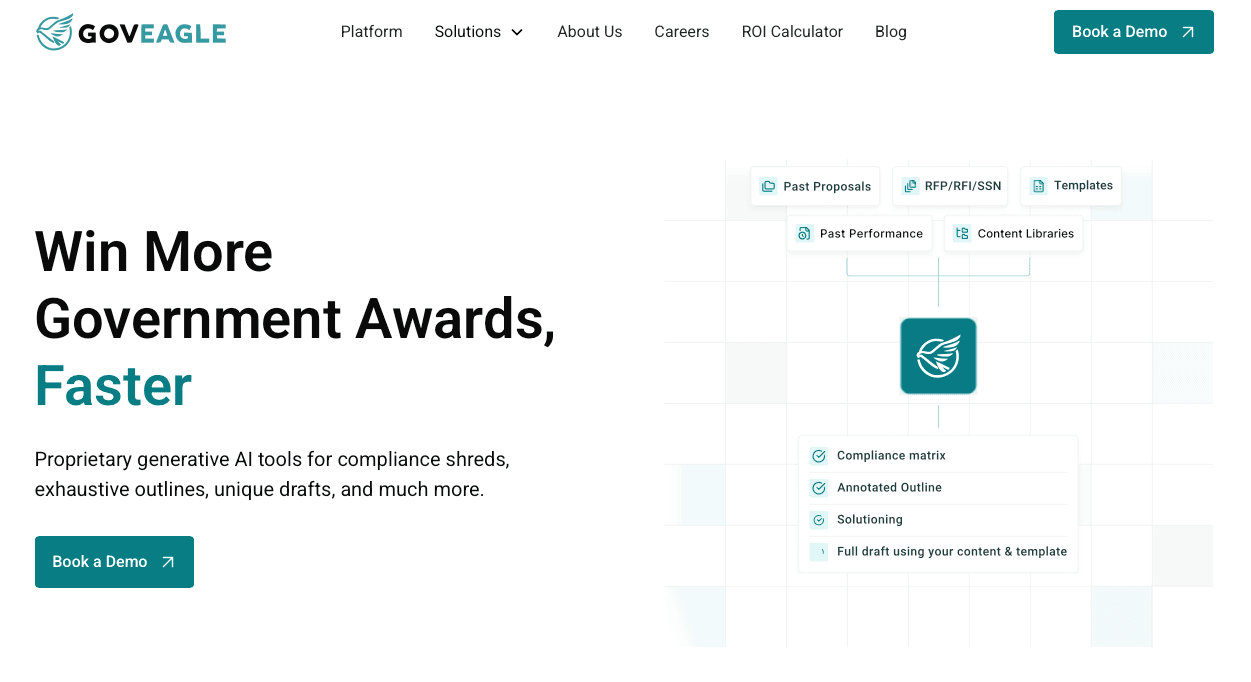
GovEagle scans RFPs and extracts requirements from Sections L, M, and C, generating a complete compliance matrix in Excel format within minutes. The output aligns with standard GovCon workflows, allowing teams to work within existing templates.
When amendments are released, the system identifies changes and updates the matrix automatically, showing where requirements have shifted and what new language has been introduced. This helps maintain alignment between the matrix and evolving solicitation requirements.
The matrix integrates with a Word add-in, linking requirements directly to proposal sections and surfacing relevant past performance and compliance content. Writers can view assigned requirements within their drafting environment, while reviewers focus on validating responses instead of managing spreadsheets.
FAQs
How long does it take to build a compliance matrix manually?
Manual matrix creation typically takes 1-3 days for solicitations with 50-150 requirements, depending on document complexity and whether requirements are buried in attachments. Automated tools reduce this to minutes during the opportunity review phase.
Can I reuse compliance matrices from previous proposals?
In most cases, each RFP contains unique requirements with different section structures, evaluation criteria, and instruction sets. Build a fresh matrix for every solicitation during the shred session to avoid missing new demands or mapping responses to incorrect locations.
How do I handle compliance matrix updates when amendments arrive?
Assign one person to own amendment tracking. When the government releases changes, review amendment changes, update affected matrix rows, and verify response locations still align with your revised outline before continuing draft work.
Final Thoughts on Implementing Compliance Matrices
In government contracting, a well-built compliance matrix is fundamental for showing evaluators exactly how your proposal meets every requirement. It reduces the risk of disqualification and supports more structured, efficient color team reviews by creating a clear path to each response. While manual matrix creation can take days for complex RFPs, tools like GovEagle allow teams to generate and maintain a compliance matrix in minutes, keeping it aligned as amendments are released. This gives proposal teams more time to focus on content quality and pursue additional opportunities without getting stuck in manual tracking work.