
Disqualified from GovCon Because of Compliance Errors? How to Avoid Rejection in September 2026

Akash Mandavilli
CEO and Co-Founder of GovEagle
About the author
Akash is a 2x founder with previous experience in AI from Meta and federal sales from IBM. Akash holds a dual-degree from Johns Hopkins University in Economics and Computer Science.
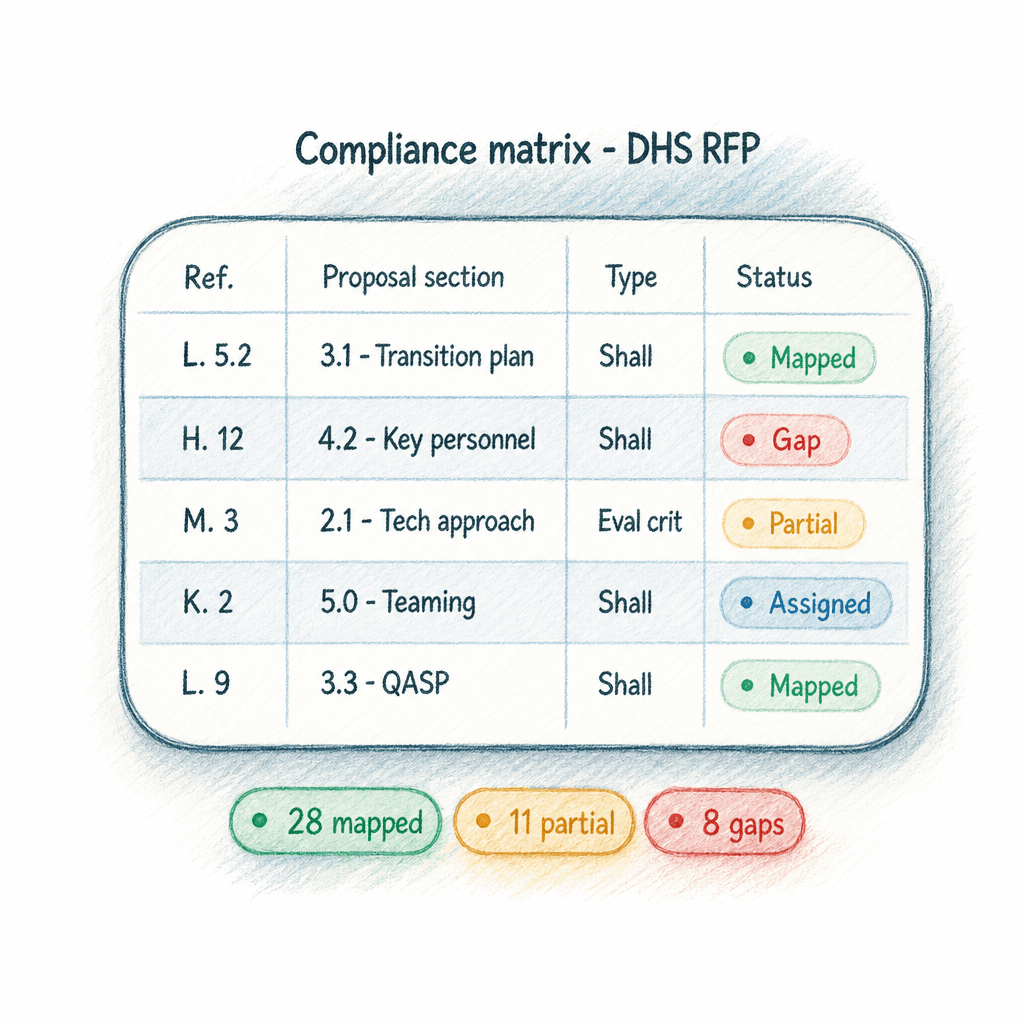
Getting disqualified from GovCon before an evaluator reads a single word is one of the most common and preventable outcomes in federal contracting. The FAR clauses responsible are predictable: FAR 52.215-1 governs proposal preparation and late-submission rejection; FAR 52.212-3 and its representations and certifications requirements eliminate submissions when entries are unsigned, stale, or missing entirely; and the formatting and compliance requirements embedded in Sections L and M give contracting officers grounds to reject proposals before a single page of your technical approach is scored. The failure happens in the compliance layer, where manual tracking breaks down under volume and tight deadlines, not in the technical solution, the past performance record, or the price.
TLDR:
- Formatting violations like wrong fonts or page counts can lead to rejection before evaluators review your proposal.
- Missing required representations, certifications, and compliance matrix items can disqualify technically strong bids.
- Amendments issued mid-cycle often override requirements your team already covered, creating silent disqualifiers.
- AI-powered proposal tools automate compliance tracking with Excel matrices and Word outlines that update when RFPs change.
- Late submissions are rejected outright under FAR 52.215-1, with very limited exceptions, typically tied to documented government control of the submission process.
Common Compliance Errors That Lead to Disqualification in Government Contracting
The most common culprits fall into a few predictable categories:
- Page count violations or incorrect font sizes can trigger immediate rejection before any content is reviewed.
- Missing representations and certifications, such as SAM.gov registrations or FAR 52.212-3, are frequent administrative failures that disqualify otherwise strong submissions.
- Incomplete sections required by Section L leave evaluators no choice but to mark a proposal non-responsive.
- Failure to track and respond to RFP amendments means your submission may contradict the actual solicitation requirements.
- Late submissions, even by minutes, are typically treated as disqualifications with only narrow exceptions under FAR rules.
None of these are technical failures. A contractor can have superior past performance and a sharper price, yet still lose to a less qualified competitor who submitted a compliant package.
Formatting and Technical Requirements That Eliminate Proposals
Many agencies treat page limit violations as grounds for rejection or exclusion from evaluation. The formatting rules buried in solicitation instructions aren't suggestions.
Common technical tripwires include:
- Submitting 11 pages when the limit is 10 gives evaluators immediate grounds for rejection before a single word of your technical approach is read.
- Using 11pt font when 12pt is specified, a detail easy to miss when copying text between documents.
- Setting margins at 0.9" instead of the required 1", which can accidentally add pages and compound violations.
- Submitting a .docx file when only PDF is accepted, or vice versa.
- Failing to label or organize volumes as instructed in Section L.
This enforcement is not limited to FAR Part 15 negotiated acquisitions. FAR 8.4 GSA Schedule procurements (task orders placed against federal supply schedules via GSA eBuy or similar vehicles) are subject to the same strict formatting rules when the RFQ explicitly conditions award on compliance. Agencies routinely state that formatting failures will render a quotation "unacceptable and ineligible for award," and GAO has consistently upheld those eliminations. Contractors who assume schedule-based orders carry more formatting flexibility than sealed bids or negotiated procurements should treat that assumption as a liability.
"Proposals that fail to conform to the solicitation requirements, including format, will be considered non-responsive."
GAO protest decisions confirm it. In RiverNorth, Inc., B-423274 (GAO, Apr. 18, 2025), a vendor was eliminated from a USDA FAR 8.4 competition because page numbers used less than 12-point Times New Roman font. GAO upheld the elimination: where an RFQ conditions award on compliance, agencies have no discretion to waive the deficiency. There is no cure period, and evaluators never reach your technical approach or pricing.
Clarifications vs. Discussions: When Agencies Can (and Must) Fix Minor Errors
Not every compliance error means automatic elimination. Under FAR 15.306(a), agencies may seek clarifications to resolve minor or clerical errors without opening discussions; these are limited exchanges that do not permit material proposal revisions. Under FAR 15.306(d), discussions are a different matter: they require the agency to include all offerors in the competitive range and allow substantive revisions, which is why agencies avoid them. Opening discussions extends the timeline and creates administrative burdens most contracting officers would rather not take on.
The practical implication: if your error is genuinely typographical (a transposed digit in a labor hour figure where the surrounding math makes the correct number obvious) you may have grounds to request a clarification before outright rejection. In Aspire Therapy Services & Consultants, Inc. v. United States (COFC 2023), the court upheld a protest on the ground that the agency failed to seek a clarification on an obvious data-entry error, finding that the omission was improper.
Do not rely on this. GAO has not adopted a rule requiring agencies to offer clarifications, and most will not. The formatting section above reflects standard practice. Aspire represents an edge case where the error was unambiguous and the agency's failure to act was documented and protested successfully. Build your compliance workflow to prevent errors, not to recover from them.
The Compliance Matrix Gap: When Requirements Fall Through the Cracks
Skipping the compliance matrix or doing it poorly is one of the most reliable ways to lose a bid you were qualified to win.
Section L tells you what to include; Section M tells you how you'll be scored. When those requirements don't map to a specific section and owner in your submission, evaluators mark them unaddressed, regardless of proposal quality.
Loss analyses repeat this across firm sizes: missed requirements stem from incomplete tracking, not weak technical solutions. A 200-page RFP with scattered amendments can bury a requirement in a seemingly unrelated section, and manual reviews miss it.
Where Manual Tracking Breaks Down
For proposal managers running lean teams against tight deadlines, a few specific failure points come up repeatedly:
- Amendments issued late in the solicitation cycle often modify Section L requirements, and those changes don't always get updated against the original matrix before submission.
- Requirements written as narrative prose instead of numbered lists are easy to overlook when building a shredded compliance checklist.
- When multiple contributors write separate volumes, cross-volume requirements get owned by no one and verified by no one.
Missing Certifications and Representations Under FAR Requirements
Section K gets the least attention and causes some of the most avoidable disqualifications. The failures here are typically administrative, not substantive:
- Incorrect business size certifications that misrepresent small business status under NAICS codes, which can trigger affiliation reviews, size protests, or loss of award
- Stale or expired SAM.gov registrations that invalidate an otherwise complete submission before evaluators read a single page
- Inaccurate ownership or control representations under FAR 52.212-3 that surface during post-submission verification
- Missing tax compliance certifications required under specific agency supplements, often overlooked when teams work from recycled proposal templates
- Unsigned or undated representations that contracting officers flag as non-responsive regardless of proposal quality
The consequences here extend well beyond losing an award. An incorrect small business size certification can trigger a formal SBA size protest from a competitor, an OHA appeal, and potential debarment if willful misrepresentation is found. Submitting knowingly false representations under FAR 52.212-3 can implicate the False Statements Act (18 U.S.C. § 1001) and the civil False Claims Act, the government's primary procurement fraud statute, which carries treble damages and per-claim penalties that quickly exceed the value of any single contract. Post-award discovery of a Section K misrepresentation can result in contract rescission, demands for repayment, and referral to the agency OIG. These are not abstract enforcement risks; they are documented outcomes from routine post-award verification. This is why legal or contracts review of Section K must happen before proposal writers touch Volume I, not as a final-step checkbox, but as a prerequisite.
Late Submissions and Deadline Enforcement in Federal Contracting
Federal contracting officers apply FAR 52.215-1(c)(3)(ii)(A) with very limited discretion: a proposal received after the exact deadline is typically rejected outright, with narrow exceptions tied to documented government-caused delays.
One recognized exception covers situations where the government's systems caused the delay and the contractor can document it. If your connection dropped or your file exceeded the size limit, the liability sits with you.
A few practices that protect your submission before the clock runs out:
- Submit 24 to 48 hours before the deadline, especially for large file packages that require extra upload time.
- Save timestamped confirmation receipts from the submission portal the moment the upload completes.
- Confirm receipt through the designated point of contact when the solicitation permits it.
- Never assume a submission went through because you clicked submit, as portals can fail silently.
Amendment Tracking Failures and How They Create Non-Compliance
Amendments don't pause the clock on your proposal work. They reset it. When the government issues a modification, every section of your compliance matrix tied to that change requires a review and update before you submit.
Most teams miss amendments because they checked SAM.gov once and moved on. Late Q&A responses can introduce binding changes when included in an amendment, quietly overriding requirements your writers already built into the proposal.
Why Amendment Tracking Breaks Down
Even disciplined teams can lose track of solicitation changes when volume is high. A few patterns that lead to disqualification:
- Monitoring SAM.gov manually without a repeatable cadence means amendments issued mid-sprint get missed entirely until it's too late to update the affected sections.
- Late-cycle Q&A postings rarely trigger internal alerts, yet they can change requirements when included in an amendment or tied to solicitation instructions.
Composite scenario drawn from common industry loss analysis: a contractor submitting a technical volume under a civilian agency IT services RFP discovered on submission day that Amendment 3, posted 11 days earlier, had changed the page limit from 25 to 20 pages and removed a mandatory staffing chart requirement. The team had been working from the original RFP. The submission came in at 24 pages and still included the now-deleted staffing chart, making it non-responsive on two counts before evaluators read a word.
- Version control gaps across distributed writing teams mean some contributors are working from an outdated RFP while others have the current one.
Responding to the wrong version of the solicitation can result in a proposal being found non-responsive.
Cost and Pricing Data Compliance Errors
Cost proposals carry their own compliance layer. Common pricing mistakes include ignoring pricing table formats required by Section B, failing to document assumptions the RFP asked for, and submitting cost data that doesn't align with your technical volume, which can give evaluators grounds to reject both.
When certified cost or pricing data is required under TINA, submitting inaccurate or incomplete data can trigger a defective pricing finding and expose your firm to price adjustments, contract disputes, or award rescission. TINA, codified at 10 U.S.C. § 3702 and 41 U.S.C. § 3502, requires certified cost or pricing data when a contract action exceeds the current threshold, currently $2 million for most contracts; verify the applicable threshold in FAR 15.403-4 before submission. A defective pricing finding arises when the data submitted was inaccurate, incomplete, or not current as of the agreement date on the Certificate of Current Cost or Pricing Data, not when a cost estimate later proves wrong. The government can demand a downward price adjustment equal to the amount by which the contract price was overstated, plus interest, and that exposure sits entirely separate from any False Claims Act liability. The most common trigger is failing to disclose a vendor quote or a recent purchase that would have lowered proposed costs, an omission that is often inadvertent but treated as a factual deficiency regardless of intent. Build your cost volume from the RFP's pricing instructions first, update your disclosed data through the agreement date, and align cost accounting with your forward pricing rates before submission.
How to Build a Compliance-First Proposal Process
Contractors who submit clean packages treat compliance as a structured workflow, not a final review task. Before drafting begins, three things need to happen:
- The RFP is shredded against Sections L and M to produce a complete compliance matrix
- Every requirement gets assigned to a specific volume, section, and owner
- Page limits, formatting rules, and file requirements are confirmed and locked
From there, color team reviews serve a specific compliance function at each gate.
How Color Teams Map to Compliance Gates
| Review | Primary Compliance Function |
|---|---|
| Pink Team | Catches structural gaps early |
| Red Team | Identifies missing requirements |
| Gold Team | Confirms submission maps to the matrix |
The critical mindset shift: compliance review runs alongside writing, not after it.
Automating Compliance Checks to Prevent Human Error
Manual compliance reviews break down under volume. When your team is tracking hundreds of requirements across multiple simultaneous bids, human error is a certainty.
AI-powered proposal tools shift compliance from a final-step scramble to a continuous, automated process. GovEagle shreds RFPs against Sections L and M to generate full compliance matrices in Excel, the same format proposal managers already use, without requiring template rework. When amendments drop, the matrix updates automatically, so your team is always responding to the current solicitation. An annotated outline in Word maps every requirement to a specific section and owner from the start, closing the cross-volume accountability gap before it opens.
The compliance review itself runs push-button through color team reports that check against win themes, style, and requirement coverage. Chevo uses this to run what they describe as a source selection evaluation review, intentionally surfacing weaknesses before submission. The result: 40% faster proposal prep with 30-40% time savings on RFIs and 15-25% on RFPs.
The goal is removing preventable errors that disqualify compliant firms before evaluators reach page one.
FAQs
Can I get disqualified from GovCon because of compliance errors even if my technical solution is strong?
Yes. Contracting officers reject proposals for compliance violations before evaluators review your technical approach or pricing. Page limit violations, missing certifications, or incomplete Section L requirements trigger immediate disqualification regardless of proposal quality.
What's the fastest way to catch RFP amendments before they cause non-compliance?
Monitor SAM.gov on a repeatable schedule throughout the solicitation cycle, and treat late-cycle Q&A postings as potential requirement changes when they are included in an amendment or referenced by the solicitation. Automated tools like GovEagle track amendments and update compliance matrices automatically, so your team always responds to the current solicitation version instead of an outdated RFP.
How do I make sure my compliance matrix doesn't miss requirements in a 200-page RFP?
Shred the RFP against Sections L and M at kickoff to map every requirement to a specific volume, section, and owner before drafting starts. Manual tracking breaks down when requirements appear as narrative prose or when amendments modify Section L mid-cycle, which is why teams use automated matrix generation to close gaps before submission.
How do I build a compliance matrix for a government RFP without missing any requirements?
Start at kickoff by shredding the full RFP (every section, including those beyond Section L) against the evaluation criteria in Section M. Map each requirement to a specific volume, section, and named owner before a single word of the technical approach is drafted. Requirements buried in narrative prose, Section C (Statement of Work), or Section H are easy to miss when teams only extract from numbered instructions. For solicitations with amendments, the matrix must be versioned: when an amendment modifies Section L, those rows update before the affected sections go back to writers. A compliance matrix that isn't tied to the current amendment version is a liability, not an asset. Three failure points account for most gaps: requirements stated as prose instead of numbered lists, cross-volume requirements owned by no one, and amendment-driven changes that don't propagate to the matrix before submission. Assign a single compliance owner at kickoff, lock the matrix structure to the RFP outline instead of your firm's internal template, and run a line-by-line matrix check at Gold Team against the final submission as the last gate before upload, not the first review.
What are best practices for running a pink team review on a government proposal in 2026?
A Pink Team review at 15 to 20 percent completion catches structural problems before writing volume makes them expensive to fix. The primary compliance function is confirming that the proposal outline maps to every Section L requirement and that Section M evaluation criteria are ghosted into the document structure, before writers spend cycles on content that may not align with how the agency scores. In practice, Pink Team panels review the annotated outline, the compliance matrix, win themes, and the discriminator strategy; they do not review polished prose. The most common Pink Team failure is running the review too late, when a substantial draft already exists and structural changes require rewriting entire volumes. Run Pink Team against the outline and matrix, not the draft. Assign reviewers who were not involved in the shred or initial outline development; fresh eyes surface missing requirements that writers worked around during drafting. After the Pink Team, update the compliance matrix with any gaps surfaced, re-assign ownership for uncovered requirements, and confirm that win themes have explicit tie-backs to Section M evaluation factors before the Red Team cycle begins.
What should go in a black hat review for a government proposal?
A black hat review asks a single question: what does the strongest competitive submission against this solicitation look like, and where does our proposal fall short by comparison? The review is conducted before the final draft is complete (typically after Red Team) and is distinct from a compliance review. Black hat panels reconstruct the likely approach of the two or three competitors most capable of winning, using publicly available past performance data, agency relationships, contract history, and pricing patterns from similar vehicles. The output is a comparative weakness analysis: for each Section M evaluation factor, the panel identifies what a competitor can plausibly claim as a strength that your proposal currently does not neutralize or counter. Common findings include past performance citations that are less relevant than a known incumbent's, a pricing model that creates cost realism risk relative to a competitor's known labor rates, and technical discriminators that are asserted but not clearly set apart from what the competitive field can also claim. The practical output of a black hat is a targeted revision list, not a rewrite: specific proposal sections where the evaluation panel is likely to score a competitor higher, with recommended language or evidence to close the gap before submission.
What are best practices for writing a cost volume and pricing section for a federal RFP response in 2026?
Build the cost volume from the RFP's pricing instructions (Section B and any cost-volume instructions in Section L) before the technical volume is finalized. The most common pricing compliance failure is submitting a cost structure that doesn't align with the labor categories, hours, and deliverables described in the technical approach, which gives evaluators grounds to flag a cost realism concern across both volumes. When certified cost or pricing data is required under TINA (codified at 10 U.S.C. § 3702 and 41 U.S.C. § 3502), the data must be accurate, complete, and current as of the date on the Certificate of Current Cost or Pricing Data, not as of proposal kickoff. Failing to disclose a vendor quote or a recent purchase that would have lowered proposed costs is the most common trigger for a defective pricing finding, even when the omission is inadvertent. For contracts below the TINA threshold (currently $2 million for most actions under FAR 15.403-4; verify the current threshold before submission), cost realism analysis still applies on cost-reimbursement contracts: evaluators assess whether proposed costs reflect a realistic understanding of contract requirements, and an unrealistically low or high cost estimate can result in a risk finding that affects technical scoring. For pricing table format compliance, follow Section B line items exactly (do not reformat or consolidate CLINs unless the RFP permits it). Verify your forward pricing rates against any existing Forward Pricing Rate Agreements (FPRAs) or Forward Pricing Rate Recommendations (FPRRs) on file with DCAA before submission.
Final Thoughts on Staying Compliant in Government Contracting Proposals
Getting disqualified from GovCon because of a missed amendment, a wrong font size, or an untracked requirement across volumes has nothing to do with capability. The mistakes covered in this article are almost never technical failures. They are process failures, and they happen before evaluators read a single word of your approach. GovEagle exists to close that gap: automated compliance matrices that update when amendments drop, annotated Word outlines that assign every requirement to an owner from day one, and push-button color team reports that surface weaknesses before submission. Build your compliance workflow to catch those failures at kickoff, not during Gold Team review.