
GovCon Set Asides: Complete Guide for Small Businesses (2026)

Akash Mandavilli
CEO and Co-Founder of GovEagle
About the author
Akash is a 2x founder with previous experience in AI from Meta and federal sales from IBM. Akash holds a dual-degree from Johns Hopkins University in Economics and Computer Science.
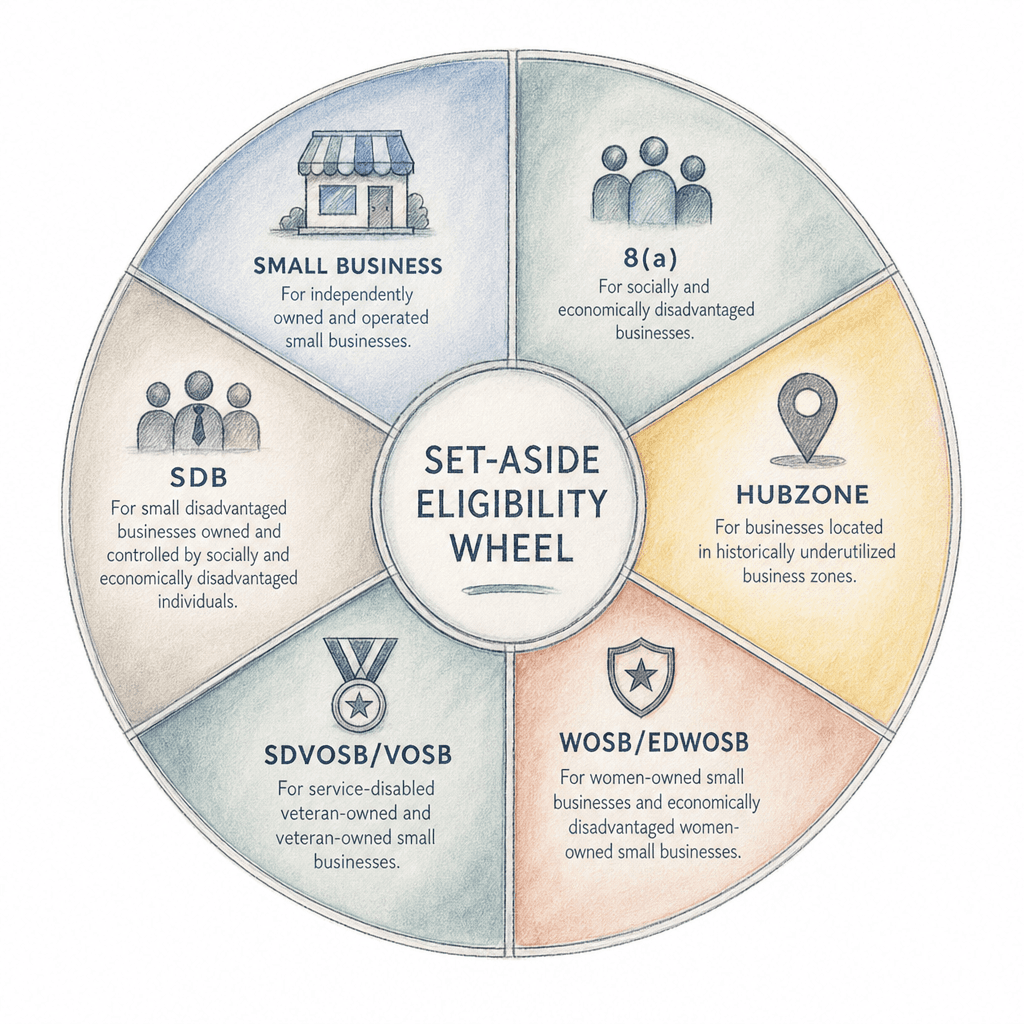
Most capture teams treat GovCon set asides as a way to avoid competing with large primes, but that view misses how much they shape a pursuit before the RFP is released. Set aside designations influence teaming structure, subcontracting limits, and whether an opportunity is restricted to small businesses. The Rule of Two drives that decision, often during market research. If you are not engaging early, you are giving up control of the competitive field before the RFP is released.
TLDR:
- Set asides reserved $117B in federal contracts for small businesses in FY2024 alone.
- The Rule of Two requires agencies to set aside contracts when there is a reasonable expectation that at least two qualified small businesses can compete at a fair market price.
- Four programs exist: 8(a) (requires personal net worth under $850K at entry), HUBZone, WOSB/EDWOSB, and SDVOSB, each with distinct requirements.
- You must meet limitations on subcontracting, and work subcontracted to similarly situated entities does not count against the prime’s limit.
- Some solutions track set aside compliance requirements and identify qualified teaming partners for faster pursuit decisions.
What GovCon Set Asides Are and Why They Matter
A set aside restricts competition to small businesses, changing your competitive field, pricing strategy, and teaming approach from the outset. Agencies use set asides to meet small business contracting goals. In FY2024, over $117 billion in federal contracts were awarded through set asides, making them a primary channel for small business capture teams.
The Rule of Two and Set Aside Decision Process
Before an agency sets aside a contract, a contracting officer must make a specific determination. The rule is straightforward: if a contracting officer reasonably expects at least two capable small businesses to submit competitive offers at a fair market price, the contract must be set aside.
How Capture Teams Fit into This
The set aside determination often happens during pre-solicitation market research, where your team can have influence. Agencies issue Requests for Information, post Sources Sought notices, and conduct industry days to gauge the small business market. Responding to Sources Sought notices and industry days shapes the contracting officer’s expectation of competitive small business interest.
If your firm responds well to a Sources Sought and shows relevant capability, you contribute to the evidence a contracting officer needs to support a set aside. Missing that window can mean the contract goes unrestricted before you ever see the RFP.
Total vs. Partial Set Asides
A total set aside reserves the entire contract for small businesses. A partial set aside splits the requirement, with one portion reserved for small businesses and the remainder open to all.
Your Pursuit Strategy
Your approach should differ depending on which type you're facing:
- On a total set aside, you're competing as prime against other small businesses only, so teaming decisions focus on capability gaps.
- On a partial set aside, you have two paths: pursue the set aside portion as a small business prime, or team with a large business pursuing the unrestricted portion.
If you team with a large prime on the unrestricted side, limitations on subcontracting still apply to the set aside portion. Confirm your self-performance percentage before finalizing workshare.
For capture managers, the key question is which portion gives your firm the stronger position to win and whether you can self-perform the required percentage.
Socioeconomic Set Aside Programs Overview
Four primary set aside programs shape eligibility and competition in GovCon: 8(a), HUBZone, WOSB/EDWOSB, and SDVOSB. Each impacts which opportunities you can pursue and how you structure your team.
Here is a quick orientation across all four:
- 8(a): Allows access to sole-source and competitive set aside opportunities that are not available to non-8(a) firms, making it a key lever in capture strategy.
- HUBZone: Eligibility tied to geographic requirements, which can create limited competition in certain NAICS codes and make HUBZone partners strategically valuable in teaming.
- WOSB/EDWOSB: Opens access to set aside opportunities in designated NAICS codes where agencies are actively working to meet WOSB spending goals.
- SDVOSB: Frequently focused on by DoD and VA, making it one of the most actionable set aside categories for firms targeting those agencies.
| Program | Key Eligibility Requirement | Sole-Source Ceiling | Primary Agency Focus | Strategic Value |
|---|---|---|---|---|
| 8(a) | 51% owned by socially and economically disadvantaged individuals; net worth under $850K at entry | $4.5M (all other requirements); $7M (manufacturing) | Governmentwide across civilian and DoD agencies | Access to sole-source awards not available to non-8(a) firms |
| HUBZone | Principal office in a designated HUBZone; 35% of employees must reside in one | $4.5M (services); $7M (manufacturing) | All agencies; strong in rural and distressed area contracts | Limited competition in many NAICS codes due to geographic restrictions |
| WOSB / EDWOSB | 51% owned and controlled by women; EDWOSB adds economic disadvantage thresholds | $4.5M (services); $7M (manufacturing) | Agencies with WOSB spending goals across hundreds of eligible NAICS codes | Opens set aside competitions in designated NAICS codes with active agency spend goals |
| SDVOSB | 51% owned and controlled by service-disabled veterans; disability documented through VA records | $5M (all other requirements); $8.5M (manufacturing) | DoD and VA carry highest award volume | DoD and VA remain major users of SDVOSB set asides and sole-source awards |
8(a) Business Development Program
The 8(a) program requires 51% ownership by socially and economically disadvantaged individuals with a personal net worth under $850,000 at entry. Participants receive nine years total, split into a four-year developmental stage and a five-year transitional stage.
Sole-source awards are available up to $4.5 million for all other requirements and $7 million for manufacturing. Above those thresholds, competition opens among 8(a) firms only.
For capture teams: if your firm holds 8(a) status, that sole-source ceiling is your fastest path to award. If not, identify a qualified 8(a) partner early in capture to access vehicles you cannot pursue as prime.
HUBZone Program Requirements
HUBZone eligibility hinges on geography, not ownership demographics. To qualify, a firm must maintain its principal office in a designated HUBZone area and have at least 35% of employees living in one. If employees move or boundaries shift, a company can fall out of compliance.
Sole-source awards under the HUBZone program are available up to $4.5 million for services and $7 million for manufacturing. Above those thresholds, competition opens among HUBZone-certified firms only. The HUBZone program also includes a 10% price evaluation preference in full-and-open competitions, which is a real bid advantage that non-HUBZone firms cannot match on price alone.
For capture teams: geographic concentration of HUBZone firms in certain NAICS codes creates thin competitive fields, meaning fewer qualified primes to compete against. Identify contracting officers at agencies with active HUBZone spending goals and monitor opportunities in areas where your firm's HUBZone footprint gives you a geographic edge. If you hold HUBZone status, confirm employee residency compliance before every major pursuit, since a lapse found during offer evaluation can disqualify your bid. If you don't hold the certification, a HUBZone sub that qualifies as a similarly situated entity can reduce subcontracting risk while keeping your team competitive on set aside awards.
Get GovCon capture and proposal insights in your inbox.
Women-Owned Small Business (WOSB) and EDWOSB Programs
WOSB status determines eligibility for set aside competitions in specific NAICS codes, making it a key filter when qualifying opportunities.
The distinction between WOSB and EDWOSB determines which set aside opportunities you can pursue, so aligning your certification with target NAICS codes is critical. Firms meeting those thresholds can pursue both EDWOSB and WOSB set asides. Firms that qualify as WOSB but exceed the economic thresholds can only compete on WOSB-designated contracts.
Where the Opportunities Are
These programs apply only to designated NAICS codes, so your pipeline should be filtered against eligible codes. Hundreds of NAICS codes qualify across IT, professional services, healthcare, and construction.
Filtering your pipeline by those designated NAICS codes against your firm's certifications with tools like GovEagle surfaces competitive opportunities fast.
Service-Disabled Veteran-Owned Small Business (SDVOSB) Program
SDVOSB eligibility requires 51% ownership and control by one or more service-disabled veterans, with the disability documented through VA records. Certification is now managed through SBA's VetCert program, replacing the legacy VA CVE process.
The strategic opening for SDVOSBs remains strongest at agencies that make heavy use of veteran-owned contracting programs, especially DoD and VA.
Sole-source awards are available up to $5 million for all other requirements and $8.5 million for manufacturing, with competitive set asides applying above those thresholds. For capture teams, identifying contracting officers at DoD and VA who are behind on their SDVOSB spend is a real prioritization signal worth acting on early.
Limitations on Subcontracting and Performance Requirements
Under FAR 52.219-14, a small business prime generally cannot pay more than 50% of the amount paid by the Government for services or supplies to subcontractors that are not similarly situated. For general construction, that limit is 85%, and for specialty trade construction, it is 75%, excluding the cost of materials.
Similarly Situated Entities
The similarly situated entity rule changes how subcontracting is counted. Work subcontracted to an entity with the same set-aside status as the prime does not count against the prime contractor’s subcontracting limit. An SDVOSB prime subcontracting to another SDVOSB firm can treat that work as performed by a similarly situated entity for limitations on subcontracting purposes.
This matters when structuring teaming arrangements. Confirm that key subcontractors hold the same certification type before finalizing workshare splits. Mixing a WOSB prime with a non-certified sub on major work scope creates compliance exposure.
What Proposal Teams Need to Document
Your proposal should cover these requirements directly:
- Identify which portions of work the prime self-performs
- Specify the certification status of any major subcontractors
- Show that the combined structure satisfies the applicable performance threshold
Working with Set Asides in Your Proposal Process
Set aside proposals carry compliance requirements beyond standard RFP instructions: check FAR clauses in Section I, the set aside designation in the award block, and certification representations in Section K.
Where Teams Commonly Miss Requirements
Three areas where proposal compliance gaps appear most often:
- Missing or outdated certifications in Section K representations that evaluators catch immediately during compliance review
- Subcontracting plans that fail to account for similarly situated entity rules, which can void your teaming structure
- Incomplete documentation of the prime's self-performance percentage against the program's required threshold
Your compliance matrix should flag each applicable set aside clause as its own requirement row. FAR 52.219-series clauses are not boilerplate. Each carries a specific obligation that evaluators check.
Bid/No-Bid Considerations Unique to Set Asides
Before committing to a pursuit, confirm your certification is active and covers the NAICS code listed in the solicitation. A size standard mismatch on the designated NAICS code can disqualify your offer regardless of how strong the technical approach is. Using structured bid/no-bid analysis tools surfaces certification mismatches and compliance gaps before proposal resources are allocated.
Accelerating Set Aside Proposal Development with GovEagle

Set aside proposals move fast, and the compliance requirements are specific enough that manual tracking creates real risk. GovEagle's bid/no-bid analysis pulls in RFP details and competition signals to help you decide whether a set aside is worth pursuing before committing resources.
Once you commit, the compliance matrix generation parses FAR 52.219-series clauses alongside technical requirements, so no set aside obligation gets buried in Section I. Because set aside RFPs include detailed compliance requirements, teams need to review them early to avoid missing requirements that affect eligibility or scoring.
For teaming, the capability gap analysis cross-matches your past performance against the PWS and flags where you need a partner using GovEagle. The teaming partner identification feature then surfaces candidates with the right socioeconomic certifications to fill those gaps, whether that's an 8(a) firm, a HUBZone sub, or a similarly situated SDVOSB. Bringing in the wrong certification type on a set aside is a compliance failure.
FAQs
What happens if my certification expires mid-proposal or after award?
If your certification lapses between submission and award, the contracting officer can disqualify your bid or rescind the award. Verify your expiration date in SAM.gov and build in renewal time ahead of any deadline.
When should I respond to a Sources Sought notice if I'm planning to bid?
Respond immediately. Your response during pre-solicitation market research directly influences whether the contracting officer has reasonable expectation of competitive small business interest under the Rule of Two, which determines if the contract gets set aside at all.
How do I verify a teaming partner's HUBZone status won't lapse before award?
Check their principal office and employee locations against SBA's current HUBZone map tool before finalizing your teaming agreement. Designation boundaries shift with census updates, and a partner's status lapse found post-submission can collapse your teaming structure.
Final Thoughts on Set Aside Pursuit Strategy
Most BD teams lose GovCon set aside opportunities before the RFP drops by missing the Sources Sought window. Strong positioning starts earlier by engaging during market research, confirming your certification aligns with the NAICS code, and building a team that meets requirements. GovEagle gives capture teams visibility into certification gaps, competitive positioning, and qualified partners so decisions are made before resources are committed.