
GovEagle vs. Loopio: Which Is Better for Federal RFPs? (September 2026)

Akash Mandavilli
CEO and Co-Founder of GovEagle
About the author
Akash is a 2x founder with previous experience in AI from Meta and federal sales from IBM. Akash holds a dual-degree from Johns Hopkins University in Economics and Computer Science.
The comparison of GovEagle vs. Loopio comes down to the type of RFP work your team actually does. Commercial response tools like Loopio are built around reusing standardized answers across repeat questionnaires, which works outside government contracting. Federal solicitations follow a different rulebook, with rigid Section L instructions, Section M scoring logic, and Section C deliverables that must be traced line by line in a compliance matrix. That gap is where a purpose-built solution makes the difference, especially one designed for federal workflows like automated Excel matrices, in-document Word drafting, and secure handling of controlled data.
TLDR:
- GovEagle uses in-document drafting inside Microsoft Office, while Loopio is primarily a web-based tool with Office export (and some Word add-in capabilities depending on configuration).
- Loopio does not currently appear in the official FedRAMP Marketplace and does not advertise FedRAMP Moderate authorization, which many federal contracts require for handling CUI.
- GovEagle generates Section L, M, and C requirement tracking automatically for federal RFPs.
- Loopio serves commercial RFP responses across industries with a Q&A content library approach.
- GovEagle is purpose-built for government contractors needing compliance-first proposal automation.
What Is Loopio?
Loopio is an RFP response management tool that helps teams answer RFPs, DDQs, and security questionnaires. The software centralizes previously approved answers in a Q&A content library. When a new RFP arrives, teams search this library to reuse existing responses instead of writing answers from scratch.
The workflow begins with uploading an RFP or questionnaire into Loopio. Users assign individual questions to subject matter experts, who either write new answers or pull from the library. Loopio tracks who's responsible for each question and monitors completion status to keep projects on schedule.
Loopio serves companies across multiple industries responding to commercial RFPs, vendor questionnaires, and security assessments. The tool focuses on general RFP response workflows instead of being purpose-built for any specific regulatory environment. Teams using Loopio work within the web interface to manage their response process, with options to export final content to Word or other formats when ready for submission.
What Is GovEagle?
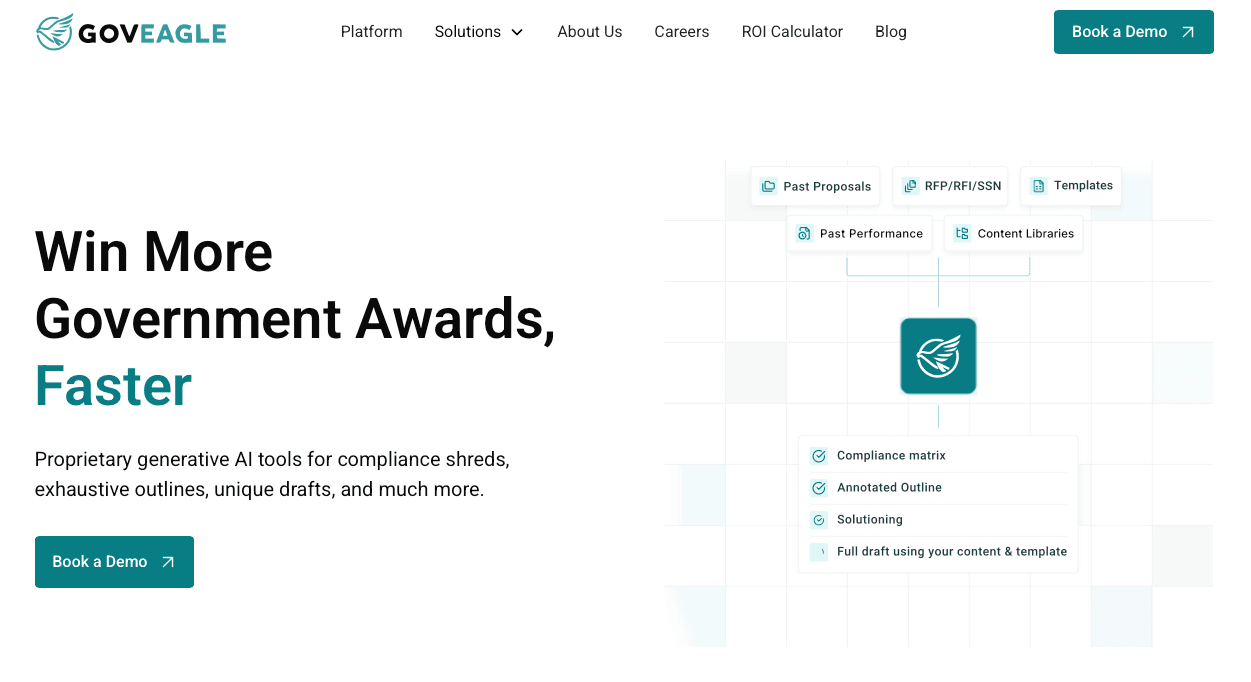
GovEagle is an AI proposal automation tool built for government contractors responding to federal RFPs, RFIs, and task orders. We serve services-based GovCon firms in IT, consulting, and staffing that need to move faster without sacrificing compliance or quality in highly regulated solicitations.
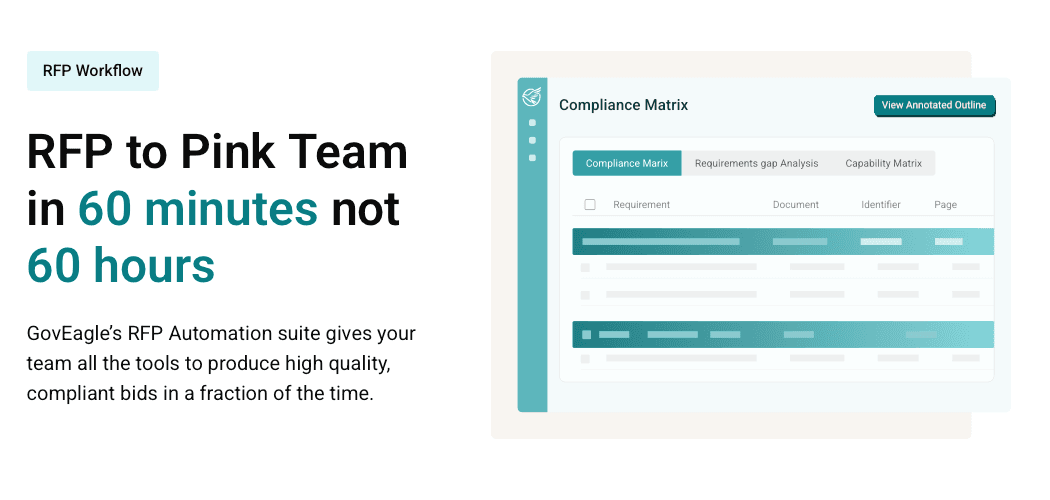
The workflow starts when you upload an RFP. GovEagle analyzes the solicitation and generates a full compliance matrix in Excel that extracts every requirement from Sections C, L, and M. From there, we create an annotated proposal outline directly in Microsoft Word, pre-populated with relevant content from your past proposals and knowledge base.
Our AI generates first-draft content for each section by learning from your previous wins and writing style. Throughout the process, you get built-in capture analysis, gap identification, amendment tracking, and automated compliance reviews. The goal is reducing proposal creation from weeks to hours while covering the entire lifecycle from bid decision through final submission.
Compliance and Government RFP Workflows
Government contracting requires precise requirement tracking across Section L (proposal format), Section M (evaluation criteria), and Section C (statement of work). Missing a single requirement can disqualify an otherwise competitive bid. For a detailed comparison of leading tools, see GovEagle vs. GovDash.
| Feature | GovEagle | Loopio |
|---|---|---|
| Automated Compliance Matrix Generation | Automatically extracts and generates full compliance matrices in Excel from Sections L, M, and C requirements with line-by-line requirement mapping | Not purpose-built for federal Section C, L, and M compliance matrices; teams typically handle detailed compliance matrices via external documents or custom internal workflows |
| Section L, M, C Requirement Tracking | Purpose-built tools to extract, map, and track federal RFP requirements across all sections with automated cross-referencing | Not included; no government-specific workflow tools for Section L, M, C tracking |
| Amendment Management | Automatically updates compliance matrices and proposal outlines when government issues amendments to solicitations | Manual tracking required; no automated amendment integration into compliance documents |
| Built-in Compliance Review Tools | Color team review tools with automated compliance checking throughout the drafting process | General review workflows without federal compliance-specific validation |
| Cross-Reference Matrix | Automated mapping of each requirement to specific proposal sections and page numbers in Excel format | Not available; cross-referencing must be managed separately outside the tool |
| Target Use Case | Federal RFPs, RFIs, and task orders with strict Section L, M, C compliance requirements for government contractors | Commercial RFPs, DDQs, and security questionnaires across various industries without federal compliance needs |
Loopio organizes responses through a Q&A content library that works across industries. Teams build this library by saving approved answers to common questions, then search and reuse content for new RFPs.
This design doesn't include government-specific workflows. Loopio does not provide a built-in federal RFP compliance matrix builder focused on Sections C, L, and M; users typically manage compliance tracking with external documents or custom workflows. Teams responding to federal solicitations must build tracking documents manually outside the system, then manage the mapping between RFP requirements and proposal sections separately.
We automatically generate full compliance matrices in Excel by analyzing the solicitation and extracting every requirement line by line. The output matches how proposal professionals manually create these documents, and the Excel format works with your existing templates.
When the government issues amendments, we automatically update your compliance matrix and proposal outline to reflect the changes. Our cross-reference matrix maps each requirement to specific proposal sections and page numbers, and built-in color team review tools check compliance throughout your drafting process. For more options, review our GovDash analysis.
Microsoft Office Integration and Workflow Compatibility
Proposal teams work in Microsoft Word, Excel, and PowerPoint for writing and formatting. How a tool fits into these workflows affects adoption and productivity.
Loopio operates as a web-based system where users manage RFP projects through a browser interface. The software supports import and export with Microsoft Office applications, but teams work primarily within Loopio's web portal. When you need to include responses into your proposal document, you export content from Loopio and manually reformat it to match your templates. This creates context switching between the web interface and your Word documents.
We take a different approach with native add-ins for Word, Excel, and PowerPoint. You access AI capabilities directly inside the applications where you're already working. Our Word add-in operates within your existing proposal templates without requiring re-architecture or reformatting. You maintain full access to tracked changes, comments, and collaborative editing features while using GovEagle's AI tools. See our guide to Microsoft Word add-ins for government proposal writing.
Task assignments sync with Word workflows, so proposal managers can coordinate section owners without forcing everyone into a separate web portal. Our Excel add-in extends beyond proposals to support finance teams with ROM calculations and cost volumes. This integration approach eliminates data migration and gets teams functional within one week.
Security and Compliance Certifications
Government contractors handling Controlled Unclassified Information (CUI) often must make sure that any external cloud service provider used to store, process, or transmit covered defense information meets security requirements equivalent to the FedRAMP Moderate baseline (per DFARS 252.204-7012 and related DoD guidance). For many DoD contractors, DFARS 252.204-7012 and DoD guidance drive the requirement that external cloud services used for covered defense information meet FedRAMP Moderate-equivalent security; CMMC levels separately define the required control sets for safeguarding FCI/CUI.
Loopio does not appear in the FedRAMP Marketplace and does not advertise FedRAMP Moderate authorization. Defense contractors and federal IT providers working with sensitive but unclassified information should not use Loopio for CUI or covered defense information unless their compliance team verifies the tool and deployment meet DFARS 252.204-7012 (FedRAMP Moderate-equivalent) and any contract-specific requirements. Many organizations either limit Loopio to non-CUI work or use it only in tightly controlled ways after compliance review; others choose a tool and deployment that more directly aligns with DFARS/FedRAMP Moderate-equivalent expectations for covered defense information.
GovEagle maintains FedRAMP Moderate Equivalency and supports GCC/GCC High environments. We comply with NIST 800-53, NIST 800-171, and CMMC, meeting the security requirements for contractors handling CUI. We deploy in AWS GovCloud with strict customer data isolation and zero-retention policies. Learn about other secure AI platforms for government proposal data. Your proprietary data never trains shared models.
We also support air-gapped deployments and SCIF environments for classified work. This security posture lets government contractors use GovEagle throughout the entire proposal process, from capture through submission.
Why GovEagle Is the Better Choice
Loopio works well for commercial organizations responding to general RFPs, DDQs, and security questionnaires across various industries. Teams that primarily handle non-government proposals with straightforward content reuse needs may find value in its Q&A library approach.
GovEagle is the stronger choice for government contractors because we tackle the specific complexity of federal procurement. Our purpose-built compliance matrix generation automatically extracts Sections L, M, and C requirements and outputs them in Excel format, matching exactly how proposal professionals work in practice.
For defense contractors and federal IT providers, FedRAMP Moderate Equivalency and CUI handling capabilities are mandatory requirements that Loopio cannot currently meet. Our native Microsoft Office integration eliminates adoption friction by working within your existing templates and workflows instead of requiring process overhaul. If you're responding to federal solicitations with compliance requirements and security standards, GovEagle delivers the specialized capabilities that general RFP tools cannot provide.
FAQs
How should I decide between GovEagle and Loopio for my team?
If you're a government contractor responding to federal RFPs with strict compliance requirements and CUI handling needs, GovEagle is built for your workflow. Loopio serves commercial organizations responding to general RFPs, DDQs, and security questionnaires across various industries where FedRAMP and Section L/M/C compliance aren't required.
Will switching to GovEagle require reformatting all my Word templates?
No. Our Word add-in operates within your existing proposal templates without requiring re-architecture or reformatting. You maintain full access to tracked changes, comments, and collaborative editing features while using our AI tools, and teams typically reach full adoption within one week with no data migration required.
Who is Loopio best suited for?
Loopio works well for commercial organizations across multiple industries that need to manage straightforward content reuse for non-government RFPs, vendor questionnaires, and security assessments. Teams that don't face Section C, L, and M compliance requirements or federal security standards may find value in its Q&A library approach.
Final Thoughts on Selecting RFP Response Software
In the GovEagle vs. Loopio decision, the real separator is whether your team is bidding on federal work that includes CUI and strict compliance rules. Loopio supports general RFP response needs, but GovEagle is built around the realities of government contracting, including FedRAMP Moderate Equivalency, automated Section C, L, and M requirement tracking, and proposal drafting that happens directly inside Word. Proposal teams should not have to adjust proven processes or accept security limitations to gain AI support. For contractors responding to federal solicitations, GovEagle aligns with how compliance-driven proposals are actually written and managed from first review through submission.