
Red Team Review Best Practices for GovCon Success | September 2026

Akash Mandavilli
CEO and Co-Founder of GovEagle
About the author
Akash is a 2x founder with previous experience in AI from Meta and federal sales from IBM. Akash holds a dual-degree from Johns Hopkins University in Economics and Computer Science.
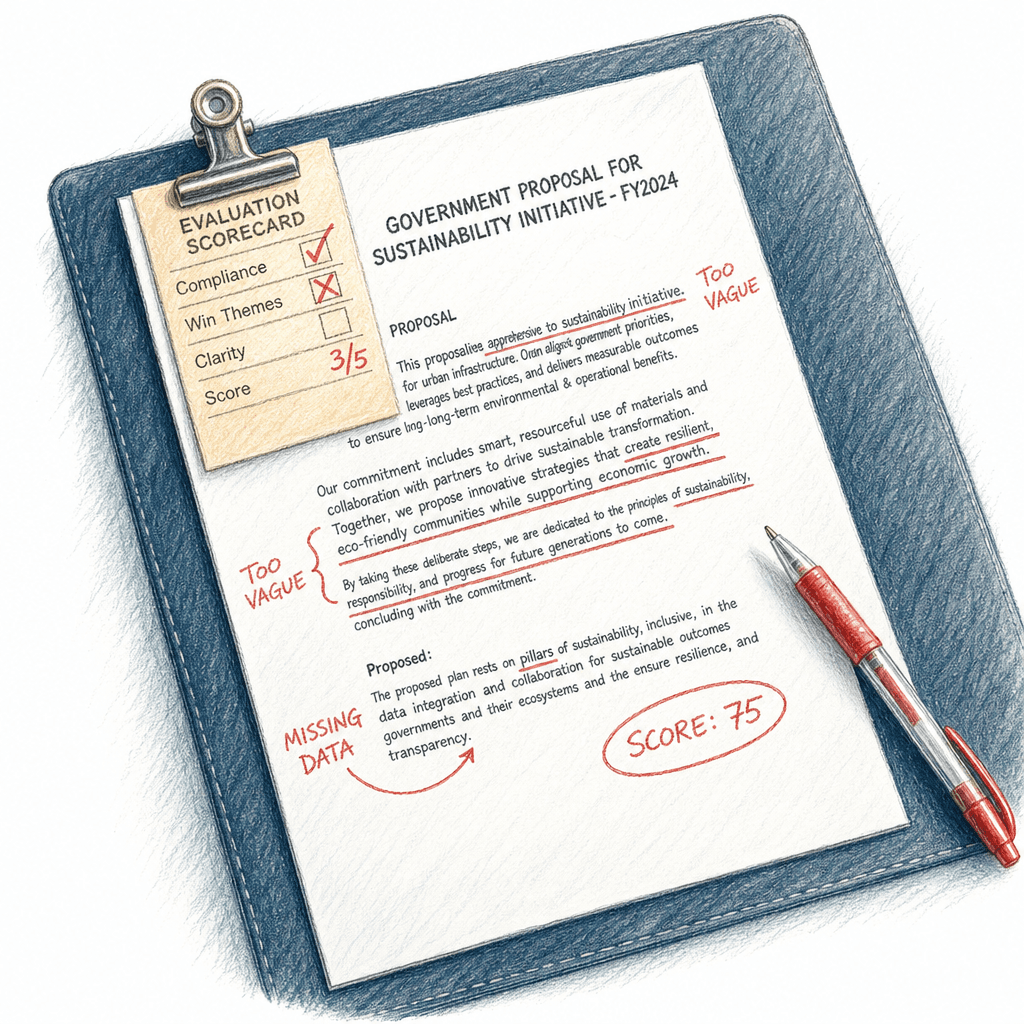
Most proposal teams know Red Team reviews matter, but many still run them like extended proofreading sessions instead of true evaluation simulations. In a Red Team GovCon review, the goal isn't cleaner writing; it's exposing how the proposal will actually score under Section M criteria. When that distinction gets lost, teams improve readability while missing the issues that cost awards: weak win themes, unsupported claims, and compliance gaps evaluators will catch immediately. The strongest teams treat Red Team as a scoring exercise first, using structured methods to surface risk before the government ever reads the draft. This guide covers how to structure the review, who should be on your team, how to score against Section M criteria, and where AI tools fit into the process.
TLDR:
- GovEagle customers report 30-40% time savings on RFIs and 15-25% on RFPs.
What Is a Red Team Review in Government Contracting?
A Red Team review is a structured, independent evaluation of a proposal draft that simulates how a government source selection evaluator would approach scoring and reviewing your submission. The team reads the proposal through the evaluator's eyes, scoring it against Section M criteria. They flag weaknesses before those gaps cost you an award.
Where Pink Team reviews focus on early structure and compliance, Red Team is the high-stakes dress rehearsal. By the time a proposal reaches Red Team, it should be largely complete, because reviewers need enough content to render a meaningful verdict.
The goal is straightforward: find the gaps before the government does. A strong Red Team surfaces vague win themes, unsubstantiated claims, and missed requirements while there is still time to fix them. That separation between proposals that win and ones that almost did is often influenced by how seriously this review is taken.
The Color Team Review Framework for Federal Proposals
Most proposals cycle through three core review stages before submission. Each one targets a different level of readiness.
| Review Stage | When It Happens | Primary Focus |
|---|---|---|
| White Team | Pre-RFP / strategy phase | Solution development, win strategy, competitive analysis |
| Blue Team | Early draft / storyboard | Draft content aligned to strategy |
| Pink Team | Early draft (30-50% complete) | Structure, outline compliance, early win themes |
| Red Team | Near-complete draft (75-90%) | Evaluator scoring simulation, persuasiveness, compliance gaps |
| Gold Team | Final draft | Executive sign-off, formatting, cost/technical alignment |
| Black Team | Independent price/cost review | Cost reasonableness, pricing strategy |
These are sequential filters, not redundant checkpoints. Pink team catches structural problems early. Red Team stress-tests the argument. Gold Team makes sure the final product holds together before it ships.
Red Team sits at the most consequential point in that sequence. The proposal is complete enough to score seriously, but there is still time to rewrite weak sections. Skip it or rush it, and you are handing the government a draft with uncaught scoring vulnerabilities.
Aligning Red Team Reviews with Section M Evaluation Criteria
Section M is the government's scorecard, listing evaluation factors, subfactors, and their relative importance. If your Red Team scores against anything else, they are running a generic quality check, not a real Red Team review.
The most effective Red Teams build a scoring sheet straight from Section M before reading a single word of the proposal. Each reviewer scores independently, section by section, using an adjectival or numerical scoring scale aligned to the source selection criteria in the solicitation. Once complete, the team compares scores and flags wide variances. Disagreement almost always points to a section that reads multiple ways, and that kind of ambiguity is exactly what kills competitive proposals at evaluation.
Pay close attention to how Section M weights each factor. A proposal that reads well but underperforms on the highest-weighted factor is still a losing proposal.
Five Scoring Pillars Every Red Team Must Evaluate
These five pillars map directly to how government source selection evaluators weight and score proposals under Section M. Reviewers should score each pillar independently before the debrief, adjusted as needed for the solicitation, agency, and contract type. A proposal that fails on any single pillar loses regardless of how strong the remaining four are, so brief your reviewers explicitly on each before they start reading.
- Win theme effectiveness: Are discriminators stated clearly and tied to specific evaluation factors, or are they buried in generic claims?
- Compliance completeness: Does every Section L instruction have a direct, traceable response, or are there gaps an evaluator would flag as non-responsive?
- Technical approach credibility: Is the solution specific and executable, or does it read as a generic capability statement that could describe any offeror?
- Management and past performance substantiation: Are relevant contract references matched to the scope and scale of this pursuit, with quantified outcomes rather than activity descriptions?
- Price/cost narrative alignment: Does the cost volume tell the same story as the technical approach, or do the two volumes contradict each other on staffing, schedule, or scope?
Reviewers often fixate on prose quality and miss the harder questions above. Structure your Red Team session around these five areas so feedback stays focused on what actually affects the source selection decision.
Get GovCon capture and proposal insights in your inbox.
Common Red Team Review Mistakes That Weaken Proposals
Red Team reviews fail in predictable ways. Knowing what to watch for saves you from running a review that feels thorough but changes nothing.
- Scheduling it too late. If revisions cannot realistically happen post-review, you are conducting a post-mortem, not a rehearsal. For example, Red Team runs 48 hours before submission, finds the pricing narrative contradicts the technical approach, and there is no time to align them before the deadline.
- Using proposal writers as reviewers. Writers are too close to the content to score it objectively. They read what they intended to say, not what the evaluator will actually see. Independent reviewers — people who had no hand in drafting — catch the gaps that familiarity hides.
- Scoring against generic quality criteria instead of Section M. A Red Team that grades grammar, flow, and formatting is running a proofreading session. If the scoring rubric is not built directly from the solicitation's evaluation factors and their relative weights, the review produces no useful signal about competitive standing.
- Running Red Team without a structured debrief. Collecting individual reviewer notes and leaving it there means ambiguous sections never get resolved. A structured debrief — comparing scores, flagging variances, and assigning revision owners — is what converts findings into fixes before submission.
Any one of these turns Red Team into a box-checking exercise that consumes time without improving your probability of win.
Building an Effective Red Team Review Process
A strong Red Team review starts well before anyone reads a draft. The preparation determines whether you get actionable scores or just senior leadership opinions delivered under deadline pressure.
Who Should Be on Your Red Team
The best reviewers are people who did not write the proposal. Former contracting officers, BD professionals from adjacent programs, or outside consultants can work well when they understand the agency, solicitation, and evaluation framework. Fresh eyes catch what familiar ones miss.
For technical volumes, include at least one reviewer with domain expertise in the relevant area, whether IT, engineering, logistics, or another discipline, so they can identify execution gaps rather than only compliance gaps. For management volumes, a former contracting officer or source selection evaluation board member brings the evaluator's perspective directly into the room. When internal bench depth is thin, proposal consultants from outside the pursuit team are a reliable way to get independent, experienced coverage without pulling writers into the review.
What to Send Before the Review
Give reviewers the full RFP, a scoring sheet built from Section M, and the proposal at least 48 hours in advance. Reviewers who read cold produce shallow feedback.
How to Run the Debrief
Score independently first, then compare. Where reviewers disagree, dig in. Variance signals ambiguity in the proposal, and ambiguity costs points.
Schedule the Red Team with enough runway to act on what you find. Two days before submission leaves no time for meaningful revision.
Step-by-Step Red Team Execution Checklist
- Distribute the RFP, Section M scoring sheet, and proposal draft at least 48 hours before the session.
- Require reviewers to score independently before the group debrief, no pre-session discussion.
- Open the debrief by comparing section scores, not reading prose aloud.
- Flag every section with a scoring variance of two or more adjectival levels for focused discussion.
- Assign a section owner and a specific revision action to every flagged weakness before the session closes.
- Set a hard deadline for revised sections that gives the proposal manager time to integrate changes before Gold Team.
How AI Changes Red Team Reviews for Government Contractors
AI tools built for GovCon proposals can run the mechanical layer of compliance checking automatically, scanning a near-complete draft against Section L instructions and Section M evaluation factors before human reviewers ever open the document. Gaps get flagged. Win theme consistency gets checked across sections. Weak or missing responses to evaluation criteria surface in a structured report instead of a debrief conversation. That same compliance scanning can run at the pink team draft stage too, so teams enter Red Team with fewer mechanical issues already resolved rather than discovering them late. AI can also compare the cost volume narrative against the technical approach to surface pricing alignment gaps before reviewers start, catching the two-story problem before it reaches an evaluator. For OASIS+ pursuits, AI can track domain-specific qualification thresholds and amendment changes automatically, reducing the manual effort of monitoring solicitation updates across pool requirements.
That frees your Red Team to focus where senior experience actually matters: competitive positioning, narrative strength, and whether the technical approach genuinely sets you apart from competitors. The compliance check becomes a starting point, not the primary focus of the session.
What AI Handles vs. What Your Red Team Handles
Some tasks belong to AI; others require human judgment. Knowing the split makes your review process sharper.
| Review Task | AI | Red Team |
|---|---|---|
| Section L/M cross-reference | Supports | No |
| Win theme consistency check | Supports | Validates |
| Narrative strength assessment | No | Supports |
| Competitive differentiation | No | Supports |
| Flagging missing requirements | Supports | No |
How GovEagle Accelerates Red Team Reviews without Sacrificing Quality

Speed and quality feel like competing priorities in red team reviews, but the real bottleneck is usually the mechanical work: cross-referencing requirements, checking win theme consistency, verifying every Section L instruction received a response. GovEagle handles that layer automatically before your reviewers ever open the draft.
The GovEagle proposal solution includes automated compliance and quality review that generates reports covering compliance, style, win themes, and compellingness. The system is built to mirror government evaluator scoring, surfacing weaknesses without the rose-colored glasses that tend to creep into internal reviews. Chevo, one GovEagle customer, reports 30-40% time savings on RFIs and 15-25% on RFPs across their proposal workflow.
The result is a Red Team that walks in with the mechanical layer already done, focused primarily on competitive differentiation and narrative strength where senior judgment actually moves the score. See how GovEagle fits into your Red Team process.
FAQs
What's the difference between a Red Team review and a pink team review?
Pink team focuses on early structure and compliance at 30-50% draft completion, while Red Team simulates government evaluator scoring on a near-complete draft (75-90%). Red Team is the high-stakes dress rehearsal that finds scoring vulnerabilities before submission, while pink team catches structural problems early.
Can I run an effective Red Team review without former government evaluators?
Yes, but reviewers must be independent from the proposal team and score using a rubric tied directly to Section M criteria. BD professionals from adjacent programs or outside consultants work well if they score objectively against evaluation factors instead of offering general opinions.
How much time should I schedule between Red Team and proposal submission?
Schedule Red Team with enough runway to rewrite weak sections, often at least several business days before submission. Two days before submission leaves no time for meaningful revision, turning your Red Team into a post-mortem instead of a rehearsal.
Should you use AI tools or manual scoring for Red Team reviews?
Use AI to handle the compliance layer first, so your Red Team can focus on competitive positioning and narrative strength where senior judgment actually moves the score. That split cuts review time without sacrificing quality.
What happens if Red Team reviewers disagree on Section M scores?
Wide scoring variance signals ambiguity in the proposal text. When reviewers disagree, that section reads multiple ways, and that's exactly what kills competitive proposals at evaluation. Dig into those disagreements during debrief and rewrite for clarity before the government evaluator encounters the same confusion.
Final Thoughts on Making Red Team Reviews Count
A Red Team GovCon review works best when it reflects how the government will actually score your proposal and leaves enough time to act on what it finds. Independent scoring, Section M alignment, and focused debriefs turn Red Team into a true predictor of evaluation outcomes. When compliance mapping and requirement tracking are handled before reviewers step in, the conversation turns to what really drives scores: differentiation and credibility. GovEagle brings that visibility into the process by surfacing scoring risks and compliance gaps before Red Team begins, so your reviewers spend their time on decisions that affect the outcome.