
AI for Federal Government Proposal Writing: Complete Guide for September 2026

Akash Mandavilli
CEO and Co-Founder of GovEagle
About the author
Akash is a 2x founder with previous experience in AI from Meta and federal sales from IBM. Akash holds a dual-degree from Johns Hopkins University in Economics and Computer Science.
Opening a 200-page DoD RFP with a 30-day clock means more than writing a GovCon proposal. It means parsing Sections C, L, and M, capturing every requirement, building a compliance matrix that actually matches your outline, and getting usable drafts in front of reviewers before the schedule collapses. This is where modern proposal software fits into the workflow, taking on the mechanical work that slows teams down while leaving strategy, win themes, and judgment with your people so deadlines feel manageable instead of punishing.
TLDR:
- AI cuts federal proposal response time by 70% through automated compliance matrices and first drafts.
- FedRAMP and CMMC compliance are often required for AI tools handling CUI and defense contractor data, depending on agency requirements, contract scope, and data sensitivity.
- Retrieval Augmented Generation and agentic search pulls from your past proposals to draft in your company's voice.
- Some modern solutions generate compliance matrices in Excel and draft in Word without template rework.
- Teams achieve 80% less SME time and 3-4x faster preparation with proposal-specific AI tools.
What Federal Government Proposal Writing Is and Why It Matters
Federal government proposal writing is the process of responding to formal solicitations like RFPs, RFIs, and other procurement documents issued by federal agencies. These responses detail how your company will meet requirements, from technical approach to past performance to pricing.
The process requires strict adherence to Federal Acquisition Regulation (FAR) guidelines. Most negotiated solicitations include detailed instructions in Section L (what to submit) and evaluation criteria in Section M (how you'll be scored). Miss a single requirement or formatting instruction, and your proposal can be eliminated before evaluators assess your technical solution.
The stakes are high. A 30% win rate is considered good in government contracting. Each loss represents months of effort from business development, capture, technical teams, and leadership.
This competitive pressure has made proposal quality and speed critical differentiators. Bid/no-bid analysis tools help teams make faster decisions about which opportunities to pursue. Firms that respond faster, maintain perfect compliance, and articulate compelling win themes gain an edge. AI has shifted from nice-to-have to necessary for teams serious about growth.
The Unique Challenges of Federal Proposal Development
Federal proposals require compliance protocols absent from commercial bids. FAR Section L defines submission requirements, while Section M determines evaluation criteria. Miss a single formatting instruction and evaluators reject your response before scoring.
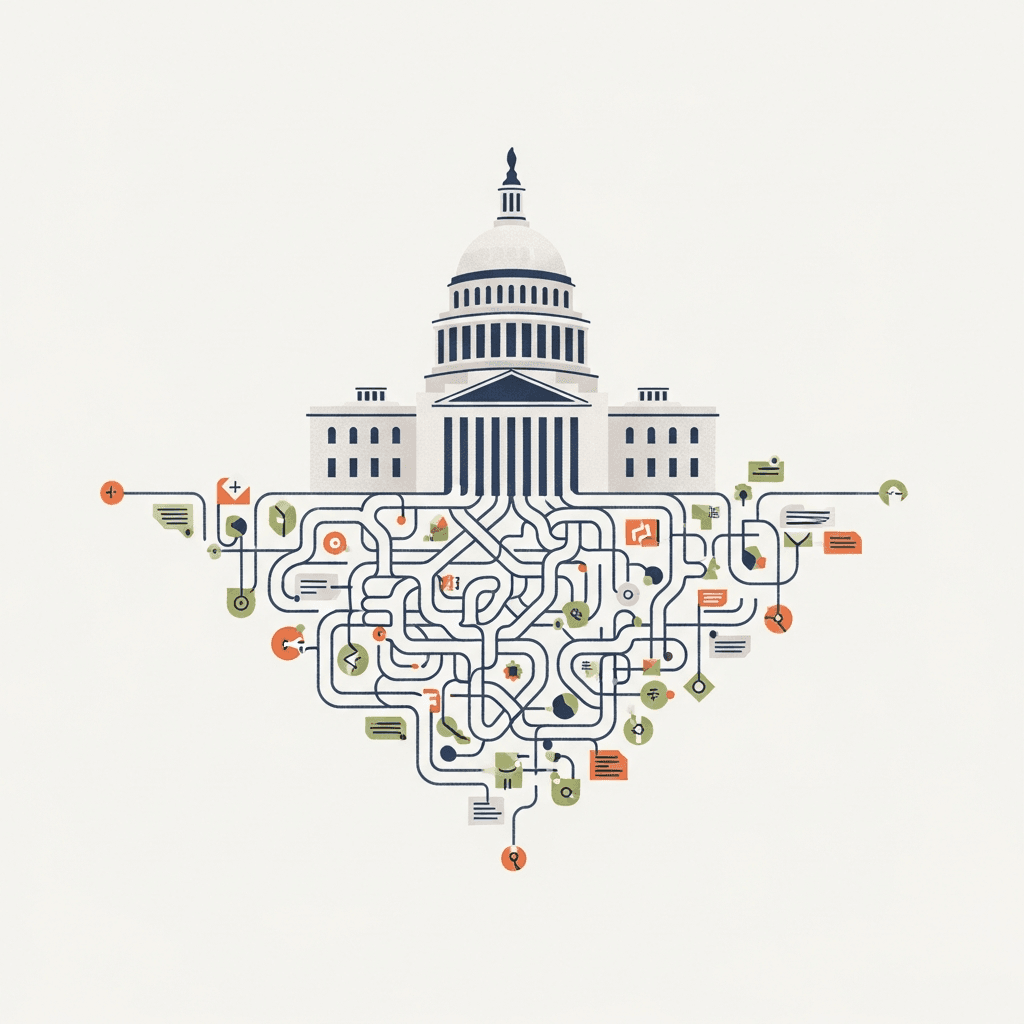
Many federal RFPs allow roughly 30 days to complete requirement analysis, content development, color team reviews, and final submission. Subject matter experts spend hours answering questions instead of delivering client work. Small BD teams can't pursue multiple opportunities simultaneously without sacrificing proposal quality or business delivery capacity. Rapid proposal turnaround solutions help mid-market firms compete without expanding headcount.
How AI Is Changing Government Proposal Writing
AI solves federal proposal challenges through automated requirement extraction, compliance mapping, content generation, and intelligent search. Automated RFP shredding can pull requirements from Sections C, L, and M in minutes. Compliance matrices can automatically map requirements to response sections in Excel format.
Content generation creates first drafts by retrieving relevant text from past proposals and corporate libraries while matching your writing style. Semantic search surfaces reusable content across previous submissions, even when RFPs use different terminology. Knowledge base integration tools connect your existing content repositories to AI systems.
Research shows AI reduces RFP response time by 70% and costs by 50%. Teams finish bid/no-bid decisions in hours and produce Pink Team drafts in days.
Compliance Matrix Automation: The Foundation of Proposal Success
A compliance matrix tracks every RFP requirement against your proposal response, giving federal evaluators proof you've tackled all mandatory elements. The document pulls requirements from Section L, Section M, and Section C, listing where each appears in your submission.
AI builds these matrices by reading RFP text and recognizing requirements automatically. The output generates in Excel, which matches how proposal teams already manage documents. When agencies release amendments, AI updates affected requirements without manual cross-checking, preventing the submission failures that occur when teams miss changed instructions under deadline pressure.
AI-Powered Content Generation and First Draft Development
AI drafting relies on Retrieval Augmented Generation (RAG) and agentic search, which pull text from your past proposals, boilerplate libraries, and corporate content instead of generating generic responses. AI proposal writing tools built for government contractors include this capability. The system searches internal documents for relevant sections matching RFP requirements, then synthesizes that content into a cohesive first draft that reflects your company's terminology, style, and formatting conventions.

Generated sections can include citations showing which source documents contributed content. You see exactly where text originated, whether from a prior federal proposal or a standard technical approach document. These citations let reviewers verify accuracy and prevent hallucinations from entering your response.
The output can be a Pink Team draft ready for SME review within hours of RFP release.
Specialized vs. Generic AI Tools for Government Proposals
Generic AI tools like ChatGPT do not natively enforce FAR regulations, Section L/M structures, or federal compliance requirements within proposal workflows. Secure AI platforms designed for government proposal data include these protections by default. Every query requires prompt engineering to explain context, formatting rules, and evaluation criteria.
Government proposal AI embeds federal procurement knowledge directly into the system. These tools recognize Section L instructions automatically, understand compliance matrix formats, and apply FAR-compliant language without custom prompting.
Specialized tools train on government contracting terminology instead of general business language. They distinguish between Performance Work Statements and Statements of Objectives, or recognize differences between IDIQ vehicles and standalone procurements. This domain fluency produces accurate first drafts that require editing instead of complete rewrites.
| Feature | Generic AI Tools (ChatGPT, Claude) | Specialized Government Proposal AI (GovEagle) |
|---|---|---|
| FAR Compliance Knowledge | Requires manual prompt engineering for each RFP to explain FAR regulations, Section L/M structures, and evaluation criteria | Built-in federal procurement knowledge recognizes Section L instructions and Section M criteria automatically without custom prompting |
| Compliance Matrix Generation | Cannot natively generate compliance matrices in Excel format; requires extensive formatting and manual cross-referencing | Automated compliance matrix creation in Excel format with automatic requirement mapping from Sections C, L, and M |
| Content Retrieval | No access to your past proposals or corporate libraries; generates generic responses from public training data | Retrieval Augmented Generation (RAG) and agentic search pull from your past proposals, boilerplate libraries, and corporate content to draft in your company's voice |
| Government Terminology | Uses general business language; cannot distinguish between PWS vs SOO or IDIQ vehicles without detailed explanation | Trained on government contracting terminology; recognizes procurement-specific language and structures automatically |
| Security & Compliance | Public cloud infrastructure not designed for CUI; no FedRAMP, CMMC, or GCC High support | FedRAMP Moderate Equivalency, CMMC compliance, GCC High support, and zero-retention policies to protect proprietary content |
| Workflow Integration | Standalone chat interface requiring copy-paste between tools; no native integration with proposal software | Microsoft Word and Excel add-ins allow drafting and compliance checks within existing workflows without switching platforms |
| Amendment Tracking | No ability to monitor RFP changes or update compliance matrices when agencies release modifications | Automated amendment tracking updates compliance matrices and affected requirements without manual cross-checking |
| Source Citations | No transparency into content sources; cannot verify which information contributed to generated responses | Citations show which past proposals or boilerplate documents contributed content, enabling accuracy verification and preventing hallucinations |
Security and Compliance Requirements for AI Proposal Tools
Federal proposal AI tools handle Controlled Unclassified Information (CUI), past performance data, and proprietary technical approaches. Any system processing this data must meet federal security standards or risk disqualifying your entire proposal.
NIST 800-171 sets baseline security requirements for protecting CUI in non-federal systems. Defense contractors may need CMMC compliance, which can involve Level 2 self-assessments or third-party assessments depending on contract requirements and data type. NIST 800-53 defines controls for federal information systems and forms the basis for FedRAMP authorization.
FedRAMP Moderate Equivalency generally means a cloud service is assessed against controls equivalent to the FedRAMP Moderate baseline without holding a FedRAMP ATO. FedRAMP High Authorization indicates the vendor has passed a government assessment and is authorized for use by federal agencies.
Zero-retention policies prevent AI vendors from training shared models on your proprietary content. Without this protection, your win themes, technical approaches, and past performance narratives could inadvertently inform competitors' proposals through the same AI system.
Defense contractors working with certain categories of DoD data may require GCC High environments that meet Impact Level 4 or 5 requirements.
Integrating AI with Existing Proposal Workflows
Proposal teams work in Microsoft Word, Excel, and SharePoint. Moving to a different system creates adoption friction and requires retraining.
AI add-ins for Word and Excel keep writers in familiar environments. Proposal writers draft in Word while accessing AI search, content insertion, and compliance checks through a sidebar. Excel add-ons handle ROM calculations and basis of estimates without moving data between systems.
Connection to SharePoint, Box, and Google Drive lets AI index existing proposal libraries without migration. The system searches your current file structure and pulls relevant content into drafts.
Best Practices for Implementing AI in Proposal Operations
Start with organized content libraries before deployment. AI retrieves from existing proposals and boilerplate, so quality inputs produce quality outputs.
Assign human oversight to win themes and strategic differentiators. AI drafts technical responses, but capture strategy and competitive positioning require human judgment.
Run standard color reviews. AI accelerates Pink Team drafts, but Red and Gold Team checkpoints catch strategic gaps AI can't assess.
Track time per section and total proposal hours. Compare win rates before and after AI adoption to measure ROI beyond speed improvements. Some teams achieve 3-4x faster proposal throughput with AI implementation.
Simplifying Proposal Development with Specialized AI Solutions
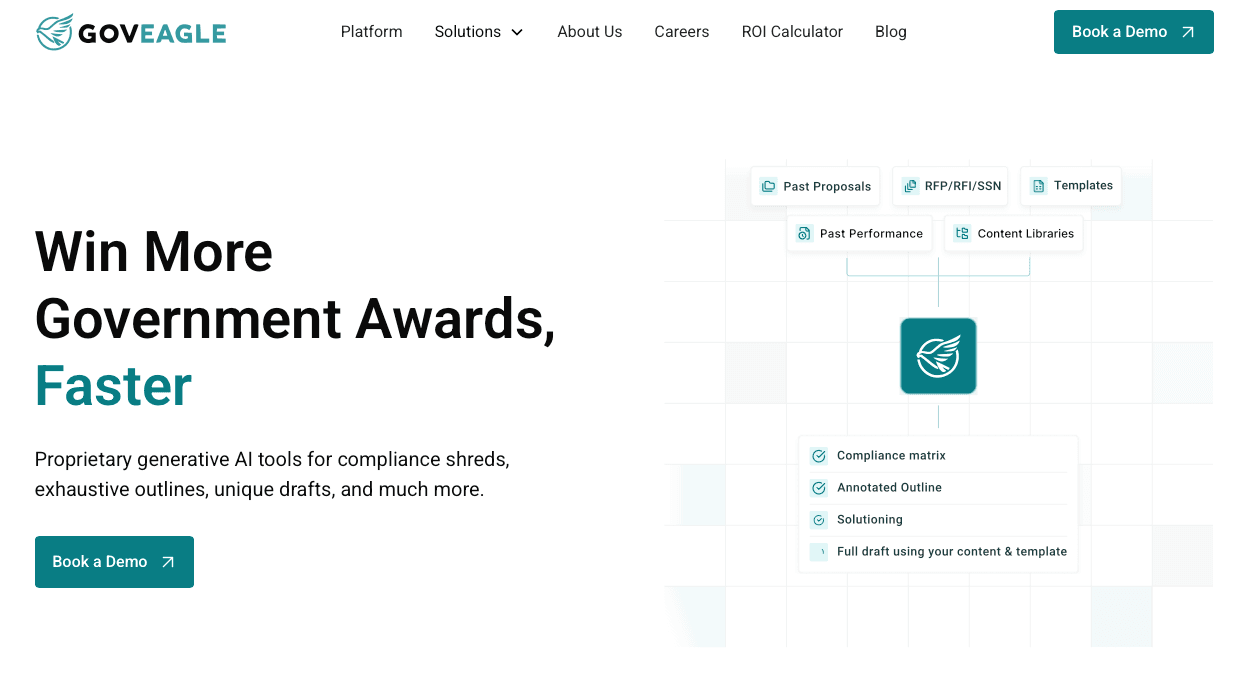
We built GovEagle for federal proposal teams managing FAR requirements, Section L/M structures, and compliance matrices that export to Excel without rework.
Microsoft Word and Excel add-ins integrate into existing workflows. Draft in Word while running AI search and compliance checks through a sidebar. Excel integration covers ROM calculations and program management beyond proposal drafting.
Amendment tracking monitors RFP changes and updates compliance matrices when agencies release modifications. The workflow spans bid/no-bid analysis, compliance matrix generation, annotated outlines, AI drafting, and automated review reports.
Security includes FedRAMP Moderate Equivalency, CMMC compliance, and GCC High support. Zero-retention policies protect proprietary content from training data.
Teams see 80% less SME time on early-stage proposals and 3-4x faster preparation cycles.
FAQs
How long does it take to implement AI proposal tools in an existing workflow?
Most federal proposal teams reach full adoption within one week when using tools with native Microsoft Word and Excel integrations that connect to existing SharePoint or Box repositories. Teams avoid the months-long implementations required by platforms demanding content migration, rigid tagging structures, or new document management systems.
Can AI generate compliant Section L and M responses without extensive prompt engineering?
Government proposal AI trained on federal procurement structures recognizes Section L instructions and Section M evaluation criteria automatically. The system builds compliance matrices in Excel format, maps requirements to response sections, and generates first drafts using Retrieval Augmented Generation from your past proposals, all without custom prompting for each RFP.
How do I maintain proposal quality when using AI-generated content?
Run standard color team reviews on all AI-generated drafts. AI accelerates Pink Team draft creation from weeks to hours, but Red Team and Gold Team reviews remain critical for verifying win themes, strategic positioning, and competitive differentiation. Every AI-generated section should include source citations showing which past proposals or boilerplate documents contributed content.
Final Thoughts on Modernizing Your Proposal Process
Modern federal proposal teams win by doing more without burning out their people, and AI has become part of that reality. When GovEagle is used for GovCon proposals, teams stay inside Word and Excel while requirement extraction, compliance matrices, and early drafts move forward in parallel, freeing staff to focus on capture strategy and review quality instead of document mechanics. The result is the ability to pursue more RFPs with the same headcount, protect revenue momentum, and build a repeatable process that scales as demand grows.