
RFQ Meaning: Complete Definition, Process and Real Examples (September 2026)

Three RFQs arrive in your inbox with overlapping deadlines, and you need to determine RFQ meaning in procurement before deciding how to respond, compare quotes, or issue pricing requests to vendors. At its core, an RFQ asks suppliers for pricing when specifications, quantities, and delivery expectations are already defined, allowing procurement teams to compare bids on equal terms. The concept appears across industries from construction materials and engineering components to federal contract vehicles like GSA Schedules. While the structure stays consistent, small variations in documentation, pricing formats, and compliance requirements can slow review cycles or create confusion when quotes arrive. Teams that rely on structured procurement workflows and tools move from solicitation intake to organized quote analysis faster while keeping vendor comparisons clear and aligned with procurement rules.
TLDR:
- RFQ (Request for Quotation) is a procurement document for price quotes when specs are defined.
- Use RFQs for standardized purchases; use RFPs for complex solutions requiring vendor proposals.
- Federal contractors often respond to RFQs through GSA Schedules and GWACs using the ordering procedures defined in FAR Subpart 8.4 (including FAR 8.405-1 and 8.405-2).
- AI automation cuts RFQ response time from days to hours by extracting requirements automatically.
- Some modern tools generate compliance matrices in Excel and connect to your existing Word/SharePoint workflow.
What RFQ Means (Definition and Core Concepts)
RFQ stands for Request for Quotation (sometimes called Request for Quote). It's a procurement document that organizations send to suppliers when they need price quotes for specific goods or services with clearly defined specifications.
When you already know exactly what you want, including specifications, quantities, and delivery requirements, you send the RFQ to pre-qualified vendors asking: "How much will this cost?"
RFQs primarily focus on pricing for predefined requirements, though agencies may still assess delivery terms, past performance, and other factors depending on the solicitation. This process assumes the solution is already defined. Vendors respond with pricing breakdowns, delivery timelines, and terms. You compare quotes and select the best value option.
This process appears across sectors from construction firms sourcing materials to government agencies purchasing IT equipment to manufacturers ordering components.
RFQ vs. RFP vs. RFI: Understanding the Key Differences
The confusion between RFI, RFQ, and RFP makes sense because procurement teams often use all three during a single project lifecycle. Each serves a distinct purpose.
An RFI (Request for Information) is the earliest stage tool, sent when researching the market, assessing vendor capabilities, or investigating potential solutions before defining requirements. An RFP (Request for Proposal) comes next for complex projects requiring vendor-proposed solutions, including methodology, qualifications, timeline, and approach alongside cost.
| Document | Primary Purpose | When to Use | Typical Response |
|---|---|---|---|
| RFI | Gather information | Market research, vendor discovery | Capabilities, case studies, general info |
| RFQ | Get pricing | Specs are defined, need costs | Line-item pricing, delivery terms |
| RFP | Solicit proposals | Complex needs, solution required | Full proposal with approach and pricing |
RFQ Meaning Across Industries: Business, Construction, Engineering, Procurement and Beyond
The core RFQ definition remains constant, but what you're quoting changes by sector.
Construction RFQs target materials, equipment rentals, or subcontractor labor. A general contractor might request quotes for 5,000 cubic yards of concrete or electrical installation, receiving unit pricing and completion timelines.
Engineering firms quote technical components with exact specifications. Aerospace engineers request machined parts with precise tolerances and material certifications, receiving compliance documentation with pricing.
Procurement teams issue RFQs for inventory, raw materials, or recurring services, comparing vendor pricing structures and payment terms for bulk orders.
Logistics RFQs focus on freight costs and delivery terms for specific routes, cargo types, and handling requirements.
The RFQ Process: Step-by-Step Workflow
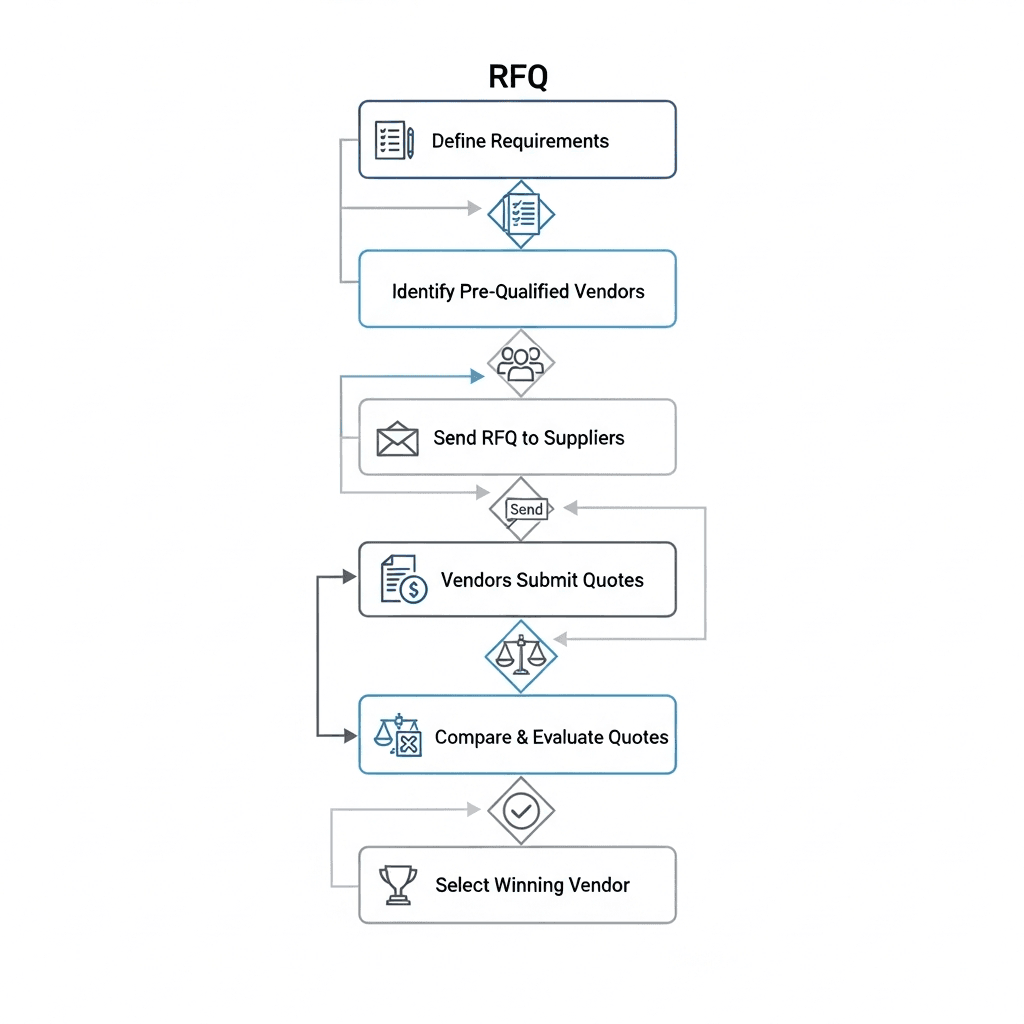
The RFQ workflow follows a predictable sequence whether you're buying office supplies or subcontracting specialized services. Understanding proven RFQ process frameworks helps teams implement consistent evaluation criteria across procurement cycles.
Start by defining exact requirements, including specifications, quantities, delivery dates, and payment terms. Draft the RFQ document with evaluation criteria like price weight, delivery speed, and vendor qualifications.
Next, identify pre-qualified vendors with proven capability to deliver. For government contractors, check SAM.gov registrations or past performance databases.
Send the RFQ to selected suppliers with a clear submission deadline. Most organizations allow 1-2 weeks for straightforward quotes, longer for complex items.
Vendors submit pricing breakdowns and terms. Government RFQs typically request written quotes that are assessed for best value instead of sealed bids.
Compare quotes against evaluation criteria. Price matters, but delivery reliability and quality certifications factor into total value.
Select the winning vendor and formally notify all participants.
When to Use an RFQ: Ideal Scenarios and Use Cases
RFQs work best when three conditions align: you know exactly what you need, specifications are non-negotiable, and price comparison drives the decision.
The ideal scenario involves standardized or commoditized purchases. Office furniture with exact model numbers, bulk materials meeting published specifications, or off-the-shelf software licenses all fit this profile. You're not asking vendors to design a solution. You're asking what they'll charge to deliver predefined requirements.
Repeat purchases with proven vendors benefit from RFQs. If you've already vetted supplier capabilities and quality standards, skip the lengthy qualification process and go straight to pricing for the next order cycle.
Pre-qualified vendor lists accelerate RFQ turnaround. Government contractors often maintain approved supplier rosters where capability verification happened during previous awards, making RFQs the faster path for recurring needs.
Skip the RFQ if you're investigating new tech, comparing different methodologies, or need custom solutions. Those situations demand RFPs or RFIs first.
Key Components of an Effective RFQ
A complete RFQ saves time for both buyer and supplier by eliminating clarification rounds. Include a company overview for context, precise specifications (product descriptions, quantities, technical requirements, quality standards, compliance certifications), delivery schedules with destinations, and standardized pricing format instructions (line-item breakdowns, unit costs, volume discounts, payment terms). If scoring beyond price, state criteria weighting upfront. Close with submission instructions covering deadlines, required formats, contact information, and mandatory documentation.
Get GovCon capture and proposal insights in your inbox.
RFQ Benefits: Why Organizations Use Request for Quotations
Organizations choose RFQs because competitive bidding reduces costs while maintaining speed. When multiple vendors know they're competing on identical specifications, they submit sharper pricing without extended negotiations or complex evaluations.
The process creates audit-ready documentation that shows fair vendor consideration against objective criteria, protecting procurement teams during reviews. Unlike RFPs, the administrative work stays minimal since you're scoring quotes instead of reviewing technical capabilities.
Standardized templates accelerate comparison. Instead of sorting through different quote formats across repeated clarifications, teams compare identical line items in hours. For recurring purchases, this builds predictable supply relationships where pricing structures and delivery expectations remain clear across multiple procurement cycles.
RFQ in Government Contracting: Federal Procurement Applications
Federal agencies use RFQs when buying well-defined goods or services through existing contract vehicles like GSA Schedules and GWACs. Under FAR Subpart 8.4, contracting officers request quotes from schedule contractors without conducting a full open competition because the underlying schedule contract has already been competed.
Schedule RFQs provide faster procurement than FAR Part 15 RFPs while meeting competition standards. Contracting officers document quote comparisons and selection decisions, typically requesting quotes from at least three schedule contractors for orders above the micro-purchase threshold, unless the contracting officer documents a justification for fewer sources.
Common RFQ Mistakes and Best Practices
Insufficient specification detail produces non-comparable quotes when vendors interpret requirements differently. Document exact specifications, quality standards, and acceptance criteria upfront.
Unrealistic response timelines limit vendor participation and force rushed quotes with higher pricing buffers. Allow one to two weeks for straightforward quotes so vendors can prepare accurate pricing.
Unclear evaluation criteria create confusion about decision factors. State evaluation weights explicitly (price 70%, delivery speed 20%, certifications 10%) so vendors know how to structure competitive responses.
Failing to provide equal information to all bidders undermines fair competition. When one vendor requests clarification, share responses with all participants simultaneously.
Neglecting post-award feedback wastes relationship-building opportunities. Brief unsuccessful vendors on selection rationale to maintain positive supplier relationships for future competitions.
How AI and Automation Are Changing RFQ Response for Government Contractors
Government contractors face a volume problem. Between GSA Schedule RFQs, task order requests, and recurring procurement opportunities, teams often receive multiple quote requests weekly with turnaround times measured in days, not weeks.
Manual RFQ response creates capacity bottlenecks. Teams spend hours parsing solicitation documents, extracting requirements, searching past performance records, drafting technical approaches, and formatting compliance matrices. When three simultaneous RFQs arrive with overlapping deadlines, proposal teams choose which opportunities to pursue based on bandwidth instead of strategic fit.
AI tools accelerate this timeline by automating requirement extraction, surfacing relevant past performance automatically, and generating initial draft responses. This moves proposal work from creation to review, letting the same team handle more simultaneous responses without sacrificing quality.
The distinction matters between generic AI and purpose-built GovCon solutions. General tools require extensive prompt engineering and lack built-in compliance checking. Purpose-built solutions understand FAR structures, generate compliant matrices, and maintain security standards required for CUI handling.
How GovEagle Accelerates RFQ and RFI Response for Government Contractors
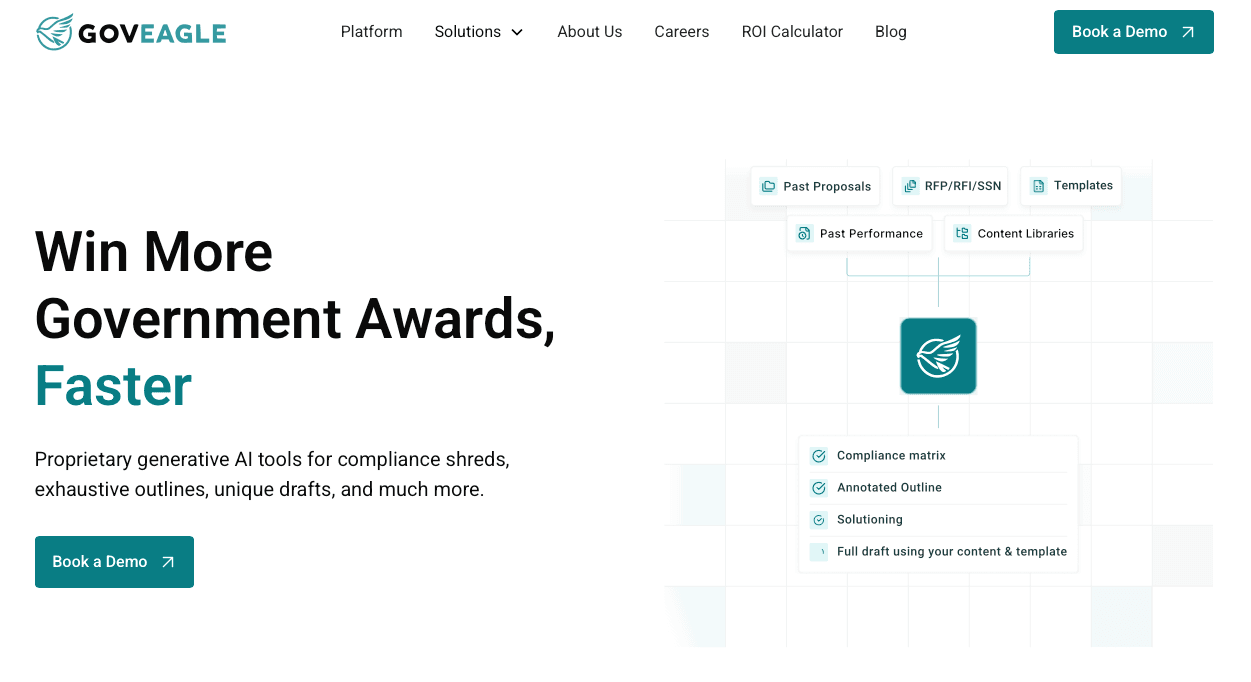
GovEagle solves the core RFQ and RFI response challenges government contractors face: compressed timelines, strict compliance requirements, and limited proposal capacity.
Our compliance matrix generation extracts every requirement from the solicitation in minutes, producing Excel-formatted matrices in the format contracting officers expect. Capability and gap analysis automatically matches task areas against your past performance database, surfacing relevant contracts and identifying teaming needs without manual searching. AI-assisted drafting generates first-draft responses using your company's voice and historical content, reducing time to first draft.
Chevo achieved 30-40% time savings on RFIs and 15-25% on RFPs after implementing GovEagle.
The solution runs inside Microsoft Word and Excel through native add-ins, connecting to your existing SharePoint or content repositories. Security meets defense contractor standards with FedRAMP Moderate Equivalent controls, NIST 800-171 compliance, and support for GCC High environments when handling CUI.
FAQs
What's the main difference between an RFQ, RFP, and RFI?
An RFI gathers market information during early research phases, an RFQ requests pricing for well-defined specifications, and an RFP solicits complete proposals including methodology and approach for complex projects. Use an RFQ when you know exactly what you need and want competitive pricing.
How long should I give vendors to respond to an RFQ?
Allow one to two weeks for straightforward quotes so vendors can prepare accurate pricing without rushing. Complex items requiring detailed analysis or custom configurations may require longer response windows.
How can AI tools reduce RFQ response time for government contractors?
AI tools automate requirement extraction from solicitations, match task areas against your past performance database, and generate compliant first-draft responses in hours instead of days. This lets proposal teams handle multiple simultaneous RFQs without choosing which opportunities to pursue based solely on bandwidth constraints.
Final Thoughts on RFQ Process and Response Strategy
Mastering RFQ meaning and the response process gives government contractors an advantage when competing on schedule contracts, task orders, and recurring procurement opportunities. While pricing is central to RFQs, winning quotes also depend on clear requirement interpretation, accurate cost breakdowns, and fast turnaround when multiple requests arrive at once. Teams that build repeatable workflows for requirement extraction, quote formatting, and vendor comparison can respond faster without introducing errors that slow evaluation or trigger clarification rounds. Many contractors now support this process with tools like GovEagle, which help generate compliance matrices, organize solicitation requirements, and produce structured first drafts so proposal teams can handle more RFQs in less time. When you combine a disciplined response process with the right technology, RFQ responses move faster, remain aligned with procurement rules, and increase the chances of winning competitive quote requests.