
CAS vs. GAAP: What the Pentagon's New Accounting Directive Means for Contractors

Akash Mandavilli
CEO and Co-Founder of GovEagle
About the author
Akash is a 2x founder with previous experience in AI from Meta and federal sales from IBM. Akash holds a dual-degree from Johns Hopkins University in Economics and Computer Science.
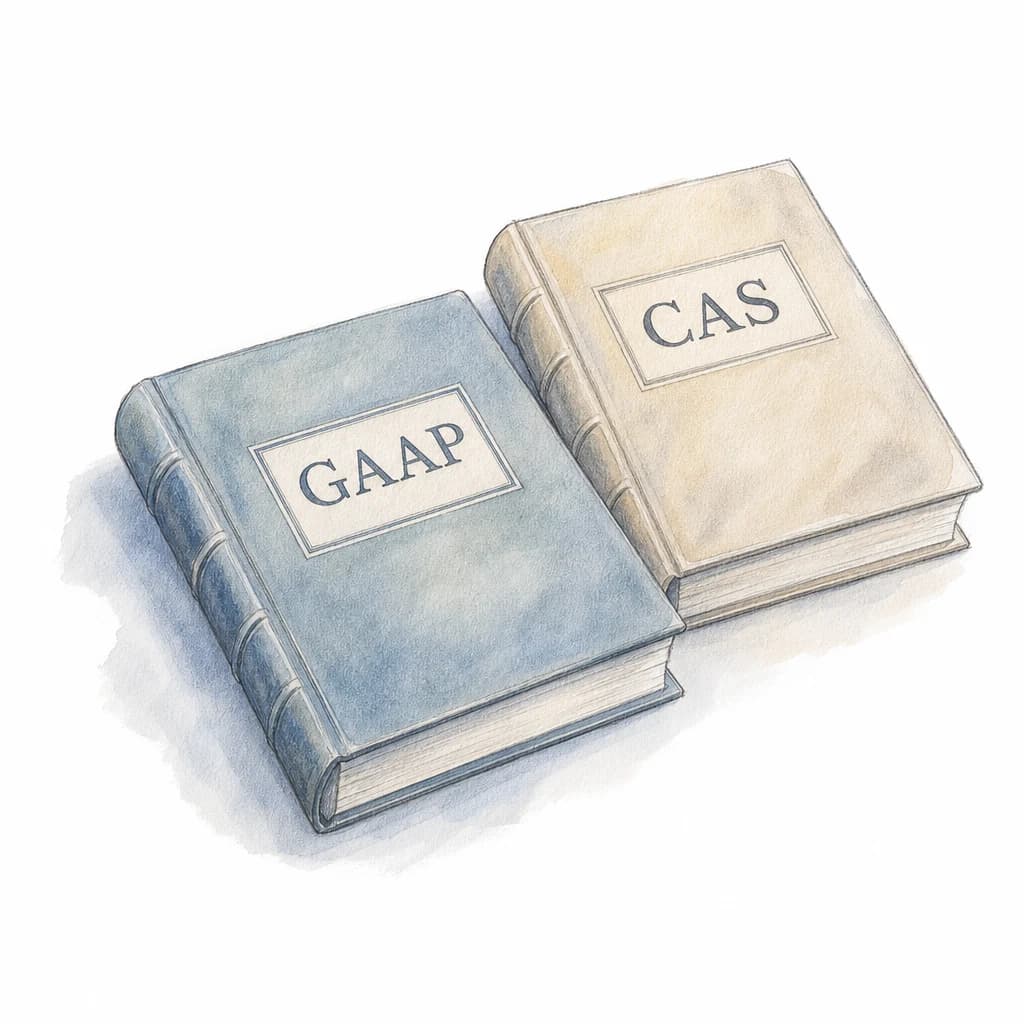
If you've ever managed a government contract, you know the drill: one set of books for your commercial business, and a second, far more invasive set for anything covered by the Cost Accounting Standards (CAS). That dual-system burden may soon be a thing of the past.
On September 15, 2026, the Department of War released a memo titled "Fostering One Strong Industrial Base", directing a sweeping shift away from government-unique accounting rules toward the standard every commercial company already uses: Generally Accepted Accounting Principles (GAAP). Here's what's changing, why it matters, and what it means for your business.
CAS and GAAP: A Quick Primer
GAAP is the accounting framework used across virtually all of corporate America, the rules your finance team already follows for financial statements, audits, and investor reporting. CAS, by contrast, is a government-only overlay: a set of 19 detailed standards governing how contractors allocate and measure costs on covered federal contracts, backed by disclosure statements, business-system reviews, and specialized audits.
For decades, any contractor crossing certain dollar thresholds had to maintain CAS-compliant systems in parallel with their normal GAAP books, essentially running two accounting operations for one business. The memo describes this dual burden bluntly, calling CAS requirements "invasive oversight," according to reporting from Washington Technology.
What the Memo Actually Directs
The memo's language is direct: "The DoW will move from government-unique Cost Accounting Standards (CAS) to the accounting every American company already uses, Generally Accepted Accounting Principles (GAAP), and push those benefits to every tier of the supply chain." It adds that "no new accounting systems or special data formats will be required."
Several concrete actions follow from that commitment:
-
Higher CAS thresholds, effective immediately. The memo directs departments to apply the increased thresholds from Section 1806 of the FY2026 NDAA. As GovWin's analysis explains, "The full CAS coverage threshold is raised from $50M to $100M. The basic CAS applicability threshold (contract-level trigger) is raised from $2.5M to $35M, eliminating the previous $7.5M 'trigger contract' mechanism."
-
A push to make CAS exemption the default, not the exception. The memo commits the Department to submit proposals to the Cost Accounting Standards Board (CASB) within 60 days "to make CAS exemption the default, confine remaining CAS coverage to sole-source, cost-based development or incentive-fee procurement, and ensure CAS applies only to relevant contracts and not companies as a whole."
-
A ban on "shadow CAS." Anticipating that some program offices might try to reimpose CAS-like burdens under a different name, the memo states components must, within 30 days, "prohibit... imposing on exempt awards and other transactions the equivalent of CAS coverage, disclosure, business-system review, or practice-change governance under another name."
-
GAAP as the baseline going forward. The memo directs the Department to formally propose to the CASB "completion of the CAS-to-GAAP conformance begun with the July 8, 2026, final rule, so that GAAP is the baseline and government-unique requirements survive only where cost-based pricing specifically demands them." As the law firm Dentons summarizes, this would make contracts "exempt from CAS by default, applying it primarily to 'cost-based development contracts of major scale awarded without adequate price competition.'"
-
Risk-based audits built on GAAP financials. Rather than duplicating audit work, the memo directs the Department to "consider a contractor's audited GAAP financial statements and internal-control attestations before performing additional work," and bars reopening previously audited years absent evidence of fraud.
Why This Matters for Contractors, Especially Newer Entrants
This isn't just a paperwork simplification; it's aimed squarely at lowering the barrier to entry for companies that have historically avoided defense work because of compliance overhead. As Breaking Defense reports, Deputy Defense Secretary Steven Feinberg framed the shift as accepting "GAAP-based accounting across all contracts to the maximum extent the law permits."
If you're a commercial company that has never built out a dedicated government cost-accounting infrastructure, this materially reduces the cost of entry. If you're an established contractor already running CAS-compliant systems, it means real relief: fewer duplicate audits, fewer standalone disclosure statements, and, per GovWin's coverage, benefits that flow through the entire supply chain, "not only to primes."
What Hasn't Changed Yet
It's worth being clear-eyed here: this is a policy memo directing future action, not a final rule. The actual mechanics (new CAS thresholds, a modernized Disclosure Statement, and the proposed class exemption) still require action by the Cost Accounting Standards Board, an independent body. The memo commits the Department to formally transmit proposals to the CASB, including "a modernized Disclosure Statement, a short certification that contract cost accounting follows the contractor's annual GAAP financial statements, audited by a registered independent public accounting firm... in a machine-readable, versioned electronic submission format." Whether and how quickly the CASB acts on these proposals remains to be seen.
The Bottom Line
For any company doing business with the Department of War, or considering it, this memo signals a real intent to close the gap between commercial and government accounting practice. Watch for the CASB's response to the Department's proposals over the coming months, and if your organization currently maintains parallel CAS and GAAP systems, now is a good time to start evaluating what a GAAP-only compliance posture would look like for your contracts.
Sources: Department of War, "Fostering One Strong Industrial Base" memo, September 15, 2026; GovWin; Washington Technology; Breaking Defense; Dentons.