
CPARS and Past Performance Reference Guide (Sep 2026)

Akash Mandavilli
CEO and Co-Founder of GovEagle
About the author
Akash is a 2x founder with previous experience in AI from Meta and federal sales from IBM. Akash holds a dual-degree from Johns Hopkins University in Economics and Computer Science.
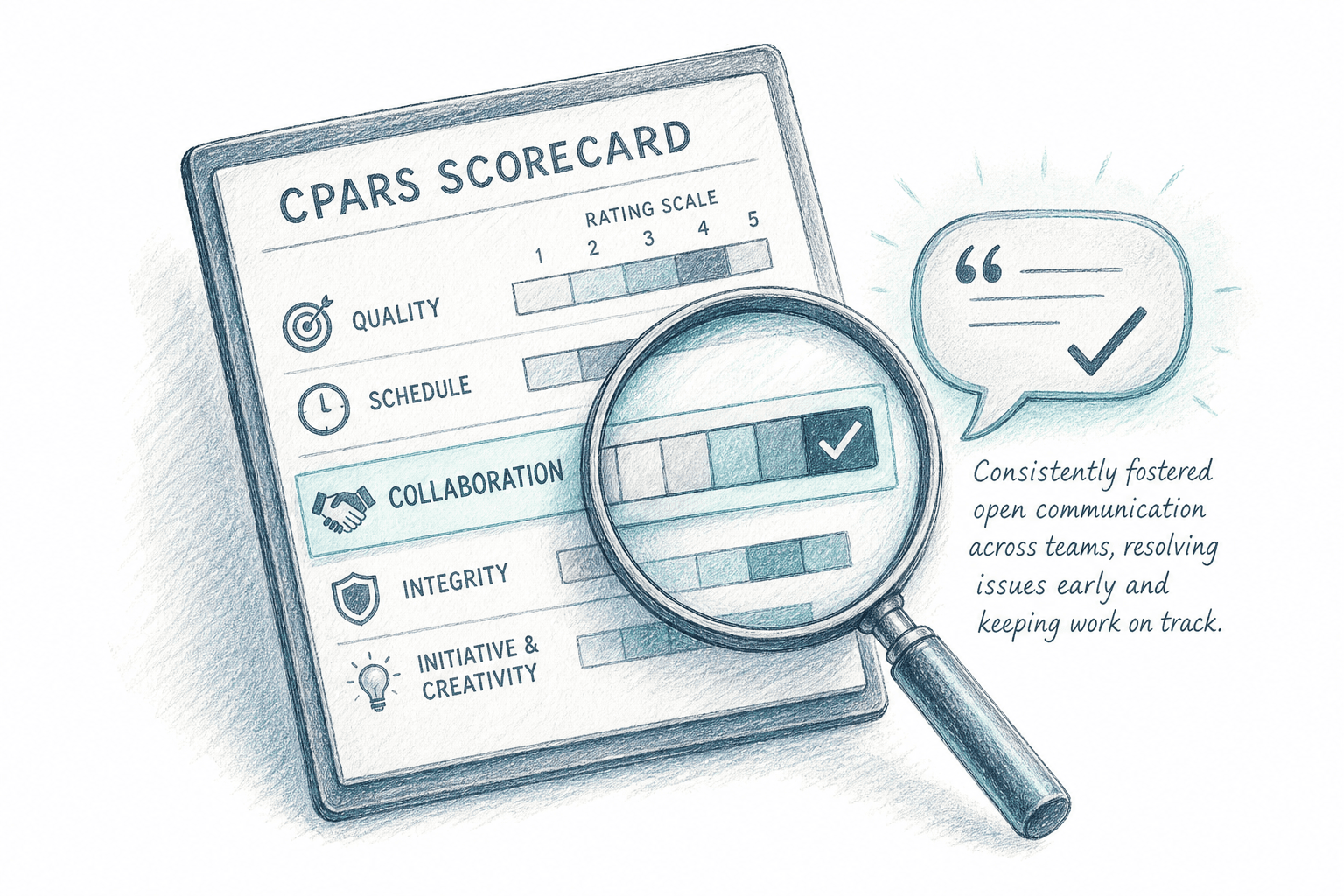
A strong past performance rating on a prior contract doesn't automatically translate into a strong past performance score on your next proposal. What evaluators can quote in a source selection report, and what they have to infer, makes all the difference. If your references aren't built to answer Section M criteria directly, even your best work can read as Satisfactory.
TLDR:
- Past performance typically accounts for 20 to 30% of best-value evaluation scores, making reference selection a scoring decision, not a formality
- Evaluators score CPARS across six dimensions, but narratives carry as much weight as adjectival ratings; a bare "Very Good" with no supporting context gives source selection officials little to quote
- Three tightly scoped, recently completed references that map directly to Section M criteria typically outperform five loosely relevant ones
- Use the FAR 42.1503(d) 14-day comment window on any inaccurate CPARS entry; rebuttals become permanent record and give future evaluators the full picture
- GovEagle's Capability and Gap Analysis cross-matches your contract history against PWS task areas and surfaces relevant past performance references in under a minute
How Evaluators Use Past Performance References in Source Selection
Under FAR 15.305(a)(2), agencies must assess the currency, relevance, source, context, and general trends of past performance information before making a source selection decision. That language matters because it tells you exactly what evaluators are doing: running a forward-looking risk assessment, not checking boxes. The question on the table is whether your firm is likely to perform well on this contract, based on evidence from comparable ones.
Past performance typically accounts for 20 to 30% of the total evaluation score in best-value source selections, making it one of the heaviest weighted factors outside of technical approach. A weak reference, or one that misses the relevance threshold, can drag your overall score even when your technical volume is strong. That risk-assessment framing shapes every downstream decision: which references you submit, how you frame scope and outcomes, and which contracts you invest time documenting before a solicitation ever drops. IBR, a federal contractor that rebuilt its compliance review workflow around GovEagle, found that surfacing the right past performance evidence at the right time was the inflection point for stronger evaluation outcomes. See how they turned AI into their compliance review team.
The CPARS Ecosystem: How the Government Records Your Performance
Roughly 120,000 CPARS evaluations are submitted across federal agencies each year.
The five adjectival ratings are:
- Exceptional
- Very Good
- Satisfactory
- Marginal
- Unsatisfactory
Each reflects an assessing official's judgment against your contractual requirements. There is no automated scoring formula. An official reviews your performance record against deliverables, schedule, quality, and management, then applies a rating based on that assessment. A Satisfactory rating means you met requirements; anything below signals execution risk that source selection officials will weigh against your proposal.
What CPARS Assessing Officials Actually Score
CPARS evaluations cover six standard performance areas: quality of deliverables, schedule adherence, cost control, management, regulatory compliance, and small business subcontracting (applied under FAR 42.1502(g) whenever a subcontracting plan is in place). Each receives its own adjectival rating, but source selection officials read the narratives alongside those labels. A "Very Good" with a compelling supporting narrative typically carries more weight than a bare rating with no context.
That narrative gap is where many contractors lose ground. If your program manager never documented incremental wins during performance, the assessing official is writing from memory at contract close.
FAR 42.1503(d) gives contractors up to 14 calendar days to review, comment on, or rebut a draft evaluation before it finalizes. Teams that treat CPARS management as an ongoing contract discipline, not an end-of-period scramble, consistently produce the documented evidence that earns Exceptional and Very Good ratings.
The Six Rating Dimensions
Where many pursuit teams get tripped up is treating all six dimensions as equally weighted when, in practice, assessing officials often anchor their overall impression on quality and management. Understanding what each dimension actually captures helps program teams know where to focus their documentation efforts throughout performance.
| Dimension | What Assessing Officials Look For |
|---|---|
| Quality of Deliverables | Conformance to requirements, defect rates, acceptance rates on first submission |
| Schedule Adherence | On-time delivery, milestone performance, proactive notification of slippage |
| Cost Control | Burn rate against estimates, variance explanations, cost avoidance actions taken |
| Management | Responsiveness to direction, subcontractor oversight, staffing stability |
| Regulatory Compliance | Labor standards, reporting obligations, adherence to applicable statutory requirements |
| Small Business Subcontracting | Achievement of subcontracting plan goals, utilization of small business concerns, compliance with FAR 42.1502(g); applied when a subcontracting plan is in place |
The narrative fields behind each rating are where contractors either substantiate the label or leave evaluators with nothing to quote in a source selection. Ratings without narrative support give source selection officials little to work with when writing evaluation findings.
The Past Performance Questionnaire (PPQ): When and How It Works
PPQs fill the gap that CPARS leaves open. When a relevant contract lacks a finalized evaluation, falls outside the CPARS-covered period, or involves a commercial client instead of a federal agency, agencies turn to the PPQ to collect structured reference feedback directly from your client contacts.
Section L typically specifies when a PPQ is required, how many to submit, and which reference relationships qualify. Many solicitations also instruct offerors to skip the PPQ for any project that already has a completed, accessible CPARS evaluation, so submitting both for the same work can draw a compliance flag.
A few tactical points that affect whether your references actually come through before the proposal deadline:
- Call your reference before sending the form. A cold PPQ request with no prior conversation often goes ignored until it's too late to follow up.
- Pre-fill every non-evaluative field: contract number, period of performance, dollar value, your firm's role. Reducing the respondent's burden meaningfully increases completion rates.
- Set an internal deadline at least three business days before the proposal due date. Government contacts operate on their own schedules.
- Follow up once, then escalate to a secondary contact if the primary goes dark.
The PPQ response itself becomes a proposal exhibit, so the reference's narrative language matters. Clients who can speak to specific outcomes, dollar values, and scope alignment give evaluators something to quote. Generic praise without context reads as a Satisfactory-equivalent regardless of the checkbox rating your contact selects.
Selecting the Right References for Your Proposal
Reference selection is where many pursuit teams default to prestige over relevance. A $50M IDIQ prime spot looks good on paper, but if the task order scope does not mirror what Section M is asking evaluators to score, it may undercut references that actually fit.
FAR 15.305(a)(2) outlines the four dimensions guiding evaluator judgment: recency, relevance, source credibility, and performance trend. Work your references against all four before committing to a list.
Recency and relevance are the ones teams most often misread. A contract completed six years ago rarely qualifies as recent under most agency standards, even if the work was exceptional. Relevance goes beyond dollar size: scope complexity, technical discipline, and management structure matter more than ceiling value. A $2M task order requiring the exact labor categories and deliverables in the current Performance Work Statement typically scores higher than a $20M contract where your firm handled a peripheral workstream.
FAR 15.305(a)(2)(ii) explicitly allows agencies to consider commercial contracts alongside federal ones, so relevant private-sector work can legitimately fill gaps in federal past performance history for firms still building their government portfolio.
Three tight references consistently outperform five loose ones. Evaluators write findings from what they can quote, and a diffuse list gives them less to work with per entry. This precision matters especially in lowest price technically acceptable evaluations where relevance thresholds are applied strictly. Pick the contracts that map most directly to what Section M evaluation factors name as evaluation criteria, confirm the assessing official or client contact is reachable, and verify the performance period falls within the solicitation's recency window before the reference package goes in.
Writing a Past Performance Reference That Earns High Relevance Marks
Evaluators read past performance write-ups quickly, looking for specific evidence they can quote in a source selection report. Entries that require them to infer relevance, interpret vague outcome descriptions, or calculate unstated metrics often settle into Satisfactory territory regardless of how well the underlying work actually went.
A strong reference write-up covers five elements in sequence:
- Contract identification: contract number, awarding agency, period of performance, and total dollar value
- Scope and role description: what was delivered, your firm's specific position (prime, sub, percentage of work), and the technical disciplines involved
- Quantified performance outcomes: on-time delivery rates, cost variance, defect or acceptance rates, SLA performance, or other contract-specific metrics
- Problem identification and resolution: any execution challenge encountered and the specific corrective action taken
- Relevance bridge to Section M criteria: an explicit statement mapping this contract's scope to the current solicitation's evaluation factors
The relevance bridge is the element teams most consistently omit or underwrite. Evaluators are scoring proposals under time pressure, and a source selection official who has to construct the relevance argument themselves is unlikely to construct it in your favor. Name the specific Section M criterion, then explain which aspect of the referenced contract satisfies it. Two to three sentences done precisely beats a paragraph of implied connection.
Quantified outcomes carry disproportionate weight here. "Delivered all milestones on schedule" is a restatement of Satisfactory-level performance. "Delivered 47 of 47 deliverables on or ahead of schedule across a 24-month base period, with zero accepted defects at first submission" gives an evaluator a quotable finding. Dollar amounts, percentages, and measurable rates anchor the narrative to contractual reality in a way general quality language cannot.
Get GovCon capture and proposal insights in your inbox.
How Teaming and Joint Ventures Affect Past Performance Eligibility
Teaming arrangements change the eligibility calculus in ways that catch firms off guard, particularly when a newer contractor is counting on a partner's record to fill a thin portfolio.
For joint ventures, agencies are required to consider the past performance of each individual JV member when scoring the combined entity's proposal. That rule creates a concrete path for less-experienced firms: structuring the pursuit as a JV instead of a straight prime-sub arrangement means your partner's Exceptional CPARS ratings can count directly toward the evaluation, and no longer sit in a subcontractor narrative that evaluators may or may not weight heavily.
Corporate affiliation does not carry the same benefit. The GAO has consistently held that a parent company, subsidiary, or sister division cannot simply lend its past performance record to a related entity proposing on a contract. The affiliate must have a meaningful role in performing the work for that credit to apply. Listing an affiliate with a strong history while assigning them minimal scope typically fails scrutiny.
Subcontractor past performance sits in a middle position. Under FAR 15.305, contracting officers "should" consider it in appropriate cases, which preserves agency discretion. SBA regulations under 13 C.F.R. 125.2 require consideration when small business subcontractors are named in the proposal, giving that performance record more procedural weight when it is formally identified as opposed to loosely implied.
The practical implication: if a teaming agreement or JV structure is part of your capture strategy, the arrangement's form determines which performance records are evaluable, and that decision should be made before RFP release.
Responding to a Neutral Rating and Contesting Inaccurate CPARS Entries
A neutral past performance rating carries a specific legal meaning under FASA and FAR 15.305(a)(2)(iv): an offeror with no relevant past performance history may not be scored favorably or unfavorably. It is a legal protection, not a disqualification. Newer contractors sometimes treat it as a liability and scramble to submit tangentially relevant references. That often backfires. A neutral rating assessed under the correct standard does less damage than a weak or mismatched reference that invites a Satisfactory or Marginal finding.
For inaccurate or negative CPARS entries, the 14-day comment window under FAR 42.1503(d) is the primary formal remedy available to contractors. Use it. Comments submitted during that window become part of the permanent record, visible to every source selection official who pulls your CPARS history. A well-documented rebuttal that outlines the factual dispute, the corrective actions taken, and the measurable outcomes after resolution gives future evaluators the full picture, instead of leaving a negative entry standing without context.
Tone in that rebuttal matters. Adversarial language signals management risk to evaluators who read the record later. The goal is a documented factual correction, not a dispute on record. State what occurred, what your firm did to resolve it, and what the outcome was. If the assessing official's characterization conflicts with deliverable acceptance records, cite them directly.
Building a Manageable Past Performance Repository for Recurring Pursuits
Proposal teams rarely lose because the past performance wasn't there. They lose because no one could find it fast enough.
A retrievable repository starts with a contract summary sheet for each active and recently completed effort: contract number, awarding agency, period of performance, ceiling and obligated value, your firm's role, and a two to three sentence scope summary. That baseline record should be created at contract award and updated throughout performance, not reconstructed from memory when an RFP drops.
Beyond the summary, the entries worth maintaining on hand include:
- Quantified performance outcomes updated quarterly: delivery rates, acceptance rates, cost variance, and any SLA metrics tracked by the contracting officer
- CPARS narrative excerpts worth quoting directly in a write-up
- Reference contact information verified at least annually
- Commendation letters, award fee determinations, or contracting officer correspondence that documents specific wins during performance
The recurring problem for growing GovCons is that this material sits scattered across a CRM, a SharePoint folder no one maintains, and the institutional memory of two or three senior staff. When an RFP drops with a five-day response window, there is no time to reconstruct it. GovEagle's Capability and Gap Analysis cross-matches your contract history against PWS task areas and surfaces relevant references in under a minute. A shared, consistently structured library built from contract award forward closes that retrieval gap before it becomes a deadline problem (Book a Demo to see how it fits into your capture workflow). Integrating this repository into your capture plan means reference selection decisions get made before RFP release, not under deadline pressure.
How GovEagle Supports Past Performance Reference Management and Proposal Integration
The structural gap described in the preceding sections (scattered documentation, last-minute retrieval, institutional knowledge locked in senior staff's heads) is exactly the capture-to-proposal continuity problem GovEagle is built to close.
GovEagle's Capability and Gap Analysis cross-matches your contract history against the solicitation's PWS task areas and surfaces relevant past performance references in under a minute, including contracts senior leadership may not have immediately recalled. Semantic search lets proposal writers pull past performance narratives, quantified outcomes, and documented wins using natural language queries, bypassing the SharePoint folders that haven't been organized since the last reorg. CRM integrations with Salesforce and HubSpot pull capture intelligence and account history directly into the proposal workspace, so reference selection decisions draw on BD context and work with it, not around it. Precise Software cut SME time on early-stage proposal work by 80% after deploying GovEagle, a result that reflects what happens when past performance retrieval and requirement mapping run in one workflow instead of five disconnected ones.
Final Thoughts on Past Performance References, CPARS, and Proposal Strategy
Evaluators read your past performance volume quickly, looking for specific evidence they can quote in a source selection report, and the firms that give them that evidence win more often. Building a retrievable repository, managing your CPARS record proactively, and selecting references that map directly to Section M criteria are what separate a competitive past performance package from one that just clears the relevance threshold. The work that separates a competitive package from one that merely clears the relevance threshold happens before the RFP drops, not after.
FAQ
How should I choose past performance references for a federal proposal when I have more contracts than slots?
Apply the Section M mapping and recency criteria covered in the reference selection section above. Three tight references that evaluators can quote directly will outperform five loosely relevant ones.
What makes a CPARS narrative earn an Exceptional rating instead of a Very Good?
An Exceptional rating requires documented evidence that goes beyond meeting requirements. Assessing officials look for quantified proof of delivery, such as defect rates, acceptance rates on first submission, or cost avoidance actions, paired with specific examples of proactive problem resolution. Program managers who treat CPARS management as an ongoing contract discipline throughout performance, not a year-end exercise, consistently produce the documented record that supports the higher rating. The 14-day comment window under FAR 42.1503(d) gives contractors a formal mechanism to correct the record before it finalizes if the draft narrative does not reflect that evidence.
How does a joint venture affect which past performance records evaluators will consider?
Agencies are required to consider the past performance of each individual JV member when scoring the combined entity, which means a less-experienced firm can have a partner's Exceptional CPARS ratings count directly toward the evaluation instead of sitting in a subcontractor narrative that evaluators may weight loosely. Corporate affiliates do not carry the same benefit. GAO has consistently held that a parent company or subsidiary cannot simply lend its record to a related entity unless that affiliate has a meaningful role in performing the work. If teaming or JV structure is part of your capture strategy, the arrangement's legal form determines which performance records are assessable, and that decision should be made before RFP release.
Can I submit a past performance questionnaire instead of CPARS for a federal contract reference?
PPQs fill the gap CPARS leaves open: when a relevant contract lacks a finalized evaluation, falls outside the CPARS-covered period, or involves a commercial client in place of a federal agency. Most solicitations instruct offerors to skip the PPQ for any project that already has a completed, accessible CPARS evaluation, so submitting both for the same work can draw a compliance flag. The PPQ response becomes a proposal exhibit, so a reference who can speak to specific outcomes, dollar values, and scope alignment gives evaluators something to quote. Generic praise without context reads as Satisfactory-equivalent regardless of the checkbox rating selected.
What happens to a federal proposal when a contractor has no past performance history at all?
A neutral past performance rating under FASA and FAR 15.305(a)(2)(iv) means the offeror may not be scored favorably or unfavorably; it is a legal protection, not a disqualification. Scrambling to submit tangentially relevant references to avoid a neutral rating often backfires: a weak or mismatched reference that invites a Satisfactory or Marginal finding does more damage than a neutral rating assessed under the correct standard. Newer contractors are better served by letting the neutral rating stand and investing proposal resources in a strong technical volume.