Step-by-Step Federal Capture Planning 2027

Akash Mandavilli
CEO and Co-Founder of GovEagle
About the author
Akash is a 2x founder with previous experience in AI from Meta and federal sales from IBM. Akash holds a dual-degree from Johns Hopkins University in Economics and Computer Science.
If your capture planning mostly means deciding whether to bid two weeks before the RFP drops, you're starting at the point where most of the advantage is already gone. The customer shaping, competitive intelligence, and relationship access that separate winning teams from the field all happen 6 to 18 months out. This is a step-by-step breakdown of how to run that process, and where most pursuit teams get tripped up along the way.
TLDR:
- Capture planning runs from opportunity qualification through RFP release; proposals written without it are written blind to customer priorities and competitive positioning.
- Average GovCon win rates fell in 2026 for the first time since the pandemic, and bidding more volume typically does not reverse that trend.
- Effective capture typically begins 6 to 18 months before RFP release; starting 60 days out closes off the intelligence-gathering and relationship access that move PWin.
- Real win theme discriminators tie a Section M factor to a concrete proof point, not a category description that fits every competitor equally.
- GovEagle's capture workflows connect bid/no-bid analysis, black hat assessments, and CRM-sourced intelligence directly into the proposal workspace.
What Capture Planning Is (And What It Isn't)
Capture planning is the structured pursuit phase that runs from opportunity qualification through RFP release. It is where a contractor decides how to win, beyond the basic question of whether to bid.
Business development casts a wide net, building relationships and surfacing opportunities across agencies. Capture is narrower and more deliberate: it activates once a specific opportunity clears your qualification threshold and focuses entirely on shaping your competitive position before the solicitation drops. Proposal writing comes after. Capture is the work that makes the proposal credible.
Skipping capture and jumping straight to proposal response is common under resource pressure, but a proposal written without capture intelligence is typically written blind to the customer's real priorities, the competitive field, and your own gaps.
Why Capture Planning Determines Win Rates Before the RFP Drops
The reflex when win rates drop is to bid more. It rarely works.
According to Unanet's 2026 GAUGE Report, average win rates across government contracting organizations fell in 2026 for the first time since the pandemic, ending five years of steady increases. The instinct to crank up proposal volume runs directly counter to what the data suggests actually moves win rates: fewer, better-qualified pursuits with stronger pre-RFP positioning.
By the time an RFP drops, the competitive field is largely set. Agencies have spoken with incumbents, industry days have shaped requirements, and evaluators already carry mental models of who can deliver. Contractors who did that relationship and intelligence work during capture enter the proposal phase with real advantages. Those who skipped it are writing into a gap they can't close in 30 days. The Building People, a fast-growing federal facilities contractor, found that when capture and institutional knowledge lived in people's heads rather than a connected system, each leadership transition reset their competitive position from scratch — until they rebuilt the workflow and cut task order response time by 75%.
When to Start Capture Planning
Industry practitioners commonly cite 6 to 18 months before RFP release as the effective capture window, with the right lead time driven by contract size, vehicle type, and whether an incumbent is already entrenched.
Large, complex requirements need the full runway. A recompete on a $200M IDIQ task order, where the incumbent has years of performance data and deep agency relationships, requires visible customer engagement well before the draft RFP surfaces. Smaller opportunities may compress that window, but rarely below six months if meaningful positioning is the goal.
The most costly mistake in pursuit execution is a late start. When capture begins 60 days before RFP release, most intelligence-gathering, relationship access, and solution shaping opportunities have typically already closed.
How to Qualify the Opportunity Before Building the Plan
Not every opportunity worth tracking is worth pursuing. The bid/no-bid decision gate exists to filter out pursuits where the math is bad before your team spends weeks building a capture plan.
Five factors typically anchor that decision:
- Agency relationship depth: Has your team had meaningful touchpoints with the contracting officer or program office? Awareness of your firm is a baseline; access and credibility move PWin.
- Past performance alignment: Can you point to two or three contracts with directly comparable scope, complexity, and agency type? Thin past performance is a structural gap evaluators will score against.
- Competitive positioning: Is there an incumbent, and how entrenched are they? Who else is likely bidding, and where do you sit relative to them on capability and price?
- Contract vehicle access: Is the solicitation restricted to a vehicle you already hold? If not, teaming to gain access is possible, but it adds complexity and changes your pricing position.
- Pricing headroom: Given known labor rates, overhead, and competitive benchmarks, can you propose compliantly at a price that wins?
No single factor disqualifies a pursuit on its own. When two or more point in the same direction, the bid/no-bid call usually makes itself. The goal at this gate is a clear-eyed PWin read, not optimism.
How to Build Your Capture Team
Capture efforts fail less often from bad intelligence than from unclear ownership. When no one is accountable for moving findings forward, insights stall in meeting notes and CRM fields that proposal teams never open.
The core roles on a capture team:
- Capture manager: owns the pursuit strategy, drives gate decisions, and is accountable for PWin throughout the pre-RFP phase
- BD lead: holds the agency relationship and is the primary source of customer intelligence on priorities, pain points, and evaluator dynamics
- Proposal manager: enters capture early to flag compliance and structural requirements before the RFP drops, not after
- Pricing lead: develops the price-to-win position in parallel with the technical approach, not as a last-minute cost-volume exercise
Small teams often collapse several of these roles into one or two people. That works if the accountability is explicit. What breaks capture is diffuse ownership, where everyone assumes someone else is synthesizing the intelligence and nobody is.
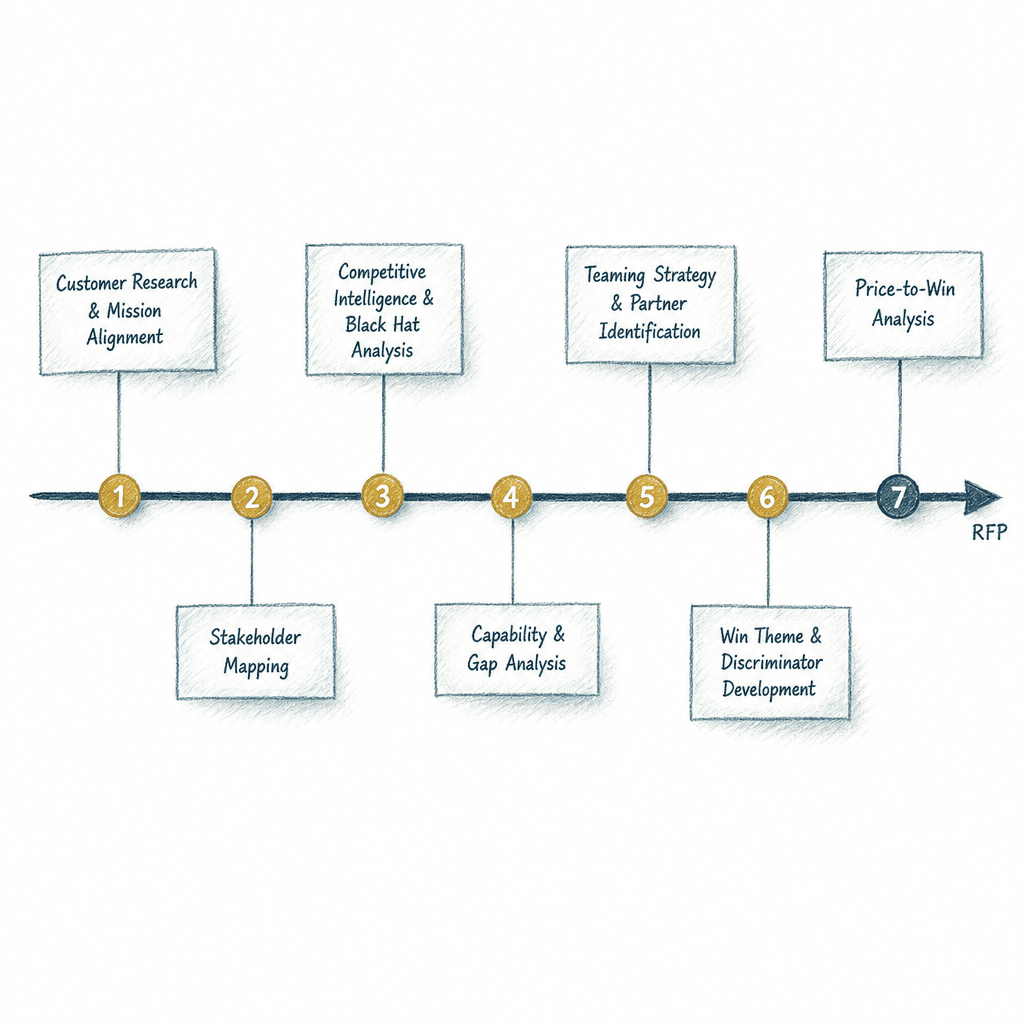
Step-by-Step: The Seven Core Stages of a Federal Capture Plan
These seven stages form the working sequence of a federal capture plan. In practice, they overlap and loop back as new intelligence arrives.
| Stage | Focus | Key Output |
|---|---|---|
| 1. Customer Research & Mission Alignment | Map the agency's stated priorities, budget trends, and program history | Agency priority profile and requirements baseline |
| 2. Stakeholder Mapping | Identify the CO, program manager, end users, and influencers who shape requirements | Stakeholder influence map with engagement approach per node |
| 3. Competitive Intelligence & Black Hat Analysis | Assess who is likely bidding, how the incumbent will position, and where each competitor is vulnerable | Competitor positioning map; ghosting inputs for technical approach |
| 4. Capability & Gap Analysis | Cross-match your past performance against the requirement | Gap register driving teaming decisions |
| 5. Teaming Strategy & Partner Identification | Fill capability or set-aside gaps with partners whose past performance and pricing complement yours | Teaming agreements; workshare and exclusivity terms |
| 6. Win Theme & Discriminator Development | Synthesize customer intelligence and competitive findings into two or three evaluator-relevant themes | Discriminators tied to specific Section M factors with proof points |
| 7. Price-to-Win Analysis | Build a competitive pricing position from known labor benchmarks and contract history | PTW position informing the cost volume before drafting begins |
How to Conduct Customer Research and Map Stakeholders
Customer research pulls from sources most teams underuse. USASpending.gov and FPDS reveal prior award history, contract scope, and incumbents. Sources-sought responses and RFI submissions give you a formal channel to signal capability while learning which requirements the agency is still shaping. Industry days, when attended with prepared questions, often surface more than the official transcript shows.
Stakeholder mapping goes beyond the contracting officer. Program managers and end users shape requirements upstream of the SSEB. Identify who owns the mission problem, who controls the budget, and who will live with the contractor's performance. Each node requires a different engagement approach and yields different intelligence.
Where most teams fall short: they map stakeholders by title, not by influence. A deputy program manager who has run a requirement for three years often carries more evaluator weight than the CO of record. Capture intelligence that only tracks official roles misses where decisions are actually forming.
Competitive Intelligence and Black Hat Analysis in Capture
Competitive assessment during capture starts with a simple question: how will each likely competitor position itself, and where does that positioning create an opening for you?
Black hat analysis structures that question into a working process. For each probable bidder, the capture team steps into that competitor's shoes and drafts the win themes they would likely advance, the past performance they would surface, and the agency relationships they would reference. The output is a positioning map, not a threat assessment.
What you learn drives ghosting decisions in the technical approach. If the incumbent leads with low-risk continuity, your differentiators need to reframe continuity as complacency. If a large prime leans on scale, your approach may ghost that by showing execution agility. Black hat findings should be traceable, section by section, into how your proposal is structured.
How to Develop Win Themes and Discriminators
Win themes and discriminators written at Pink Team are almost always generic. Under drafting pressure, "proven past performance" or "mission-focused delivery" fills the gap. Those phrases describe most competitors equally well and score nothing.
A real discriminator connects a Section M factor to a concrete proof point: not "deep cybersecurity experience" but "three consecutive FISMA High ATO certifications supporting HHS data systems, directly matching the PWS requirement for FISMA High compliance." The first is a category. The second is a discriminator.
Win themes developed during capture reflect what the customer actually cares about, going beyond what the RFP states they care about. Customer conversations, industry day feedback, and prior award patterns often reveal priority gaps between stated evaluation criteria and what the program office is anxious about. A capture team that catches a program manager's concern about transition risk can build a win theme around continuity of key personnel before the RFP formalizes it as an evaluation factor.
Each theme should clear three bars: it is true, it is relevant to a specific Section M criterion, and it is difficult for the likely field to match.
Teaming Strategy: Set-Asides, Partners, and Joint Ventures
Teaming decisions made the week before proposal submission are almost never good ones. The partner pulled in at the last minute hasn't been briefed on the customer, doesn't have a draft past performance write-up ready, and almost certainly hasn't aligned on price.
Set-aside designations are the first forcing function. If the solicitation is restricted to HUBZone, WOSB, or SDVOSB firms and you don't hold that status, your path to prime is closed. Set-aside analysis happens at qualification, not after six weeks of capture investment.
Beyond status requirements, teaming fills two distinct gaps: capability and credibility. A capability gap surfaces when your past performance doesn't cover a meaningful task area in the PWS. A credibility gap is subtler: you may have the technical depth but lack a contract reference an evaluator would recognize as directly relevant. Evaluators flag arrangements where the sub's scope is thin or the teaming agreement reads as a compliance vehicle and not a genuine delivery structure.
Mentor-protégé arrangements deserve separate consideration. They carry SBA program obligations and timeline requirements that don't fit a single-pursuit teaming strategy, but for firms building long-term agency positioning in a specific domain, the joint venture option they unlock can affect pricing and set-aside eligibility in material ways.
Whatever the structure, the teaming agreement itself becomes a capture artifact. Letter of intent timing, workshare commitments, and exclusivity terms all shape your competitive posture before a word of the proposal is written.
Common Capture Planning Mistakes to Avoid
Five mistakes show up repeatedly across otherwise competent pursuit teams.
- Starting after RFP release. At that point, customer shaping is over and you're writing to stated requirements with no ability to influence them.
- Mistaking relationship activity for capture intelligence. Attending industry days and exchanging emails is not capture. Intelligence is specific: what the program office is anxious about, who the evaluators are, what the incumbent did wrong.
- Letting capture documents go stale. A capture plan built six months ago that hasn't been updated since the draft RFP dropped carries false assumptions into the proposal.
- Freezing PWin at the initial gate read. A teaming announcement from a large prime, a protest on the predecessor contract, or a budget realignment all change your position and should trigger a reassessment.
- Leaving capture artifacts in the CRM. Win themes documented in Salesforce opportunity notes rarely reach the proposal team in usable form, so proposal writers reconstruct strategy from scratch under deadline pressure, which is exactly the continuity failure that undermines win rates at execution.
How AI Is Changing Capture Planning for GovCon Teams
AI accelerates the mechanical work of capture without replacing the judgment that makes capture valuable.
The highest-impact applications cluster around tasks that are time-consuming but not strategically complex: synthesizing prior award history from USASpending, drafting initial competitive positioning summaries, generating first-pass capture deck content from RFP sections and known past performance, and flagging gaps between your capability profile and PWS task areas. AI can compress hours into minutes in these areas, freeing capture leads to spend more time on customer engagement and competitive strategy, which is the work that actually moves PWin. Teams looking to build this into a connected pursuit workflow can review GovEagle's BD and capture solution.
Where teams get into trouble is treating AI-generated outputs as finished intelligence. A competitive positioning summary built from public data tells you what a competitor has won, not how they're positioning for this specific requirement or what relationships they're actively using. That last layer requires human judgment and direct customer access.
For price-to-win modeling, AI can surface labor category benchmarks and historical contract pricing faster than manual research, but the defensible PTW position still depends on your read of the competitive field and the program office's cost sensitivity. AI-generated inputs accelerate the analysis; they don't replace the analyst.
The practical frame: AI is worth deploying in capture when it removes mechanical bottlenecks that delay the strategic work. A capture team still running on manual document assembly and keyword-based opportunity searches is spending cognitive budget on the wrong problems.
How GovEagle Supports the Full Capture-to-Proposal Workflow
GovEagle's BD and capture workflows are built around that continuity gap. The capture module populates capture decks directly from RFP sections and your knowledge base, and CRM integrations with Salesforce and HubSpot route capture notes, win themes, and account intelligence directly into the proposal workspace, so teams enter drafting with capture context already in place instead of reconstructing it under deadline pressure. The black hat analysis workflow guides teams through competitor positioning assessments and feeds findings into win theme development, while bid/no-bid analysis pulls in past performance data and competitive intelligence to support PWin reads earlier in the pursuit cycle. If your team is losing capture artifacts to CRM silos before they reach the proposal workspace, Book a Demo to see how GovEagle's capture deck automation closes that gap.
Teams running this connected workflow typically report faster proposal prep. For teams handling CUI, GovEagle holds full FedRAMP Authorization, listed on the FedRAMP Marketplace, so agencies can verify the security posture directly.
Final Thoughts on Federal Capture Planning and Win Rate Improvement
Capture is the work that makes your proposal credible. Starting early, qualifying the right opportunities, and getting win themes and competitive intelligence into the hands of your proposal team before the RFP drops is what separates a strong submission from a reactive one. Teams that build that continuity from bid/no-bid through to drafting consistently enter the proposal phase with a stronger position than those reconstructing strategy under deadline pressure.
FAQ
What does effective capture planning for federal contracts actually look like 6 to 18 months before an RFP drops?
Effective capture planning at that stage focuses on four parallel tracks: customer intelligence gathering (agency priorities, budget trends, program history), stakeholder mapping beyond the contracting officer to program managers and end users, competitive positioning through black hat analysis of likely bidders, and capability gap assessment against the expected PWS task areas. The goal is to enter the proposal phase with win themes already grounded in what the program office is anxious about, not reconstructed from the RFP after it drops.
How do I benchmark my win rate against industry averages for GovCon pursuits?
The 2026 GAUGE benchmarking report, cited by Federal News Network, tracks win rates across government contracting organizations and found average rates declined in 2026 for the first time since the pandemic, signaling that higher bid volume alone does not move win rates. The more reliable lever is pursuit qualification: fewer, better-qualified bids with stronger pre-RFP positioning typically outperform higher-volume approaches where capture investment is spread thin.
GovEagle vs. manual capture planning workflow for federal contract pursuit?
A manual workflow typically leaves capture intelligence in CRM notes and capture decks that proposal teams never open under deadline pressure, forcing writers to reconstruct win themes and competitive positioning from scratch. GovEagle connects capture artifacts (win themes, black hat findings, bid/no-bid analysis, CRM data from Salesforce or HubSpot) directly to the proposal workspace, so the intelligence gathered during capture shapes the draft instead of sitting in a system nobody opens at RFP release.
Can a small GovCon firm run a structured capture process without a dedicated capture team?
Yes, though it requires explicit role accountability over a full headcount. The core functions (pursuit strategy ownership, agency relationship management, compliance flagging, and price-to-win development) can be distributed across one or two people provided each responsibility has a named owner. A shared capture tracker with weekly owner check-ins is the most reliable way to keep the plan current and prevent stale assumptions from carrying into the proposal phase.
How do I develop win themes that actually score during federal proposal evaluation?
A scoring win theme connects a specific Section M evaluation factor to a concrete, verifiable proof point: for example, five years of continuous DISA Impact Level 5 system operations, not a vague category like "cloud experience." Each theme should meet three tests: it is factually true about your firm, it maps to a stated Section M criterion, and it is difficult for the likely competitive field to match. Themes built during capture from direct customer engagement and competitive analysis consistently outperform themes drafted under Pink Team pressure.