
Use-It-or-Lose-It Season: The 12 Weeks and 4 People Who Decide If Your Deal Gets Signed

Akash Mandavilli
CEO and Co-Founder of GovEagle
About the author
Akash is a 2x founder with previous experience in AI from Meta and federal sales from IBM. Akash holds a dual-degree from Johns Hopkins University in Economics and Computer Science.
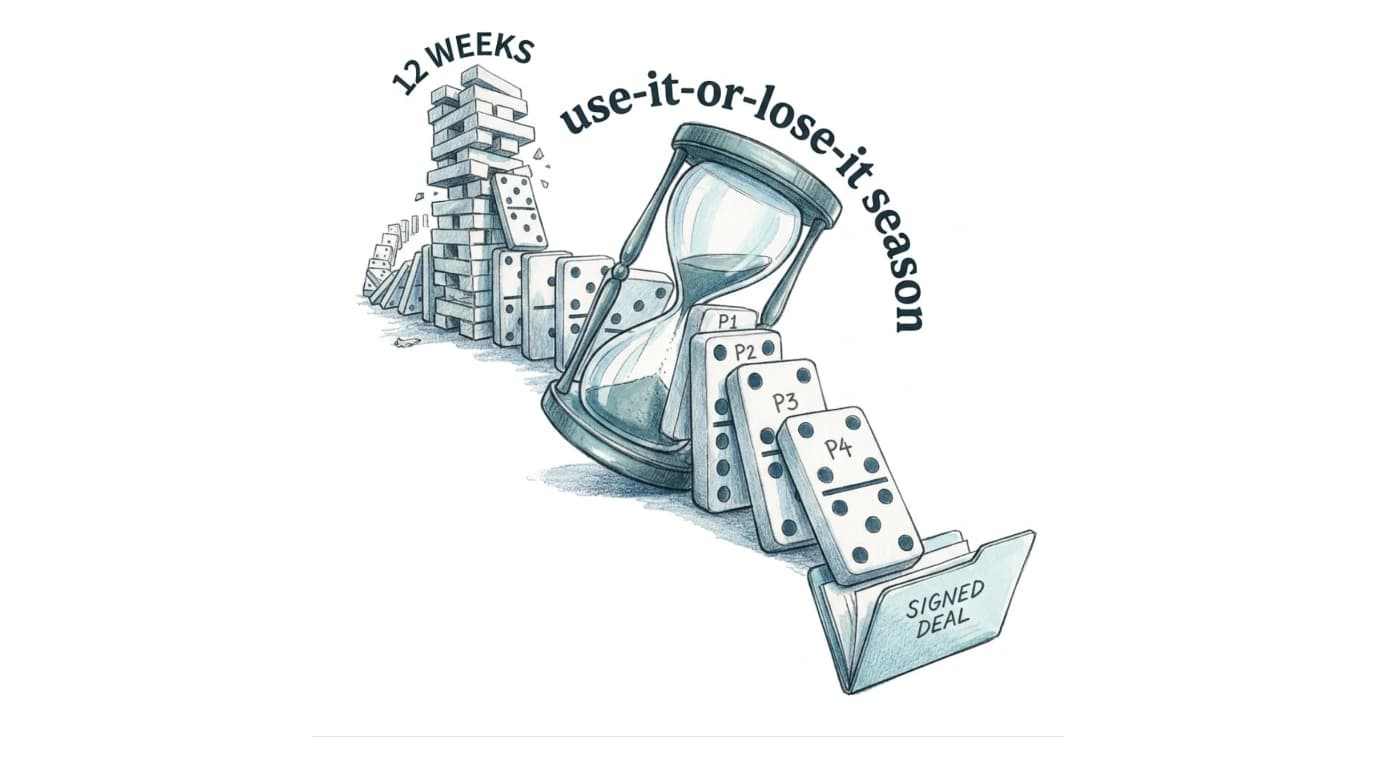
Every close-out season looks the same on paper. We know the money disappears October 1.
Yet every year, some of it still goes unspent. Why?
It's not because agencies don't want to spend it, and it's not because they don't need the products or services the budget earmarked to accomplish.
Budget goes unspent because there wasn't enough time to find a deal that fit the requirements.
Fix that problem with a streamlined, right-sized, well-defined deal, and you'll win work and the thanks of a very stretched customer staring down an impossible deadline.
TLDR:
- Your customer wants the money obligated but usually can't get it scoped in time, offer to help scope it.
- Your on-site contact can tell you what's stuck and where a program stands against its obligation target.
- The CO signs everything, but you rarely talk to them directly, make the package that reaches them lighter instead.
- The comptroller shop wants a defensible number, not a rushed one, give them something clean.
Your agency customer: ask this before you pitch anything
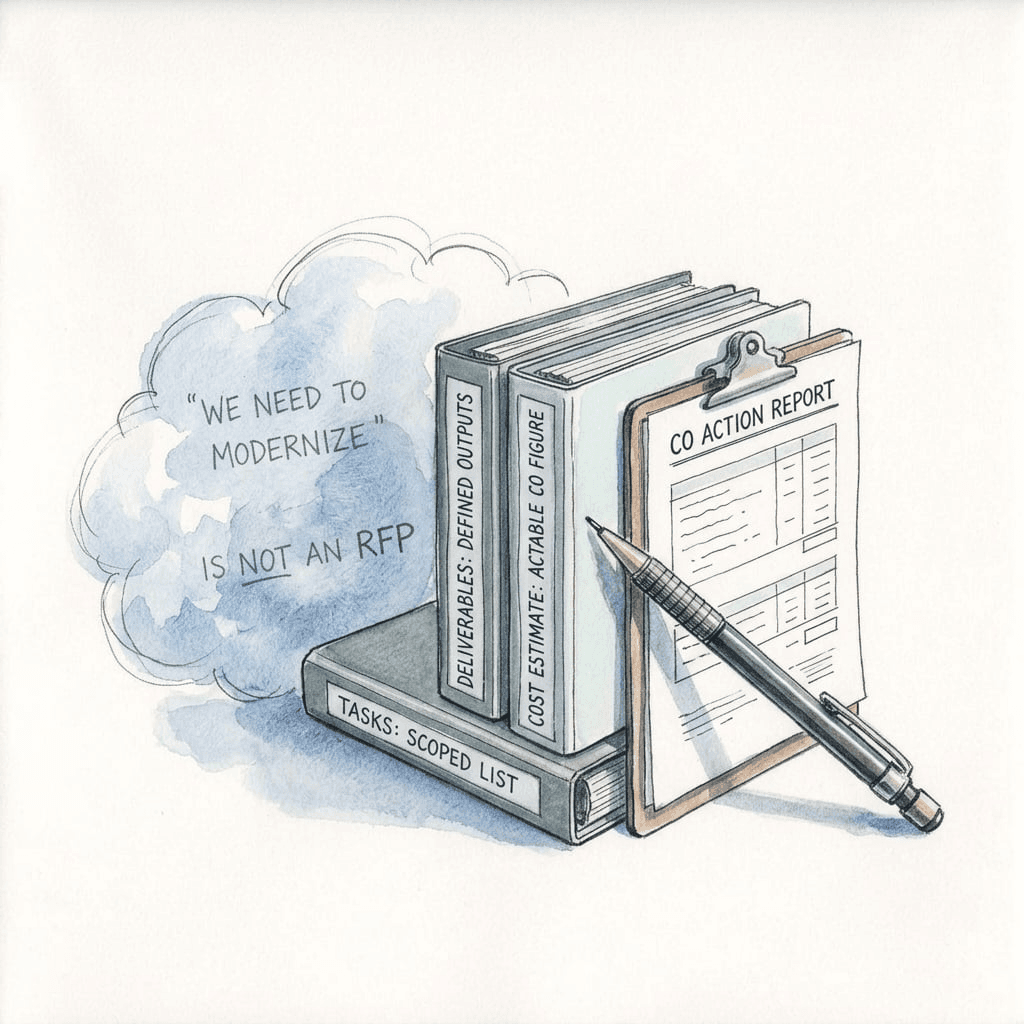
Your agency customer owns the requirement and wants the money obligated before it disappears. But there is often a scoping gap. It looks like this: "we should modernize this" is aspirational, but it's not an RFP.
It needs to be scoped into tasks, deliverables, and a cost estimate a CO can act on.
It doesn't help that program offices thin out every August, right when that work needs to happen most.
What to ask and how to help
Ask them: Is there a piece of what you want that's small enough to scope and award before September 30?
Help them: offer a rough SOW or PWS draft, or an independent cost estimate they can use internally.
This is standard market-research engagement under FAR 15.201. If there's no existing effort to attach to, an unsolicited proposal under FAR Subpart 15.6 is the formal path. And if you're already on a usable vehicle, IDIQ, BPA, schedule, say so; skipping a new competition is often the single biggest time saver in the deal.
One caveat: on larger actions, helping scope a requirement and then bidding the resulting competitive contract can raise an organizational conflict of interest question under FAR Subpart 9.5. Loop your contracts or legal team in before you offer, not after.
How GovEagle helps: our BD & Capture tooling brings agency signals, incumbent context, and scoping gaps into one view, so you can see this picture before a requirement ever turns into an RFP.
Your insider: ask this if you have people on-site
If you have staff or connections embedded with the agency, ask them to help you identify org and spending pressure.
Ask them if they have seen farewell emails or Slack messages from people changing roles or leaving the company. Any colleagues with changes to their LinkedIn profiles?
Do this: Follow your customers' social media. They'll announce top-level reassignments. You should also create a list of key influencers and monitor their LinkedIn for change.
ProTip: Orange Slices includes a section on career moves in the industry. Keep an eye on that.
No one on-site? Your fallback is your customer contact directly, or a prime or systems integrator you're teamed with who has people there.
The CO: do this to make their workload lighter
The contracting officer holds sole legal authority to obligate the money. Close-out season doesn't add more of them, every program racing to spend before September 30 routes through the same small pool, and the agency doesn't staff up to match the surge. Volume goes up, headcount doesn't; that mismatch is the real Q4 bottleneck.
You're rarely talking to the CO directly this early. The leverage is what shows up on their desk by way of the program office.
Do this:
- Hand over a scope already broken into clean, awardable tasks, not something they have to send back for rework.
- Back the price with a real independent cost estimate, so there's nothing to renegotiate.
- Name a usable vehicle up front, IDIQ, BPA, schedule, instead of leaving them to find one.
- Answer questions fast and completely, don't make them chase you.
- Have past performance references and socioeconomic documentation ready, not something they have to request.
None of this is required of you, and most companies don't bother. Program offices are often structurally short on the people who'd normally build this package, the contracting specialist, the cost analyst, and in close-out season there's rarely time to backfill that internally. A contractor willing to do that work is filling a real capacity gap. That's the differentiator: not the loudest bidder, the one who made the agency's job easier right when their bandwidth ran out.
How GovEagle helps: Knowledge Management keeps your past performance and proposal history indexed, so pulling together what a CO needs doesn't mean starting from scratch under deadline.
Get GovCon capture and proposal insights in your inbox.
The comptroller: give them a number they can defend
This office tracks which funds expire and when, often before the program office catches up, and they're the ones who answer for the number if it comes in bad. That puts them in a bind at close-out: they want the money to move, but not sloppily. A rushed, thinly justified award invites exactly the audit or IG attention that makes "we spent it" look worse than "we didn't."
Give them: a scoped, justified, ready-to-award package, so they have a number they can report with confidence instead of a story to defend. A clean scope also lowers protest risk, and a protest is the fastest way to blow past September 30 with the money still unobligated. If you have any relationship here, it's worth knowing early where the money is stuck, since they'll usually see it before it becomes public.
Proof it works
A capture lead we work with walked into exactly this kind of scoping gap on a $5M deal. The agency wanted the full buy but couldn't get it scoped and competed in time.
Rather than wait for that to resolve itself, the team offered the piece that could be scoped and funded right now, the upfront engineering work, and left the bigger contract for later. The agency spent instead of losing the money, they were closer to having something they needed, and the team was still in the room when the follow-on came up.
The same team has done this at a smaller scale too: a $500K effort, funded with end-of-year money, that became the foundation for a larger contract down the line. Same pattern, different size. Not a bigger pitch, a smaller, fundable first step.
Bonus: what to do about it in your own Q4
Here's the catch: your calendar Q4 (October through December) is the government's Q1, the slowest stretch of their year. If you don't already have the contacts or capabilities this post assumes, that quiet window is exactly when to build them, so you're ready the next time federal close-out rolls around:
- Get on a usable vehicle now. IDIQ, BPA, or schedule applications take months. If you don't have one, this is the quarter to start, not next June.
- Build relationships before the rush, not during it. Program offices, comptroller shops, and OSDBU staff have real bandwidth in the fall. Industry days and small business events are easier to get real conversations out of when nobody's racing a deadline.
- Template the above-and-beyond work. A reusable SOW/PWS framework and a cost estimate methodology you can adapt quickly are worth building when you have time to do them well, not when you're up against September 30.
- Keep your registrations and documentation current. SAM registration, past performance references, and socioeconomic certifications should be ready to hand over the moment someone asks, not something you scramble to assemble in August.
- Track which of your target agencies actually behave this way. Not every agency or program surges the same amount. A quick look at award timing from this year tells you where to focus next year's close-out push.
How GovEagle helps: the same BD & Capture view that surfaces agency signals in season is what lets you track, going into next year, which of your target agencies actually behave this way.
None of this pays off immediately. It pays off next July, when you're the contractor who already has the relationship, the vehicle, and the template ready, instead of the one starting from zero.
A printable, quick-reference version of everything above, organized by who you're talking to.
Download the PDF →Book a demo →