
How to Accelerate Time to Pink Team Review in 2026: Best Practices for GovCon Proposals

Akash Mandavilli
CEO and Co-Founder of GovEagle
About the author
Akash is a 2x founder with previous experience in AI from Meta and federal sales from IBM. Akash holds a dual-degree from Johns Hopkins University in Economics and Computer Science.
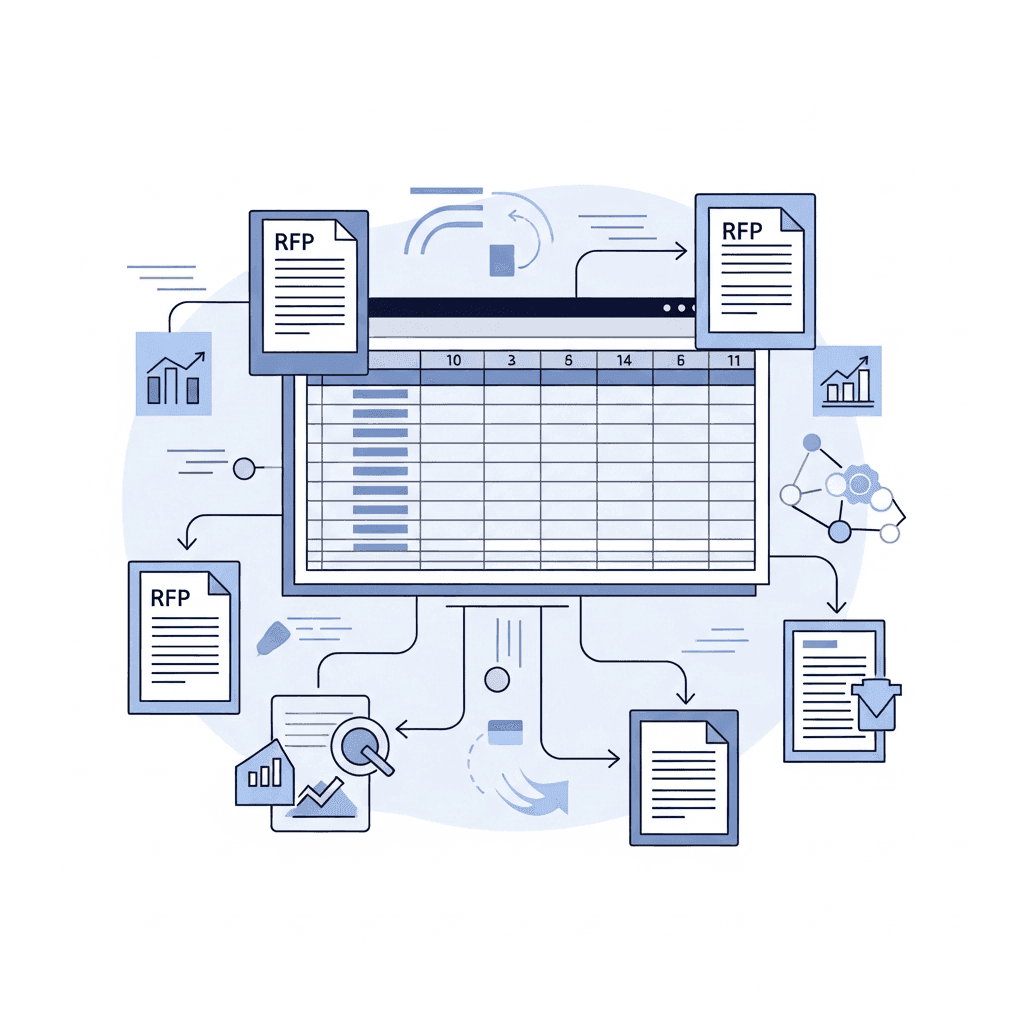
You schedule Pink Team around the midpoint of your proposal timeline like you’re supposed to, then watch it slip when compliance matrices and annotated outlines consume the first third of the timeline. The issue isn’t the review itself, it’s the front-end lift that delays drafting and compresses everything that follows. Teams that consistently accelerate time to Pink Team reduce that setup from days into hours, giving writers a real starting point when the schedule calls for it. The difference comes down to how quickly you can move from RFP release to a structured, compliant draft using the right proposal development workflow.
TLDR:
- Pink Team reviews early in the proposal timeline catch misalignment before full drafting begins, reducing rework at Red Team.
- AI-generated compliance matrices cut setup from 2-3 days to minutes, allowing writers to start immediately.
- Automated annotated outlines map RFP requirements to sections, eliminating blank-page starts for writers.
- Centralized content retrieval improves draft maturity, helping teams reach Pink Team with 60-70% complete sections.
- An AI-driven proposal workflow helps teams reach Pink Team 30-40% faster by automating matrices, outlines, and first drafts.
Understanding Pink Team Reviews in Government Contracting Proposals
A Pink Team review is a structured proposal checkpoint that typically happens early in the proposal timeline, once an initial outline or partial draft is ready for evaluation. At that stage, the proposal team presents an early draft or outline for evaluation against the solicitation's requirements, win themes, and overall strategy.
The goal is a gut check, not a polished draft. Has the team interpreted the RFP correctly? Are the win themes compelling? Is the structure compliant with Sections L and M? Catching misalignment here costs a fraction of what it costs at Red Team.
Why Timing Matters
For services-focused GovCon firms, this checkpoint carries extra weight. Tight timelines on federal services proposals leave little margin for a late course correction.
- If your Pink Team review gets pushed back, every downstream color team review compresses in turn, leaving Red Team and Gold Team reviewers less time to catch weaknesses before submission.
- A delayed Pink Team often means evaluators receive incomplete sections, forcing rushed or partial feedback that misses compliance gaps.
- Quality suffers across the board when the review schedule slips, particularly on proposals with multiple volumes.
Build a Compliant Proposal Outline Faster
The outline is where proposals are won or lost before a single paragraph gets written. If your structure doesn't marry Section L's instructions with Section M's evaluation criteria from the start, writers work in the wrong direction and you pay for it at every review.
Most teams build outlines manually, pulling requirements from the RFP into a structured outline document and mapping them section by section. That process alone can eat two to three days on a complex solicitation.
What a Strong Annotated Outline Does
A well-built annotated outline does more than list section headers. It maps every RFP requirement to a specific location in the proposal, surfaces relevant past content, and gives writers a head start so they aren't starting from a blank page.
- Writers know exactly what to cover in each section, reducing back-and-forth with the proposal manager during the draft phase.
- Compliance gaps surface before drafting begins, so your Pink Team reviewers are reviewing strategy and narrative quality instead of catching missing requirements.
- Proposal managers can assign sections and set expectations right away, without a separate kickoff step eating another day off the schedule.
Getting this right early is what separates teams that reach Pink Team on schedule from those still reorganizing sections the night before.
Automate Compliance Matrix Generation to Save Critical Hours
The compliance matrix is the backbone of any government proposal, mapping every RFP requirement to a corresponding section in your response. Without one, you are writing blind.
Building one manually means reading through every page of the solicitation, extracting requirements line by line, tagging each one to a proposal section, and formatting everything into a compliance matrix. On a complex federal RFP, that process runs 10 to 18 hours, roughly one to two full working days within the proposal timeline before a single word of proposal content gets drafted.
When a proposal manager spends multiple days on matrix development, Pink Team either slips or the team rushes into drafting without a solid structure underneath them.
How AI Cuts Matrix Build Time
Automation changes that math considerably. GovEagle generates compliance matrices in minutes, pulling requirements from Sections L and M, along with relevant scope sections, into an Excel-ready output that mirrors how a human would build it. Proposal managers can start assigning sections, and writers can get to work the same day the RFP drops.
Optimize Your Proposal Schedule to Reach Pink Team Earlier
Scheduling a Pink Team review sounds straightforward until you map it against a real proposal calendar. The review should fall early enough in the proposal period to validate structure and compliance before full drafting is complete, which means working backwards from submission to calculate how much time compliance matrix work, outline development, and early drafting actually consume.
Most teams underestimate those front-end tasks. They plan Pink Team at the right time on paper, then spend the first third of the schedule on matrix and outline work and arrive at the review with incomplete sections.
The fix is building your schedule in reverse. Start from your Pink Team date, not your submission date, and block time for each prerequisite task explicitly:
- Compliance matrix: roughly 1 day with automation, compared to 2 to 3 days done manually
- Annotated outline: can be completed the same day as the matrix if your tools handle both together
- Initial draft: 3 to 5 days depending on volume count and page limits
| Proposal Task | Manual Approach | GovEagle AI-Assisted | Time Saved |
|---|---|---|---|
| Compliance Matrix | 10 to 18 hours reading the RFP line by line and tagging requirements to sections in a spreadsheet | Generated in minutes from Sections L and M, along with relevant scope sections; exported directly to Excel in your existing template | Up to 2 days recovered before drafting begins |
| Annotated Outline | Half a day to a full day building section headers and mapping requirements manually in Word | Populated in Word the same day as the matrix, with relevant past content surfaced per section | Same-day outline ready for writer assignment |
| Initial Draft | 3 to 5 days of blank-page writing, often without reusable content readily available | First drafts generated from your past performance library in your organization's voice within hours | 30 to 40% faster overall proposal prep |
| SME Involvement | Senior staff pulled into early-stage writing and boilerplate sections, consuming limited SME availability during the proposal period | SMEs review structured drafts instead of writing from scratch, reserved for strategy and accuracy | Significant reduction in SME time on early-stage work (see body for sourced figure) |
| Pink Team Readiness | Reviews can often arrive with sections that are only partially complete due to compressed front-end setup | Teams can often reach Pink Team with substantially more complete sections and a compliant draft in hand | Meaningful review instead of a status check on incomplete work |
Cutting front-end setup time is what creates breathing room for a prepared, on-schedule review.
Get GovCon capture and proposal insights in your inbox.
Use Past Performance Libraries for Rapid Content Assembly
When writers spend the first days of a proposal period hunting through SharePoint folders, email threads, and shared drives for relevant past performance, that time compounds fast. A team that cannot find its own best content is effectively starting from scratch on every bid.
The difference between a 30% complete Pink Team draft and a 60-70% complete one often comes down to how accessible your past performance and proposal content is. Organized libraries of past technical approaches, management narratives, and boilerplate sections let writers pull proven content and adapt it instead of writing from zero.
Semantic search changes how proposal teams retrieve past performance content. Instead of knowing exactly which folder holds a specific past proposal, writers can search by concept and pull relevant sections in seconds. GovEagle indexes content from SharePoint, Box, Google Drive, and similar repositories without requiring any file migration, so your existing library becomes immediately usable the day you start a new pursuit.
Reduce SME Bottlenecks During Early-Stage Proposal Development
SMEs are your sharpest strategic asset, but most proposals burn that asset on early-stage drafting instead of review and refinement. When a senior SME spends hours writing boilerplate approach sections, they are not available for the higher-value input that actually shapes your Pink Team outcome.
Some GovCon teams report reducing SME time on early-stage proposals by up to 80% by shifting initial research and content assembly to AI-assisted workflows, reserving expert judgment for strategy and review instead of first-draft production.
There are a few structural changes that make this handoff work in practice:
- Use past performance libraries and AI drafting to build section shells before pulling SMEs in, so they are reacting to structured content instead of starting from a blank page.
- Reserve SME review for win theme validation and technical accuracy, keeping their focus on the decisions that move the needle.
- Assign SMEs to specific sections with clear questions to answer, not open-ended writing tasks that balloon their time commitment.
That handoff structure means your SMEs arrive at Pink Team having reviewed a near-complete draft instead of having written it from scratch, which is where their input carries the most weight.
Accelerate Pink Team Readiness with GovEagle
Too much setup time before substantive drafting begins is the root cause behind most delayed Pink Team reviews. When compliance matrices eat two days, outlines eat two more, and SMEs are pulled into writing approach sections, the review arrives before the proposal is ready for it.
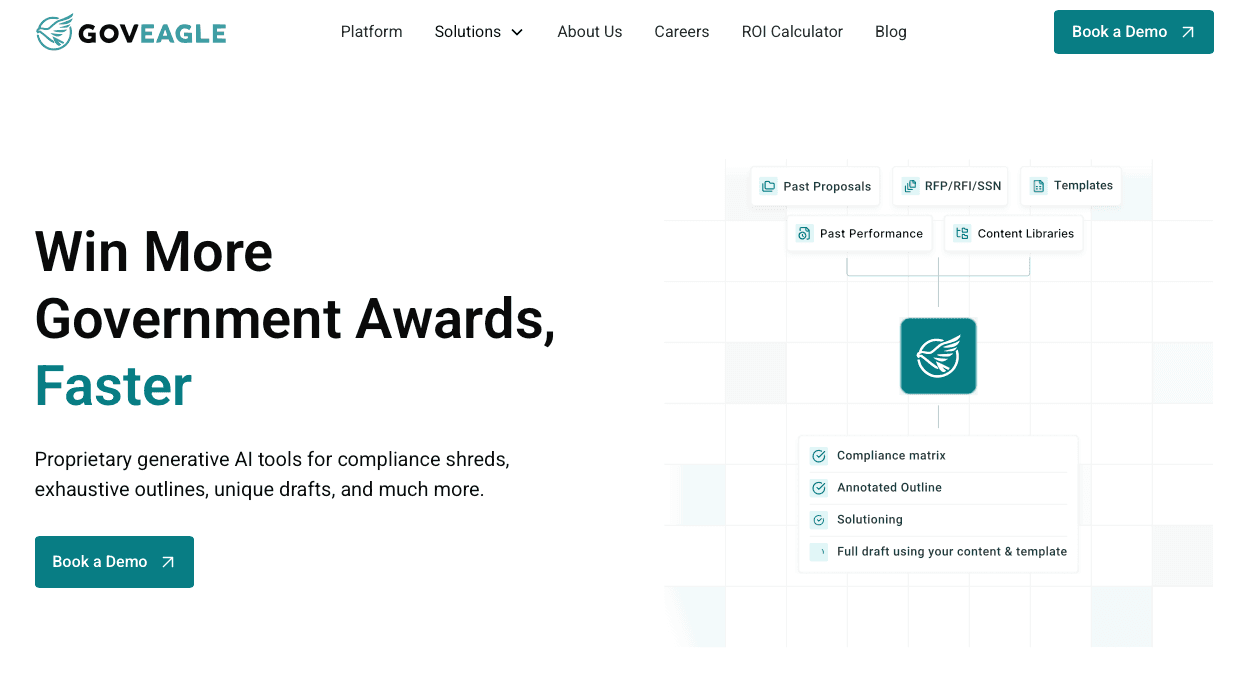
GovEagle tackles each of those gaps as a connected proposal development process instead of isolated fixes. GovEagle's AI-assisted drafting generates compliance matrices in Excel in minutes, populates annotated outlines in Word the same day, and pulls from your existing past performance library to produce compliant first drafts aligned to your prior proposal language and tone, so writers spend their time editing and refining compliant draft content instead of building from scratch.
That compression delivers measurable results: GovEagle customers report 30-40% faster proposal prep without sacrificing compliance coverage or review quality. For proposal managers and capture leads holding a schedule together, that margin is the difference between a prepared review and a scramble. See how GovEagle supports proposal teams in reaching Pink Team on time with a draft ready for meaningful review.
FAQs
Can I use my existing SharePoint or Google Drive files without migrating content?
Yes. Semantic search indexes content directly from SharePoint, Box, Google Drive, and similar repositories without requiring file migration, so your existing past performance library becomes immediately searchable by concept instead of by folder structure the day you start a new pursuit.
Why do SMEs spend so much time on early-stage proposal work?
Most SMEs get pulled into first-draft writing and boilerplate sections instead of strategy and review, which consumes their hours on lower-value tasks. Shifting initial research and content assembly to AI-assisted workflows reserves expert judgment for win theme validation and technical accuracy where their input carries the most weight.
How much time can automation actually save on front-end proposal tasks?
Compliance matrix work drops from 2-3 days to under 1 day, annotated outlines generate the same day as the matrix, and AI-assisted drafting produces compliant first drafts in hours instead of days. Some GovCon teams report 30-40% faster proposal prep on RFIs and 15-25% on RFPs without sacrificing compliance coverage.
Final Thoughts on Compressing Your Proposal Setup Phase
Every proposal schedule breaks at the same point: too much time spent building structure before writing begins. When that setup compresses, Pink Team becomes a checkpoint on incomplete work instead of a meaningful review. GovEagle changes that equation by reducing the time spent on matrices, outlines, and early drafts, so teams can accelerate time to Pink Team with a draft that is ready for real feedback.