
NSPM-11 Is Rewriting How the Government Buys AI.

Akash Mandavilli
CEO and Co-Founder of GovEagle
About the author
Akash is a 2x founder with previous experience in AI from Meta and federal sales from IBM. Akash holds a dual-degree from Johns Hopkins University in Economics and Computer Science.
Here's What Your Proposals Need to Say Differently by Q4.
On June 5, the White House signed NSPM-11 — a directive that doesn't just change AI policy, it changes procurement.
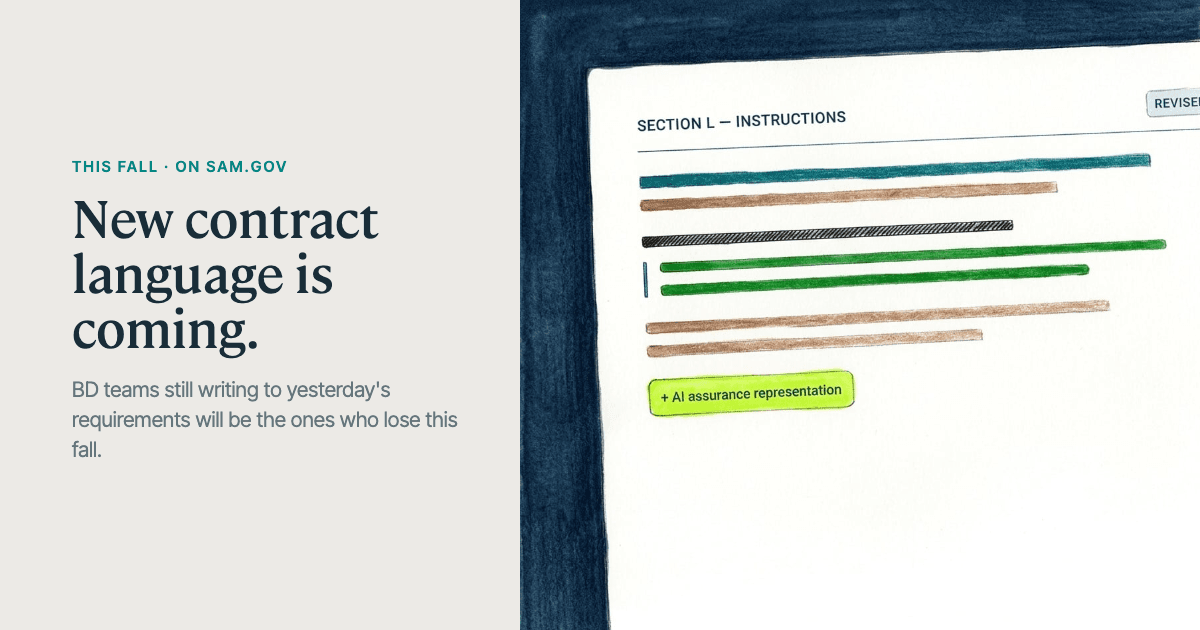
Agencies have 90 to 120 days to update how they buy AI. Those deadlines land in September and October. Which means new contract language starts showing up in solicitations this fall.
BD teams that aren't tracking this will be writing proposals to yesterday's requirements.
Here's what's actually changing — and what it means for what you put on paper.
The Four Pillars Aren't Just Policy Language. They're Evaluation Criteria.
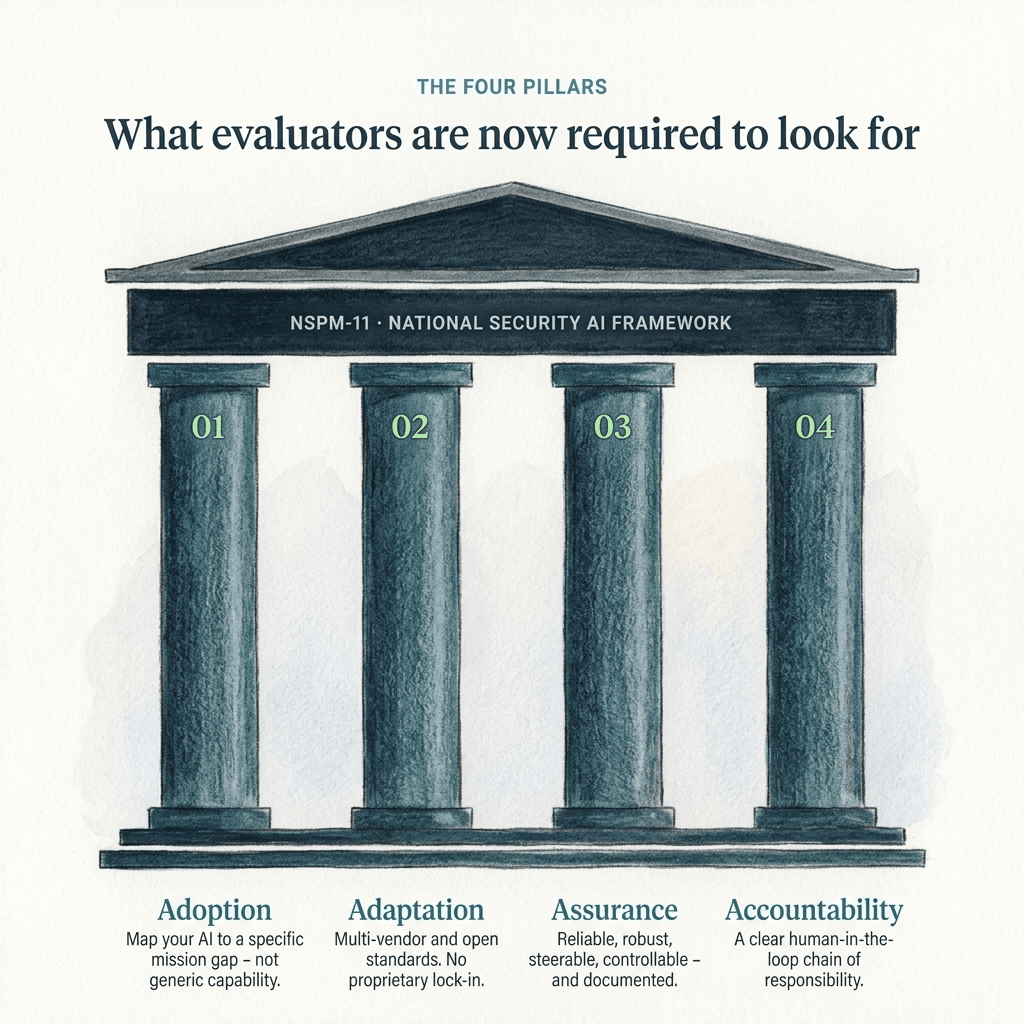
NSPM-11 organizes the entire national security AI framework around four pillars: Adoption, Adaptation, Assurance, and Accountability.
- Adoption means the national security enterprise must identify where AI can enhance effectiveness, remove barriers to adoption, and "maintain deep, proactive partnerships with industry."
- Adaptation means adapting commercial and open-source AI from many suppliers and sharing solutions across the enterprise.
- Assurance means AI must be "reliable, robust, steerable, and controllable."
- Accountability means military commanders and agency directors are personally responsible for keeping AI use within law and policy.
If you're writing proposals for defense or IC customers, these four pillars are the lens evaluators will be using. Start aligning your language now.
On Adoption: "We Have AI Capabilities" Is No Longer Enough.
NSPM-11 directs the national security enterprise to identify mission areas where AI can improve operational effectiveness and to eliminate unnecessary barriers to AI deployment. The emphasis on mission-specific effectiveness matters.
Generic AI positioning ("we leverage cutting-edge AI") won't move evaluators. The question they're asking is: where specifically does this contractor's AI capability close a gap for our mission?
Your proposals need to answer that question with precision. Vague claims will read as noise. The teams that win will be the ones who've mapped their capabilities to specific mission outcomes — and that requires knowing the opportunity deeply before you start writing.
(Reference: NSPM-11 Section 2, Adoption pillar. Analysis: Benton Institute breakdown, June 2026)
On Adaptation: Multi-Vendor Compatibility Is Now a Stated Government Priority.
The 120-day timeline for procurement updates makes the policy objective clear: eliminate single-vendor lock-in and ensure the public sector can rapidly deploy the best commercial and open-source models available simultaneously.
This is a significant shift. NSPM-11's assurance language requires agencies to ensure "through contractual clauses or other means" that no commercial entity or adversary can prevent a system's use, disable or degrade it, or materially modify it without federal knowledge and approval.
If your solution sits on a proprietary stack with no interoperability story, that's a flag to evaluators now. Your proposals need to address portability, open standards, and how your solution plays in a multi-vendor environment — not just what it does in isolation.
(Reference: NSPM-11 Section 4(a) on procurement process updates; Ward & Berry analysis)
On Assurance: Expect Tougher Contract Representations to Show Up in Solicitations.
This is where the compliance burden gets real. Contractors should expect tougher representations, flow-down terms, audit rights, and diligence requests across the supply chain. That language flows from the contract termination authority in the memo itself: agencies are directed to terminate for default or convenience contracts with companies that have repeatedly demonstrated a pattern of conduct inconsistent with NSPM-11 policy.
What this means for proposals: technical accuracy isn't just about winning — it's about what you're signing up for. NSPM-11 defines AI security as applying protections across the AI technology stack to ensure the confidentiality, integrity, and availability of AI systems from design through deployment.
If your proposal makes AI capability claims, you'll want internal documentation that backs them up. Evaluators — and contracting officers — will be reading those claims differently than they did six months ago.
(Reference: NSPM-11 Section 3 on contract termination; HiddenLayer analysis)
On Accountability: The Chain of Command Language Has Proposal Implications.
The update to DoD Directive 3000.09 — due by approximately September 3, 2026 — must ensure "deliberate adoption of AI systems that respect the chain of command and operational authorities." This isn't just about autonomous weapons. It signals a broader evaluator expectation: any AI-enabled solution needs a clear human accountability structure, and your proposal needs to describe it explicitly.
Who is responsible for the AI outputs your solution produces? How are errors surfaced and corrected? What does human-in-the-loop look like in your solution? These aren't compliance checkboxes yet — but they're becoming proposal differentiators.
(Reference: NSPM-11 Section 3 on DoD Directive 3000.09 update; Crowell & Moring analysis)
The Operational Reality for BD Teams.
The first evaluator of your proposal may no longer be human. Federal agencies are deploying AI tools that conduct compliance evaluations in minutes — verifying that required forms are included, proposals meet solicitation requirements, and clauses and terms are adhered to.
NSPM-11 accelerates that trend. More AI in procurement means more structured evaluation, faster. It also means the window between when new solicitation language drops and when RFPs close will be shorter than BD teams are used to.
The teams that win this fall won't be the ones who read NSPM-11 in October. They'll be the ones who've already mapped what it means for their specific capability areas, track new language as it hits SAM.gov, and built proposals that speak directly to what evaluators are now required to look for.
That's a BD operations problem. And it's exactly what we built Pursuit OS to solve.
Sources:
- Full NSPM-11 text: whitehouse.gov
- Ward & Berry legal analysis (four pillars breakdown, supply chain implications): wardberry.com
- Government Contracts Legal Forum (procurement update timeline, contract termination authority): governmentcontractslegalforum.com
- Benton Institute (plain-language section-by-section breakdown): benton.org
- Small Wars Journal (DoDD 3000.09 and autonomous weapons implications): smallwarsjournal.com
- Federal News Network (AI-assisted proposal evaluation): federalnewsnetwork.com