
Tracking the FAR Overhaul

Todd Armstrong
Government Contracting Consultant
About the author
Todd has nearly three decades of government contracting experience, including running his own consulting firm. He previously served a 20 year US Air Force career as a Joint Terminal Attack Controller with conventional and special operations forces, with a final assignment in requirements and acquisition.

Government contractors are awaiting the FAR update with anticipation. We are as well. So, we're monitoring developments and analyzing potential impacts to best position for what's to come.
The overhaul is a work in progress, and it remains to be seen what actually happens in implementation. Much of the effort is simplifying and reorganizing, with background and amplifying information being moved to nonmandatory guides. There are a few emerging areas thus far that contractors should be preparing for.
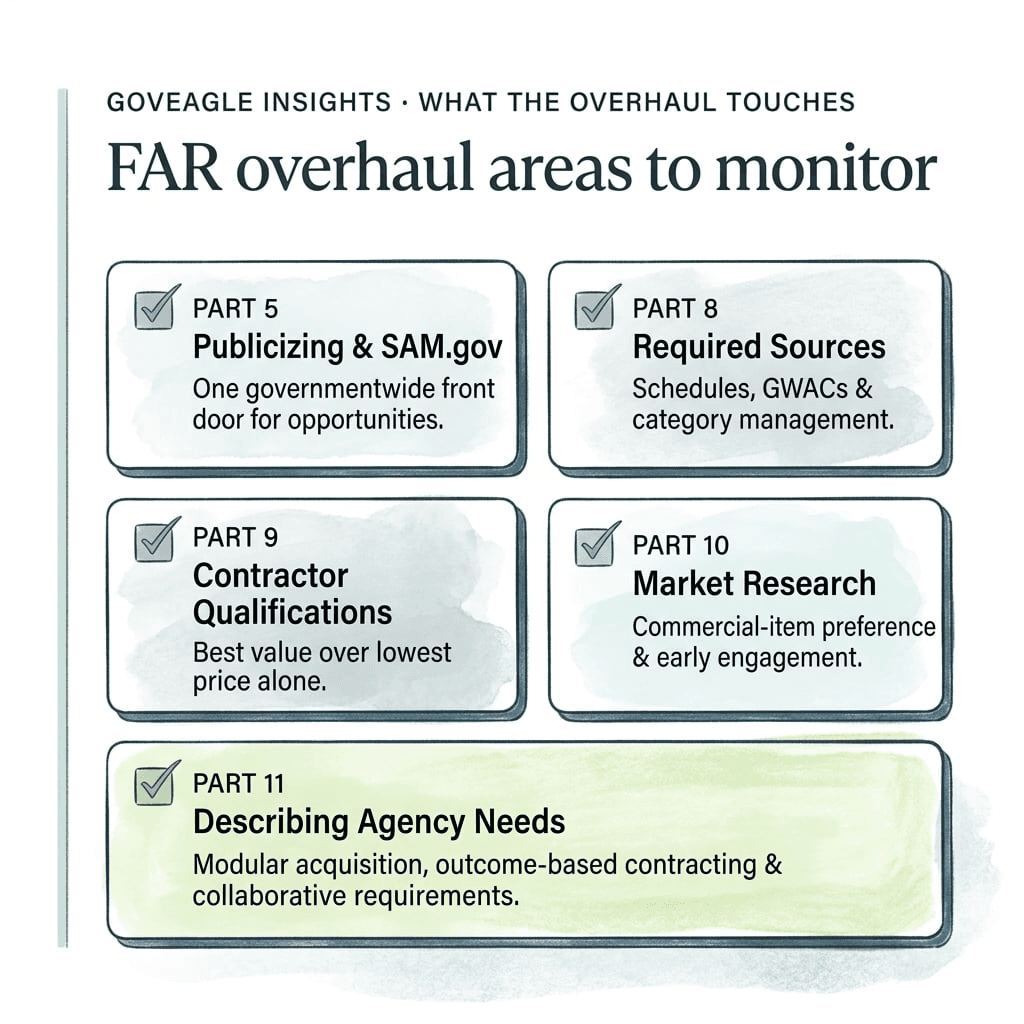
Part 5 — Contract Notices and SAM.gov
Part 5 emphasizes using SAM.gov as the governmentwide point of entry for contract notices. Agencies and programs may have their own sites and portals, but they must link to SAM.gov. This should help consolidate opportunities that were scattered in the past.
Part 8 — Existing Contracts and Best Value
Part 8 prescribes maximum use of existing contracts with emphasis on Federal Supply Schedules, governmentwide acquisition contracts, and category management to leverage centralized purchasing, improve efficiency, and reduce administrative burdens. Now's the time to get those contracts in place.
On best value determinations: orders under Federal Supply Schedules and governmentwide contracts will focus on balanced evaluations of price and non-price factors, leveraging pre-competed vehicles to simplify price and reasonableness assessments.
Part 9 — Total Cost Consideration
Part 9 addresses total cost consideration. Awarding contracts solely based on the lowest evaluated price can lead to problems like defaults or delays that increase overall costs. While fair and reasonable pricing is essential, evaluation criteria should focus on best value rather than just the lowest offer.
Part 10 — Commercial Items and Market Research
Part 10 states agencies must prioritize procuring commercial items using a hierarchical approach. Market research methods will be flexible and tailored to circumstances without mandaniques.
The Companion Guide for Part 10 emphasizes data-informed decision-making, proportional documentation, and early industry engagement — including innovative practices like reverse industry days and standardized RFIs. The acquisition workforce must adopt strategic, flexible market research approaches.
Part 11 — Requirements and Acquisition Strategy
Part 11 touches several areas contractors should watch closely.
Modular acquisition: Agencies are encouraged to break down complex requirements into components to broaden competition, reduce integration risks, and support gradual technology upgrades.
Outcome-based contracting: The emphasis shifts to defining performance goals and measurable outcomes rather than prescribing technical methods — encouraging vendor innovation and efficient solutions. This should allow contractors to better leverage their strengths and differentiate their proposals.
Collaborative requirements development: Early industry involvement in requirements drafting through RFIs and industry days will be promoted to ensure practical, achievable government needs and increase competition.