
CRM Integration for AI Proposal Tools in GovCon (September 2026)

Akash Mandavilli
CEO and Co-Founder of GovEagle
About the author
Akash is a 2x founder with previous experience in AI from Meta and federal sales from IBM. Akash holds a dual-degree from Johns Hopkins University in Economics and Computer Science.
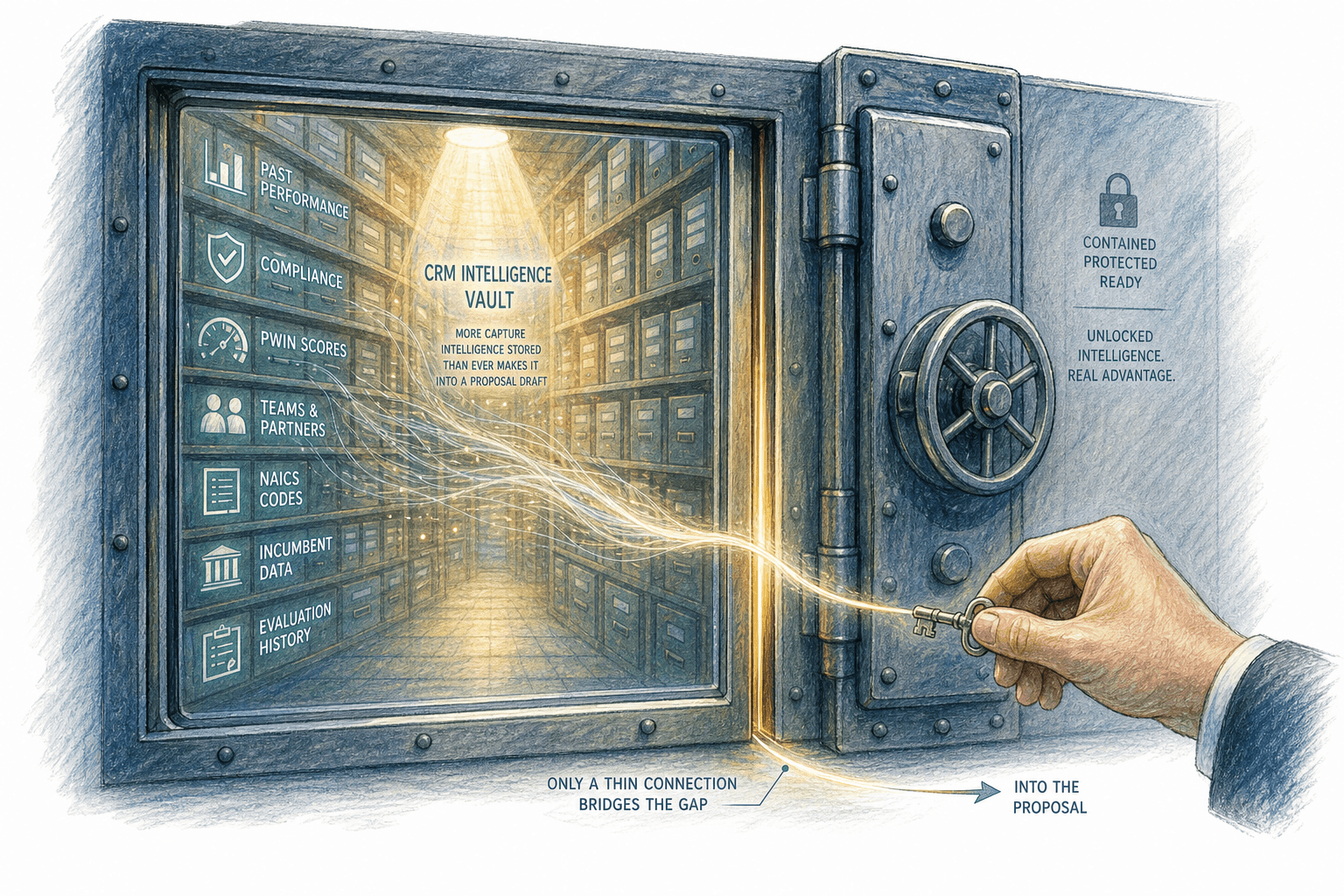
Most GovCon teams running Salesforce or HubSpot have more capture intelligence stored in their CRM than ever makes it into a proposal draft. The gap between that pipeline data and your proposal workflow is where things break down, and the decision to integrate AI with your Salesforce CRM in Government Contracting is what determines whether your BD investment carries forward or resets at kickoff.
TLDR:
- CRM intelligence built during pre-RFP capture often stays locked in Salesforce or HubSpot records and never reaches the proposal workspace where it matters.
- AI proposal tools connected to your CRM can pre-populate Section L responses, cross-reference past performance against Section M criteria, and pull bid/no-bid signals like PWin scores directly from CRM opportunity records.
- HubSpot is not FedRAMP authorized; teams tracking CUI through it need to confirm data boundaries before connecting any AI proposal tool.
- When assessing integration depth, ask vendors whether the tool recognizes GovCon-specific fields like NAICS codes and incumbent data by default, and whether attaching a solicitation to an opportunity record automatically triggers proposal section population.
- In practice, GovCon teams using a connected AI proposal workflow have cut RFI preparation time by 30 to 40 percent and reached full adoption in one week without migrating their existing content repository.
Why GovCon BD Teams Run on Salesforce and HubSpot
GovCon BD teams gravitate toward Salesforce and HubSpot for the same reason capture managers obsess over pipeline visibility: federal pursuit cycles are long, and contact relationships decay faster than most CRMs are configured to track. A single IDIQ opportunity can involve agency contacts, teaming partners, incumbent research, and bid/no-bid checkpoints spread across 18 to 36 months. Generic CRM setups were not built for that kind of pursuit cadence.
Salesforce dominates at larger primes and mid-tier contractors where BD and Contracts teams need shared pipeline views, custom opportunity stages tied to capture phases, and integrations with procurement data feeds. HubSpot has gained ground at smaller firms and growth-stage 8(a) or SDVOSB contractors who need structured capture pipeline tracking without the configuration investment that full Salesforce deployments typically require for GovCon-specific field mapping.
Both systems end up holding the intelligence that drives proposal decisions: agency relationship history, teaming partner contacts, prior capture notes, and bid history with past-performance data. The gap most pursuit teams hit is that this intelligence stays locked inside CRM records and never connects to the proposal workflow where it would actually reduce Section L response time or sharpen past-performance selection.
The Capture-to-Proposal Intelligence Gap
Most GovCon CRM environments hold more capture intelligence than any proposal team ever retrieves. Contacts, call notes, incumbent data, and past-performance references accumulate in Salesforce or HubSpot records, then sit disconnected from the proposal workspace when an RFP drops. The result: writers pull from memory or shared drives instead of the structured intelligence the BD team spent months building.
That gap is where proposals lose coherence before the first draft is written.
AI proposal tools that integrate with Salesforce and HubSpot close this by pulling CRM data directly into the drafting environment, so the capture context follows the opportunity instead of staying behind in a CRM record no one opens under deadline. The same continuity matters across the rest of the proposal stack: Chevo connected GovEagle to its existing SharePoint repository without a data migration or process overhaul, reached full adoption in one week, and cut RFI preparation time by 30 to 40 percent.
What CRM Integration with an AI Proposal Tool Actually Does
When a GovCon team connects an AI proposal tool to Salesforce or HubSpot, the integration does more than sync contact records. Capture data that previously sat in CRM notes, including incumbent intel, agency relationships, past-performance tags, and historical PWin scores, becomes active input for AI-generated proposal drafts, win themes, and compliance matrices.
The practical result is that proposal writers stop re-entering context that BD already captured. Section L requirements get mapped against pursuit history pulled directly from the CRM record. Win themes drafted by the AI reflect the actual account intelligence logged by capture managers, not generic boilerplate.
For GovCon teams running multiple pursuits simultaneously, that connection between CRM activity and proposal output can reduce the coordination overhead that typically consumes time between capture close and proposal kickoff.
Key Capabilities Unlocked by CRM-Connected AI Proposal Tools
When a CRM like Salesforce or HubSpot feeds directly into an AI proposal tool, the integration does more than cut down on copy-paste work. It changes what capture teams can act on and when. A few capabilities tend to matter most in practice.
- Opportunity data pulled from Salesforce or HubSpot can pre-populate proposal sections automatically, drawing on incumbent details, contract vehicle history, and agency relationship notes that BD teams have already logged during pre-RFP capture activities.
- AI tools connected to CRM pipelines can cross-reference past performance records stored in the CRM against Section M evaluation criteria, surfacing which prior contracts are worth citing before the writing even starts.
- Bid/no-bid scoring can draw on CRM signals like PWin estimates, incumbent status flags, and relationship depth scores, giving capture leads earlier visibility into whether a pursuit is worth resourcing.
- Account intel logged in the CRM, including agency relationship notes, teaming partner history, and prior contract data, can feed directly into win theme generation and capture deck population, so the intelligence the BD team built during pre-RFP pursuit carries into proposal development without manual re-entry.
The practical result is that intelligence captured during the pursuit phase stops living only in CRM notes and starts feeding the proposal directly. That matters in GovCon because the gap between what a capture team learns about an agency and what actually makes it into a proposal draft is often where competitive differentiation gets lost.
How to Assess CRM Integration Depth When Selecting an AI Proposal Tool
When a GovCon team reviews AI proposal tools, CRM integration is often treated as a checkbox, not a structural criterion. That framing leads to a common procurement mistake: selecting a tool that "connects" to Salesforce or HubSpot in name but leaves capture intelligence siloed the moment proposal workflows begin.
Integration depth matters more than integration existence. A few areas where the distinction shows up most clearly:
| Integration Criterion | Shallow Integration | Deep Integration |
|---|---|---|
| Data Flow Directionality | Manual or unreliable pull: capture data must be copied into the proposal workspace by hand at kickoff, creating gaps when notes are incomplete or the CRM record is out of date | Reliable inbound pull: capture intelligence, opportunity stage data, and account history from CRM records flow into the proposal workspace automatically when a pursuit goes active, so proposal teams start with the full pursuit context the BD team built |
| Field Mapping | Maps to standard Salesforce or HubSpot objects only; NAICS codes, vehicle types, and incumbent data are not recognized | Maps to GovCon-specific custom fields, preserving the capture intelligence your BD team has already built, including incumbent data, vehicle history, and agency relationship history |
| Trigger-Based Automation | Passive connection; capture data must be manually pulled into the proposal workspace at kickoff | Attaching a solicitation to an opportunity record auto-populates Section L compliance matrix requirements, removing the manual handoff that introduces errors or delays |
Before committing to a tool, ask vendors directly how reliably capture intelligence flows from CRM records into the proposal workspace, what GovCon-specific field mappings come preconfigured, and whether workflow triggers can be customized to your capture stages.
GovEagle: Closing the Loop Between Salesforce and Proposal Execution

Most CRM integrations stop at data sync. A contact record updates, a tag fires, an opportunity stage advances. The proposal workflow stays exactly where it was: in a separate tool, a shared drive, or someone's inbox.
GovEagle is built to close that gap. When a Salesforce opportunity reaches a configured capture threshold, GovEagle can pull the relevant BD intelligence directly into the proposal workspace, including incumbent data, teaming notes, agency history, and win themes developed during pre-RFP capture activities, without requiring the proposal manager to hunt across systems.
What That Looks Like in Practice
Capture leads update opportunity records in Salesforce as intelligence develops. When a pursuit moves to active proposal, GovEagle reads those records and pulls the relevant BD intelligence into the proposal workspace, so the process starts with real capture context, not a blank template. The account history, agency notes, and win themes the BD team built during pre-RFP capture become the starting point for proposal development, not artifacts that stay locked in the CRM. Book a Demo to see how that handoff works across live pursuits in your pipeline.
For GovCon teams managing simultaneous pursuits across multiple contract vehicles, that inbound connection matters. Proposal managers get structured capture input at the moment they need it, with the pursuit intelligence the BD team built already loaded into the workspace when the proposal kicks off.
Security and Deployment Context
GovEagle is FedRAMP authorized and supports AWS GovCloud and Azure self-hosted deployments. For teams handling CUI within their proposal or CRM workflows, the integration architecture aligns with NIST 800-171 requirements, which matters given that DFARS 252.204-7012 safeguarding obligations remain in force regardless of the current CMMC Phase II suspension.
FAQs
What does "integration depth" mean for a Salesforce-connected AI proposal tool in government contracting?
Integration depth refers to whether the connection between your CRM and your AI proposal tool moves capture intelligence into active use or just syncs records. The practical tests are pull reliability (does capture intelligence flow automatically into the proposal workspace when a pursuit goes active, or does someone have to manually pull it across?), field mapping (does the tool recognize GovCon-specific fields like NAICS codes, vehicle types, and incumbent flags?), and trigger-based automation (does attaching an RFP to an opportunity automatically populate Section L requirement mappings?).
Should I integrate my AI proposal tool with Salesforce Government Cloud or standard Salesforce if my team handles CUI?
Salesforce Government Cloud offerings are designed to support organizations with FedRAMP and federal compliance requirements. Teams handling CUI under DFARS 252.204-7012 should verify that both their Salesforce environment and any connected AI tools meet their contractual security obligations. The configuration difference matters for AI tool connections too: GovCloud uses separate API endpoints, so AI proposal tools built against the standard Salesforce API may require a purpose-built connector to authenticate correctly.
Can I connect HubSpot to an AI proposal tool for federal pursuits, or does HubSpot's lack of FedRAMP authorization block the integration?
HubSpot integrations are feasible for federal proposal workflows, but the data boundary requires deliberate scoping since HubSpot is not FedRAMP authorized, which means teams should confirm that CUI stays out of HubSpot records or is handled through a compliant intermediary before connecting any AI proposal tool to it. Where HubSpot works well is syncing opportunity stage data, BD call logs, and pre-RFP engagement notes into proposal context for past-performance and management approach sections, as long as the data involved does not cross into controlled territory.
Final Thoughts on Using AI to Bridge CRM Data and Proposal Execution
Most BD teams are already sitting on more pursuit intelligence than their proposal teams ever see. The problem is not the data; it is that Salesforce and HubSpot records and the proposal workspace are two separate systems with no live connection between them. Teams that integrate AI with their Salesforce CRM in Government Contracting close that gap, so capture context feeds the Section L response framework from day one instead of getting reconstructed from memory.