
The Army Is Moving Its Intelligence IT Work to a Ten-Year CSO

Akash Mandavilli
CEO and Co-Founder of GovEagle
About the author
Akash is a 2x founder with previous experience in AI from Meta and federal sales from IBM. Akash holds a dual-degree from Johns Hopkins University in Economics and Computer Science.
What notice W50NH9-26-S-0001 says, how it got here, and what capture teams should do about it.
The short version
The Army has opened a Commercial Solutions Opening covering commercial IT for the Army Information Enterprise - Information Technology Services program, notice ID W50NH9-26-S-0001. Per OrangeSlices (September 10, 2026), the pathway stays open through 2036, though that duration figure comes from the same single-source tracking summary as the scale figures below, so treat it with the same caution until confirmed on SAM.gov.
Instead of one RFP with one due date, the Army will issue targeted Calls for Innovative Solutions as requirements come up, and evaluate submissions in stages. Vendors rated "of Merit" who do not win can be held in a qualified vendor pool for later calls.
Five things to do this week:
- Download the notice and every attachment from SAM.gov. Do not work from trade coverage, including this post.
- Check the clearance gate. Awards supporting classified environments generally require a Top Secret Facility Clearance and TS/SCI eligible personnel. You cannot obtain an FCL on your own, so if you do not hold one, your realistic path is a cleared teaming partner. Sort that out before you spend capture hours.
- Screen yourself against the capability areas: enterprise IT operations, cybersecurity, Zero Trust, DevSecOps, cloud and infrastructure modernization, software and data services, logistics, mission-specific intelligence IT, and program management. If you are trying to triage which capability areas or future calls are worth pursuing, a structured bid or no-bid scoring pass against these criteria is worth doing early, before you invest capture hours in the wrong Area of Interest.
- Read the July RFI alongside the CSO. It explains the Army's reasoning and tells you what the government was worried about.
- Build a repeatable process for short submissions. The first document, white paper or solution brief, is the front door here, and there will be more than one.
How the Army Got to This CSO
On July 15, 2026, Army Contracting Command at Detroit Arsenal put out an RFI under solicitation number AIE-ITS-001, with INSCOM as the requiring activity.
It did not ask for capability statements. It asked industry whether a CSO was the right way to buy enterprise IT services at this scale, and floated a master CSO followed by capability-specific Areas of Interest, with solution briefs, pitch sessions, and then formal proposals (OrangeSlices, July 15, 2026; SAM.gov). An Industry Day preceded it, and responses closed August 15.
The September CSO adopted that exact strategy. Going from RFI close to a standing pathway in six weeks is fast.
The RFI is worth reading in full because it shows what the Army is trying to fix. It describes moving off fragmented level-of-effort contracts toward outcome-based managed services, and asks industry how it would price firm-fixed-price service offerings, define measurable service levels, and speed up onboarding for cleared people.
The target floated for onboarding TS/SCI cleared technical staff is ten business days or less, supported by what the Army calls a Talent Supply Chain. Anyone who has tried to stand up a cleared team knows what a demand that is.
Solicitation-tracking summaries of the RFI put the planned scope at roughly $3.8 billion over ten years, consolidating around 19 legacy contracts and supporting 14,000 users and 26,000 classified devices across more than 680 locations. We have not been able to confirm those figures in a government document, so treat them as directional rather than as terms.
If you support any of the incumbent contracts in that portfolio, this is your recompete, and it does not look like the last one.
A note on the name: the RFI is titled Army Information Enterprise - Information Technology Services, and it describes supporting the Army Intelligence Enterprise. Both acronyms are AIE. Some coverage of the CSO has merged them into "Army Intelligence Enterprise - Information Technology Services." Use the title on the notice.
What a CSO actually is
A Commercial Solutions Opening is a general solicitation authorized by 10 U.S.C. § 3458 and implemented through DFARS subpart 212.70. Congress made the authority permanent in section 803 of the FY22 NDAA, which moved it from 10 U.S.C. 2380c to its current section (Federal Register).
Two corrections to how CSOs often get described, including in some of the coverage of this one.
First, a CSO is not outside the FAR. It is a DFARS-based alternative to a conventional RFP, and the statute treats the procedures as competitive procedures. Awards can land as FAR Part 12 commercial contracts or as other transactions, depending on what the specific call calls for.
Second, the "innovative solutions" framing is now dated. Under the FY26 NDAA, Congress struck the word "innovative" from § 3458, which opens CSOs up as a general commercial acquisition tool rather than a narrow one (Holland & Knight). Expect to see more of these.
CSOs are also not exotic anymore. DoD has been directed to use the authority at least four times a year since the FY24 NDAA (Mayer Brown), and the Army ran one in April for rapid electromagnetic warfare and SIGINT capabilities (Breaking Defense).
What makes AIE-ITS notable is the duration and the size of the portfolio behind it.
Get GovCon capture and proposal insights in your inbox.
What changes for your capture team
The tracking model. A ten-year open pathway does not fit a pipeline entry with a due date. Somebody needs standing responsibility for watching for new calls and deciding fast whether each one is a fit.
In practice this means treating AIE-ITS as a living opportunity record rather than a single pursuit: log it once, keep milestones tied to expected call windows rather than a single due date, and update it as each new Area of Interest opens rather than starting over.
GovEagle does this kind of monitoring through Opportunity Search and bid agents. You set up a bid agent that describes what you're looking for, relevant NAICS/PSC codes, keywords like "AIE-ITS" or "Army Information Enterprise," clearance requirements, and so on, and it pulls new opportunities from SAM.gov, GSA eBuy, and GovWin every day, decides which ones are worth pursuing, and estimates your probability of winning with reasoning. Results land in your team's inbox as an email digest after each run, so nobody has to manually re-check SAM.gov for new Calls for Innovative Solutions under this CSO.
The agent's match reasoning and PWin score handle the "deciding fast" part too, checking each new posting against your company profile and content library evidence before anyone has to open the notice.
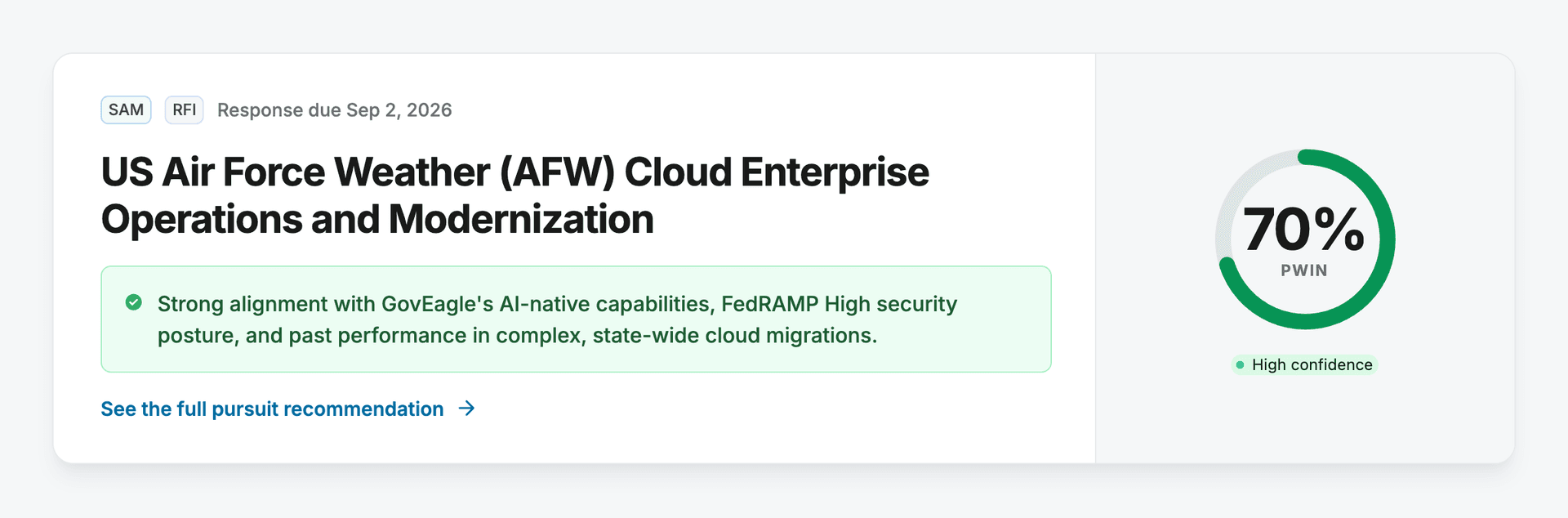
One caveat specific to a ten-year CSO: bid agents are built around ingesting new opportunity postings, so once a specific Call for Innovative Solutions goes out as its own notice or amendment, it should get picked up the same way any new opportunity would. Treat the standing notice, W50NH9-26-S-0001 itself, as the master pathway you track manually, and set the bid agent's keywords broad enough to catch each new call issued under it as it appears.
The first deliverable. Your first submission is a short document, not a full proposal. Coverage of the CSO describes a written solution brief. The RFI described a white paper stage ahead of briefs and demonstrations, so read the phasing in the notice itself and do not assume.
Either way, if the first document lands well you may get asked to present or demo, and only then to submit a proposal. That lowers your cost of entry per call. It also means the team that can turn one out in days has a real structural advantage over the team that needs three weeks.
The short written submission. Your front door into every call.
If the first document lands, you may be asked to present or show it live.
Requested only after the earlier stages go well.
Win the call outright, or land "of Merit" status for future calls.
The pricing story. Much of this work has historically been sold by labor category and hour. The Army's stated intent is outcome-based delivery of commercial capability, priced as firm-fixed-price services against defined service levels. Submissions built around a staffing plan will read as the thing the Army is trying to move away from.
The value of losing. A solution judged "of Merit" can sit in the qualified vendor pool for future calls. Note the word "may" in the notice. It is not automatic, and the criteria are worth reading closely rather than assuming.
Where GovEagle helps
The short submission is the workflow that changes. Whatever the first document turns out to be called, white paper or solution brief, it is short, it is due fast, and you will write several against calls that appear with little warning.
GovEagle drafts it in Word from your own templates, past performance library, and company profiles, so it pulls in quantified results instead of generic claims. Load the CSO package into the opportunity's Solicitation tab first, and the requirements and scope come across without anyone re-reading a 40-page PDF to answer a basic question.
Once a specific Call for Innovative Solutions has defined evaluation criteria or service-level expectations, running the notice through GovEagle's compliance matrix extraction turns that language into a structured requirements list your team can respond against directly, rather than someone combing the call by hand each time one lands.
Given the clearance and staffing pressure built into this CSO, GovEagle can map KSA (Knowledge, Skills, and Abilities) requirements extracted from a solicitation's labor category or personnel qualification sections directly against your resume library. This lets your team instantly identify which candidates in the content library best match each required KSA, speeding up staffing plan development and key personnel selection. Where no resume in the library satisfies a required KSA, GovEagle flags the gap early, so recruiting or subcontracting needs can be addressed well before proposal submission rather than discovered during compliance review.
The second is staying ready. The qualified vendor pool rewards companies whose capability narrative is current when a call drops. Keeping past performance and capability material maintained in one place, rather than rebuilt per submission, is the difference between responding to a call and watching it pass.
Because AIE-ITS will generate many short submissions off the same underlying relationship, the value of quantifying a past performance reference once (specific contract value, specific user counts served, specific onboarding times met) and reusing it compounds with every call, instead of writing "extensive experience" language fresh each time.