
IDIQ Contracts: How to Find Task Order Opportunities

Akash Mandavilli
CEO and Co-Founder of GovEagle
About the author
Akash is a 2x founder with previous experience in AI from Meta and federal sales from IBM. Akash holds a dual-degree from Johns Hopkins University in Economics and Computer Science.
Your team can hold a position on every major GWAC in your space and still lose on task orders to firms that did their homework earlier in the capture cycle. Knowing how to find IDIQ contracts is only the first step. The competitive advantage sits in how you research incumbent task order concentration, read fair opportunity procedures before award, and structure teaming before the on-ramp closes.
TLDR:
- Winning an IDIQ vehicle position is access, not revenue; task order competitions are where contracts are actually won.
- GovSpend counts $72.4 billion through major GWACs and IDIQs in FY25, with the top five vehicles taking more than half.
- Vehicle solicitations post on SAM.gov, but most task order requests go through eBuy, SEWP, or agency ordering portals; read a vehicle's ordering procedures before any other terms.
- Use USASpending.gov to map incumbent task order concentration by IDV contract number before committing pursuit resources.
- GovEagle monitors IDIQ solicitations and amendments, and is FedRAMP Moderate Authorized with GCC High support for CUI-bearing vehicle pursuits.
What IDIQ Contracts Are and How Task Orders Work
An IDIQ contract sets a ceiling value and pre-negotiates rates and terms, but obligates the government to only a guaranteed minimum, which is often modest. Actual revenue flows through individual task orders (services) or delivery orders (products) competed separately among contract holders after award.
That sequencing is the strategic reality most pursuit teams underestimate. Winning a vehicle position is access, not revenue. The task order competitions that follow are where contracts are actually won and lost.
Multiple-award IDIQs dominate the federal market, meaning the government distributes vehicle positions across several awardees, then runs fair opportunity competitions for each task order among that pool. Single-award vehicles skip that step, but they are the exception. GWACs extend the multiple-award model governmentwide, letting any agency place orders without running its own acquisition, which expands the task order pipeline considerably for holders.
Where Federal IDIQ Spending Is Concentrated
Not all IDIQ vehicles carry equal pursuit value. According to GovSpend's FY25 analysis, $72.4 billion flowed through the GWACs and IDIQs it tracks, and the top five vehicles (NASA SEWP V, Alliant 2, SeaPort-NxG, OASIS Unrestricted Pool 1, and IAC MAC) accounted for more than half. Knowing where that concentration sits tells you which vehicles actually generate task order pipeline.
The major categories worth tracking:
- IT services: Alliant 2 and Alliant 3, STARS III, and Polaris carry much of the agency IT spend routed through GWACs. NITAAC cancelled CIO-SP4 in early 2026 before award and is winding down CIO-SP3, with non-HHS IT work shifting to GSA vehicles.
- Complex professional services: OASIS+ consolidates multiple legacy GSA vehicles into a single framework covering management consulting, logistics, and engineering disciplines.
- Products and IT commodities: NASA awarded SEWP VI in June 2026, with ordering anticipated to open November 1, 2026. No on-ramp has been announced, so firms without a SEWP VI seat should plan to team with a holder. Existing SEWP V orders can be extended by modification for up to five years.
Thousands of IDIQs exist across the federal space, but volume is concentrated. Narrowing pursuit focus to vehicles with consistent agency adoption and high task order frequency is where prioritization starts.
How to Find IDIQ Solicitations on SAM.gov
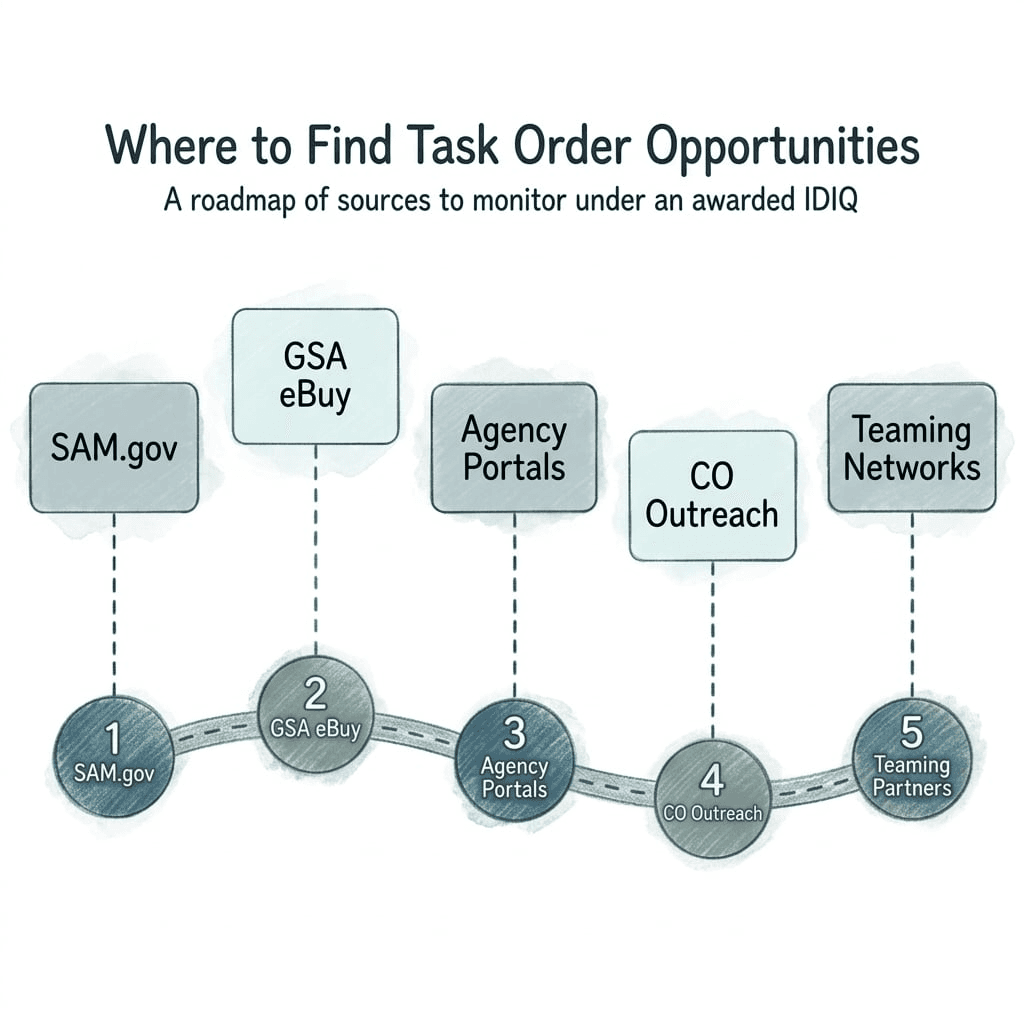
SAM.gov is where vehicle-level solicitations post when firms compete to become contract holders. Task order competitions (FOPRs or TO RFPs) are different: orders are generally exempt from public posting and go only to existing holders through GSA eBuy, the SEWP ordering portal, or agency ordering systems. Knowing which channel a vehicle uses keeps pursuit hours from going to the wrong portal.
To filter for vehicle-level IDIQ solicitations, use the Contract Opportunities search with these parameters:
- Contract type: IDIQ, matched against your core NAICS codes so you are not sifting through unrelated awards
- Set-aside category: filter by small business, 8(a), WOSB, HUBZone, or SDVOSB as applicable to your socioeconomic designations
- Agency: narrow to agencies where you carry past performance and active relationships, which also signals realistic competitive positioning
Some agencies do post task order notices on SAM.gov, and those often reference the parent IDIQ contract number in the description. Searching by parent contract number or vehicle name surfaces that activity, but for most vehicles the holder portal is the primary channel.
Set up saved searches for each vehicle or NAICS cluster you actively pursue and turn on email alerts. SAM.gov will notify you when matching notices post, removing the manual monitoring burden across a live pipeline.
Once a vehicle solicitation is in hand, one step matters before anything else in the document.
Read the Ordering Procedures Before Anything Else
Something most capture teams skip: when a vehicle solicitation drops, find the ordering procedures (often in Section G or H, or a separate ordering guide) before reviewing any other terms. That section governs how task order competitions will run post-award, including fair opportunity thresholds, ordering timelines, and exceptions to competition. A vehicle that looks attractive at the base-contract level may carry ordering procedures that favor incumbents or cap task order values in ways that limit your realistic pipeline well before the first FOPR hits.
How to Use USASpending.gov to Research IDIQ Vehicles and Incumbents
USASpending.gov turns publicly available award data into competitive intelligence, but most pursuit teams treat it as an afterthought instead of a pre-bid research tool. Before committing to a vehicle pursuit, you can use it to map incumbent concentration, task order volume, and agency ordering patterns across any active IDIQ.
Here is a practical workflow for turning that data into actionable capture intelligence:
- Search by the IDV contract number to pull all task orders issued under a specific vehicle.
- Filter by awarding agency to see which agencies are actively ordering versus which are only theoretically eligible.
- Filter by NAICS code to isolate task orders relevant to your service lines.
- Review awardee-level spend to identify which holders are winning task order volume and which are holding a vehicle position with little to no activity.
That last filter matters for bid/no-bid. A vehicle with 20 holders where two firms absorb 80% of task order value tells you something about competitive dynamics before you write a single page. It also surfaces natural teaming targets: holders with vehicle access but thin relevant past performance may be open to arrangements where you bring execution depth.
Pay attention to the prime-versus-subcontract distinction when reading award data. Some firms appear in task order data as subcontractors and not primes, which affects how their past performance reads during evaluation. USASpending.gov labels prime awards and subcontract actions separately, so confirm which role an incumbent held before drawing conclusions about their competitive position.
How to Get on an IDIQ Vehicle: Competing for a Position
Vehicle-level competitions are usually structured source selections, with technical evaluation, past performance review, and often labor rate or pricing submissions. The format varies: GSA MAS follows schedule procedures, and OASIS+ used self-scored qualification criteria. Winning a position requires the same disciplined compliance work as any major proposal.
The eligibility trap catches more firms than the competition itself. Vehicles like OASIS+ require qualifying projects mapped against domain-specific matrices, with average annual value thresholds that vary by domain. Contractors who wait until solicitation release to audit their contract history against those requirements typically cannot recover in time. Map your past performance against vehicle domain criteria before you submit.
Entry Timelines Vary by Vehicle
Not every IDIQ runs on the same access schedule, and that distinction often determines whether a firm can compete at all.
- GSA MAS and OASIS+ Phase II both accept offers on a continuous basis, and OASIS+ makes awards on a rolling basis as evaluations finish.
- Vehicles like Alliant 3 and SEWP VI award through fixed competitions with no scheduled on-ramp. Missing the competition can mean waiting years for the next chance to enter.
For firms that cannot yet qualify independently, subcontracting onto an existing holder's task order pursuits is a viable path. It builds relevant past performance under the vehicle framework and positions the firm for a prime seat when the next on-ramp opens.
Get GovCon capture and proposal insights in your inbox.
How Fair Opportunity Works for Task Order Competitions
FAR 16.505(b)(1) governs how task orders are competed once you hold a vehicle position. Contracting officers must give every holder a fair opportunity to be considered for each order above the micro-purchase threshold. For orders above $7.5 million, that obligation tightens: written notice to all holders, upfront disclosure of evaluation factors, and a written selection rationale are required.
Six statutory exceptions allow sole-source awards without fair opportunity:
| Exception | Condition Required | BD Implication |
|---|---|---|
| Urgency | The agency need is so urgent that providing fair opportunity would result in unacceptable delays | The agency must document the need; routine schedule pressure does not qualify |
| Only one capable source | Only one awardee can provide the required supplies or services at the required quality level because they are unique or highly specialized | Distinct capabilities and past performance built during the vehicle pursuit can support this where the facts do |
| Logical follow-on | The order is a logical follow-on to an order already issued under the contract, provided all awardees had a fair opportunity on the original order | Incumbents benefit most; winning the base order creates downstream sole-source opportunity |
| Minimum guarantee | The order is needed to satisfy the contract's minimum guarantee | Applies narrowly; a limited strategic lever for most BD teams |
| Statutory authorization | A statute expressly authorizes or requires the purchase from a specified source | Applies only where a statute names the source |
| Small business set-aside | The order is set aside for small business, 8(a), HUBZone, SDVOSB, or WOSB concerns | Your socioeconomic status directly shapes which orders you can compete for |
Recognizing these exceptions matters for BD strategy. Agency relationships can influence positioning toward a logical follow-on or only-one-capable-source justification, but they cannot manufacture an exception that the facts do not support.
One structural shift to plan around: Executive Order 14402, signed April 30, 2026, makes fixed-price the default contract type. The FAR Council's Part 16 class deviation applies to solicitations issued on or after July 15, 2026. Multiple-award contracts themselves are exempt, but the task and delivery orders under them are not: a non-fixed-price order at or above $10 million ($25 million at DHS, $35 million at NASA, $100 million at DoD) needs an approved written justification. Teams responding to FOPRs should expect fixed-price to be the default format and build pricing strategy around it from the start of capture.
Teaming Strategy for IDIQ Vehicle Pursuits
Teaming for an IDIQ vehicle differs from teaming for a single award because the arrangement has to hold through years of task order competitions, not a single proposal submission.
The exclusive-versus-non-exclusive decision carries real tradeoffs. Exclusive teaming at the vehicle level signals commitment and prevents a competitor from claiming your sub's differentiator, but it locks that subcontractor to a single prime. If that prime does not win a position, the sub has no vehicle access at all. Non-exclusive arrangements give subcontractors exposure across multiple holders, which improves their odds of downstream task order work but dilutes the signal to evaluators at the vehicle level.
For set-aside vehicles, compliance obligations govern how that structure can be built:
- FAR 9.601 defines contractor team arrangements and the terms under which a teaming agreement is recognized in federal acquisitions.
- Under the ostensible subcontractor rule, SBA can find a prime and subcontractor affiliated when the subcontractor performs the primary and vital requirements of the contract or the prime is unusually reliant on it.
- Small business primes on set-aside service contracts cannot pay more than 50% of the amount the government pays them to subcontractors that are not similarly situated.
Before committing to any arrangement, pull the prospective partner's award history from USASpending.gov. Look at their task order win rate on vehicles they already hold, the agencies they are active with, and whether they are performing as prime or sub. A partner with vehicle access but thin task order activity may add less value than their position suggests.
How GovEagle Supports IDIQ Pursuit Execution
IDIQ pursuits break down in predictable places: amendments missed across a spread-out pipeline, task order requests that never post on SAM.gov, and compliance matrices rebuilt from scratch for every order.
GovEagle continuously monitors SAM.gov and GSA eBuy for opportunities that match your saved searches and picks up amendments as they post, so BD teams are not polling portals by hand. When an amendment drops, upload it to the opportunity and rerun the compliance matrix so the team works from the current requirements. The full capture workflow, from pipeline development through task order pursuit, is covered at goveagle.com/solutions/bd-capture.
At the bid/no-bid stage, GovEagle pulls RFP details, past performance data, and competitive intelligence into a structured analysis before vehicle proposal resources are committed. For the vehicle proposal itself, GovEagle parses Section L and Section M requirements directly into a compliance matrix generated in Excel and an annotated proposal outline in Microsoft Word, the same workflow it applies to any complex FAR Part 15 solicitation.
At the task order stage, vehicle proposal content and capture notes stay in your content library, so each FOPR response starts from that work instead of from scratch. Without that continuity, firms lose ground to incumbents who already have agency context organized and accessible.
For defense contractors pursuing vehicles that involve CUI, GovEagle is FedRAMP Moderate Authorized and listed on the FedRAMP Marketplace, meeting the baseline DFARS 252.204-7012 sets for cloud services handling CUI, and supports GCC High environments.
Final Thoughts on IDIQ Contract Strategy and Task Order Pursuit
The research workflows covered here, SAM.gov filters, USASpending.gov incumbent analysis, and Section G review before anything else, are what separate firms that hold vehicle positions from firms that win off them. Your teaming decisions, eligibility audits, and agency relationships all carry more weight when they are built before a solicitation drops, not in response to one. GovEagle supports the full IDIQ pursuit cycle, from opportunity monitoring and bid/no-bid analysis through vehicle proposal compliance and task order capture, so the work done during the vehicle pursuit carries into each FOPR response. Teams that want to see how that workflow applies to their pipeline can explore a live demo at goveagle.com/demo, but the structural advantage sits in building capture intelligence before the solicitation exists, not after it drops.
FAQ
How do I find IDIQ task order competitions if I'm not already a vehicle holder?
You cannot compete directly for task orders on most multiple-award IDIQs without holding a vehicle position first. Until you win a position through a vehicle-level source selection or an on-ramp window, your primary path to task order revenue is subcontracting onto an existing holder's pursuit, which builds relevant past performance under the vehicle framework and positions your firm for a prime seat when the next on-ramp opens.
What is fair opportunity under FAR 16.505 and how does it affect task order strategy?
FAR 16.505(b)(1) requires contracting officers to give every vehicle holder a fair opportunity to be considered for each order above the micro-purchase threshold. For orders above $7.5 million, that obligation tightens to include written notice to all holders, upfront disclosure of evaluation factors, and a written selection rationale. Six statutory exceptions allow sole-source awards without fair opportunity, including urgency, only one capable source, logical follow-on to a previously competed order, and small business set-asides.
How do I build a teaming strategy for a large multi-award IDIQ vehicle pursuit?
An exclusive teaming arrangement at the vehicle level signals commitment and keeps a subcontractor's differentiator off competing teams, but it locks that sub to one prime. If that prime does not win a position, the sub has no vehicle access. Non-exclusive arrangements give subcontractors exposure across multiple holders, which improves their odds of downstream task order work but reduces the competitive signal at the vehicle level. For set-aside vehicles, the ostensible subcontractor rule under SBA regulations and the 50% subcontracting limit for small business primes on service contracts govern how those arrangements can be structured.
How does GovEagle compare to manual SAM.gov monitoring for IDIQ pipeline management?
Manual SAM.gov monitoring across a live pipeline of multiple vehicles creates gaps, especially when agencies post FOPRs with short response windows or GSA issues mid-cycle amendments. GovEagle's continuous opportunity monitoring tracks solicitations and picks up amendments as they post, so BD teams are not polling SAM.gov and GSA eBuy across fragmented vehicle portfolios. At the task order stage, vehicle proposal content and capture notes stay in the content library, so FOPR responses start from that work instead of from notes.
Can I use USASpending.gov to assess competitive dynamics before committing to an IDIQ vehicle pursuit?
Yes. Searching by IDV contract number pulls all task orders issued under a specific vehicle, and filtering by awardee-level spend shows which holders are winning volume versus holding a position with little activity. A vehicle with a dozen holders where task order awards cluster around two or three firms, with the rest showing little to no activity, reveals both the competitive concentration and the teaming picture: holders with vehicle access but thin relevant past performance are natural partnership targets for firms that bring execution depth.