
Positioning for FY 2027: an August action plan for enterprise GovCon teams

Akash Mandavilli
CEO and Co-Founder of GovEagle
About the author
Akash is a 2x founder with previous experience in AI from Meta and federal sales from IBM. Akash holds a dual-degree from Johns Hopkins University in Economics and Computer Science.
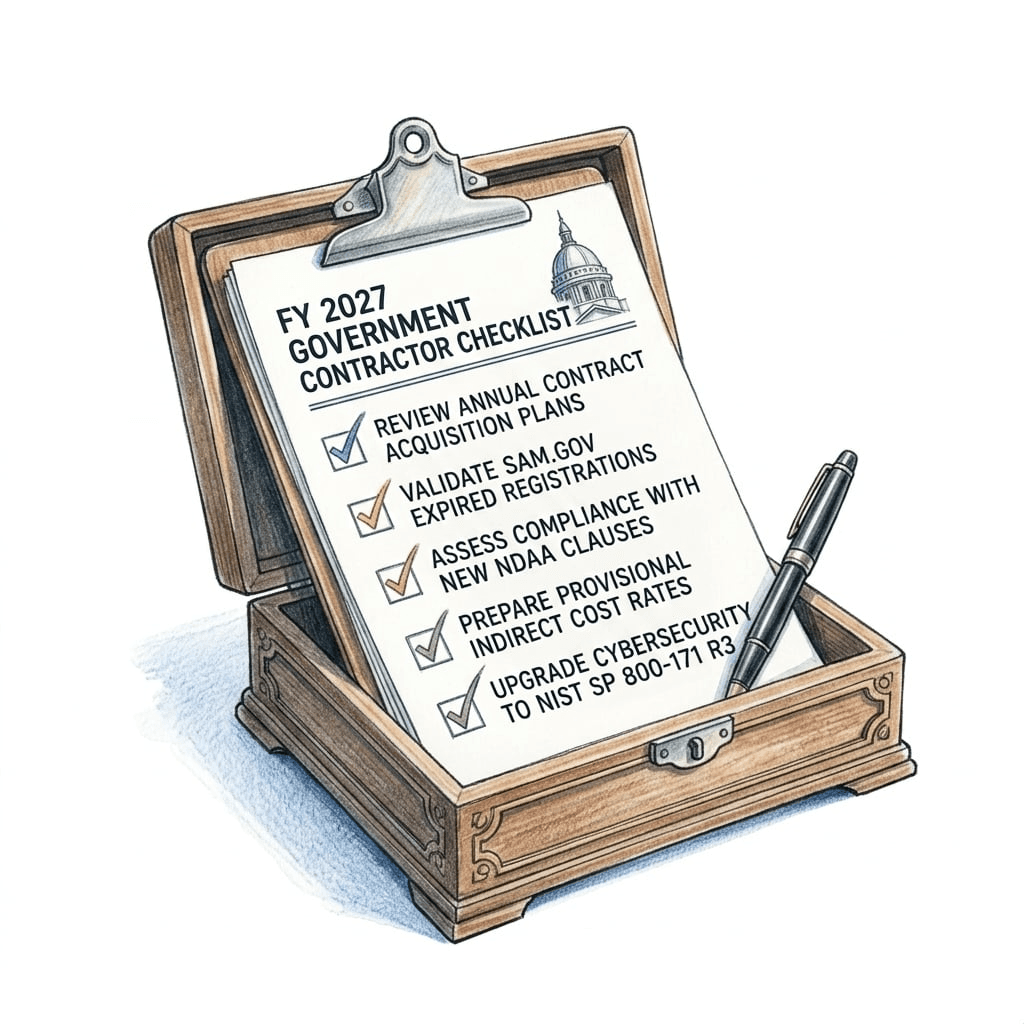
Federal fiscal year 2027 opens October 1. For a growing government contractor with a handful of contracts, that's a tight but manageable window. For an enterprise organization running multiple business units, dozens of active contract vehicles, and simultaneous capture efforts across agencies, eight weeks requires coordinated, portfolio-wide action starting now.
Here's where large GovCon teams should be focusing in August, and why the smartest enterprises are already looking past FY 2027 entirely.
1. Align your portfolio to the FY 2027 budget picture across every business unit
The White House's FY 2027 budget request, released in early April, proposes $1.8 trillion in total spending: $1.15 trillion for defense and $660 billion for civilian programs, with defense dollars concentrated in AI, shipbuilding, unmanned systems, and missile defense, and $75.7 billion proposed for civilian IT (Winvale). It also proposes cuts to the IRS, DHS, and SBA.
For a single-market contractor, that's a data point. For an enterprise with business units spanning defense, civilian, and homeland security, it's a signal to rebalance investment across your portfolio: double down where growth is real, and stress-test revenue assumptions where cuts are proposed.
The House Appropriations Committee, for instance, has already pushed back on some of those civilian cuts, approving a Homeland Security bill on June 11, 2026 that boosts CISA funding to $2.4 billion, $400 million above the administration's request, and restores FEMA grant funding, though the bill has not yet passed the full House or Senate (iQuasar).
On funding continuity, the House passed a continuing resolution on July 22, 2026 to fund the government through December 4, 2026, but the measure now heads to the Senate and has not yet been signed into law (The Guardian). If it clears the Senate and is enacted, FY 2027 will very likely open under a CR, meaning your Q1 revenue forecasts across every division should assume delayed new-start obligations, not a clean October 1 start.
2. Run portfolio-wide capture governance, not isolated business-unit efforts
Large enterprises often run capture independently within each business unit, which means duplicate effort, missed cross-selling opportunities, and inconsistent bid/no-bid discipline. August is the time to consolidate: pull FY 2027 procurement forecasts across every agency account you touch, roll them into a single enterprise-wide capture register, and apply consistent qualification criteria before committing capture resources.
This is also the moment to flag opportunities where two business units could team internally, combining a systems integration division with a cyber division, for example, rather than compete against each other or miss the opportunity to present a stronger, unified team.
3. Get ahead of compliance changes that disproportionately hit large primes
Several recent regulatory changes land hardest on enterprise contractors.
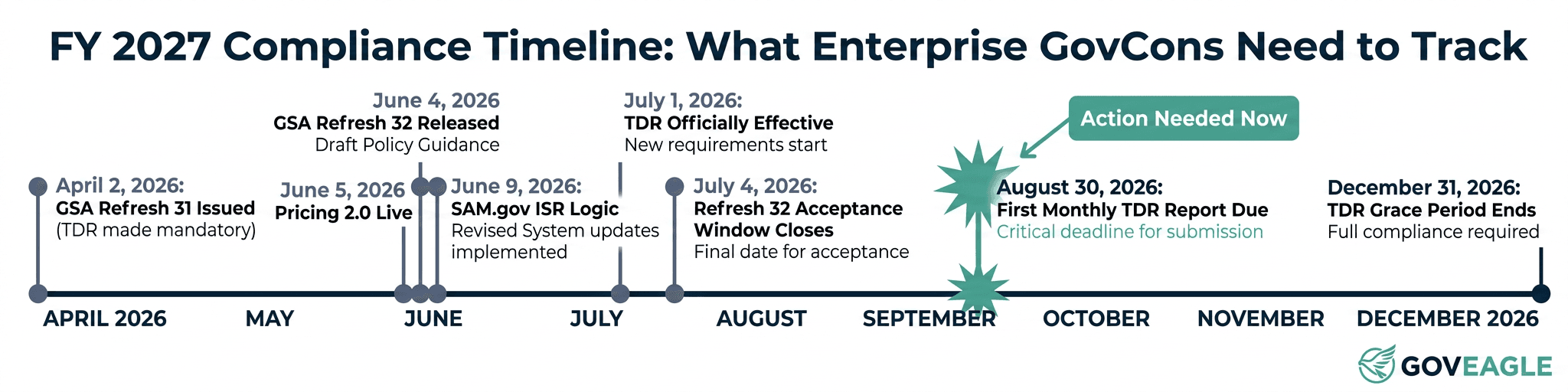
GSA made Transactional Data Reporting mandatory across all Multiple Award Schedule Special Item Numbers under Refresh 31, issued April 2, 2026, and TDR officially took effect July 1, 2026 for contractors who accepted the required mass modification.
GSA has set a six-month grace period through December 31, 2026 before enforcing data quality standards, but the first monthly TDR report, covering July 2026 sales, is due August 30, 2026, a real deadline if your enterprise holds a large, multi-SIN schedule and hasn't yet built out the reporting process (Federal Schedules).
GSA's Refresh 32 followed on June 4, 2026, adding a new DEI clause, tightened past performance requirements, and its "Pricing 2.0" algorithm update on June 5, 2026, designed to flag outlier pricing across MAS contracts.
The 30-day window to accept the Refresh 32 mass modification has already closed, so confirm your enterprise's acceptance is on file rather than treating this as upcoming (Federal Schedules).
On the subcontracting side, a June 9, 2026 revision to Individual Subcontract Report eligibility logic means primes with mandatory subcontracting plans may see a significantly larger volume of contracts and subcontracts appear in their SAM.gov workspace, though SAM.gov notes this increased visibility does not automatically require an ISR submission. Still, it is worth a compliance team review now, before FY 2027 reporting cycles begin (SAM.gov Announcements).
4. Consolidate past performance into one enterprise-grade library
Enterprise proposals live or die on the strength and consistency of past performance across business units. As FY 2026 contracts close out, task every division to submit final CPARS ratings, quantified outcomes, and case studies into a shared, centrally tagged library, organized by agency, contract vehicle, and capability, so any proposal team, in any business unit, can find the strongest example fast.
This matters more at enterprise scale: a technical volume that can draw from your strongest performance anywhere in the company, not just within one division's files, wins against competitors who can only cite a single business unit's track record.
5. Mobilize staffing, teaming, and financial capacity at scale
FY 2027 new-start awards will cluster in the first quarter, and enterprise contractors face a unique risk: multiple large proposals competing for the same key personnel, the same pricing and contracts staff, and the same working capital.
Map your key personnel commitments across every active pursuit now to catch conflicts before they become a problem in November. Confirm teaming and subcontract agreements are signed, not just drafted, and validate that your bonding and working capital capacity can support simultaneous large awards. An enterprise that waits until proposals are due to resolve these conflicts loses time it doesn't have across every pursuit at once, not just one.
6. Don't stop at FY 2027: the enterprise playbook already looks to FY 2028 and beyond
The largest and most sophisticated GovCon organizations aren't treating FY 2027 as the planning horizon. They're using it as one waypoint in a multi-year strategy.
Defense planning is built this way by design: the FY 2027 defense budget request comes packaged with the Future Years Defense Program, which projects appropriations and spending out to 2031 (Janes).
That request also emphasizes multi-year procurement of critical munitions and a goal of a clean DoD audit by FY 2028, both of which require contractors to commit production and compliance investment years ahead of any single award (Heritage Foundation). The Space Force made this concrete in April 2026, seeking industry input on National Security Space Launch Phase 3 missions spanning FY 2027 through FY 2029 (GovConWire).
Civilian IT tells the same story. Customs and Border Protection is executing a plan to migrate its entire 276-application portfolio to the cloud by January 2028, and a 2025 GAO report identified other agency modernization plans with completion dates in December 2028 and beyond (HSToday, GAO).
Congress is pushing agencies further in this direction through the proposed Legacy IT Reduction Act of 2026, introduced in April and still in committee, which would push agencies toward longer-term legacy-system modernization planning government-wide (CGI).
And the contract vehicles enterprises compete through are built on the same long horizon: GSA's Alliant 3 GWAC, awarded in February 2026, runs for 10 years, meaning awardees and competitors alike are already mapping task order strategy and eventual recompete timing years out (GSA).
Industry leaders are saying this out loud. A March 2026 recap from a GovCon consulting firm noted that planning is already underway for "Beyond 2027," urging contractors toward "Strategic Patience" and "Pipeline Management Beyond the Quarter," investing ahead of opportunity rather than reacting quarter to quarter (Red Team Consulting).
The takeaway for enterprise teams: build your FY 2027 action plan so it feeds directly into a longer strategic runway, not as a standalone sprint.
The bottom line
FY 2027 will open under budget uncertainty, tighter compliance requirements, and a compressed award timeline. Enterprise GovCons that treat the five near-term actions above as coordinated, portfolio-wide priorities in August, while keeping an eye on the multi-year defense, IT modernization, and contract vehicle horizons already shaping FY 2028 and beyond, will enter Q1 FY 2027 ready to move fast while competitors are still getting organized.