
The Marine Corps Wants AI Priced Into Your Labor Rates. Now It's Asking How to Order the Work.

Akash Mandavilli
CEO and Co-Founder of GovEagle
About the author
Akash is a 2x founder with previous experience in AI from Meta and federal sales from IBM. Akash holds a dual-degree from Johns Hopkins University in Economics and Computer Science.
What sources sought notice M67854-26-I-4208 says, what the three ordering models mean for your pricing, and why it's worth responding even if you won't bid.
The short version
AI tooling is moving out of its own line item and into your labor rates.
On October 16, 2026, Marine Corps Systems Command (MARCORSYSCOM) updated a sources sought notice titled Marine Corps Cyberspace Environment (MCCE) Operational Support Services (OSS) and Enterprise Artificial Intelligence (AI) Integration. The update, Amendment 03, tells respondents that the cost of any AI tools a contractor brings belongs inside its fully burdened labor rates.
The same amendment asks industry a bigger question. Should the Marine Corps stop ordering this work by labor category and buy "hours of service" or service outcomes instead?
That question is still open. Responses are due November 3, 2026, at 1:00 p.m. ET. If you sell IT operations labor to the Department of Defense (DoD), this is a chance to help design how that work gets bought, whether or not you plan to bid.
What the notice says
The requirement comes from MARCORSYSCOM's Portfolio Acquisition Executive Mission Systems (PAE MS) in Quantico, Virginia. It was first posted September 11, 2026, under NAICS 541513, Computer Facilities Management Services. No set-aside is listed.
The primary requirement is skilled IT touch-labor, meaning people doing hands-on operations and support work. Amendment 03 repeats that point. AI and automation tools are welcome, but only as an embedded part of how the service is delivered, there to augment the workforce. The notice states the goal plainly: to "lower manual touch-labor costs over time."
On price, Amendment 03 resolves a conflict industry raised between two sections of the RFI. This is a services acquisition. Licenses and subscriptions for contractor-provided tools go into the labor part of your rough order of magnitude (ROM) estimate. The separate "Platform Licensing/Subscription" and "Variable/Consumption Costs" lines are only for costs the government would incur on its own platforms, such as ServiceNow credits or Power Platform licensing. If your approach doesn't create those costs, you enter $0.
Amendment 03 also moved the due date from October 19 to November 3. Questions and answers are in final review and will be released in Amendment 04. Amendment 02 closed the window for new questions.
The three ordering models
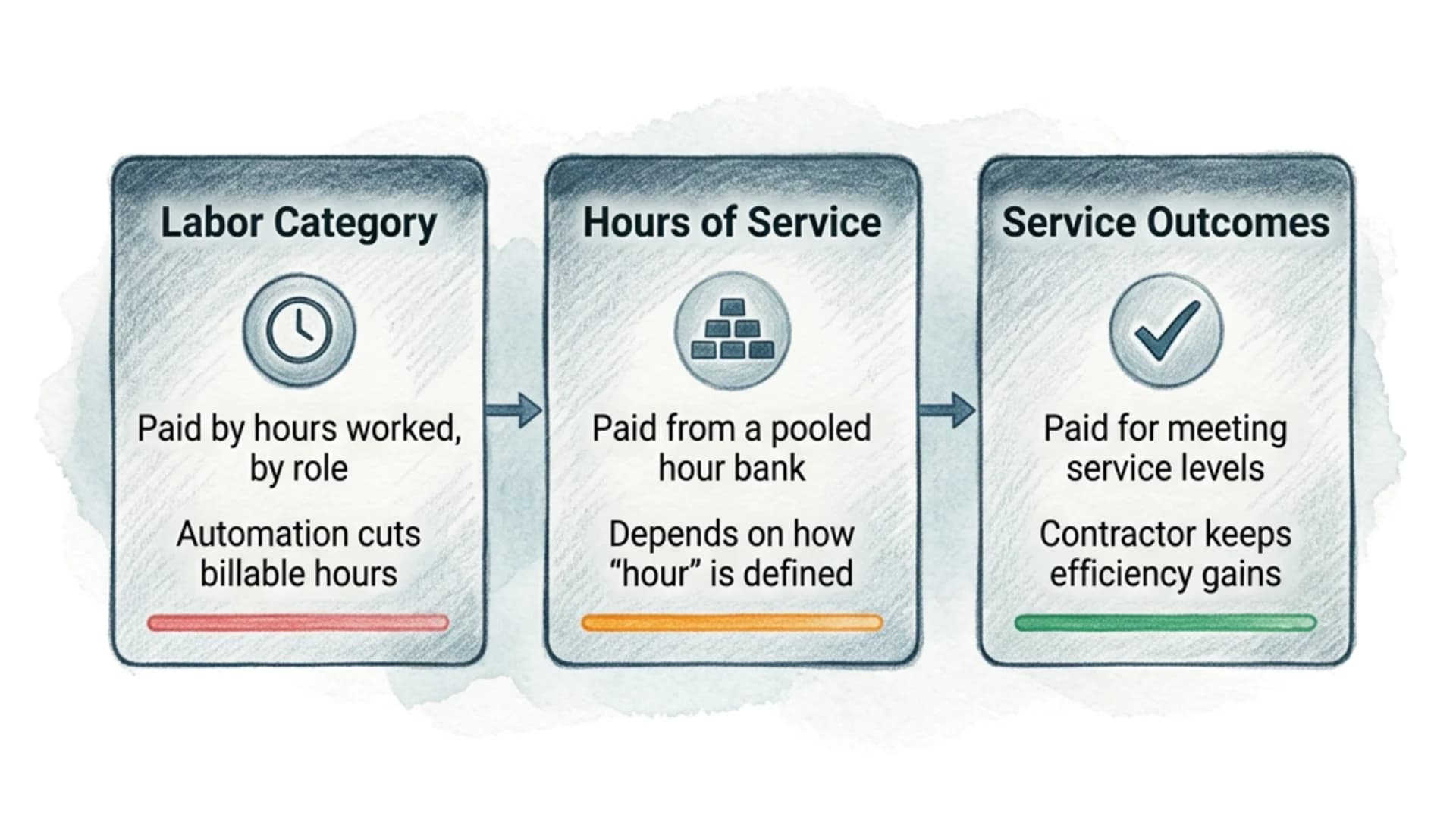
This is the least familiar part of the notice, and the part most likely to shape the eventual contract. The notice names the alternatives but doesn't define them. The descriptions below are how these models typically work, not the Marine Corps' definitions.
1. By labor category. This is the traditional model. The government orders, say, a System Administrator II for a set number of hours at a set rate, and pays for hours worked. The contractor carries the risk that its rates are too low. The government carries most of the risk that the work takes longer than planned.
2. Hours of service. The government buys a pool of hours, often at a single blended rate, and the contractor decides which people and tools deliver them. The contractor now carries mix risk. If the work needs more senior staff than the blended rate assumes, the margin shrinks.
3. Service outcomes. The government pays for results measured against service levels, such as ticket resolution time, system availability or patch windows. The contractor carries the performance risk and much of the volume risk. The government needs reliable baseline data to set fair targets.
The biggest difference between the three is what each one does to the incentive to automate.
| Ordering model | You get paid for | Who carries most of the risk | What automation does to your revenue |
|---|---|---|---|
| Labor category | Hours worked, by role | Government (quantity); contractor (rate) | Cuts billable hours |
| Hours of service | Hours drawn from a pool | Shared; contractor carries the mix | Cuts billable hours, if an "hour" means a person's hour |
| Service outcomes | Meeting service levels | Contractor | Contractor keeps the efficiency gain |
Under labor categories, every hour a tool saves is an hour you can't bill. Hours of service changes that only if an "hour of service" means a unit of delivered coverage rather than an hour a person worked. If you respond, address that definition directly.
Under outcomes, a contractor that automates well keeps the savings, which is the behavior the notice says it wants. It's also the model where the contractor has the most to lose if the baseline is wrong.
Get GovCon capture and proposal insights in your inbox.
Who benefits, who's at risk
This section is our analysis. None of it comes from the notice.
The incentive problem. The notice wants touch-labor costs to fall. If the final contract orders by labor category or by hours worked, the contractor that automates the most bills the least. Without a way to share savings, the ordering model may work against the notice's own goal.
Rates that look high. Folding tool costs into burdened rates pushes those rates above the same labor category without tools. If evaluators compare them with historical labor-category rates or General Services Administration (GSA) Schedule ceiling rates, the offers with the most tooling may look the most expensive.
Lock-in at recompete. When a contractor's own tools run the workflows, the scripts, automations and ticket history may live inside software the government doesn't own. That could raise transition costs at recompete and favor the incumbent, unless data rights and transition terms are settled up front.
Authorization hurdles. Contractor-owned AI tools on Marine Corps networks would likely need an authority to operate (ATO). Vendors whose tools already hold DoD authorizations may have a head start. Others may wait months before a tool can be used at all.
Claims no one can check. Any respondent can say AI will cut effort by some percentage. Without baseline metrics and an agreed way to measure, those claims may be impossible to verify, whichever model the Marine Corps chooses.
Bundling pressure. The notice describes consolidating professional services at enterprise scale. Tool costs carried inside rates are easier to absorb across a large workforce. Small and mid-size firms may find it harder to compete as a prime and may be pushed toward teaming or subcontracting.
On balance, the likely winners are large integrators with mature tooling and existing authorizations, plus specialist firms that can prove their automation on real metrics. The firms most at risk are those whose current Marine Corps work is priced by labor category and hour, and anyone whose tools can't be authorized in time.
Why respond even if you won't bid
A sources sought response is market research, not a proposal. Agencies use these responses to understand who can do the work and, often, to shape the acquisition strategy, including set-aside decisions. This notice asks directly how to structure ordering and measure performance. Those choices may carry into the solicitation.
A useful response could cover:
- A recommended ordering model, with your reasons and how the risk would be split.
- A definition of an "hour of service," if you recommend that model.
- Proposed service levels, a baseline period, and how performance would be tracked.
- How price reasonableness should be judged for rates that include tools.
- Who owns automations and data at transition, and who carries the cost and schedule of an ATO.
Amendment 03's format limits:
- Capabilities Narrative: 5 pages, PDF.
- Supplementary Materials (optional): separate, up to 15 pages, PDF.
- Vendor Comment Matrix: native Microsoft Excel (.xlsx), with a 300-word limit per cell.
Read the full package on SAM.gov and check for Amendment 04 before you submit. Don't work from secondhand summaries, including this one. At least one newsletter has called OSS "open source." In this notice, it stands for Operational Support Services.
Where GovEagle fits
GovEagle is software for business development, capture and proposal teams. It doesn't run help desks, patch servers or do any IT operations work.
Where it helps is the response itself. A five-page narrative plus a comment matrix, due in two weeks, is hard to start from a blank page. GovEagle drafts RFI responses in Word from your own past performance and content library, so your team can spend its time deciding what position to take on ordering and measurement. One customer, Chevo, cut its RFI prep time by 30 to 40 percent.