
Finding and Using PSC Codes in Government Contracting

Akash Mandavilli
CEO and Co-Founder of GovEagle
About the author
Akash is a 2x founder with previous experience in AI from Meta and federal sales from IBM. Akash holds a dual-degree from Johns Hopkins University in Economics and Computer Science.
Most BD teams look up PSC codes when they need to fill in a field, which is fine, but it leaves a lot of market intelligence on the table. The same codes that populate a solicitation also organize years of FPDS award history by agency, vehicle, and incumbent. Understanding how the four-character structure works, and which tools actually reflect the current code list, gets you to better pipeline decisions faster.
TLDR:
- PSC codes are four-character codes required on every FPDS contract action; wrong codes distort your market research.
- NAICS codes describe your business; PSC codes describe what the government bought, and conflating them creates SAM.gov registration errors.
- Verify all codes against the April 2025 PSC Manual at acquisition.gov before using them in proposals or registrations.
- Filtering FPDS by PSC surfaces agency spend volume, incumbent patterns, and contract vehicle concentration for BD prioritization.
- GovEagle lets BD teams filter solicitations by PSC alongside NAICS, so pipeline development starts from documented spend patterns.
What PSC Codes Are and Why They Matter
A Product and Service Code (PSC) is a four-character code for federal contracting to classify products, services, and R&D purchased under contract. GSA maintains the full list through the PSC Manual, and the code appears as a required data field on every contract action reported to the Federal Procurement Data System (FPDS). Without an accurate PSC, the government's spend tracking breaks down, and contractors who misread the codes they compete under risk misreading the market entirely.
How PSC Codes Are Structured
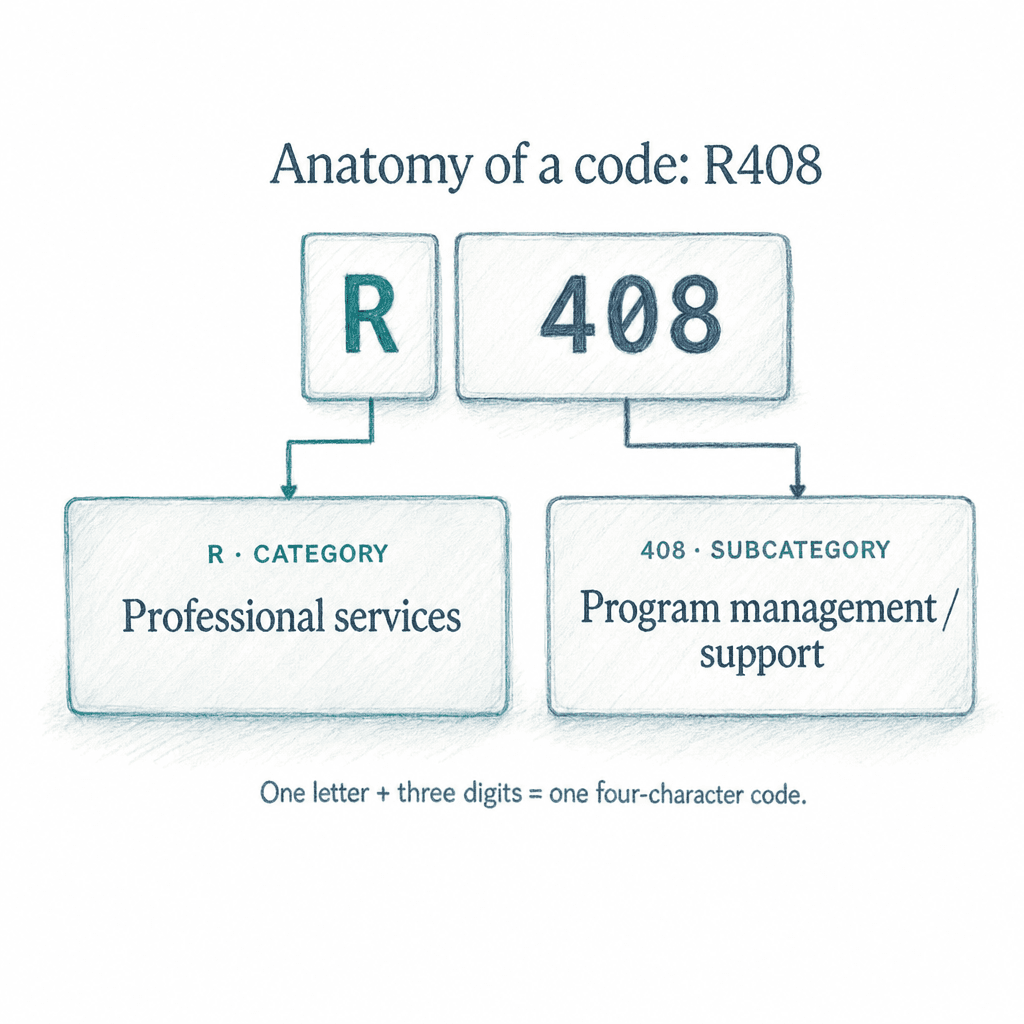
PSC codes follow a consistent four-character logic: the first character signals the broad category, and the remaining three narrow it to a specific product, service, or R&D activity.
The system divides into three top-level categories:
- Products: Product codes are numeric and organized by two-digit Federal Supply Group (e.g., FSG 10 for weapons, FSG 58 for communication, detection, and coherent radiation equipment)
- Services: First character is a letter (e.g., "D" for IT services, "R" for professional services)
- Research and Development: All R&D codes begin with A; the second letter identifies the field (e.g., AA for agriculture)
A code like R425 breaks down as "R" for support services, with "425" specifying the type. That granularity is what makes PSCs more precise than NAICS codes for describing what the government is actually buying.
PSC Codes vs. NAICS Codes
NAICS codes identify the type of industry a business operates in and set the size standard thresholds that determine small business eligibility on a given contract. PSCs identify what the government is actually buying. As Iowa State's CIRAS program notes, "NAICS codes identify a type of industry, whereas PSCs more specifically identify the products and services the government is purchasing."
Most solicitations carry both codes. A contract for IT consulting might list NAICS 541512 and PSC DA01. The NAICS code determines whether your firm qualifies as small; the PSC tells you exactly what the agency is buying. Registering the right NAICS codes in SAM.gov matters for set-aside eligibility, but it won't tell you which PSCs dominate your target agencies' spending, which competitors keep winning those codes, or where the pipeline is growing.
The PSC Manual: The Official Reference
GSA publishes and maintains the PSC Manual as the authoritative reference for all federal product and service codes. The current version is the April 2025 edition, available at acquisition.gov in PDF, Word, and Excel formats.
The manual covers code definitions, environmental reporting requirements, R&D stage definitions, IT service code categories, and change control procedures governing when codes are added or retired. Pull directly from acquisition.gov before using any PSC in a proposal, SAM registration, or market research effort, because outdated editions circulate widely online.
How to Look Up PSC Codes: Tools and Resources
Three resources cover most lookup needs: the DoD PSC Selection Tool for code identification, FPDS-NG for spend research, and the April 2025 PSC Manual for authoritative code definitions.
DoD PSC Selection Tool
The DoD PSC Selection Tool supports keyword search, direct code search, GSA spend category filters, and DoD's 16-group taxonomy. It also surfaces suggested NAICS codes for many PSCs and maps codes to Object Classification Codes for cross-referencing spend data. Use it when identifying which PSC to list on a solicitation response or validating a code before registering in SAM.gov.
Matching the Tool to the Task
- FPDS-NG: market research on agency spend by PSC, incumbent concentration, and contract ceiling sizes
- SAM.gov: opportunity pipeline filtering using PSC fields populated directly on agency solicitations
- April 2025 PSC Manual from acquisition.gov: code definitions and historical context
The 16 DoD Portfolio Groups
The DoD organizes all PSCs into sixteen portfolio groups: nine covering services and seven covering products. This taxonomy underlies the DoD PSC Selection Tool and reflects how the department views its own spend.
Service Portfolio Groups
- Knowledge Based Services (e.g., R408 program management support, R425 engineering and technical support)
- Electronic & Communication Services
- Equipment Related Services (e.g., J058 maintenance of communication equipment)
- Facility Related Services
- Construction Services (e.g., Y1AA construction of office buildings)
- Medical Services (e.g., Q301 reference laboratory testing)
- Research & Development (e.g., AA11 agriculture R&D, basic research)
- Transportation Services
- Logistics Management Services
Product Portfolio Groups
The DoD also covers seven product portfolio groups. Verify current group names against the DoD PSC Selection Tool before citing them in capability statements or market analysis.
Knowing which group your offering falls under shapes how you search opportunities in FPDS and how contracting officers categorize what they buy. The groups also drive how the DoD aggregates spend data for strategic sourcing decisions, so understanding yours helps you frame market research around the right competitive cohort.
Common PSC Codes by Category
The table below maps the most common PSC categories to their code prefixes and representative examples.
| Category | Code Prefix | Example Codes |
|---|---|---|
| IT Services | D-series (incl. DA-DK) | DA01 (IT and Telecom - Business Application/Application Development Support Services (Labor)) |
| Professional Services | R-series | R408 (program management support), R425 (engineering and technical support), R499 (other professional services) |
| Construction | Y-series | Y1AA (construction of office buildings) |
| R&D | A-series | AA11 (agriculture R&D, basic research) |
| Transportation | V-series | Consult the April 2025 PSC Manual for current V-series codes |
Service codes use letters; product codes use numbers. Within services, the letter identifies the service family and the trailing characters narrow the specific activity. 7-series codes classify IT products rather than IT services and belong in a separate product category from the D-series service codes.
A few categories worth knowing in detail:
- R-series codes cover professional and management support services. R425 designates engineering and technical support, while R408 covers program management support (Program Management/Support Services), and R499 catches professional services that fall outside narrower R-series definitions. Check whether a more precise code exists before defaulting to R499.
- D-series and DA-prefix codes cover IT. DA01 designates IT management services. GSA has restructured portions of the IT PSC taxonomy over successive PSC Manual editions, so older D-series references may point to end-dated codes such as D305, which was retired in 2019.
- Y-series codes cover construction. The four-character structure gets specific quickly: Y1AA is construction of office buildings, while other Y-prefix codes distinguish facility type and construction activity.
Get GovCon capture and proposal insights in your inbox.
How PSC Codes Are Used in FPDS Reporting
FAR 4.606 requires federal agencies to report all contract actions above the micro-purchase threshold to FPDS, and every action must carry an assigned PSC. That code is how the government categorizes what it spent money on: not which vendor won, not which agency paid, but what was actually purchased. When a contracting officer assigns the wrong PSC, that action gets counted in the wrong spend bucket, distorting both agency reporting and the competitive intelligence contractors extract from FPDS.
For BD professionals, FPDS organized by PSC code is the primary raw material for market research. Filtering by PSC surfaces which agencies are buying what you sell, at what volume, and through which contract vehicles. Misassigned codes create gaps in that picture: an IT management services award miscoded as general professional services disappears from D-series spend analysis entirely.
"PSCs indicate what the government has purchased for each contract action, and these purchases are tracked in the Federal Procurement Data System." (DoD PSC Quick Guide)
When FPDS data looks thin for a PSC you know is active, check whether incumbents are winning under adjacent codes. Spend patterns in FPDS reflect both procurement activity and coding discipline, and those two things are not always the same.
Using PSC Codes for Market Research and Pipeline Development
PSC-based filtering is where pipeline development actually starts. On SAM.gov, entering a PSC into the opportunity search returns active solicitations tagged to that code. In FPDS, the same code surfaces historical awards: which agencies spent, how much, and through which vehicles.
The practical sequence for a BD team:
- Identify the PSC codes that map to your capabilities using the DoD Selection Tool
- Pull FPDS spend data by PSC and agency to find where annual volume concentrates
- Cross-reference those agencies' NAICS code usage to confirm small business set-aside patterns
- Filter SAM.gov by those PSCs to track active and upcoming solicitations
Volume alone does not drive prioritization. An agency spending heavily under R425 through a single incumbent on a long-running IDIQ may offer less near-term opportunity than a smaller agency with a fragmented award pattern and an expiring base period. PSC data from FPDS tells you the spend; contract structure and ceiling data tell you whether the door is open.
PSC Codes and Environmental Reporting Requirements
Certain PSC codes trigger environmental data fields in FPDS that contractors often overlook until a solicitation surfaces a sustainability requirement. The PSC Manual designates specific product codes as subject to biobased reporting under the USDA's BioPreferred program and sustainability and biobased reporting fields designated in the PSC Manual, requiring contracting officers to populate additional FPDS fields.
For contractors, two practical implications follow. If your product falls under a PSC with biobased or green procurement designations, your solicitation response may need to document compliance explicitly. When researching FPDS spend data under those codes, the environmental fields can also reveal whether an agency favors certified products, which affects how you position against incumbents.
Review the April 2025 PSC Manual before assuming a code is environmentally neutral, especially in facilities, supplies, and construction categories where biobased triggers are most common.
Common PSC Code Errors and How to Avoid Them
Four errors account for most PSC mistakes in practice.
GSA end-dates codes in each PSC Manual update, and outdated editions circulate widely online. D305 (IT teleprocessing and cloud) was end-dated in 2019; contracts still referencing it create FPDS anomalies that skew spend analysis for anyone researching that space.
Defaulting to an overly broad code when a specific one exists is equally common. R499 catches professional services that lack a narrower home, but teams frequently apply it to work that belongs under R425 or another specific R-series code. Your FPDS profile then accumulates awards under a catch-all code that contracting officers rarely filter on, reducing visibility in PSC-based source searches.
Confusing PSC with NAICS is most common when firms new to federal contracting populate SAM.gov or capability statements. The NAICS code describes your business; the PSC describes what the government bought. Conflating them produces registration errors that affect set-aside eligibility screening.
Applying a product code to a services contract, or vice versa, distorts agency spend reports and creates discrepancies between what a contractor claims to deliver and what FPDS shows they have won. A services contract miscoded under a numeric product prefix disappears from agency service-spend analysis entirely.
Before registering codes in SAM.gov or citing them in a proposal, verify against the April 2025 PSC Manual at acquisition.gov and cross-check recent FPDS awards to confirm the code is active and consistently used by the agencies you target.
PSC Codes in IDIQ and GWAC Vehicles
On a multiple-award IDIQ or GWAC, the master contract typically covers a broad range of PSC codes reflecting the vehicle's intended scope. OASIS+ domain contracts, for example, carry dozens of eligible PSCs spanning professional services, management and advisory, technical and engineering, and R&D categories. The task order is where the PSC narrows: an agency issuing one under OASIS+ for program management support will assign R408 to that action regardless of the parent vehicle's broader coverage.
That distinction matters for BD teams running FPDS research. Award data rolls up at the task order level, so filtering by PSC reflects what was actually bought. A competitor with OASIS+ access showing heavy R425 awards and minimal DA01 activity tells you where their delivery footprint actually sits.
Two practical points follow:
- When assessing whether a vehicle is worth pursuing, look at the PSC distribution of task orders already awarded under it, beyond the vehicle's authorized code list. Concentration in a few PSCs often signals agency preference patterns that shape future task order competitions.
- When tracking incumbents, their FPDS award history filtered by PSC and vehicle tells you more about their actual competitive position than their GSA Schedule listing or vehicle on-ramp ever will.
How GovEagle Uses PSC Intelligence Across the Pursuit Lifecycle
GovEagle's BD and capture solution lets teams filter federal solicitations by PSC code alongside NAICS codes, so pipeline development starts from documented agency spend patterns instead of keyword guesses. When a solicitation surfaces under R425 at an agency where FPDS shows three consecutive incumbents holding that code, the capture picture differs from a first-time award under the same PSC at a different agency. That distinction shapes the bid/no-bid call before the RFP drops. And if you want to see how PSC-based opportunity filtering works inside a live pipeline, Book a Demo to walk through it with the GovEagle team.
PSC data also feeds into black hat analysis. Which codes does your most likely competitor hold across active IDIQs? Where are they thin? GovEagle's continuous monitoring tracks PSC-tagged opportunities through the solicitation cycle, supporting pipeline tracking beyond SAM.gov so capture teams skip the manual checks when a recompete changes PSC or scope.
When an opportunity qualifies, PSC-coded data flows from Salesforce or HubSpot into the proposal workspace through GovEagle's CRM integrations. The pipeline intelligence captured during BD, including which PSC the agency used on prior awards and what that signals about evaluation emphasis, reaches the proposal team without manual re-entry. That continuity is where PSC intelligence stops being a lookup exercise and starts driving win strategy.
Final Thoughts on What PSC Codes Mean for Your Federal BD Strategy
Once you treat PSC codes as market intelligence beyond a required field, your FPDS research gets more specific and your pipeline targeting gets more deliberate. The April 2025 PSC Manual is your starting point, and the DoD Selection Tool handles the lookup work. From there, it is a matter of cross-referencing spend data, tracking incumbent patterns, and filtering SAM.gov with codes that actually match what agencies buy. That intelligence carries through from BD into the proposal workspace, and the firms that structure that handoff deliberately are the ones whose capture teams walk into a recompete already knowing the incumbent's PSC footprint.
FAQ
What are PSC codes and how do they differ from NAICS codes in federal contracting?
PSC codes are four-character codes that classify what the federal government is actually buying on a given contract action, reported through FPDS on every award above the micro-purchase threshold. NAICS codes identify the industry a business operates in and set small business size standard thresholds for set-aside eligibility. A solicitation for IT consulting might carry both NAICS 541512 and PSC DA01; the NAICS code determines whether your firm qualifies as small, and the PSC tells you what the agency is purchasing.
Where can I do a free PSC codes lookup to find current, active codes?
The most reliable free options are the April 2025 PSC Manual at acquisition.gov (available in PDF, Word, and Excel) and the DoD PSC Selection Tool, which supports keyword search, direct code lookup, and GSA spend category filters. Pull from acquisition.gov before using any PSC in a proposal or SAM registration, as outdated editions circulate widely and retired codes like D305 (end-dated in 2019) can skew FPDS spend analysis if referenced.
PSC codes vs. NAICS codes for SAM.gov registration: which matters more for pipeline research?
Both matter, but for different jobs. Registering the right NAICS codes in SAM.gov drives set-aside eligibility screening. PSC codes, filtered through FPDS, drive market research by surfacing which agencies buy what you sell, at what volume, through which vehicles, and with what incumbent concentration. A BD team that only tracks NAICS data will miss the spend patterns that reveal where a competitor holds three consecutive task orders under R425 at a target agency, or where a first-time award under DA01 signals an opening.
How do I use PSC code data from FPDS to research incumbents and pipeline?
Filter FPDS by the PSC codes that map to your capabilities, then layer in agency and contract vehicle fields to surface award history: who won, how often, and at what ceiling sizes. Heavy incumbent concentration under a single code at one agency often signals a long-running IDIQ with limited near-term access, while a fragmented award pattern and an expiring base period at a smaller agency may represent a better near-term target. Volume alone does not drive prioritization; contract structure and ceiling data tell you whether the door is open.
Can PSC code intelligence feed directly into bid/no-bid decisions before an RFP drops?
Yes, when PSC-tagged spend data is connected to your capture workflow instead of treated as a separate lookup exercise. As the IDIQ and GWAC section above shows, incumbent patterns visible in FPDS at the task-order level shape the bid/no-bid call before a solicitation is ever published. GovEagle's opportunity search lets BD teams filter by PSC alongside NAICS codes, and its continuous monitoring tracks PSC-tagged solicitations through amendment cycles, so the spend intelligence gathered during research reaches the proposal team without manual re-entry through CRM integrations with Salesforce and HubSpot.