
What Is a Pink Team Review? A Complete Guide for September 2026

GovEagle is not affiliated with, sponsored by, certified by, or otherwise associated with Shipley Associates.
Your proposal draft is 70% complete and the structure looks right on the surface, but no one has traced each section back to the RFP’s evaluation criteria or confirmed that win themes show up where evaluators will score them. That gap rarely shows up until it’s expensive to fix. Pink Team is the checkpoint that surfaces those issues while the draft is still flexible, giving your team time to correct structure, strengthen positioning, and avoid late-stage rework. Here’s how it fits into the color team sequence, when to schedule it, and how to keep reviewers focused on what actually impacts scoring.
TLDR:
- Pink Team reviews happen at 60-70% draft completion to catch structural and strategic issues before Red Team.
- Schedule Pink Team once the draft reaches 60-70% completion, which often falls around day 7-8 on 30-day RFPs or day 10-11 on 45-day timelines.
- Focus on RFP compliance, win theme integration, and content gaps, not grammar or line edits.
- AI-assisted drafting and compliance checks produce Pink Team-ready drafts in hours, improving draft quality before review begins.
- Structured reviewer scorecards tied to Sections L and M produce actionable feedback instead of subjective comments.
What Is a Pink Team Review in Government Contracting?
A Pink Team review is an internal evaluation of your proposal draft at roughly 60-70% completion, the first major structured checkpoint during proposal development after drafting begins. Reviewers aren't reading for polish. They're asking harder questions: Does the outline hold up against Sections L and M? Are win themes woven into the narrative, or listed as bullet points evaluators will skim past? Does each section respond to what evaluators score under Section M criteria?
The Pink Team sits within the broader color team review sequence that most government contractors follow, often based on the Shipley proposal process. Each color serves a distinct purpose at a distinct phase.
| Review | Stage | Primary Focus |
|---|---|---|
| Pink Team | ~60-70% draft | Structure, win themes, compliance alignment |
| Red Team | Full draft | Evaluator-perspective scoring and weakness ID |
| Gold Team | Near-final | Executive approval and overall messaging |
| White Glove | Final | Formatting, production, submission readiness |
Pink is where changes are still inexpensive. By Red Team, you're editing a full draft. By Gold Team, you're mostly defending what's already written.
The Color Team Review Framework Explained
Not every opportunity needs every color. The framework gives proposal managers structured decision points, not a checklist to follow on every bid. Here's how the sequence breaks down:
- Blue Team: Validates capture strategy and confirms the go/no-go decision before proposal work begins
- Pink Team: Reviews the early draft for structure, strategy, and compliance alignment
- Red Team: Reviews the full draft from the evaluator's perspective, scoring for weaknesses
- Green Team: Focuses on pricing and cost volume reasonableness, used mainly on cost-heavy solicitations
- Gold Team: Senior leadership review for executive sign-off on messaging and risk
- White Glove: Final production check before submission
Smaller teams often collapse Green into Red, or skip Blue entirely if capture happened informally. Pink reviewers are the primary checkpoint for catching structural and strategic problems before the writing is locked in. Skip Pink and go straight to Red, and you risk Red Team comments arriving too late to fix foundational problems without substantial rework.
When to Schedule a Pink Team Review
The general rule is scheduling Pink Team when the draft reaches roughly 60-70% completion, which typically falls within the first half of the proposal timeline depending on how quickly drafting begins. Many government solicitations allow around 30 days for proposal preparation, with longer timelines such as 45 days more common for complex or set-aside opportunities. On a 30-day window, that puts your Pink Team review around day seven or eight. On a 45-day window, you're looking closer to day ten or eleven.
A few scheduling considerations worth building into your process:
- Lock the Pink Team date on Day 1 of proposal kickoff, not as an afterthought
- Allow at least 48 hours after review for the team to process feedback before revision begins
- For complex, multi-volume proposals, consider a rolling Pink Team by volume instead of waiting for all sections
- If the RFP dropped with a short turnaround, compress the review window but don't eliminate it
Key Objectives and Focus Areas of Pink Team Reviews
Without defined focus areas, reviews devolve into grammar debates that consume time without improving the proposal. The five areas every Pink Team should cover:
- RFP compliance: Does the draft structure map directly to Sections L and M? Are all required sections present and in the right order?
- Win theme integration: Are discriminators visible in the narrative, or buried in bullet points that evaluators will skim past?
- Capture alignment: Does the draft reflect what was promised in the capture strategy, or did the writing team drift?
- Messaging consistency: Do the same strengths get reinforced across volumes, or does each section read like a different proposal?
- Content gaps: Which sections are thin, placeholder-heavy, or missing proof points entirely?
Give reviewers a structured scorecard tied to these five areas before the session. Subjective feedback like "this section feels weak" is hard to act on. Scored criteria with comment fields produce revision roadmaps. A Pink Team that only reviews what is written misses what is absent, and gaps surfaced at Red Team require a scramble.
Who Should Participate in Your Pink Team
The best Pink Team mixes people who know the opportunity with people who didn't write the draft. A workable composition:
- Capture manager: Confirms the draft reflects capture intelligence and win themes
- Proposal manager: Owns compliance and structure against Sections L and M
- One SME per technical area: Validates solution accuracy without rewriting sections
- One reviewer with no prior involvement: Catches assumptions the writing team made without realizing it
Avoid loading the session with the original writers or executives who might redirect strategy mid-review. Save executive input for Gold Team.
Common Pink Team Review Challenges and How to Avoid Them
Pink Team reviews fail in predictable ways. The most common issue: reviewers show up without reading the RFP and give feedback based on what sounds good instead of what the solicitation requires. Fix this by sending a pre-read packet at least 48 hours before the session: Sections L and M, the win theme summary, and the capture brief.
Copy editing is a close second. Reviewers default to grammar because it feels productive. Set the expectation before the session, and if someone starts marking up sentences, redirect them to the scorecard. When reviewer feedback conflicts, designate the proposal manager as final arbiter. Feedback gets logged, conflicts get resolved, revisions get assigned.
A few rules worth enforcing:
- No proofreading or line edits during Pink Team
- Reviewers must cite the RFP section driving each concern
- All feedback goes through a single consolidation log, not separate email threads
- Capture manager has final say on win theme disputes
Writers typically need several days to get a reviewable draft together, depending on scope and timeline. Reviewers need 48 hours to read it. Build both into the schedule from Day 1.
Get GovCon capture and proposal insights in your inbox.
Preparing Your Proposal Draft for Pink Team Review
"Pink Team ready" means reviewable, not polished. Set a clear standard upfront so writers know what to bring and reviewers know what to expect. A Pink Team-ready draft typically includes:
- Full section narratives, even if rough, covering at least 60% of required content
- Placeholder graphics or tables where visuals are planned, labeled with intended data
- Win themes visible in each section, even if just bracketed reminders
- Basic formatting that mirrors the final submission structure
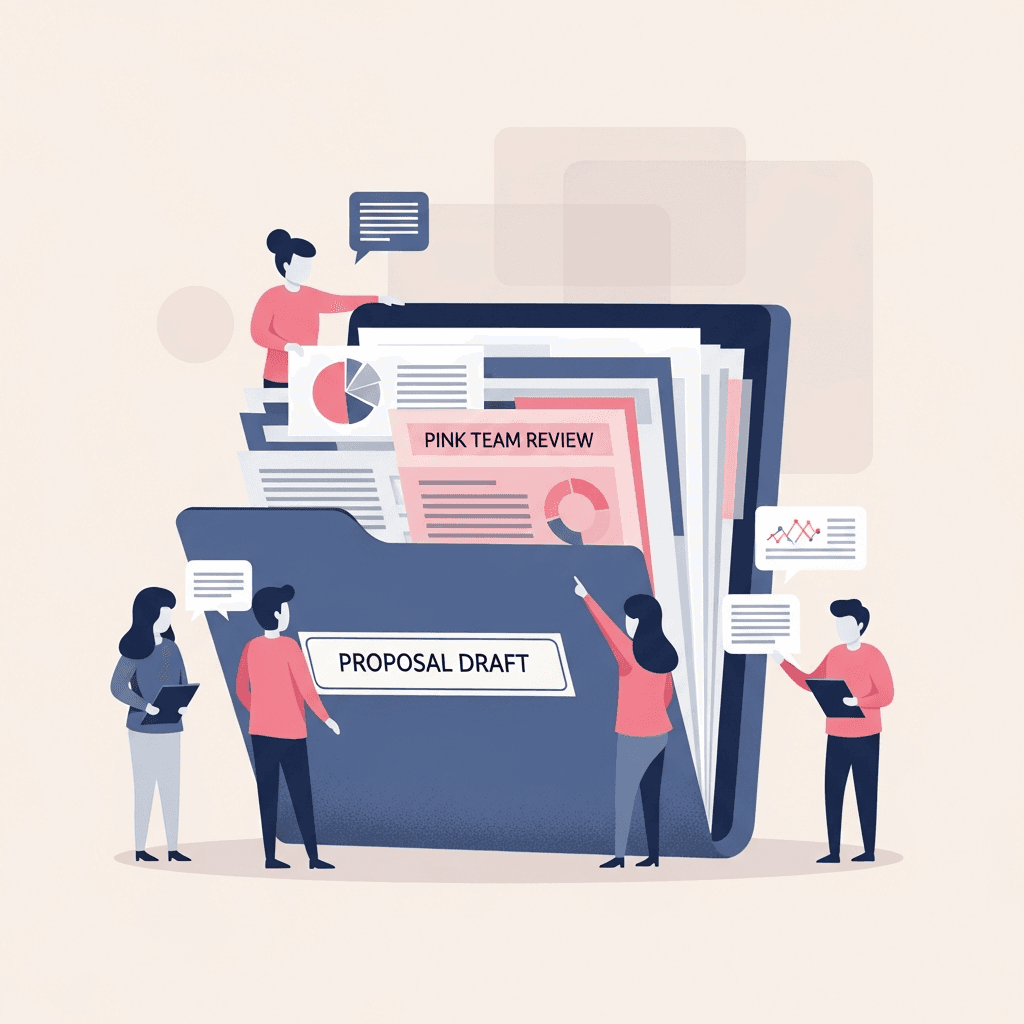
Sections marked "TBD" give reviewers nothing to assess. Hold them back with a noted gap, or assign a placeholder narrative that signals intent.
Conducting an Effective Pink Team Review Session
Structure the session into four phases. Before the session, send reviewers a pre-read packet including Sections L and M, the win theme summary, and the draft. Open with a ten-minute kickoff: restate scope and ban line edits explicitly. During review, keep each section time-boxed and capture comments in one consolidated log. Close with a brief caucus where the proposal manager resolves conflicts and assigns revision owners before anyone leaves the room.
The goal is agreement on which comments drive revision priority, not consensus on every comment.
Turning Pink Team Feedback into Actionable Revisions
Raw feedback is a starting point, not a revision plan. Sort, rank, and assign before a single writer opens a document:
- Critical: Compliance gaps, missing required sections, win themes absent from key volumes
- High: Strategy drift, weak proof points, inconsistent messaging across sections
- Deferred: Style preferences, minor structural suggestions, items better suited for Red Team
When two reviewers disagree, the tiebreaker is the RFP evaluation criteria. Track every comment through to resolution: comment, source, priority, assigned owner, and status. Feedback that gets logged and ignored is worse than no review at all.
Pink Team Reviews for Fast-Turnaround Proposals
Short turnarounds compress the Pink Team; they don't eliminate it. When a solicitation drops with a 10-day window, a short, targeted review focused on the highest-weighted sections is often the most practical approach. Everything else gets a compliance spot-check.
Three approaches worth considering based on timeline:
- Rolling micro-reviews: reviewers assess sections as they're completed instead of waiting for a single draft milestone
- Targeted section review: full Pink Team effort directed at technical approach and management volumes only
- Solo compliance audit: proposal manager alone maps draft structure against Sections L and M before Red Team
Skipping Pink Team on a fast-turnaround is a defensible call when the opportunity doesn't warrant it. Skipping it without making that call consciously is how compliant-but-uncompetitive proposals get submitted.
How AI and Automation Are Changing Pink Team Reviews
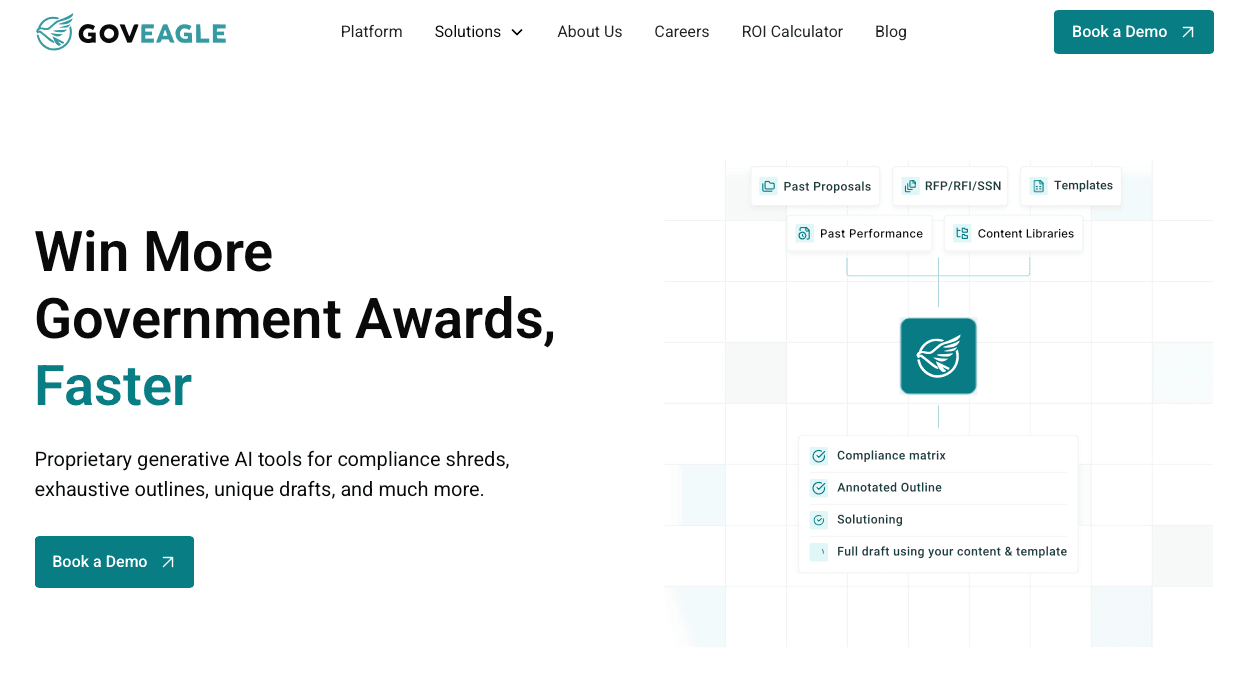
AI changes the Pink Team calculus in one concrete way: the draft you bring into review is stronger before the first comment is written. GovEagle's AI-assisted drafting generates a Pink Team-ready draft in hours, pulling from your past proposals and boilerplate in the correct voice and format.
The automated compliance review runs simultaneously, flagging missing requirements before reviewers open the document. For smaller teams, that matters; a two-person shop can arrive at Pink Team with a level of structural rigor that typically requires days of manual review cycles.
The downstream effect is a better use of reviewer time. When the draft is already structurally sound and compliant, Pink Team sessions shift away from catching basic gaps and toward pressure-testing win themes and discriminators. That's the conversation that actually moves the needle on your score.
FAQs
What's the difference between a Pink Team and Red Team review?
Pink Team reviews your proposal when it's 60-70% complete, focusing on structure, win theme integration, and compliance alignment before the draft is fully written. Red Team reviews the complete draft from an evaluator's perspective to score for weaknesses. Pink catches foundational problems when changes are still inexpensive to make.
Who should participate in a Pink Team review session?
Include your capture manager (to confirm the draft reflects win themes), proposal manager (for compliance oversight), one SME per technical area (for solution validation), and one reviewer with no prior involvement in the opportunity. Avoid loading the session with the original writers or executives who might redirect strategy mid-review.
Can I run a Pink Team review on fast-turnaround proposals?
Yes, but compress the format instead of skipping it entirely. For short turnarounds, run a short, targeted review focused only on sections tied to the highest-weighted evaluation criteria, or conduct rolling micro-reviews as sections are completed. Reserve full Pink Team sessions for recompetes and strategically valuable opportunities.
Final Thoughts on Making Pink Team Reviews Work
Pink Team delivers the most value when it forces real decisions early, while the draft can still change direction without major rework. Teams that treat it as a structured checkpoint catch compliance gaps, strengthen win themes, and walk into Red Team with a draft that holds up under evaluation criteria. GovEagle supports that outcome by building Pink Team-ready drafts with compliance alignment and win themes already in place, so reviewers spend their time on strategy instead of basic fixes.