
6 RFP Automation Software Tools for GovCon Teams in September 2026

Akash Mandavilli
CEO and Co-Founder of GovEagle
About the author
Akash is a 2x founder with previous experience in AI from Meta and federal sales from IBM. Akash holds a dual-degree from Johns Hopkins University in Economics and Computer Science.
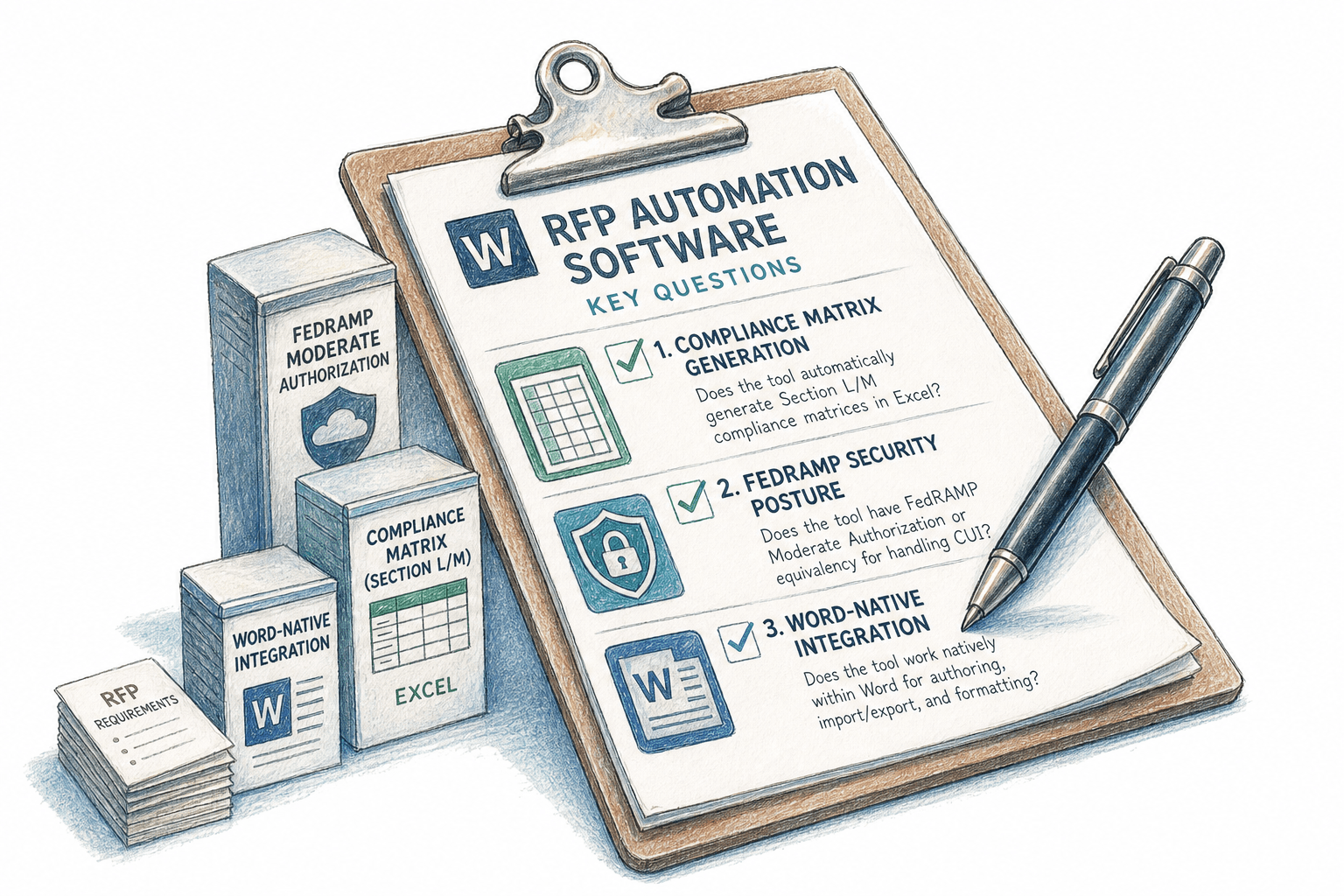
RFP automation software options have expanded fast for GovCon teams, and that means more choices with very different scopes. Some tools cover the full capture-to-submission workflow. Others are strong at one stage (pre-solicitation intelligence, post-draft review, or content reuse) but require your team to bridge the gaps with manual effort or additional tooling. Here's how six of the current RFP automation software options stack up across the decision variables that matter most to proposal managers and capture leads working federal opportunities.
TLDR:
- Auto-generated compliance matrices, native Word/Excel integration, and FedRAMP posture are the three variables that most separate GovCon-ready RFP tools from generic ones.
- Tools in this category split into two workflow positions: creation-first automation (drafting, matrix generation) and post-draft analysis; your bottleneck determines which you need.
- Security posture varies materially across tools: FedRAMP Moderate Authorization or Equivalency covers most CUI environments, while SOC 2 Type 2 alone may not satisfy agency-specific requirements.
- AI-assisted drafting across the category can reduce federal proposal first-draft time by roughly 50 to 70 percent, though results depend on how well the tool aligns with GovCon solicitation structures.
- One end-to-end tool in this roundup covers capture-to-submission in a single workflow, with auto-generated Section L/M compliance matrices in Excel, native Word integration, and AWS GovCloud deployment for teams handling CUI.
How We Ranked RFP Automation Software for GovCon
Ranking RFP automation software for GovCon requires a different lens than a generic software review. The criteria below reflect what actually matters. Each tool was reviewed based on the capabilities that matter most to GovCon proposal teams.
- Compliance matrix generation: Automatically parses Section L and M requirements into a traceable matrix.
- Proposal drafting: Produces drafts aligned with PWS/SOW language, past performance, and evaluation criteria.
- Security posture: Supports applicable CUI requirements, including FedRAMP, CMMC Level 2, and NIST 800-171 where needed.
- GovCon workflow integration: Works natively with Microsoft Word, Excel, and SharePoint.
- Content reuse: Reuses past proposals, content libraries, and institutional knowledge efficiently.
- Scalability: Supports multiple simultaneous pursuits without increasing SME workload.
These rankings reflect the needs of GovCon proposal teams, not general business users.
Best Overall RFP Automation Software: GovEagle

GovEagle is built for GovCon, connecting pre-RFP capture, automated Section L/M compliance matrices, and proposal drafting in a single workflow. It automatically generates a compliance matrix from the RFP, maps requirements to Section L and M, and exports the results to Excel, giving proposal teams a structured framework before drafting begins. If manual compliance matrix creation is slowing your team down, Book a Demo to see how GovEagle accelerates the process before Pink Team.
What GovEagle Does in Practice
GovEagle's AI reads the solicitation, identifies every requirement, and populates the matrix with response obligations and evaluation criteria. From there, proposal managers can assign sections, track completion status, and run the draft through built-in review workflows without leaving the tool.
A few specifics worth knowing for GovCon teams assessing security posture:
- GovEagle runs on AWS GovCloud, with virtual private cloud and air-gapped options available in Azure or AWS environments.
- The tool is FedRAMP Moderate Equivalent and aligns with CMMC Level 2 and Level 3 and NIST SP 800-171, which matters for any contract where proposal materials touch controlled data.
- Microsoft Word and Excel integration is native, so proposal managers work in the artifacts they already version-control: no exporting from a web editor into a format that breaks formatting.
- Precise Software, using GovEagle, cut SME time on early-stage proposals by 80%, with proposal teams reporting capacity to pursue more opportunities per quarter.
For BD directors weighing where RFP automation software produces the most measurable return, the combination of compliance matrix generation, GovCloud deployment, and Word-native drafting covers the three friction points that typically consume the most calendar time between solicitation receipt and Pink Team.
AskSage
AskSage is a GovCon AI assistant focused on research, document analysis, and drafting. Its IL4/IL5 deployment options make it attractive for classified environments, but it lacks built-in compliance matrices and proposal workflow management.
Where the Trade-offs Show Up
The gap between a general-purpose AI assistant and dedicated RFP automation software surfaces clearly in structured proposal workflows. AskSage does not offer native compliance matrix generation, Section L/M cross-referencing, or color team workflow management out of the box. Teams using it for full proposal development often need to layer in additional tooling or manual processes to handle the structured compliance tracking that federal solicitations require.
- The security posture is a genuine differentiator: AskSage supports IL4 and IL5 environments, making it one of the few AI tools accessible to teams working on classified or sensitive programs where Controlled Unclassified Information handling requirements shape tool selection.
- Pricing and access are tiered, with government-specific deployment options available, though enterprise configuration for classified environments typically involves additional setup.
- For BD and capture teams that need a flexible AI assistant for research, summarization, and early drafting across a range of tasks, AskSage covers that ground well. For teams that need end-to-end RFP automation with built-in compliance workflows, it functions more as a complement than a standalone solution.
VisibleThread
VisibleThread focuses on post-draft analysis, including readability, passive voice, and compliance reviews. It is best suited for improving existing drafts, not generating proposals or compliance matrices.
Where VisibleThread Fits in the Proposal Workflow
VisibleThread focuses on post-draft analysis, not proposal creation. It scans completed drafts against Section L and Section M requirements, identifies readability issues, and flags passive voice to help teams refine content before Red Team.
It is not designed for first-draft generation or compliance matrix automation, so teams typically need additional tools to move from RFP release to a structured draft. While it can generate content when paired with an LLM, its primary strength is improving existing proposals, not accelerating proposal production.
- Readability and compliance scanning features are well-regarded among proposal editors and technical writers.
- Pricing and deployment details are available through direct sales.
- FedRAMP authorization status is not publicly confirmed, which may be a consideration for teams handling CUI.
pWin.ai
pWin.ai focuses on capture intelligence and opportunity qualification before an RFP is released. Teams still need separate tools for compliance matrices and proposal drafting.
Who It Fits
For contractors who need RFP automation software that covers both capture intelligence and proposal production in a single workflow, pWin.ai's scope is narrower than what a full proposal automation tool delivers. The capture-to-submission gap is a real coordination cost at volume.
- Small to mid-sized contractors whose primary workflow friction is pre-solicitation positioning, not proposal production volume. If your BD team spends more time qualifying opportunities than writing responses, the tool's capture-focus aligns with that priority.
- Teams that already have a capable proposal shop and are looking to strengthen the front-end intelligence layer without replacing their existing drafting workflow.
- Firms pursuing federal civilian agencies where spending history and incumbent mapping carry more weight in the pursuit decision than in defense-heavy portfolios.
Rohirrim

Rohirrim speeds first drafts by reusing past proposals and content libraries. However, it lacks end-to-end proposal workflow features such as compliance matrix generation and capture management.
Limitations to Weigh
Rohirrim works well for teams whose primary bottleneck is first-draft speed, but pursuit teams with more complex compliance workflows may find the toolset narrower than they need.
- Compliance matrix generation and Section L/M traceability are not core features, so teams still need a separate process for requirement mapping and cross-referencing.
- The tool is positioned around content generation, not end-to-end capture workflow, meaning BD tracking, pipeline management, and color team review support fall outside its scope.
- Firms handling CUI or operating in classified environments should verify current security certifications, as FedRAMP authorization status is not publicly confirmed at this time.
Awarded AI (Procurement Sciences)
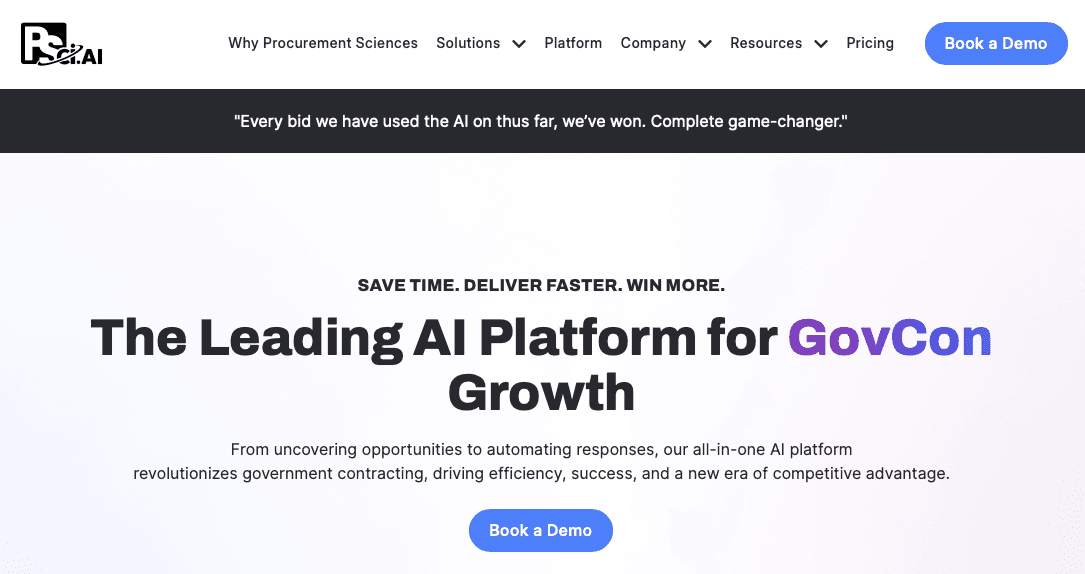
Awarded AI, developed by Procurement Sciences, targets the federal proposal space with an AI-driven workflow that covers opportunity identification through final submission. The tool draws on a curated database of federal procurement data to help teams build proposal outlines, draft responses, and track solicitation activity.
Where the Trade-offs Show Up
The product is offered as a web-only solution, which is a meaningful friction point for teams whose drafting workflows live in Word and Excel. Exporting content between the browser environment and those document formats adds steps that proposal managers working under tight deadlines will feel.
- Procurement Sciences has disclosed FedRAMP Moderate Authorization and SOC 2 Type 2 certification, which positions Awarded AI well for teams operating in environments where those credentials are a procurement requirement.
- Teams that need deep Word and Excel integration or the flexibility to work across air-gapped or SCIF environments may find the web-only constraint limits their workflow options for classified or high-assurance programs.
- Shops running high-volume proposal operations with mature document-centric workflows may find the web-only constraint a recurring friction point, not an occasional inconvenience.
RFP Automation Software Comparison: All Six Tools at a Glance
| Tool | AI Drafting | Compliance Matrix Generation | MS Office Integration | Pricing Transparency |
|---|---|---|---|---|
| GovEagle | Full proposal drafting in Word | Auto-generated in Excel from Section L/M | Native Word and Excel add-ins | Contact sales |
| AskSage | Research and drafting assistant | Not built-in | Not confirmed | Tiered; contact sales |
| VisibleThread | Post-draft analysis and refinement; can generate content with an LLM | Scanning only, not automated generation | Word add-in only | Contact sales |
| pWin.ai | Limited; capture intelligence focus | Not built-in | Not confirmed | Contact sales |
| Rohirrim | Content reuse and first-draft generation | Not built-in | Not confirmed | Contact sales |
| Awarded AI | Full drafting from federal procurement database | Compliance cross-check, not Excel-native Section L/M generation | Web-only; no Word or Excel add-in | Contact sales |
Why GovEagle Is a Leading RFP Automation Software for GovCon
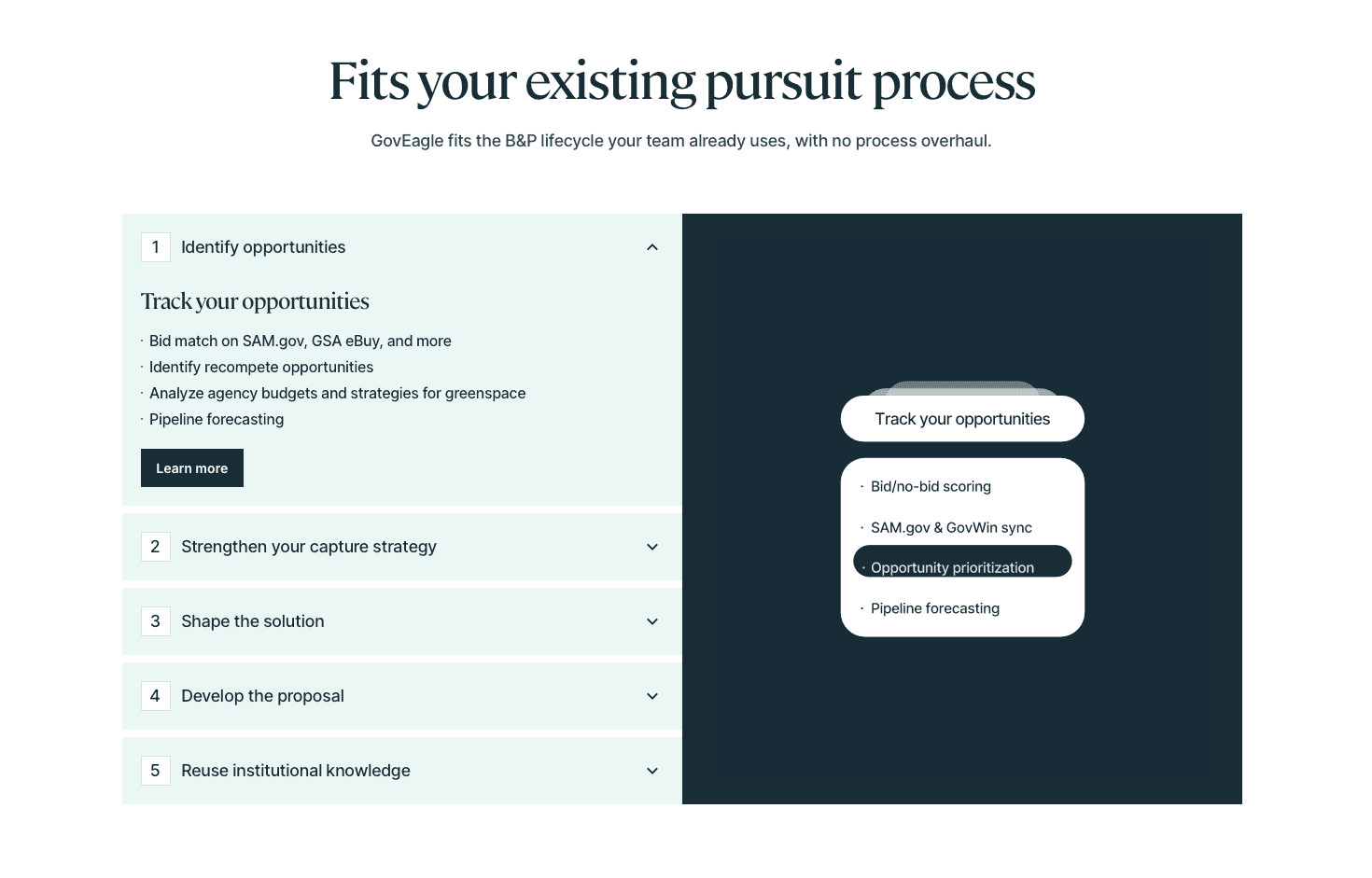
GovEagle is built for GovCon, supporting the full proposal workflow from RFP ingestion through submission. It automatically generates Section L/M compliance matrices in Excel, drafts proposal content in Microsoft Word using your content library and past performance, and keeps capture intelligence connected throughout the process.
GovEagle runs on AWS GovCloud with Azure self-hosted deployment options and aligns with FedRAMP Moderate Equivalency, CMMC Level 2 and Level 3, and NIST 800-171 requirements for teams handling CUI.
Teams using GovEagle have seen measurable gains, including an 80% reduction in early-stage SME time at Precise Software and the ability to pursue more opportunities without adding headcount. Native Word and Excel integration also helps eliminate version-control issues and speeds collaboration through the review cycle.ence, building early content libraries against anticipated requirements, and positioning the team to move faster once the official RFP is released.
FAQs
When should a GovCon firm consider pWin.ai versus a full proposal automation tool like GovEagle?
pWin.ai is best for pre-RFP capture activities such as opportunity qualification and incumbent analysis. Teams that need compliance matrix generation, proposal drafting, and capture in one workflow will find GovEagle better suited.
Is VisibleThread or GovEagle a better fit for teams whose bottleneck is review quality over drafting speed?
VisibleThread focuses on post-draft analysis, including readability and compliance reviews. GovEagle starts earlier with compliance matrices and drafting, making it a better fit for teams looking to speed the entire proposal workflow.
Can smaller GovCon firms with limited proposal staff realistically get value from RFP automation software, or are these tools built for larger shops?
Yes. Smaller firms often benefit the most because AI reduces SME workload and proposal preparation time. GovEagle customer Precise Software reduced early-stage SME time by 80%, helping teams pursue more opportunities without adding headcount.
Final Thoughts on RFP Automation Software Built for Federal Proposal Teams
RFP automation software covers real range, from capture intelligence tools to post-draft analysis to end-to-end proposal automation, and no single tool wins every comparison. What matters is whether the RFP automation software you pick actually fits how your team moves from solicitation receipt to a submittable draft. Request a GovEagle demo to walk through the workflow with a real RFP.