
Driving AI Adoption Across BD and Proposal Teams (September 2026)
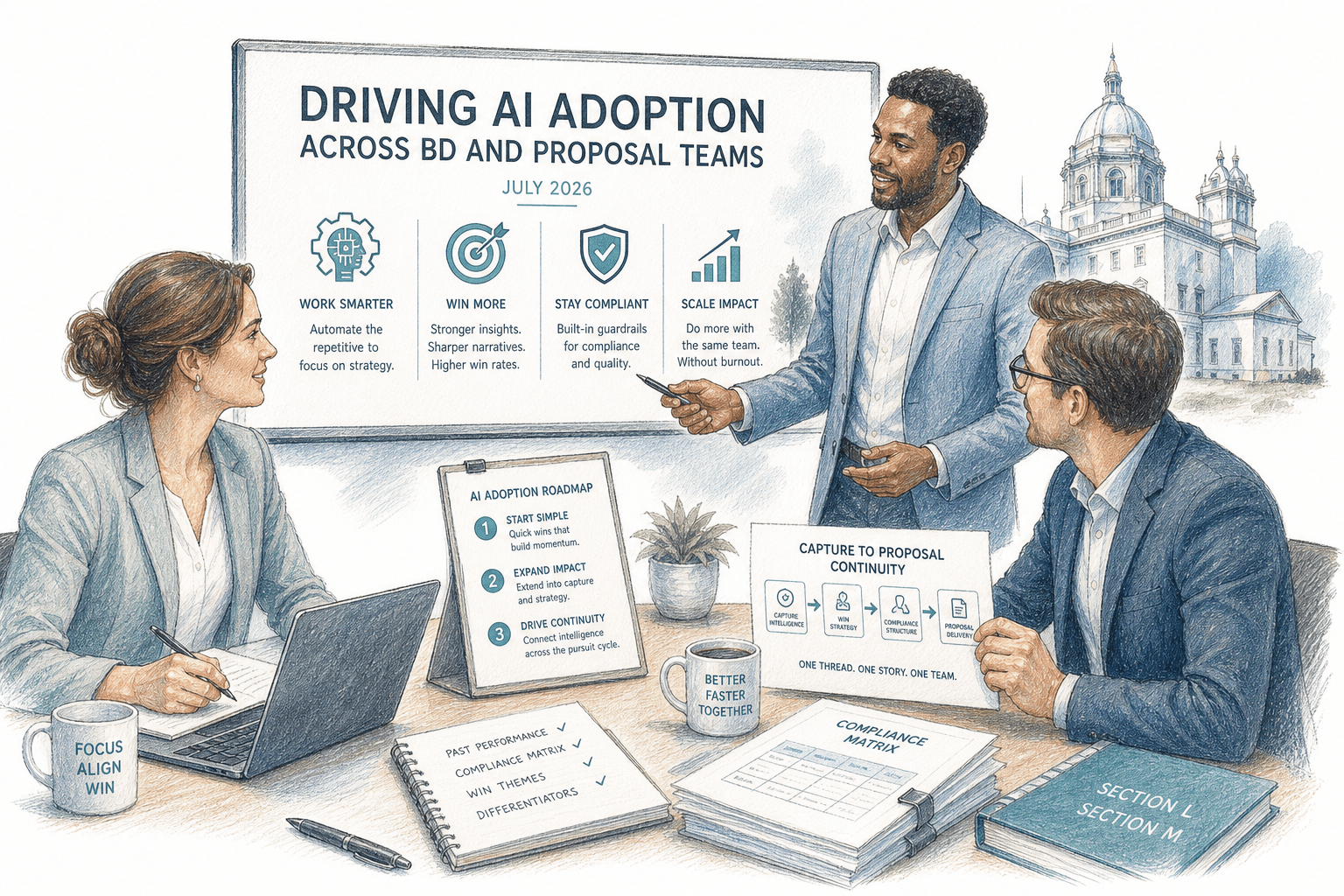
If your BD and proposal teams are still running AI as a side experiment instead of as a core part of the pursuit cycle, the gap between your team and your AI-equipped competitors is already compounding across your pipeline. Getting AI adoption across BD and proposal teams right doesn't require a full workflow overhaul; it requires starting in the right places and building from there.
TLDR:
- AI-equipped GovCon teams increase throughput without adding headcount.
- The capture-to-proposal intelligence gap, where strategic context gets stranded in CRM notes, is where PWin erodes before drafting begins.
- Federal agencies are beginning to deploy AI-assisted tools to score proposals, so Section L structure and Section M specificity both need to hold up to two evaluation filters.
- Roll out AI in phases: start with compliance matrix generation and past-performance formatting before extending into pre-RFP capture intelligence workflows.
- Purpose-built GovCon proposal platforms close the capture-to-proposal continuity gap by carrying win themes and compliance structure forward from pursuit into the proposal environment in Word and Excel.
The Competitive Pressure AI Is Creating for GovCon Teams
Government contractors who delay AI adoption are falling behind on productivity metrics and ceding ground in evaluations where competitors are already moving faster, writing sharper, and responding to more opportunities with the same headcount.
GovCon teams that have adopted AI in their proposal workflows report concrete throughput gains. Chevo reduced proposal prep time by 30 to 40 percent on RFIs and 15 to 25 percent on RFPs within a week of full adoption. Integrity Defense Solutions achieved 3 to 4x faster proposal throughput without adding headcount. In GovCon, where teams routinely operate at capacity across overlapping pursuits, those gains compound quickly across a pipeline.
The Capture-to-Proposal Intelligence Gap
Most capture teams run their intelligence in one system and write proposals in another. By the time an opportunity reaches the proposal phase, strategic context from capture has to be manually reconstructed from CRM notes, email threads, and memory. That gap is where win probability erodes: proposal writers start cold, color team reviewers flag disconnects between win themes and section content, and compliance matrices get built without the agency context that should shape them.
How AI Reshapes the Capture Function
AI has pulled analytical work earlier into the pursuit cycle, giving capture managers visibility that previously required days of manual research. The most direct impact shows up in opportunity qualification: AI tools can scan solicitation histories, incumbent data, and agency spending patterns to surface PWin signals before a team commits pursuit resources. Teams that previously had capacity to actively pursue a handful of opportunities can often manage a larger, better-qualified pipeline without adding headcount.
What AI Changes in the Proposal Development Workflow
Requirement extraction, compliance mapping, and past-performance retrieval are the phases where manual processes burn the most hours. AI can parse Section L and Section M requirements and generate a cross-referenced matrix in a fraction of the time a proposal coordinator would spend manually, cutting that phase from days to hours. AI-assisted drafting can reduce federal proposal first-draft time by roughly 50 to 70 percent, freeing SMEs to focus on win theme development and evaluation-aligned strategy.
Agencies Are Now Using AI to Score Your Proposals
AI evaluation is no longer a future concern for capture and proposal teams. Federal agencies are actively deploying AI-assisted tools to score proposals, flag compliance gaps, and identify inconsistent language across volumes.
Get GovCon capture and proposal insights in your inbox.
Structuring Proposals for Both AI Screeners and Human Evaluators
Where AI-assisted scoring tools are used, proposal reviews may include an automated screening step alongside human review for clarity, relevance, and risk. Both filters trace back to FAR Part 15 contracting rules that govern how agencies score and review solicitation responses.
AI screeners parse proposals for keyword alignment with Section L instructions, requirement traceability, and format compliance. Human evaluators score against Section M criteria, weigh past performance narratives, and flag execution risk. A proposal that satisfies the screener but reads as boilerplate loses ground on technical merit. One that reads well but misses a Section L deliverable may not survive initial review.
Writing to Both Sets of Criteria at Once
The practical approach is to treat Section L as a structural scaffold and Section M as the evaluative lens applied to everything built on that scaffold.
- Map every Section L requirement to a discrete proposal section before drafting begins, so the compliance structure is load-bearing from the start and not retrofitted after the narrative is written.
- Write section headers that mirror the language of Section L line items, which both satisfies AI traceability checks and signals to human evaluators that the response is directly responsive.
- Anchor every technical claim to a measurable outcome tied to the evaluation criteria in Section M, so the narrative carries the weight of both keyword relevance and evaluator-facing proof.
Proposal automation tools that surface Section L and Section M requirements in parallel during the drafting phase make this discipline easier to maintain under deadline pressure, where the instinct is often to write and comply separately.
Data Security and CUI Governance When Adopting AI Tools
Federal proposal workflows may involve CUI, including information contained in past-performance write-ups, technical volumes, or pricing materials when it has been designated or marked as CUI. When proposal data includes CUI, vet any AI tool for appropriate security controls, deployment options such as AWS GovCloud, Azure Government, or self-hosted environments, and documentation your organization's security team can review. Tools running on shared commercial endpoints without boundary controls create real exposure for contractors under CMMC Level 2 obligations.
Building a Phased AI Rollout Across BD and Proposal Operations
The biggest barrier to AI adoption in capture and proposal teams is rarely the tech itself; it is the sequencing. Teams that deploy AI across BD, capture, and proposal all at once often stall on change management and uneven tool fluency. A more durable approach starts narrow and expands deliberately.
Phase 1 anchors on high-frequency, low-complexity tasks: compliance matrix generation, past performance formatting, and boilerplate drafts. Clear inputs and outputs make AI-assisted results easy to review. Phase 2 extends adoption upstream into pre-RFP capture activities (competitive environment summarization, incumbent research, and agency spend analysis) tied to familiar artifacts like bid/no-bid memos. Phase 3 connects outputs across BD, capture, and proposal so intelligence gathered during pursuit does not get stranded in CRM notes, and win themes from capture inform section strategies directly.
Measuring the ROI of AI in Proposal Operations
Measuring AI adoption ROI means tracking more than output volume. The metrics that reflect competitive health fall into two categories: throughput and quality. The table below maps both to what each measures and how to track it:
| Category | Metric | What It Measures | How to Track |
|---|---|---|---|
| Throughput | Active pursuits per quarter | Pipeline capacity without adding headcount | Compare quarters: baseline pursuits vs. AI-assisted pursuits |
| Throughput | First-draft production time | Hours saved on initial proposal drafts | Track hours from RFP receipt to complete first draft; target 50-70% reduction |
| Quality | Compliance matrix completion rate | Requirements mapped and responded to before Red Team review | Percentage of Section L line items with traceable responses at Red Team entry |
| Quality | Reviewer cycle reduction | Color team passes needed before Gold Team standard | Count color team rounds per pursuit; flag proposals requiring more than two passes |
| Quality | SME time recaptured | Hours shifted from formatting and boilerplate to technical differentiation | Log SME hours per pursuit category; measure shift toward win theme and technical work |
The caution here is attribution. AI tools support the process; they do not determine the outcome. A well-structured compliance response still requires a capture strategy grounded in pre-RFP intelligence and a win theme that holds up under evaluator scrutiny. ROI calculations that credit AI for win rate increases without controlling for opportunity quality will mislead pipeline planning. Track what the tooling controls: speed, coverage, and review cycle throughput. Hold win rate accountable to the capture strategy upstream.
How GovEagle Closes the Capture-to-Proposal Continuity Gap

Most AI adoption efforts in capture and proposal stall at the individual contributor level: a BD analyst drafts summaries in one tool, a proposal manager runs sections through another, and the intelligence stays siloed. The structural gap sits between what capture teams document in Salesforce or HubSpot and what proposal teams see when the solicitation drops. Win themes, competitive assessments, and agency context rarely survive that handoff intact, so writers reconstruct capture strategy from memory while the clock runs.
GovEagle is built around closing that gap. Its Salesforce and HubSpot integrations pull capture notes and opportunity intelligence into the proposal workspace so writers are not starting cold when the RFP arrives. GovEagle then parses Section L and Section M requirements, generates the compliance matrix in Excel, and produces an annotated outline in Microsoft Word with win themes already mapped to requirement structure.
The result is that proposal automation functions as a connective layer across the full pursuit lifecycle, going well beyond an isolated drafting aid. Capture leads get earlier visibility into qualification decisions, proposal managers stop burning color team cycles on context misalignment, and SMEs shift from boilerplate reconstruction to technical differentiation. That reallocation of skilled labor is where AI adoption across capture and proposal teams actually takes hold.
FAQs
How do you get capture and proposal teams to actually adopt AI instead of letting it sit unused after purchase?
Start with high-frequency, low-complexity tasks the team already dislikes: compliance matrix generation, past performance formatting, and boilerplate section drafts. Clear inputs and outputs make results easy to verify. Once baseline confidence builds, extend adoption upstream into capture activities. Ownership must be assigned explicitly or the tool becomes optional by default.
What is the capture-to-proposal intelligence gap and why does it erode win probability for government contractors?
The gap occurs when win themes and agency intelligence gathered during capture stay trapped in CRM notes and never reach the proposal team in a usable format. Writers start cold, reviewers flag misalignment at Red Team, and compliance matrices get built without strategic context. Purpose-built GovCon platforms close this gap by pulling capture intelligence directly into the proposal workspace.
How should government contractor proposal teams measure the ROI of AI adoption beyond win rate?
Win rate alone conflates tooling performance with opportunity quality. Track throughput metrics like active pursuits per quarter (some teams expand from 8-10 to 12-15 without added headcount) and quality metrics like compliance matrix completion rates before Red Team, reviewer cycle reduction, and SME hours recaptured from formatting work.
Final Thoughts on AI Adoption for Capture and Proposal Teams
The firms that pull ahead are not necessarily running more resources; they are running better continuity between the intelligence built during capture and the proposals written under deadline. AI adoption across BD and proposal teams is mostly a sequencing problem, and a phased rollout gives your team the space to build confidence before expanding scope. GovEagle is built around that continuity, carrying capture intelligence and RFP-parsed compliance structure forward into the proposal environment in Word and Excel so the strategic reconstruction work is done before drafting begins. The throughput and quality metrics covered here give you a way to track whether the tooling is moving the needle.