
Understanding Proposal Automation (September 2026)

Akash Mandavilli
CEO and Co-Founder of GovEagle
About the author
Akash is a 2x founder with previous experience in AI from Meta and federal sales from IBM. Akash holds a dual-degree from Johns Hopkins University in Economics and Computer Science.
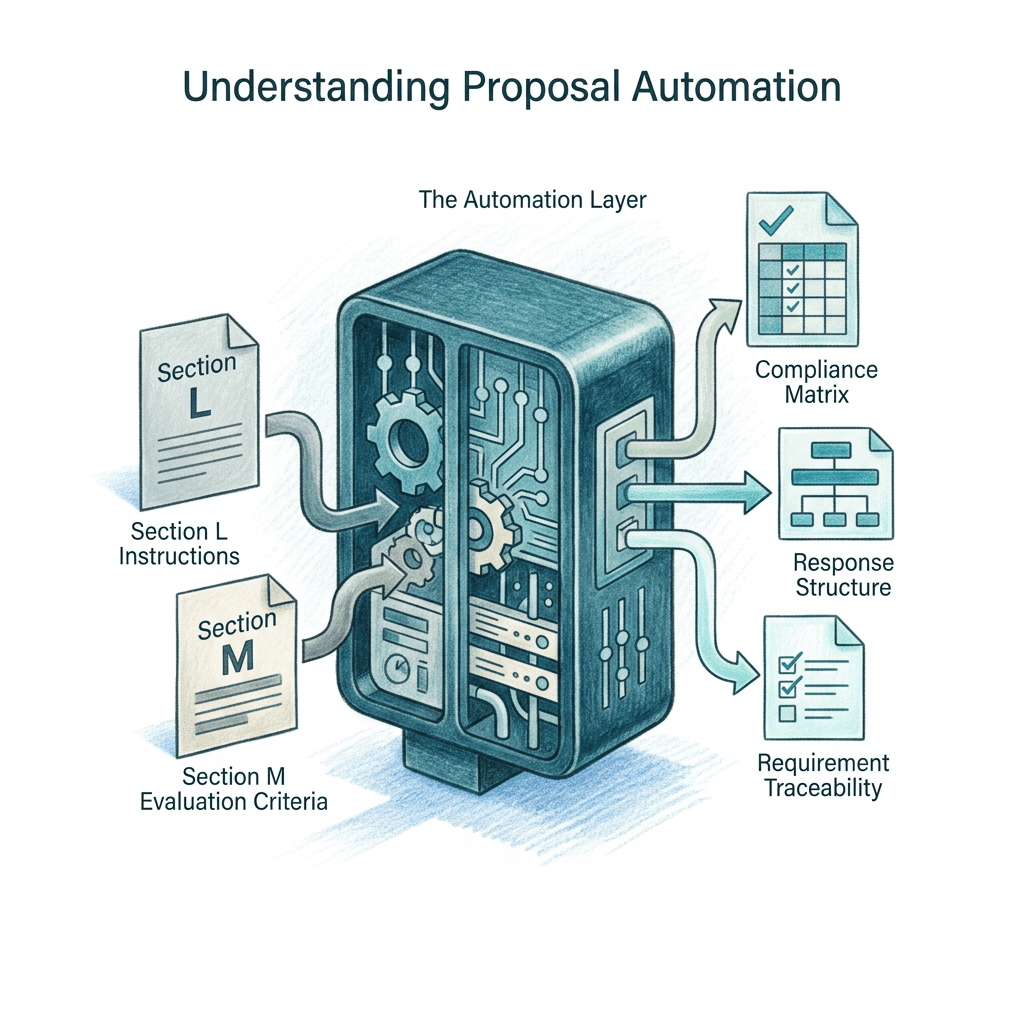
What is proposal automation in government contracting? It's the software layer that takes Section L instructions and Section M evaluation criteria from an RFP and generates the compliance matrix, response structure, and requirement traceability without manual extraction. Where teams used to spend days building that framework by hand, GovCon proposal automation produces it in minutes and keeps it updated through amendment cycles and review rounds. The result is more time for win theme development and technical solutioning, and less time spent in spreadsheets. This primer covers where automation fits in the proposal lifecycle, what it handles well, and what still requires your capture team's judgment. See our AI proposal tools roundup.
TLDR:
- Proposal automation reads Section L/M, maps requirements to responses, and flags gaps before Pink Team review.
- Manual compliance matrix builds often take hours or days; automation parses RFPs and produces structured matrices in minutes.
- AI-assisted drafting of Section L/M-aligned responses can reduce federal proposal first-draft time by roughly 50 to 70%, freeing SMEs for technical solutioning over document formatting.
- Federal proposal tools handling CUI should align with applicable security requirements such as FedRAMP, CMMC Level 2, or NIST SP 800-171, depending on the environment and contract.
- End-to-end proposal automation tools cover the capture-to-submission workflow: compliance matrices, proposal content libraries, Section L/M drafting, and color team tracking.
What Proposal Automation Means in Government Contracting
Proposal automation in government contracting refers to software that takes structured RFP inputs, such as Section L and Section M criteria, and generates compliant draft content, compliance matrices, and supporting artifacts with minimal manual effort from the pursuit team.

The term covers a range of capabilities, but in a GovCon context the core function is requirement traceability: the system reads the solicitation, maps each requirement to a response structure, and surfaces gaps before the first Pink Team review.
Where Automation Fits in the Proposal Lifecycle
Most teams encounter automation at the proposal development stage, but the tech can touch earlier capture activities. Where it typically appears:
- Compliance matrix generation from Section L/M, which would otherwise mean manually extracting and cross-referencing every instruction and evaluation factor across hundreds of pages.
- Boilerplate and past-performance retrieval, pulling prior narratives from a content library by requirement matching instead of keyword search.
- Section drafting and review preparation, where AI generates initial response text and organizes annotated drafts against evaluation criteria so color team reviewers score against Section M instead of reading for general quality.
Why Government Contractors Need Proposal Automation
Many federal solicitations receive numerous compliant bids, increasing competitive pressure on proposal teams, so the quality bar keeps rising while BD teams face the same resource ceilings.
Manual workflows burn hours on tasks that don't move scores: chasing boilerplate, rebuilding compliance matrices, and cross-checking Section L requirements. Proposal automation handles that repetitive, rules-based work so proposal managers and capture leads focus where their judgment matters.
This is most apparent when:
- Many teams running concurrent bids rebuild past performance write-ups, staffing narratives, and compliance matrices from scratch each time, with no system for reusing prior work.
- Compliance tracking across long RFPs can slip under deadline pressure, and a single missed requirement creates an evaluatable gap that reviewers flag.
- When scarce SMEs spend cycles on formatting instead of technical content, quality suffers in the sections evaluators weight most heavily.
Bid/No-Bid Analysis and Opportunity Qualification
Before a single Section L requirement gets read, there's a decision gate most teams move through too quickly: whether to bid at all. Automation can bring structure to that call by cross-matching RFP requirements against a contractor's past performance, flagging gaps that would require teaming, and producing a capability alignment assessment before the team commits resources to capture planning.
It's a structured read on PWin that replaces the gut check with traceable data. A bid/no-bid tool surfaces a weak position earlier, when changing course is still inexpensive. That discipline compounds: fewer poor bets means more bandwidth on the pursuits a firm was positioned to win.
Compliance Matrix Generation and Requirement Tracking
Compliance matrix generation is where many teams feel the sharpest pressure. Every Section L requirement needs a traceable response mapped to Section M criteria, which on a complex RFP can run into hundreds of line items.
Proposal automation handles this by parsing the RFP, extracting each requirement, and organizing them into a structured matrix that tracks what was asked, where it must be answered, and who owns the response. Tasks that often take proposal managers hours or even a full day can be completed in minutes with automation.
What a Generated Compliance Matrix Typically Captures
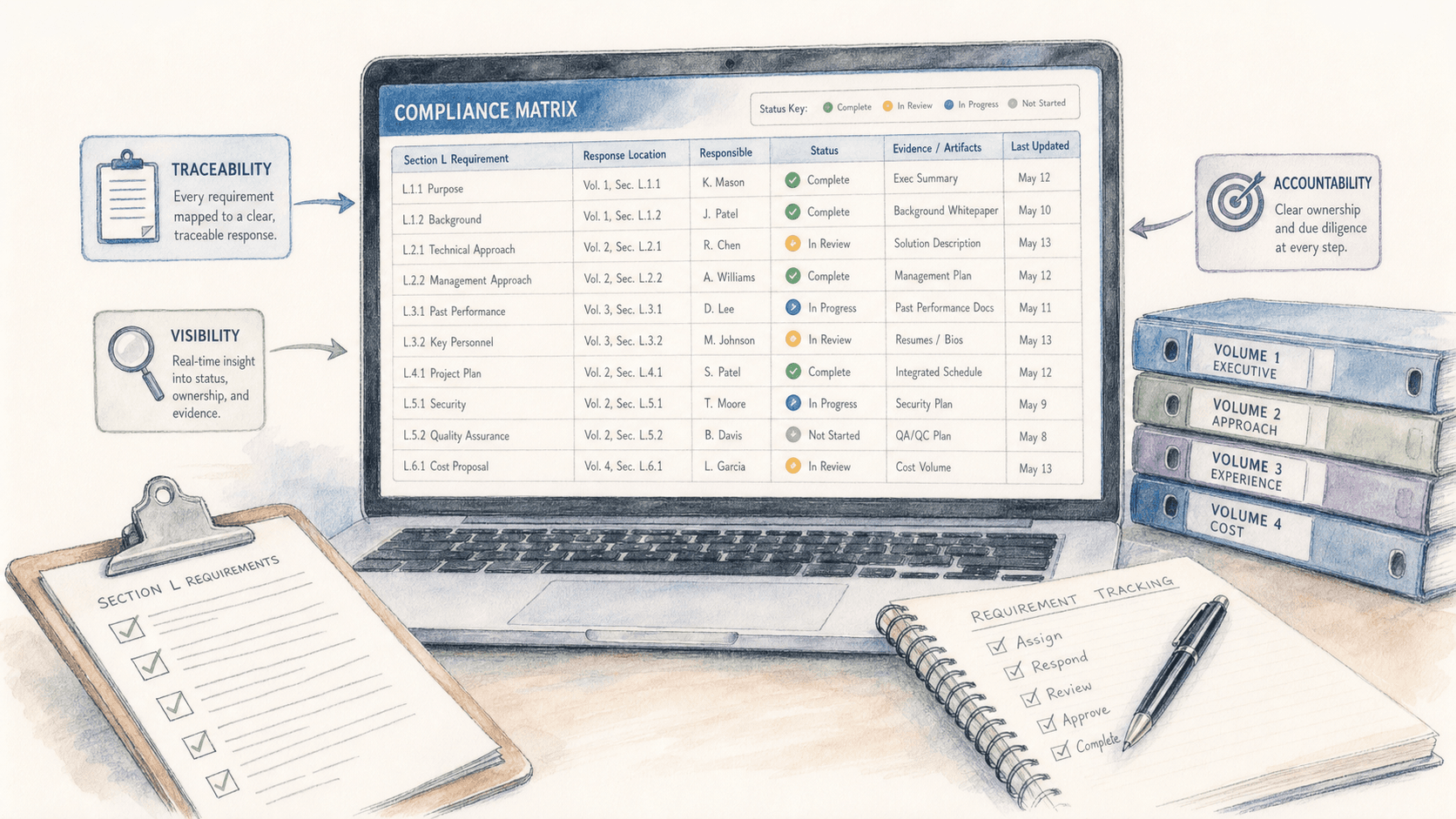
The output varies by tool, but most automated compliance matrices include:
- The verbatim requirement or instruction pulled directly from Section L, so nothing is paraphrased or lost in translation
- The corresponding Section M evaluation criterion, giving the writing team a direct line of sight to how that requirement will be scored.
- The volume and section of the proposal where the response belongs, based on the RFP's own organizational structure
- An owner or responsible party field, which connects the matrix to the proposal team's assignment workflow
- A completion status indicator so the proposal manager can track open items at a glance without chasing down contributors
Why Tracking Matters as Much as Generation
Keeping it current through amendments is where manual approaches break down. When an amendment adds new requirements, a static spreadsheet needs someone to catch the change, update the matrix, and notify writers. Automated systems tied to the source document flag those changes directly, reducing the risk that a requirement slips through to submission.
For reviewers running a Gold Team pass, a well-maintained matrix becomes the primary audit tool: each requirement checked off in sequence, with evidence of how it was satisfied.
Automated Outline Creation and Proposal Structuring
Once an RFP drops, one of the first tasks is translating Section L requirements into a working outline. Done manually, that eats a full day of mapping instructions to Section M criteria and standing up a skeleton in Word. Automation tools parse the RFP and generate a structured outline tied to the requirements, with some pre-populating boilerplate and section headers from prior proposals.
Teams get tripped up between outline generation and compliance verification. An outline that misses Section L instructions creates problems in color team reviews. Better tools cross-reference the outline against the full RFP to flag gaps before writing starts.
AI-Assisted Content Generation and First Draft Development
First-draft development has long been the most labor-intensive phase of the capture cycle. AI-assisted generation pulls from a firm's proposal content library, past performance repository, and RFP requirements to produce draft proposal responses aligned to Section L/M criteria.
Most tools ingest the solicitation, map requirements to source content, and draft proposal responses section by section. Output quality depends on the quality of prior proposal content, past performance, and Section L/M requirement mapping available to the system.
What AI Generation Handles Well
- Section-by-section draft responses keyed to specific PWS or SOW requirements, reducing the time required to develop an initial compliant response.
- Past performance narratives drawn from prior submissions, adapted to the current solicitation's scope and evaluation criteria.
- Boilerplate and management approach sections where the firm's standard methodology applies across pursuits with minor tailoring.
Where Human Review Remains Non-Negotiable
AI-generated drafts require capture team ownership at review. Evaluators score against documented Section M criteria, and AI may miss win themes, differentiators, or agency-specific context that proposal managers and capture leads carry. The draft is a starting point, not a finished compliance product.
Color Team Review Automation and Quality Assurance
Color team reviews sit at the heart of quality control, but running them manually creates scheduling and version-control headaches. Proposal automation tools support structured review workflows that mirror the Pink, Red, and Gold team cadence most capture shops already run.
What Automated Review Support Looks Like in Practice
Automation centralizes comments and compliance tracking against Section M criteria, so reviewers score sections and surface risks without the proposal manager chasing annotations across file versions.
AI can also pre-screen drafts before human reviewers see them, checking for:
- Unanswered RFP requirements
- Win theme consistency, so the same discriminators appear across technical, management, and past performance volumes
- Compliance gaps, unsupported claims, and evaluation misalignment.
The result is that color teams spend their limited time on judgment calls instead of hunting down gaps a pre-screen catches automatically.
Security and Compliance Requirements for GovCon Automation
Federal proposal automation doesn't operate in a regulatory vacuum. Any tool handling controlled acquisition data, proprietary pricing, or classified program details may need to meet the compliance thresholds that govern contractor systems.
What the Compliance Baseline Actually Looks Like
GovCon automation tools handling CUI or covered defense information may need to align with one or more of these frameworks:
| Framework | Applicability | What It Governs |
|---|---|---|
| FedRAMP Moderate | Cloud-hosted systems used for federal information or CUI, depending on agency and contract requirements | Sets the floor for cloud-hosted systems; tools marked FedRAMP Moderate Equivalent are assessed against NIST 800-53 controls but have not gone through the full Joint Authorization Board process |
| CMMC Level 2 | DoD contracts involving CUI | Applies to DoD contracts involving CUI, a substantial share of defense proposals; tools storing draft technical volumes or past-performance data may fall within your CMMC scope boundary |
| NIST 800-171 | Non-federal systems handling CUI | Defines how CUI is protected in non-federal systems; most mature tools reference NIST 800-171 alignment in their security posture |
GovEagle: Proposal Automation Built for Federal Contractors
GovEagle is purpose-built for federal proposal work, not adapted from a generic writing tool. It covers the full capture-to-submission workflow: compliance matrix generation, federal proposal content library management, Section L/M drafting, and color team review tracking within a single proposal workspace.
The compliance matrix comes out in Excel, formatted to Section L. Proposal writers get AI-assisted drafting that pulls from your organization's past performance library, approved proposal content, and boilerplate. Capture leads get a workspace that keeps the pursuit record, contact history, and competitive intel in one place from pre-RFP through submission.
GovEagle runs on AWS GovCloud and meets FedRAMP Moderate Equivalent requirements, with CMMC and NIST 800-171 support, plus Azure self-hosted and air-gapped options for sensitive programs.
Precise Software cut SME time by 80%. That result comes from replacing the manual coordination loop, not from writing faster.
FAQs
What's the difference between proposal automation and a generic AI writing tool?
Proposal automation reads Section L and Section M inputs, then generates compliant drafts, compliance matrices, and proposal deliverables mapped to those requirements. General-purpose AI writing tools generate text from prompts but don't parse federal solicitations, map Section L to Section M, or maintain requirement traceability.
Can I use proposal automation without a large content library already built?
Yes. Most tools generate compliance matrices and Section L-aligned proposal outlines straight from the RFP. Response quality improves as your proposal content library, past performance records, and approved boilerplate expand, but you don't need a fully tagged repository to start.
Proposal automation vs manual compliance matrix creation for complex RFPs?
Manual matrix creation on complex RFPs consumes days of extracting and cross-referencing Section L requirements. Automated tools parse the RFP and produce a structured Excel matrix in minutes, mapping each requirement to its Section M criterion and proposal section, then keep it current through amendments without manual re-entry.
Final Thoughts on Proposal Automation in Government Contracting
The BD organizations that get the most from proposal automation in government contracting are the ones that wire it into capture workflows from the start, not the proposal-development stage alone. The gains come from recovering hours lost to compliance tracking and matrix reconciliation and redirecting that time toward evaluation alignment and discriminator development. GovEagle handles Section L extraction and compliance mapping from RFP drop through final submission. See the compliance matrix generator in action.