
Continuing Resolutions: Federal Awards and Contractor Strategies September 2026

Akash Mandavilli
CEO and Co-Founder of GovEagle
About the author
Akash is a 2x founder with previous experience in AI from Meta and federal sales from IBM. Akash holds a dual-degree from Johns Hopkins University in Economics and Computer Science.
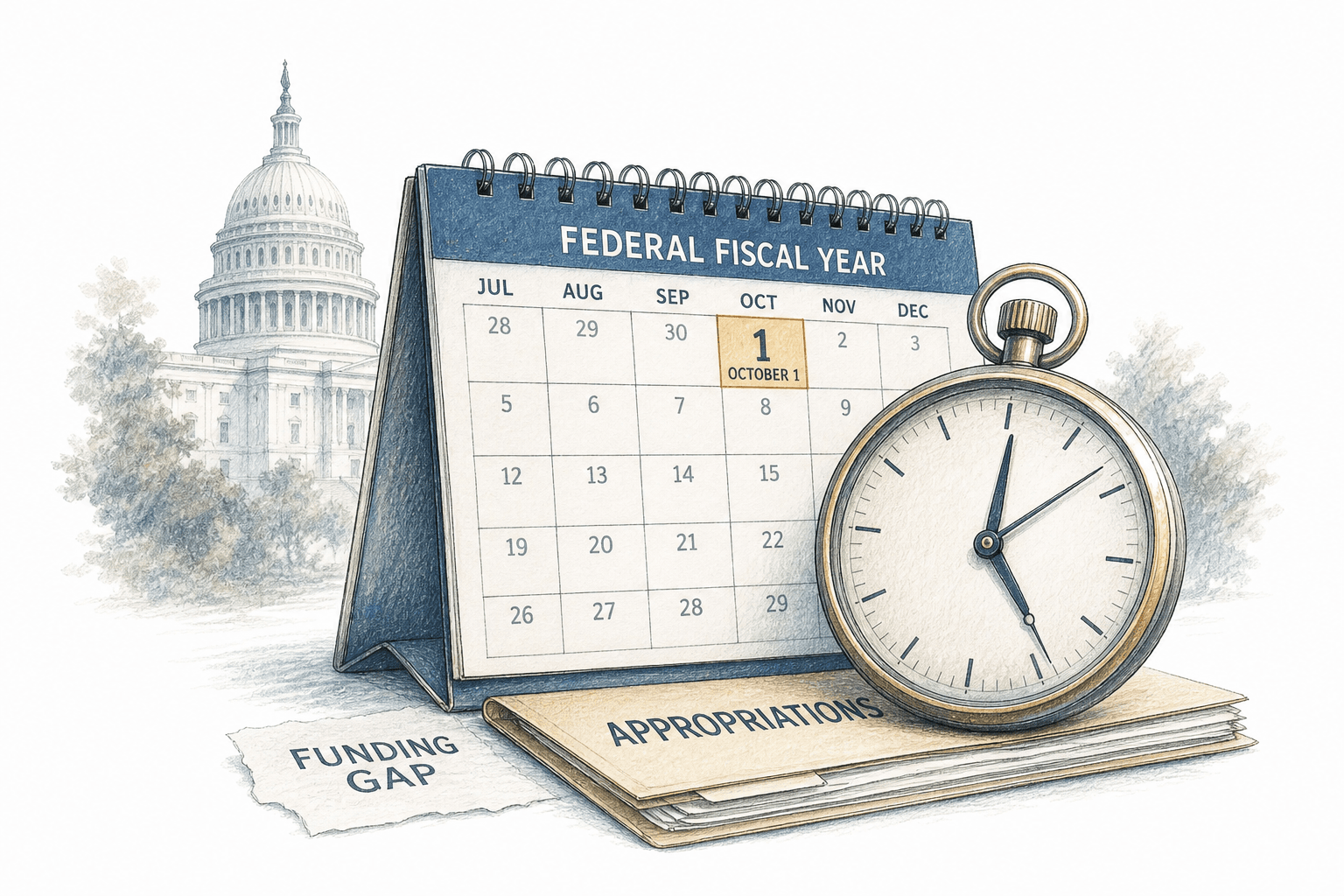
CRs are not anomalies anymore. DoD has operated under one in all but 12 of the last 49 fiscal years, which means your team is more likely than not planning around a funding constraint that was never fully priced into your BD calendar. How you use the quiet stretch before full-year appropriations clear tends to determine how well you compete when the surge window opens.
TLDR:
- CRs freeze new-start contract awards under FAR 32.702 until full-year appropriations pass, stalling solicitations in final stages.
- GAO found 36 of 74 DoD programs reported CR-driven schedule delays in 2026 (GAO-26-107065); one program saw costs more than double.
- Option year anniversaries in October through December carry real lapse risk when CR rates can't cover the full obligation.
- CR quiet periods reward firms that advance capture, build content libraries, and focus recompetes ahead of speculative new-starts.
- GovEagle's end-to-end proposal automation workflow lets lean teams absorb post-CR solicitation surges without triage.
How a Continuing Resolution Works
When Congress fails to pass full-year appropriations by the start of the federal fiscal year on October 1, agencies operate under a continuing resolution. A CR is a stopgap appropriations measure that keeps the government funded at roughly the prior year's enacted rate, typically expressed as a daily or weekly allotment tied to that baseline.
The Anti-Deficiency Act, referenced in FAR 32.702, prohibits agencies from obligating funds in excess of what has been appropriated. Under a CR, contracting officers can only commit funding consistent with the CR's rate and duration. They cannot treat a CR as a full-year budget, even if the program has a multiyear need. The GAO's most recent continuing resolution analysis documents how this constraint shapes agency spending patterns across the acquisition lifecycle.
The practical effect is that agencies lose budget flexibility precisely when fiscal year planning should be accelerating.
How Often CRs Occur in Practice
FY 2026 opened with a 42-day funding lapse before Congress passed a stopgap running through January 30, 2026. According to the GAO's continuing resolution analysis, the Department of Defense has operated under a CR in all but 12 of the last 49 fiscal years. FY 2026 opened with a 42-day funding lapse before Congress passed a stopgap running through January 30, 2026.
For BD and proposal teams, the pattern matters more than any single instance. A CR at the start of a federal fiscal year is no longer a surprise; it is a baseline planning assumption. The contractors who get caught flat-footed are the ones still treating full-year appropriations on October 1 as the expected case.
The New-Start Prohibition and What It Blocks
The most consequential constraint a CR imposes is the new-start prohibition. Under FAR 32.702, agencies typically cannot initiate programs or contracts requiring funding levels beyond prior-year appropriations, though exceptions exist by agency and contract type. Contracting officers may not obligate the government in advance of appropriations, which means any award requiring "new money" is effectively frozen until a full-year bill passes.
In practice, this blocks three categories contractors care about most:
- New contract awards that have no prior-year funding baseline, leaving solicitations in final stages before October 1 at risk of stalling entirely if award would obligate funds the agency has not yet received authority to spend.
- New program phases requiring incremental funding authority, where even a well-positioned incumbent cannot move forward without appropriations the agency cannot yet access.
- Option exercises where the option year funding exceeds the CR's rate-of-operations allowance, as Inside Government Contracts has noted, agencies can continue ongoing programs at prior-year rates but cannot ramp up scope or add new efforts.
How Incremental Funding Changes Contract Execution
When a CR is in effect, agencies managing active contracts often shift to incremental funding in place of obligating a full contract value they cannot legally authorize. Under FAR 52.232-18, funds are made available on a periodic basis tied to appropriations authority, and the contractor may only perform work up to the funded ceiling. FAR 52.232-22 goes further, requiring the contractor to notify the contracting officer when cumulative costs approach a defined threshold, typically 75 percent of the total funded amount, so the agency has time to add funding or stop work before an Anti-Deficiency Act violation occurs.
Whether incremental funding is permissible depends on how the work is structured:
| Service Type | Definition | Funding Rule Under a CR | Contractor Exposure |
|---|---|---|---|
| Severable | Work divisible into discrete periods, each with independent value | Can be funded incrementally without violating appropriations law | Lower: each funded period stands alone; work stops at the funded ceiling |
| Non-severable | Deliverable has value only upon full completion | Must be fully funded at award; a CR does not change this rule | Higher: contractor performing under incremental funding is exposed if appropriations lapse before full obligation is placed |
For contractors managing work in progress, the notification obligation under FAR 52.232-22 is a live program-execution responsibility. Tracking funded ceilings, projected burn rates, and notification triggers cannot be treated as a contracts-team task disconnected from program management. Missing the threshold notification can leave a contractor performing unauthorized work with no legal obligation on the government to pay for it.
Contract Options at Risk: The Option Year Problem
Option year anniversaries that fall inside a CR window create real exposure for incumbents. An agency can exercise an option only if funds are available to cover the full option period's obligation. When the CR rate does not support that obligation, the contracting officer may be legally unable to exercise the option on the anniversary date.
FAR 52.232-19, the "subject to the availability of funds" clause, offers one path forward: it allows performance to continue incrementally as funding becomes available, without requiring full obligation at exercise. Where that clause is not in the contract, the CO and contractor may negotiate a short-term bridge or defer the anniversary date by mutual consent, as Inside Government Contracts has noted.
The risk incumbents miss is timing. An option that lapses without exercise may not be revivable (see FAR 17.207(f) and agency-specific clause requirements). Capture and contracts teams should flag anniversary dates falling in the October through December window, confirm whether FAR 52.232-19 is in scope, and open dialogue with the CO before the anniversary date arrives.
GovEagle's opportunity tracking can flag these anniversary dates automatically alongside your live pipeline, so capture and contracts teams see the exposure before it becomes a lapsed option, not after. Pair that with a quick capture refresh (updated win themes, a review of PWS alignment, and a pass through your content library) during the CR quiet period, so the recompete or option exercise conversation with the CO starts from a position of readiness rather than catch-up.
Cost and Schedule Effects Across the Acquisition Lifecycle
CR-driven delays carry real cost consequences across the acquisition lifecycle. In GAO's January 2026 survey, GAO DoD CR acquisition survey reported schedule delays tied directly to CR constraints, including deferred contract awards and pushed delivery milestones. In one facilities sustainment program, CR-related delays in FY 2024 caused contract costs to more than double.
The administrative burden compounds the schedule risk. F-35 program officials, per the same GAO survey (GAO-26-107065), estimated that roughly 20 percent of their financial management staff's time went toward replanning driven by CR constraints alone, overhead that produces no mission output.
These are documented cases drawn from a broad survey sample, not edge-case failures. For contractors, the implication is that CR exposure ripples into cost structures, resource planning, and schedule commitments that were built around an appropriations calendar that rarely holds.
Get GovCon capture and proposal insights in your inbox.
How CRs Compress the Bid Pipeline and End-of-Year Surges
Bottled-up awards do not disappear during a CR. Once full-year appropriations pass, agencies release them in a compressed window, and solicitations that stalled for months hit the market simultaneously. BD and proposal teams that were pacing moderate workloads suddenly face overlapping deadlines across multiple pursuits.
Smaller contractors feel this disproportionately. Large primes can absorb surge volume across dedicated proposal staff, but a firm with one or two proposal writers has to choose which opportunities to chase and which to pass, often under a two-week response window. One small lean defense team handled exactly this limit by building GovEagle into their workflow, achieving 3 to 4 times faster proposal throughput without adding headcount. That is the kind of capacity multiplier that determines how many opportunities actually make the cut when solicitations drop simultaneously.
How the Triage Problem Compounds Over Time
That forced triage is where the continuing resolution impact on federal contract awards becomes a structural problem, well beyond a scheduling inconvenience. Each CR cycle that forces a small or mid-tier contractor to pass on a pursuit is a compounding loss: no past performance citation, no relationship with the CO, no foothold in that agency's vendor pool. Repeated across two or three CR cycles, the attrition is cumulative.
A few patterns tend to surface in post-CR surge periods:
- Proposal writers absorbing three or four simultaneous deadlines often triage based on page count or incumbent status instead of strategic fit, which can push firms away from growth opportunities toward safer, lower-margin renewals.
- BD teams that did not pre-position during the CR quiet period have less intel on evaluation criteria and agency priorities, gaps a strong capture plan would have closed, which means their proposals start from a weaker foundation precisely when speed matters most.
- Teaming conversations that should have happened months earlier get compressed into days, increasing the risk of poorly scoped work share agreements and last-minute NDAs that do not hold up under source selection scrutiny.
Large primes have the staff depth to run parallel color team reviews during a surge. For smaller firms, the Red Team often collapses into a single pass, or gets skipped entirely, which is where compliance gaps tend to surface after submission and not before.
Contractor Adaptation Strategies During CR Periods
CR periods reward firms that treat the funding pause as planning time, not dead time. The contractors who come out of a CR surge well-positioned are typically the ones who made deliberate choices during the quiet stretch, not reactive ones after full-year appropriations cleared.
A few approaches tend to separate those firms from the ones scrambling to catch up:
- Monitor appropriations posture weekly and raise bid/no-bid thresholds for new-start opportunities until full-year funding clears. The probability of win on those awards changes materially under a CR, and your pursuit criteria should reflect that.
- Structure proposals with severable service periods aligned to likely CR expiration windows, giving contracting officers a legally clean path to award incrementally without waiting for a full-year appropriation.
- Keep a cash buffer sized to cover two to three months of contract execution without a new obligation. Incremental funding gaps can arrive without warning, and firms without that cushion are forced into reactive cost decisions.
- Document every schedule and cost impact in writing as it occurs. That contemporaneous record becomes the evidentiary foundation for an equitable adjustment claim if a CR extends long enough to cause real damage.
- Stay active on existing IDIQ vehicles. Task orders drawing on prior-year ceiling funds can often continue moving regardless of CR status, keeping revenue flowing while new-start awards stall.
- Use the quiet period before solicitations drop to advance GovCon opportunity tracking and capture. Agency meetings, RFI responses, and teaming conversations are not blocked by a CR, and competitors who go quiet during this stretch cede ground that is hard to recover.
The firms that move offensively during a CR, building relationships and sharpening capture intel while others wait, tend to submit stronger proposals when the surge window opens.
How Proposal Volume Strategy Changes Under a CR
When the pool of actionable new-award solicitations shrinks, proposal capacity does not need to shrink with it. The firms that manage this well redistribute that capacity instead of idling it.
Recompetes on active contracts become the natural priority. Those programs are already funded, already performing, and already generating evaluation data a well-positioned incumbent can use. A CR period is a reasonable time to sharpen that capture work, review PWS alignment, and build the discriminators for a recompete proposal before the RFP ever drops.
For anticipated post-CR opportunities, extending capture timelines pays off in proposal quality. Teams that spend the quiet window on agency meetings, draft RFP reviews, and teaming alignment tend to enter the surge period with a stronger technical approach already shaped, not developing strategy under a two-week response clock.
The credible bid volume question is the one most BD leads get wrong. Maintaining pipeline numbers by loading up on speculative new-starts that have no realistic path to award before full appropriations clear ties up proposal writers on work that will not produce revenue. Raising bid/no-bid thresholds on those pursuits and redeploying that capacity into bid readiness, content library updates, and past performance documentation is a more defensible use of the quiet period.
Where Redistributed Capacity Goes in Practice
The specific investments that tend to hold value across CR periods follow a pattern:
- Recompete capture work: Review PWS performance data, document contract execution outcomes, and refine win themes while the program is still active and evaluation context is fresh.
- Pre-RFP agency engagement: Use the reduced proposal workload to schedule capability briefings and informational meetings with target customers before solicitations publish, a practice central to positioning for FY 2027 that feeds the draft RFP influence window that most teams miss.
- Content library development: Past performance write-ups, staffing matrices, and management approach sections built during low-volume periods reduce first-draft cycle time when the post-CR surge hits.
- Bid/no-bid discipline: Opportunities with speculative timelines tied to full appropriations should clear a higher threshold. Capacity freed from those pursuits compounds into stronger responses on the opportunities that do move.
How GovEagle Supports Proposal Teams Through CR Uncertainty
When the post-CR solicitation surge opens, the teams that respond to the most opportunities are rarely the ones with the most people. They are the ones who can move from RFP receipt to compliant first draft without losing days to manual shredding, outline construction, and compliance matrix builds.
GovEagle's end-to-end workflow covers exactly that span: bid/no-bid analysis, compliance matrix generation in Excel, annotated proposal outline creation in Word, AI-assisted first drafting, and color team review automation. A lean team running that sequence can execute at a volume that would otherwise require far more headcount. Precise Software cut SME time on early-stage proposals by 80 percent after adopting GovEagle. Integrity Defense Solutions achieved 3 to 4 times faster proposal preparation. In a compressed post-CR window where four solicitations drop in two weeks, those multipliers determine which opportunities make the cut. If your team is calibrating now for the next post-CR surge, GovEagle's compliance matrix generation and annotated outline workflow are the steps that compress first-draft cycle time the most. Book a Demo to see how the sequence runs end to end.
For teams pursuing opportunities that involve CUI, GovEagle holds full FedRAMP Authorization and is NIST 800-171 compliant, removing the security review friction that can otherwise slow tool adoption on sensitive pursuits. When agencies enact full-year appropriations and begin releasing amended solicitations, including IDIQ task order proposals, GovEagle's amendment tracking keeps compliance matrices and annotated outlines current automatically, flagging the sections that need revisiting without requiring a manual re-shred of a document that has already been partially worked.
The CR cycle does not change the fundamentals of proposal execution. It compresses the window in which execution has to happen and raises the cost of slow processes. Teams already running a disciplined, automated workflow absorb that compression without triage.
Final Thoughts on the Continuing Resolution Impact on Federal Contract Awards
CRs compress the window where execution actually matters, and the cost of slow processes goes up accordingly. Your capture work, teaming conversations, and content library all travel forward into the surge period, for better or worse. GovEagle's end-to-end workflow supports that preparation (Book a Demo to see it in action), covering bid/no-bid analysis through compliance matrix generation, first drafting, and color team review. The firms that invest during the pause tend to submit better proposals when it counts.
FAQ
How does a continuing resolution affect federal contract award timing for new-start opportunities?
A CR blocks new-start awards because FAR 32.702 prohibits contracting officers from obligating funds beyond what has been appropriated. Any solicitation in final stages before October 1 risks stalling entirely if award would require funding the agency has not yet received authority to spend. The award does not disappear, but it cannot move forward until full-year appropriations clear.
What should a lean government contracting proposal team do during a CR quiet period to prepare for the post-CR solicitation surge?
Use the reduced proposal workload to advance capture: schedule agency meetings, respond to RFIs, lock in teaming arrangements, and build out your content library with past performance write-ups and management approach sections. BD teams that pre-position during the CR quiet period enter the post-CR surge with stronger technical approaches already shaped, while competitors who went quiet scramble to develop strategy under a two-week response clock.
How does incremental funding under FAR 52.232-22 create execution risk for contractors during a continuing resolution?
FAR 52.232-22 requires contractors to notify the contracting officer when cumulative costs approach roughly 75 percent of the funded ceiling, giving the agency time to add funding or stop work before an Anti-Deficiency Act violation occurs. Missing that notification threshold can leave a contractor performing unauthorized work with no legal obligation on the government to pay for it. Tracking funded ceilings and burn rates is a live program management responsibility, not a contracts-team administrative task.
Can GovEagle help a small GovCon firm respond to more opportunities when post-CR solicitations drop simultaneously?
Yes. GovEagle's end-to-end workflow covers bid/no-bid analysis, compliance matrix generation in Excel, annotated outline creation in Word, AI-assisted first drafting, and color team review automation, letting a lean team execute at a volume that would otherwise require far more headcount. Precise Software cut SME time on early-stage proposals by 80 percent after adopting GovEagle; Integrity Defense Solutions achieved 3 to 4 times faster proposal preparation. In a compressed post-CR window where four solicitations drop in two weeks, those multipliers determine which opportunities make the cut.
What happens to option year exercises when a continuing resolution is in effect?
An agency can exercise an option only if funds are available to cover the full option period's obligation. When the CR rate does not support that obligation, the contracting officer may be legally unable to exercise on the anniversary date. Where FAR 52.232-19 is not in the contract, the CO and contractor may negotiate a short-term bridge or defer the anniversary date, but an option that lapses without exercise may not be revivable. Capture and contracts teams should flag anniversary dates falling in the October through December window and open dialogue with the CO before that date arrives.