
Making the BD Software Business Case: September 2026

Akash Mandavilli
CEO and Co-Founder of GovEagle
About the author
Akash is a 2x founder with previous experience in AI from Meta and federal sales from IBM. Akash holds a dual-degree from Johns Hopkins University in Economics and Computer Science.
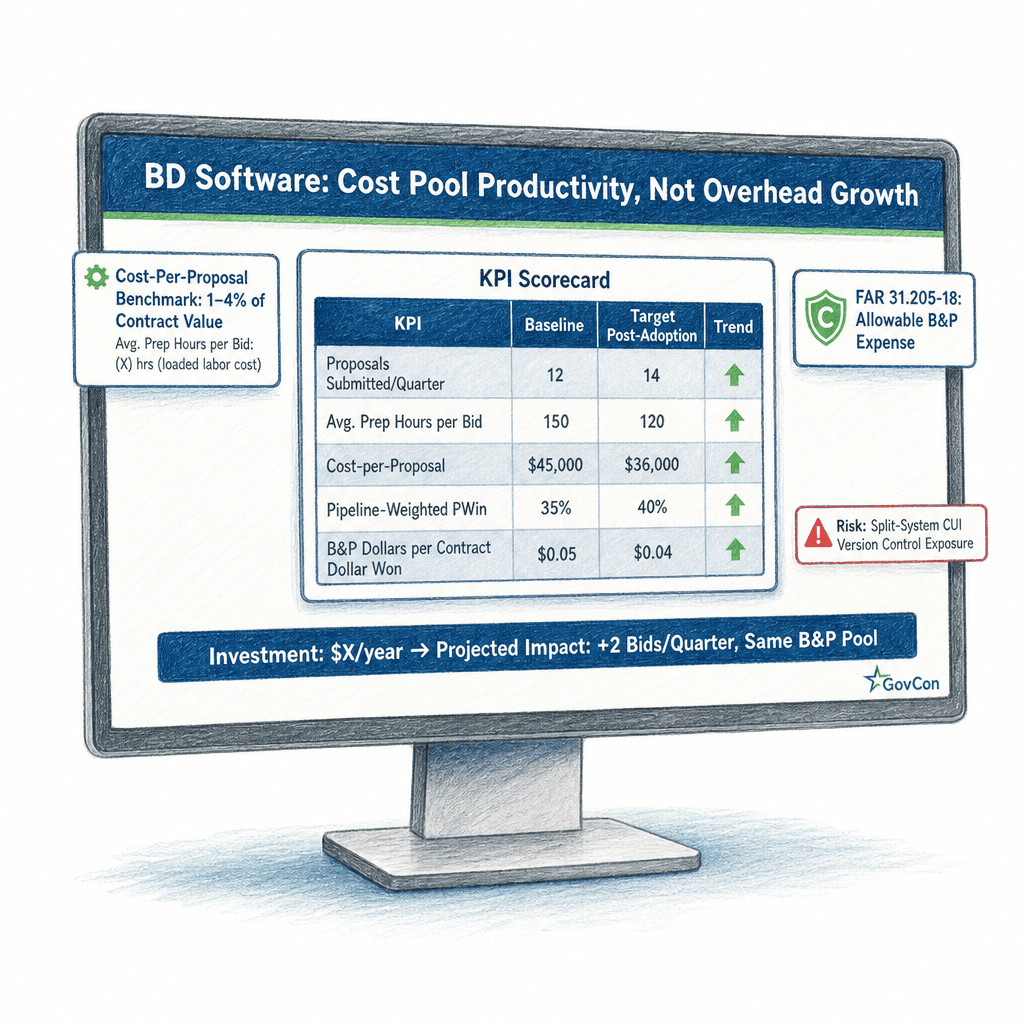
For a government contractor trying to justify the cost of BD software to a CFO, the standard pitch falls flat. The CFO isn't blocking new tools; they're running a mental model where every overhead dollar is visible to the government and every indirect rate increase is a competitive risk on the next recompete. A pitch built around time savings and feature counts doesn't fit that model. Build it around B&P cost recovery, cost-per-proposal, and pipeline-weighted PWin, and the same investment looks a lot different.
TLDR:
- GovCon CFOs assess BD software through indirect rate impact, B&P pool governance, and cost-per-win math, not feature counts.
- Under FAR 31.205-18, qualifying bid and proposal costs are generally allowable as indirect expenses to the extent they are allocable and reasonable. A BD software subscription may be included in B&P costs when its use and accounting treatment support that classification.
- One 2026 federal contracting analysis reports a 28% average win rate for companies with formal bid/no-bid processes versus 12% for companies that bid indiscriminately.
- A non-compliant proposal workflow is a contingent liability; split-system CUI handling creates version control risk with traceable labor costs.
- Firms using purpose-built BD software report 80% reductions in SME time on early-stage proposals and 3 to 4 times faster proposal throughput for lean defense teams.
The GovCon CFO's Framework for Technology Investment Decisions
GovCon CFOs operate under a constraint set with no parallel in the broader federal contracting space: every dollar spent on overhead is visible to the government. Indirect rates touch every contract. A CFO who lets fringe, G&A, or B&P costs creep upward risks pricing the firm out of competitive range on the next recompete.
When a BD or proposal team brings a software request to the table, the CFO is running a different calculation. The question is not simply whether the tool pays for itself. It is whether the spend fits within B&P budget governance, how it affects the indirect rate structure, and what the pipeline risk looks like if the team stays under-resourced.
The True Cost of Doing BD Without Dedicated Software
The CFO doesn't need to be convinced that BD costs money. What goes unexamined is the cost of manual operations relative to what teams get back. Senior technical staff spending 20 to 30 hours per proposal carry a fully loaded burden rate that comes off billable work. Without a system retaining past content, teams rebuild compliance matrices and boilerplate from scratch every pursuit, keeping cost-per-proposal high. Precise Software cut SME time on early-stage proposals by 80% after closing the capture-to-proposal gap, reducing the senior-staff labor required for those proposal activities and freeing capacity for other work.
The win rate math is the sharper argument. Some industry estimates put proposal preparation costs at roughly 1% to 4% of total contract value, though actual costs vary substantially by opportunity. On a $5M bid, that's $50,000 to $200,000 per pursuit. The question stops being "what does this software cost?" and becomes "what is our current cost-per-win, and is it defensible?" One small lean defense team achieved 3 to 4 times faster proposal throughput without adding headcount, putting more bids into the same recoverable B&P pool.
How B&P Cost Recovery Changes the Investment Math
Under FAR 31.205-18, bid and proposal costs are allowable indirect costs when incurred for preparing, submitting, and supporting bids and proposals on potential government contracts. The full FAR 31.205-18 text confirms that qualifying B&P costs are allowable as indirect expenses to the extent they are allocable and reasonable. That classification changes the conversation entirely for any BD software purchase decision stalling at the "does this hurt our rates?" filter.
The more useful framing: if the software increases proposal throughput, the per-bid cost within that same allowable pool effectively drops. That is a cost pool productivity argument, which is a metric a GovCon CFO actually cares about.
One Caveat Worth Flagging
FAR 31.205-18 excludes from B&P costs effort sponsored by a grant or cooperative agreement and effort required in the performance of a contract. Costs also must be properly accumulated, allocated, and documented under the applicable accounting requirements. The allowability determination depends on how costs are accumulated and allocated, so the accounting treatment matters as much as the category label.
Win Rate Math: Framing BD Software as Revenue Infrastructure
In the 2026 GAUGE benchmarking survey of more than 1,200 GovCon executives and leaders, the largest share of surveyed firms, 37%, reported winning 25% or less of the proposals they submit. For firms at the upper end of that group, a 25% win rate means roughly three losses for every win, making cost-per-pursuit and bid selection discipline increasingly important at scale.
The firms pulling ahead apply discipline before the RFP drops. Companies with formal bid/no-bid decision processes average a 28% win rate, compared with 12% for companies that bid indiscriminately, per Fed-Spend's 2026 win rate analysis. That 16-point gap is not a writing quality difference. It comes from earlier opportunity engagement, structured pursuit qualification, and capture intelligence that actually reaches the proposal team.
If you want to see how that math maps to your own pipeline before the CFO meeting, book a demo with GovEagle to walk through the business case with numbers from your own pursuit history.
Get GovCon capture and proposal insights in your inbox.
Translating BD Software Capabilities into Financial Language
Each BD software capability has a parallel cost category in your CFO's budget model. The reframe is mechanical: map what the tool does to a number the finance team already tracks.
Compliance Matrix Generation as Audit Risk Reduction
Manual matrix creation carries two costs: the labor hours to build it, and the exposure when something gets missed. The specific failure points are traceable: a "shall" buried in a SOW attachment that never made it into the matrix, a requirement mapped to the wrong section, a gap that nobody caught until Red Team. GovEagle's compliance matrix generation automates "shall" extraction directly from the RFP, maps each requirement to a response section, and flags gaps before any reviewer touches the document. Framing that as a control that reduces the probability of a costly compliance failure moves it from a productivity feature to a risk management argument, which lands differently with a CFO.
AI-Assisted Drafting as Capacity Expansion Without Headcount
Hiring a proposal writer carries salary, fringe, and overhead burden. BD software that produces compliant first drafts expands effective capacity without adding a headcount line. Build the comparison around the fully loaded cost per unit of draft output produced per quarter.
Key Performance Indicators That Anchor the Business Case
Before the CFO meeting happens, the BD leader needs a metric framework that connects software adoption to numbers the finance team already owns. The KPIs below map directly to line items in the indirect cost structure and B&P budget model.
| KPI | What It Measures | Why the CFO Cares |
|---|---|---|
| Proposals submitted per quarter | Throughput capacity | More bids from the same B&P spend improves cost pool productivity |
| Average prep hours per bid | Labor burden per pursuit | Loaded hours are traceable cost; reductions are verifiable savings |
| Cost-per-proposal | Composite of labor, overhead, and direct costs | The CFO's actual unit cost metric for B&P spend |
| Pipeline-weighted PWin | Expected revenue value of active pursuits | Connects pursuit selection discipline to forecasted award |
| B&P dollars per contract dollar won | Recovery performance | Measures how hard the allowable pool is working |
Set baselines before the tool goes live. A CFO reviewing a post-adoption ROI case will ask how the numbers improved; without pre-adoption data, the answer is a vendor claim. Pull three to four quarters of historical data on prep hours, proposal volume, and win rate before the software is in production.
Compliance and Security as a Financial Risk Argument
Most software ROI conversations treat security as a separate procurement checklist. In GovCon, it belongs in the financial argument from the start. When a proposal tool cannot process CUI in a compliant environment, teams typically split content across two systems. That split creates version control risk: sections diverge, edits in one system don't propagate to the other, and when a Red Team reviewer is working from a different draft than the writer, the rework cost is traceable to a process architecture decision. An AI tool that processes, stores, or transmits CUI can become part of the contractor's CMMC scope depending on how the environment is architected and how the tool interacts with CUI. As of August 2026, DoD has suspended implementation of CMMC Phase II while it conducts a program review, but Phase I requirements remain in effect and DoD continues to enforce applicable NIST SP 800-171 Rev. 2 and DFARS cybersecurity requirements. If the tool lacks the required security posture, it may need to be excluded from the workflow or trigger remediation costs to bring the system boundary back into compliance.
The CFO framing: a non-compliant workflow is a contingent liability. A cost-accounting issue may surface during a DCAA incurred cost review, while a CUI security or scoping issue may surface during a CMMC or other DoD cybersecurity assessment, but the remediation cost, the business system risk, and the potential contract performance implications are all financial events. Compliance-capable tooling reduces that exposure, making it a risk mitigation investment, not a premium feature.
How GovEagle Supports the Business Case BD Teams Are Already Making

GovEagle's documented outcomes map directly to the metrics that drive this conversation with finance and leadership. Customers report 80% reductions in SME time on early-stage proposals and 3 to 4 times faster proposal throughput for lean defense teams. The Building People increased proposal volume pursued per quarter by 50% without adding headcount. Chevo cut proposal prep time by 30 to 40% on RFIs and 15 to 25% on RFPs, reaching full team adoption in under a week.
The BD tool ROI framework in the sections above only holds if the tool behind it produces verifiable, trackable results. GovEagle gives finance teams a number they can pull quarter over quarter, not a projected outcome from a vendor pitch deck.
FAQs
How do I make the case for BD software costs to a GovCon CFO who is focused on indirect rate pressure?
Frame the investment in cost pool terms, not feature terms. BD software costs that are properly classified as B&P under FAR 31.205-18 may be allowable as indirect expenses to the extent they are allocable and reasonable, so the CFO's real question is whether the tool makes the B&P pool work harder, not whether it adds overhead. Connect reduced prep hours per bid, increased proposal throughput, and better bid/no-bid filtering to cost-per-win, and the question moves from "what does this cost?" to "what is our current cost-per-win, and is it defensible?"
What KPIs should a BD leader track before and after deploying GovEagle to build a credible ROI case for leadership?
Pull three to four quarters of baseline data before the tool goes live: proposals submitted per quarter, average prep hours per bid, cost-per-proposal, and pipeline-weighted PWin. Post-adoption, track B&P dollars per contract dollar won to measure recovery performance. Without pre-adoption baselines, the ROI case rests on vendor claims over internal evidence, and a GovCon CFO reviewing the numbers will notice.
Can a small GovCon firm realistically make the case for BD software costs when B&P budgets are already stretched thin?
Yes, and the B&P cost recovery structure under FAR 31.205-18 is the reason why. When the subscription is properly classified as an allowable B&P expense, it becomes part of the contractor's indirect cost structure rather than a direct charge to a single pursuit, which changes the investment calculation. Precise Software cut SME time on early-stage proposals by 80% after deploying GovEagle; for a lean team, that reduction in loaded senior-staff hours often exceeds the software cost within a single quarter.
Final Thoughts on Making the Financial Case for BD Software to a GovCon CFO
The firms winning more with the same B&P budget are making bid selection decisions earlier and tracking cost-per-win as a real metric, not an estimate. For any government contractor working to justify BD software costs to a CFO, the data points are already in-house. The work is connecting them to a tool that moves the numbers, then documenting the baseline so the improvement is yours to own, not a vendor's claim to borrow. Use the GovEagle ROI calculator to run the cost-per-win math before the CFO meeting, then schedule a demo when you're ready to build that case with verifiable numbers behind it. The firms that win that argument are the ones that started tracking the baseline before the software went live.