
Large Prime BD Strategy for Set-Aside Markets (September 2026)

Akash Mandavilli
CEO and Co-Founder of GovEagle
About the author
Akash is a 2x founder with previous experience in AI from Meta and federal sales from IBM. Akash holds a dual-degree from Johns Hopkins University in Economics and Computer Science.
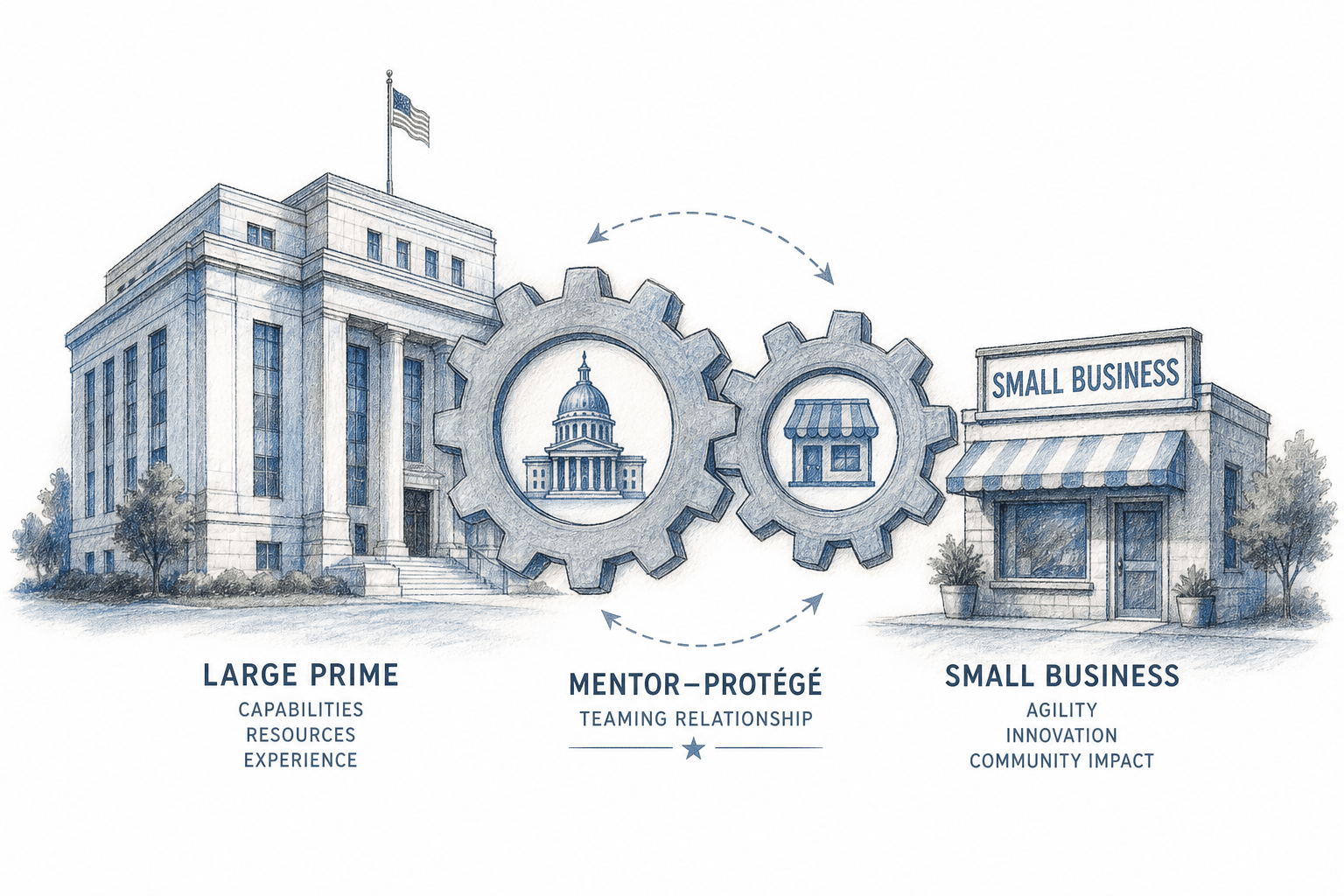
When a contract goes to a small business set-aside, large primes often treat it as a closed door and move on. But the strategies that keep competitive primes in the game, including mentor-protégé structures, teaming arrangements, and pre-solicitation influence over acquisition strategy, only work if you're building toward them well before any specific solicitation appears. The window is almost always earlier than it feels.
TLDR:
- Large primes cannot hold the prime position on a set-aside under FAR 19.502-2 once the Rule of Two is met; standard teaming workarounds do not change this
- The SBA Mentor-Protégé program is one of the few mechanisms letting an other-than-small firm hold the prime position on a set-aside via an approved joint venture
- Subcontracting plans required under FAR 52.219-9 on contracts above $900,000 are scored by evaluators and carry liquidated damage exposure under 15 U.S.C. 637(d)(4)(F)
- Track set-aside frequency by agency and NAICS code over multiple fiscal years; a defense and civilian agency in the same code can differ by 50+ percentage points
- GovEagle customers report 50%+ average time savings on proposal preparation, supporting higher full-and-open pursuit volume without proportional headcount growth
How Set-Asides Limit Large Prime Access to Federal Opportunities
Under FAR 19.502-2, contracting officers must set aside any acquisition above the simplified acquisition threshold (currently $250,000) for small business exclusive competition when the Rule of Two is met: a reasonable expectation that at least two capable small businesses will submit offers at fair market prices. Once that determination is made, other-than-small primes are locked out entirely. No teaming workaround lets a large business hold the prime position on a set-aside contract.
The scale of that exclusion matters. In FY2024, federal contract awards reached $773.68 billion, with small businesses capturing a growing share through set-aside mechanisms. For large prime BD teams, that represents a substantial portion of the addressable market that requires a different competitive strategy altogether.
The Major Set-Aside Program Categories That Restrict Prime Competition
Each set-aside category carries its own eligibility rules and agency usage patterns. Recognizing which program is gating a solicitation shapes what alternatives are available.
| Program | Key Eligibility Hook | Annual Goal | Heavy Agency Users |
|---|---|---|---|
| 8(a) Business Development | SBA-certified, socially/economically disadvantaged owner | 5% of prime awards | DoD, DHS, civilian agencies with large service spend |
| WOSB / EDWOSB | Women-owned; EDWOSB adds economic disadvantage | 5% of prime awards | Agencies with designated NAICS set-aside lists |
| SDVOSB | Service-disabled veteran ownership and control | 5% of prime awards | VA (mandatory first-look requirement), DoD |
| HUBZone | Principal office and 35% of workforce in qualified zone | 3% of prime awards | Agencies with geographic-distribution mandates |
Two programs here warrant closer attention from a BD pipeline perspective.
The VA's Service-Disabled Veteran-Owned Small Business preference moves faster than most primes expect. Under the Veterans First Contracting Program, the VA must give SDVOSBs priority before opening competition more broadly, which means VA opportunities close off to large prime pursuit earlier in the acquisition cycle than at other agencies.
HUBZone solicitations follow a different pattern. The geographic workforce requirement tends to concentrate eligible opportunities in specific regions, so a BD team can often anticipate HUBZone friction based on where the work is performed, independent of agency-level signals alone.
The Shifting Policy Environment Affecting Set-Asides in 2025 and 2026
The policy ground under set-asides shifted considerably starting in 2025. Executive Order 14173 directed agencies to wind down diversity-based contracting preferences, and SDB agency goals were reset from the higher Biden-era targets back to the statutory 5% baseline. The SBA also increased audit and suspension activity within the 8(a) program, and a FAR Part 19 rewrite in September 2025 (Federal Register, Sept. 26, 2025) restructured several small business contracting provisions.
In practice, some socioeconomic set-aside targets are contracting while the overall 23% small business prime goal and the Rule of Two remain intact. The practical risk for large prime BD teams is blanket assumptions. An agency that routinely set aside work under EDWOSB or 8(a) authority in prior years may be running fewer such procurements now, while the base small business preference stays firmly in place. Track this by agency and NAICS code, not by broad program category.
Subcontracting Plans as a Strategic Positioning Tool
Federal Acquisition Regulation Subpart 19.7 and FAR 52.219-9 require a small business subcontracting plan on any unrestricted prime contract above $750,000. Most BD teams treat this as a compliance box to check before award. The stronger play is building that plan as a source selection asset.
Evaluators score subcontracting plans. Credible, specific goals across small business, SDB, Women-Owned Small Business, HUBZone, SDVOSB, and VOSB categories signal both execution capability and existing supplier relationships. A plan with realistic percentages and named partners reads differently than one with round numbers and no supporting rationale.
The compliance stakes are real. Under 15 U.S.C. 637(d)(4)(F), failure to make a good-faith effort to meet subcontracting goals can result in liquidated damages. That moves this from an administrative task to a contract performance obligation with financial exposure.
Treated as a BD tool, subcontracting plans also build the supplier network that matters for future set-aside-adjacent pursuits. A prime with documented subcontracting history across multiple socioeconomic categories has a credible answer when evaluators probe teaming depth on the next full-and-open competition.
Using the Mentor-Protégé Program to Access Set-Aside Work
The SBA Mentor-Protégé program is one of the few mechanisms that lets an other-than-small firm compete on a set-aside as the joint venture prime. Under an SBA-approved mentor-protégé joint venture, the combined entity can bid on contracts set aside for the protégé's socioeconomic category, whether 8(a), WOSB, HUBZone, or SDVOSB, without the large business disqualifying the team.
Structurally, the mentor provides developmental assistance: technical, managerial, financial, and in some cases equity investment. In return, the approved joint venture gains eligibility for opportunities the mentor could never pursue alone. The protégé builds delivery capacity; the mentor gains access to a restricted market segment and a credible socioeconomic partner for future pursuits.
DoD's version adds a financial wrinkle worth noting. Developmental assistance costs a mentor incurs under a DoD-approved agreement can count toward the mentor's subcontracting plan goals under certain conditions, which links back directly to the compliance obligations in FAR 52.219-9.
The limiting factor is time. SBA approval requires a formal application, documentation of the developmental assistance plan, and a documented working relationship between the parties. Treating this as a pre-solicitation strategy is the only way it works. A mentor-protégé agreement assembled after a relevant solicitation posts is almost always too late to compete on that opportunity. BD teams pursuing this path need to identify protégé candidates, build the relationship, and file for approval well before a specific contract surfaces in the pipeline.
Teaming and Joint Ventures With Set-Aside Eligible Firms
Teaming with a set-aside eligible firm differs from mentor-protégé arrangements in one key respect: the small business must genuinely hold the prime position and perform the required share of the work. Under 13 CFR 125.6, the small business prime on a service contract must perform at least 50% of the cost of the contract with its own employees. That limitation shapes how any teaming arrangement gets structured, what work the large business can absorb, and how the division of labor reads to evaluators.
For capture managers, the small business partner's actual delivery capacity matters more than its socioeconomic certification. A WOSB or HUBZone firm with thin staffing and no relevant past performance may have the right eligibility but insufficient ability to credibly hold 50% of contract performance. Evaluators and SBA size reviewers look at the real division of work, beyond what the teaming agreement says on paper.
Vetting teaming candidates against a specific opportunity requires matching on at least three dimensions: socioeconomic eligibility for the anticipated set-aside category, relevant past performance in the NAICS code and PWS task areas, and actual delivery capacity at the contract scope and period of performance. A partner who checks one box without the other two is a compliance risk, not a teaming asset.
The pipeline implication is worth treating seriously. Relationships with capable small business partners take time to build, and the best teaming candidates are often committed to competing teams well before a solicitation appears. Primes who wait for a specific RFP to start conversations about teaming regularly find their preferred partners already spoken for. Treating the small business partner network as a standing BD asset, not a reactive response to a given procurement, is where this strategy compounds over time.
Get GovCon capture and proposal insights in your inbox.
Competing More Aggressively on Full-and-Open Acquisitions
Full-and-open acquisitions are where large prime volume has to come from when set-asides compress the addressable market. The question is which solicitations are realistically going to stay unrestricted.
A few signals tend to predict this reliably. High contract values above roughly $25 million often fall outside the Rule of Two threshold in practical terms, because the pool of small businesses with both the capacity and relevant past performance to compete credibly narrows fast. Acquisitions requiring clearances, specialized infrastructure, or multi-agency coordination present similar constraints. Tracking agency-level set-aside rates by NAICS code over two or three fiscal years gives a cleaner read than any single solicitation's acquisition history.
Indefinite Delivery Indefinite Quantity vehicles add another layer of complexity. A multiple-award IDIQ can be awarded unrestricted at the master contract level while individual task orders carry set-aside designations. Under FAR 19.502-4, contracting officers can reserve a portion of task order competition for small business categories while leaving the remainder open. For BD teams managing IDIQ pipelines, the practical effect is that winning a vehicle seat no longer guarantees access to every order under it. Each task order's set-aside designation needs to be tracked separately, and pursuit decisions made accordingly.
The strategic response is volume. Full-and-open competitions attract more offerors, require stronger differentiation on past performance and technical approach, and run longer evaluation cycles. Primes who can pursue more of them without proportionally expanding proposal staff hold a structural advantage, which is where proposal throughput becomes a competitive variable, and a direct BD concern, not solely an internal operations one. Integrity Defense Solutions case study, a lean defense contractor whose team was stretched across BD, capture, and proposal work, cut RFI preparation time by 3 to 4 times and went from weeks-long turnarounds to strong draft responses in a day, giving them the capacity to pursue opportunities they previously had to pass on. GovEagle's compliance matrix generation and annotated proposal outline remove the manual build time that caps pursuit volume. Book a Demo to see how teams are closing that gap.
Influencing Acquisition Strategy Before the Solicitation Drops
Market research is the evidentiary record contracting officers use when making the Rule of Two determination. When a BD team submits a detailed RFI response that documents scope complexity, specialized clearance requirements, or the limited pool of small businesses with relevant past performance in the NAICS code, that information enters the pre-solicitation record. Contracting officers are not required to accept it, but they do rely on it.
SBA Procurement Center Representatives add another variable. PCRs review pre-solicitation strategies and can recommend set-aside designations to the contracting officer, or push back on an unrestricted determination if they believe the small business market can support competition. Primes who understand the PCR review cycle can time industry day participation and RFI submissions to get useful data into the contracting officer's hands before the PCR review concludes.
The practical constraint is that none of this works reactively. Agency relationships, program office access, and a documented track record of market intelligence take time to build. A capture team engaging six to twelve months before a solicitation can shape the acquisition strategy. One engaging thirty days out is responding to a decision that was already made.
Pipeline Management When Set-Asides Fragment Your Target Market
GovCon set-aside frequency varies more than most BD teams account for, and the variation tracks by agency, program office, and contract size range. A defense agency awarding primarily in NAICS 541330 may set aside fewer than 10% of its professional engineering competitions, while a civilian agency in the same code routinely restricts 60% or more. Treating these as equivalent in a pipeline model produces a distorted picture of which recompetes are actually pursuable.
The SBA FY2025 Small Business Procurement Scorecard shows agencies continue to be scored on small business utilization, creating consistent institutional pressure to designate set-asides at recompete. An incumbent prime that won a full-and-open competition five years ago should not assume the recompete follows the same path. Contracting officers frequently revisit set-aside eligibility when a contract comes up for recompete, particularly if the agency is behind on its socioeconomic goals for the fiscal year.
SAM.gov award notices from the prior contract term show the original set-aside status, and presolicitation notices often flag a forthcoming designation change before the RFP posts. Agency procurement forecasts, where published, sometimes list anticipated set-aside categories by NAICS code alongside dollar thresholds. Pulling these signals together for each major agency customer gives a BD team a probabilistic read on which pipeline opportunities are at risk of restriction before a solicitation appears.
The practical implication is that not every expiring incumbent contract belongs in the same pursuit tier. A recompete carrying meaningful set-aside re-designation risk should be tracked separately from confirmed full-and-open pursuits, with:
- A lower default PWin probability of win that reflects the realistic chance the opportunity restricts before award
- A pre-identified teaming candidate who can carry the prime role if the contract goes set-aside
- A clear decision point for when pursuit resources shift to higher-probability opportunities if restriction is confirmed
How GovEagle Helps Primes Pursue More Full-and-Open Opportunities
When set-asides remove contracts from a large prime's addressable pipeline, the practical response is pursuing more full-and-open acquisitions. That increases proposal volume without adding headcount, which puts direct pressure on throughput.
GovEagle customers report 50%+ average time savings on proposal preparation, with some teams achieving 3 to 4 times faster throughput on individual pursuits. Faster bid/no-bid analysis supports earlier Gate 0 decisions on full-and-open opportunities. RFP shredding and compliance matrix generation, output in Excel, structures development against Section L and Section M requirements from the start. The annotated proposal outline in Microsoft Word gives writers a compliant, requirement-mapped structure before drafting begins.
For primes managing subcontracting plan obligations alongside active proposals, GovEagle's knowledge management and past performance retrieval help teams surface relevant small business teaming history quickly during proposal development, without reconstructing it from scattered CRM notes.
GovEagle is also FedRAMP Authorized, meaning it can be deployed in environments handling CUI, a requirement that surfaces frequently on defense-adjacent full-and-open competitions where large primes concentrate their pursuits.
Final Thoughts on How Primes Compete Against Small Business Set-Asides
Set-aside frequency is not evenly distributed, and a BD pipeline that treats every agency the same way will consistently overestimate how much of the market is actually pursuable. The firms that do well here build teaming relationships early, track re-designation risk on incumbent contracts, and push volume on full-and-open competitions where differentiation on past performance and technical approach actually matters. Book a demo with GovEagle to see how faster proposal preparation supports that pursuit volume without adding headcount. That combination: early teaming, pipeline discipline, and throughput at scale, is what separates primes that grow full-and-open share from those that watch the addressable market shrink one set-aside at a time.
FAQ
How can a large prime compete when set-asides remove contracts from its addressable pipeline?
The primary response is volume on full-and-open acquisitions: pursuing more unrestricted competitions without proportionally expanding proposal staff. Primes who build standing relationships with set-aside eligible teaming partners and engage in pre-solicitation market research also retain options that reactive BD teams lose before a solicitation ever posts.
Should a large prime use the SBA Mentor-Protégé program or a standard teaming arrangement to access set-aside work?
The SBA Mentor-Protégé program lets an other-than-small firm hold the joint venture prime position on a set-aside, which a standard teaming arrangement cannot; the small business must genuinely hold the prime role and perform at least 50% of contract cost under 13 CFR 125.6. Mentor-protégé is the stronger mechanism for market access but requires SBA approval well before a specific solicitation posts, making it a pre-solicitation strategy, not a reactive one.
How do I track which recompetes are at risk of set-aside re-designation before the RFP drops?
SAM.gov award notices show the original set-aside status for the prior contract term, and presolicitation notices often flag an anticipated designation change before the RFP posts. Agency procurement forecasts, where published, sometimes list expected set-aside categories by NAICS code, and tracking an agency's small business utilization scorecard gives a probabilistic read on which recompetes face restriction pressure.
How does GovEagle help large primes pursue more full-and-open opportunities without expanding proposal headcount?
GovEagle generates the compliance matrix in Excel against Section L and Section M requirements and produces an annotated proposal outline in Microsoft Word before drafting begins, giving writers a requirement-mapped structure from day one instead of building it manually under deadline.
What signals predict whether a full-and-open acquisition will stay unrestricted?
Contract values above roughly $25 million, clearance requirements, specialized infrastructure, or multi-agency coordination tend to narrow the pool of capable small businesses below the Rule of Two threshold in practice. Tracking an agency's set-aside rate by NAICS code over two to three fiscal years gives a cleaner read than any single solicitation's acquisition history.