
Loopio Reviews, Pricing, and Alternatives (August 2026)

Akash Mandavilli
CEO and Co-Founder of GovEagle
About the author
Akash is a 2x founder with previous experience in AI from Meta and federal sales from IBM. Akash holds a dual-degree from Johns Hopkins University in Economics and Computer Science.

You’re comparing Loopio alternatives because the pricing model and feature set no longer line up with how your proposal team actually works. Per-user licenses escalate fast as contributors rotate in and out, and for government contractors, gaps around compliance workflows and federal security requirements quickly become blockers instead of minor inconveniences. Commercial RFP software is built for sales teams responding to standardized questionnaires, not FAR-driven solicitations that demand Excel-based compliance matrices, native Word workflows, structured past performance inputs, and verified handling of CUI. As proposal volume increases, these gaps force teams into manual workarounds that slow submissions and raise risk.
TLDR:
- Loopio does not provide automated government-style Excel compliance matrix generation, and its workflow is primarily web-based instead of fully native inside Word/Excel for document-centric GovCon proposals.
- A few modern alternatives automate compliance matrices, integrate natively with Word/Excel, and maintain FedRAMP Moderate Equivalency for CUI data.
- Government contractors need specialized tools for proposals governed by the FAR instead of commercial RFP software.
- Some tools reduce proposal creation from weeks to hours while maintaining strict compliance with zero data retention.
- Purpose-built Loopio alternatives let government contractors scale proposal volume without adding licenses or manual compliance work as teams and bid activity grow
What Is Loopio and How Does It Work?
Loopio is a cloud-based RFP response software built for commercial procurement teams managing responses to RFPs and vendor questionnaires. The tool serves sales and business development organizations by centralizing approved content in a searchable library where teams can store, organize, and reuse responses.
The workflow starts with importing an RFP document into the web interface. Proposal managers assign questions to subject matter experts, who search the content library for existing answers, modify them as needed, and submit their responses. Once complete, teams export the finished proposal back to Word or PDF format for submission.
Loopio includes Response Intelligence, proprietary machine learning that surfaces content recommendations during the response process. The tool focuses on content management and collaboration aspects of proposal development, helping teams avoid duplicating effort by making past responses easily accessible across multiple opportunities.
Why Consider Loopio Alternatives?
Loopio works well for commercial RFP teams managing vendor questionnaires and sales-driven proposals. Government contractors with FAR-specific requirements often need different solutions because of several constraints.
Loopio is not designed for graphics-intensive proposal development, which can limit teams that rely on visually rich layouts, complex figures, or design-driven Word templates common in government proposals. Collaboration occurs primarily within Loopio’s web interface instead of directly inside native Word or Excel documents. While multiple contributors can work in parallel, teams must leave their Microsoft Office environment to collaborate, which can slow reviews and increase rework for Word-centric government proposal teams.
User-based pricing means costs scale with headcount. Organizations pay for full licenses even for occasional contributors, creating budgeting challenges as teams grow. SSO and CRM integrations are priced separately. Content migration requires dedicated IT resources.
Government contractors face acute limitations. Loopio does not provide automated generation of government-style Excel compliance matrices using agency-specific formats, requiring teams to build and maintain those matrices manually outside the platform. Loopio relies primarily on a web-based authoring model with export and add-in support for Microsoft Word, instead of fully native, document-centric workflows required for FAR-compliant proposals built and reviewed directly inside Word and Excel. The system has no workflows for past performance analysis or PWS shredding.
For defense and federal IT contractors, Loopio does not publicly document FedRAMP authorization or FedRAMP Moderate Equivalency for processing CUI data, which creates verification challenges for many government contractors with strict federal security requirements.
Best Loopio Alternatives in August 2026
GovEagle

GovEagle is an AI-driven proposal automation solution purpose-built for government contractors responding to federal, state, and local solicitations. The system can considerably accelerate early-stage proposal development, from weeks to days or even hours for initial drafts, while maintaining alignment with government requirements and handling CUI data securely.
GovEagle integrates directly into Microsoft Word, Excel, PowerPoint, and SharePoint, allowing teams to work within existing workflows. Key capabilities include compliance matrix generation in Excel that extracts all RFP requirements including Sections L, M, and C, native Microsoft Office add-ins that preserve templates and formatting, and FedRAMP Authorization with support for CUI workflows aligned with NIST SP 800-171 requirements, relevant for organizations scoping CMMC Level 2 work (note: the DoD suspended CMMC Phase II's C3PAO third-party audit requirement on July 13, 2026, pending a 60-day Reform Task Force review; Phase I self-assessment obligations and NIST SP 800-171 requirements remain in force). The solution supports end-to-end government contracting workflows including bid/no-bid analysis, capability gap identification, past performance ranking, and annotated outlines.
GovEagle serves government contractors of all sizes (50 to 2,000+ employees) that need to increase proposal volume and reduce SME burden without process overhaul.
Vultron

Vultron is an AI-powered proposal workspace built around collaborative drafting for federal proposals. The platform offers AI-assisted section drafting, a centralized past performance and boilerplate content library, and multi-author editing workflows. Its agentic AI layer includes adaptive scoring and strategic review functions that flag alignment gaps and compliance issues during development.
Vultron targets larger federal BD teams that need structured collaboration across writers, SMEs, and reviewers on concurrent pursuits. The system supports compliance matrix workflows and can generate section drafts against Section L structures, but operates through a browser-based editor rather than native Word or Excel add-ins, and does not produce automated Excel-format compliance matrices using agency-specific templates.
Loopio vs. GovEagle vs. Vultron: Feature Comparison
| Feature | Loopio | GovEagle | Vultron |
|---|---|---|---|
| Built for Government Contracting | No. Designed for commercial RFP and sales questionnaire workflows | Yes. Purpose-built for federal solicitations governed by the FAR | Partial. General proposal workflow tool, not GovCon-specific |
| Excel Compliance Matrix Generation | Not available. Teams build matrices manually outside the tool | Yes. Automated extraction of Sections C, L, and M into Excel using existing templates | Partial. Supports compliance matrix workflows but no automated Excel-format generation using agency-specific templates |
| Microsoft Office Integration | Web-based authoring with Word export and add-in support; not fully native inside Word/Excel | Native add-ins for Word, Excel, and PowerPoint. Teams work inside familiar documents without switching apps | Limited. No confirmed native Word or Excel add-ins |
| FedRAMP / CUI Security | No publicly documented FedRAMP authorization or Moderate Equivalency for CUI processing | FedRAMP Authorized. Supports GCC and GCC High environments; zero data retention; NIST 800-171 and CMMC alignment | Not confirmed |
| Past Performance Analysis | Not available | Yes. Ranks past performance contracts against PWS task areas; capability and gap analysis included | Not available |
| PWS Shredding | Not available | Yes. Extracts task areas and requirements directly from the PWS | Not available |
| Bid/No-Bid Analysis | Not available | Yes. AI-assisted bid/no-bid qualification built into the workflow | Not available |
| Annotated Proposal Outline (Word) | Not available | Yes. Generates Section L/M-mapped outline directly in Microsoft Word | Document assembly from existing content libraries |
| Pricing Model | Per-user licensing; SSO and CRM integrations priced separately | Contact for pricing. Scales with proposal volume, not headcount | Contact for pricing |
Why GovEagle Is the Best Loopio Alternative
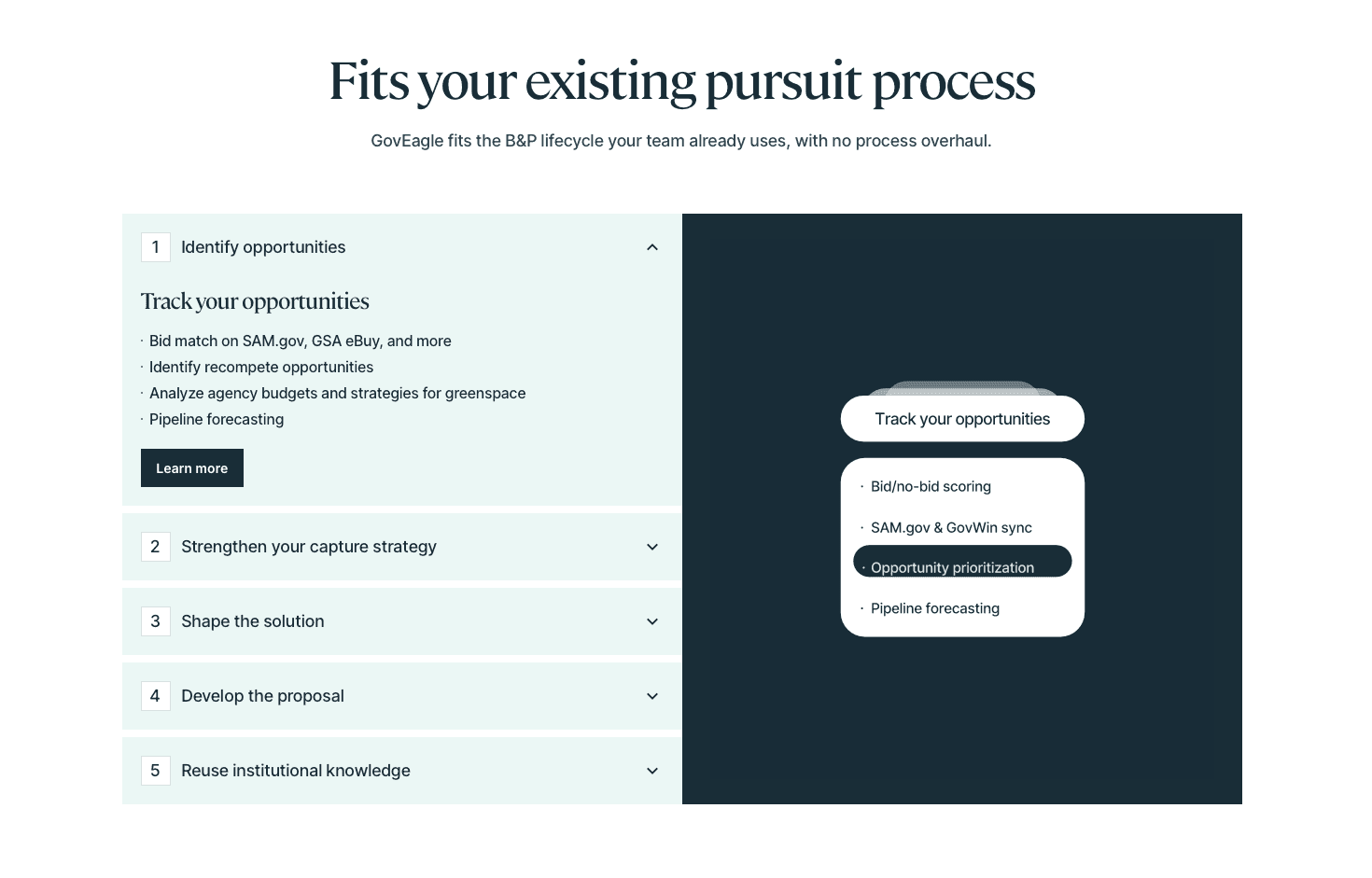
Loopio works for commercial RFP teams, but government contractors operate under a different set of rules. Solicitations governed by the FAR demand precise compliance, structured requirements tracking, and secure handling of CUI, none of which can be bolted onto software built for sales questionnaires. GovEagle was built particularly for GovCon teams that live inside Word and Excel, face compressed timelines, and cannot afford compliance misses or security uncertainty.
The difference shows up immediately in how work gets done. GovEagle shreds RFPs the way experienced proposal managers do, extracting every instruction, requirement, and evaluation factor into full compliance matrices that can be exported directly to Excel using your existing templates. Annotated outlines, past performance ranking, capability and gap analysis, and PWS shredding are part of a single workflow, not separate tools or manual steps. Proposal teams start with a compliant structure and informed strategy instead of a blank page.
GovEagle also fits how government contractors actually collaborate. Native Microsoft Word and Excel add-ins allow writers, SMEs, and managers to work inside familiar documents with tracked changes and comments intact. AI-assisted drafting produces Pink Team-ready content in the company’s own voice using its past proposals and libraries, while automated reviews flag compliance gaps and weaknesses before color team reviews. Teams using GovEagle routinely cut proposal timelines by half or more while reducing SME involvement on early-stage work.
Security and trust are foundational. GovEagle maintains FedRAMP Moderate Equivalency with NIST 800-171 and CMMC alignment, supports GCC and GCC High environments, and enforces zero data retention so proprietary proposal content never trains shared models. For contractors responding to federal solicitations at scale, GovEagle delivers a purpose-built alternative to Loopio that supports faster submissions, tighter compliance, and institutional knowledge that stays with the organization instead of walking out the door.
FAQs
Why do government contractors look for alternatives to Loopio?
Government contractors need specialized capabilities that Loopio doesn't provide, including automated compliance matrix generation in Excel format, native Microsoft Office integration that preserves existing templates, and verified security certifications for processing CUI data under FedRAMP Moderate Equivalency standards.
What features should you focus on when comparing RFP response tools for government contracting?
Focus on compliance automation (particularly Excel-based compliance matrices), deep Microsoft Office integration that works within your existing workflows, security certifications that meet your agency requirements (FedRAMP, NIST 800-171, CMMC), and government-specific capabilities like past performance analysis and PWS shredding.
When should you consider moving away from commercial RFP software?
Consider switching when you're responding primarily to government solicitations that require FAR compliance, when your team spends excessive time manually creating compliance matrices, or when security requirements demand FedRAMP Moderate Equivalency for CUI processing that your current tool cannot verify.
How does native Microsoft Office integration differ from basic export functionality?
Native integration means working directly inside Word, Excel, and PowerPoint with add-ins that preserve your templates, formatting, and tracked changes without switching between applications, while basic export functionality requires moving content between a web interface and Office documents, often breaking formatting and requiring manual rework.
Final Thoughts on Assessing Loopio and Its Alternatives
Choosing among Loopio alternatives comes down to whether your proposal software matches the realities of government contracting and the day-to-day pressures your team faces during active solicitations. Commercial tools like Loopio can support sales-driven RFPs, but federal work demands Excel-based compliance matrices, native Microsoft Office workflows, structured requirements tracking, and verified security for CUI handling under FedRAMP standards. Without those capabilities, teams often rely on manual spreadsheets, duplicated content libraries, and last-minute formatting fixes that introduce risk and burn staff time. GovEagle was built with these federal requirements in mind, giving GovCon teams a tool aligned to FAR-driven solicitations without forcing workarounds or parallel systems. As proposal volume grows, having software that fits existing Word and Excel processes becomes a competitive advantage, not a convenience.