
Past Performance Volume Scoring: What Evaluators Want

Akash Mandavilli
CEO and Co-Founder of GovEagle
About the author
Akash is a 2x founder with previous experience in AI from Meta and federal sales from IBM. Akash holds a dual-degree from Johns Hopkins University in Economics and Computer Science.
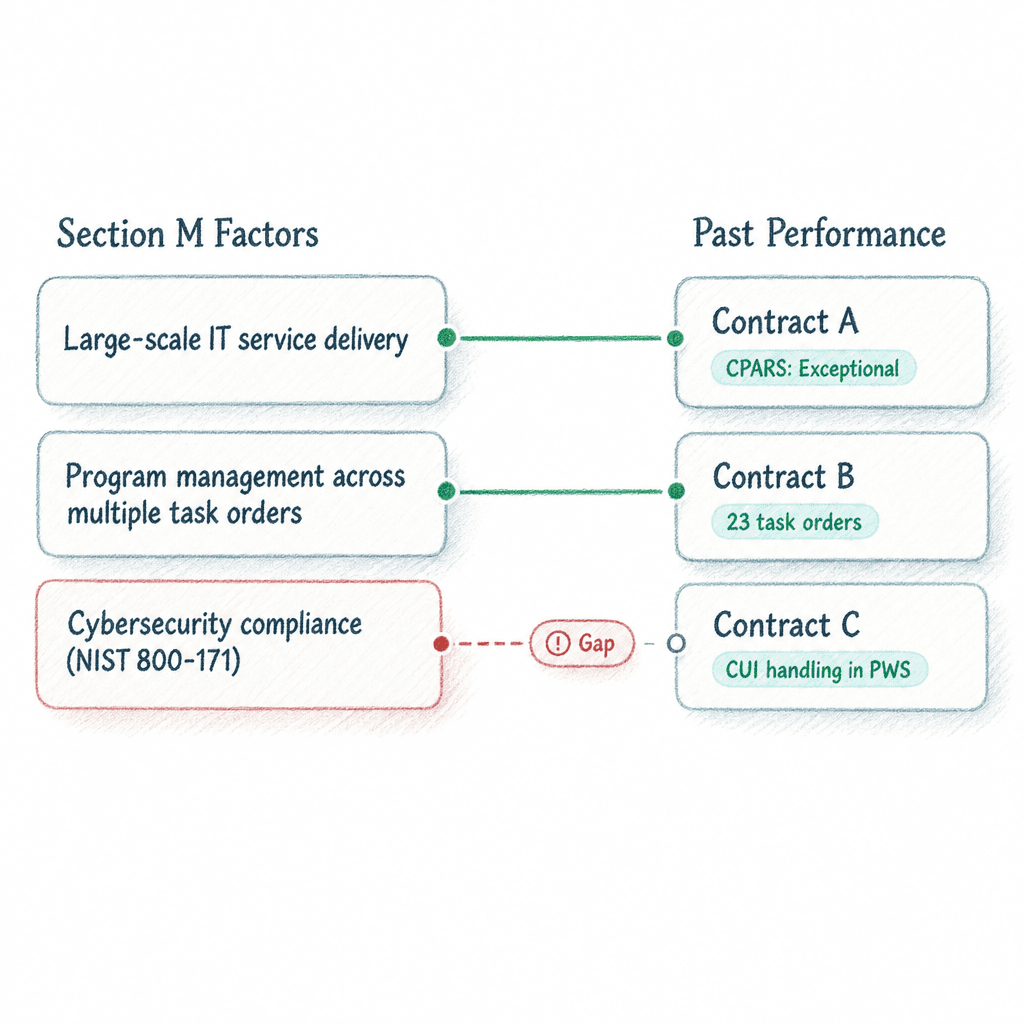
If your past performance volume isn't explicitly mapped to Section M evaluation factors, evaluators are left to infer the connection on their own, and inference is risk. The write-ups that score well aren't necessarily from firms with the strongest track records. They're from firms that understood what evaluators are scoring and structured every reference around that answer.
TLDR:
- Evaluators score past performance across three dimensions: relevance, recency, and quality; a reference that fails any one can pull your confidence rating down regardless of the other two.
- Relevance is tiered in Section M across scope, contract value, and technical complexity; missing any variable can drop your reference a tier even with strong CPARS ratings.
- Recency windows typically run three to five years and vary by agency; out-of-window references submitted without explanation often receive no credit.
- Quantified outcomes beat qualitative descriptions; stating CPARS ratings explicitly and documenting resolved corrective actions gives evaluators a basis for projecting forward confidence.
- GovEagle's Capability and Gap Analysis cross-matches contract history against PWS task areas, surfacing relevant references that may otherwise be missed before the first narrative is written.
What Evaluators Are Actually Scoring in the Past Performance Volume
Evaluators apply a structured assessment across three dimensions: relevance, recency, and quality. Each dimension carries weight independently, and a reference that scores well on two but fails the third can pull a confidence rating down.
- Relevance asks whether the prior contract matches the scope, scale, and technical domain of the current requirement. A strong performance record on a dissimilar contract often scores lower than an adequate record on a comparable one.
- Recency reflects how current the experience is. Work completed outside the typical three-to-five year window may receive limited or no credit depending on solicitation instructions.
- Quality covers the substance of documented outcomes: were deliverables met, were there corrective actions, and what do references say when contacted?
The past performance volume is scored evidence, not a reference list. A thin write-up on a strong contract loses to a well-documented write-up on a comparable one. IBR, a federal contractor, rebuilt its compliance review workflow around GovEagle and found that surfacing the right past performance evidence at the right time was the turning point for stronger evaluation outcomes.
The FAR Framework Governing Past Performance Evaluation
FAR 15.305(a)(2) makes past performance one indicator of an offeror's ability to perform successfully. It requires agencies to consider the currency and relevance of the information, its source, its context, and general trends in the contractor's performance. It requires the solicitation to describe how past performance will be evaluated, including for offerors with no relevant record. It also says evaluations should consider the past performance of key personnel, predecessor companies, and subcontractors who will perform major or critical aspects of the work. Everything else (weighting, the exact recency window, the number of references, and how relevance tiers are defined) is set by the agency in Sections L and M.
The FAR names currency (recency) and relevance explicitly. Quality is assessed through the performance record itself: CPARS ratings, questionnaires, and documented outcomes. What "relevant" means for a particular acquisition is defined by the agency, not the regulation. A past performance volume written against a generic template instead of the specific Section M criteria misses the mark before an evaluator reads a single line.
Relevance: Why Contract Scope, Size, and Complexity Must Match
Agencies rarely leave "relevance" undefined in Section M. Most solicitations tier it explicitly using language like Very Relevant, Relevant, Somewhat Relevant, or Not Relevant, with each tier mapped to a scoring range across three variables: scope of work, contract value, and technical complexity. Missing on any one of them can drop the reference a tier, even when the work was performed well.
Dollar thresholds are the most common cut. Submitting work performed at half the stated threshold, even with exceptional CPARS ratings, often lands in a lower relevance tier where quality has limited room to compensate.
Contract type and vehicle can also factor in. Some solicitations weight experience on comparable vehicle structures, particularly for IDIQ task orders where managing delivery-order complexity is part of the performance expectation.
The practical challenge arises when your strongest past work is technically comparable but misaligned on size. A few strategies worth considering:
- Aggregate subcontract and teaming roles to build toward the required value, where the solicitation permits it
- Cite the specific task order value instead of the overall IDIQ ceiling if the task order itself meets the threshold
- Frame scope comparability in the narrative before tackling size, so evaluators weigh the technical match before encountering the value gap
Relevance positioning is a selection problem before it is a writing problem. Which references you submit, and in what order, matters as much as how each one is documented.
Recency Windows and How to Handle Gaps
Most solicitations define recency as work performed within the past three to five years, though the window varies by agency and acquisition type. Some DoD solicitations compress this to three years for highly technical requirements; civilian agency RFPs sometimes extend to six. The operative window is always in Section M, not in the FAR.
Work completed outside the defined window typically receives little or no credit, though agency practice varies. If the performance period ended before the cutoff date, the reference is exposed.
Where this creates real risk is when a firm's most comparable work wrapped up just outside the window. A few approaches worth considering:
- If the contract had a final option period that extended into the recency window, cite that period's completion date explicitly and document the performance scope covered during it.
- Key personnel with documented history on relevant contracts can sometimes carry relevance where the firm's own corporate record falls short. The FAR encourages agencies to consider key personnel experience, and the solicitation governs how and whether it may be submitted.
- A subcontractor or teaming partner with recent, comparable experience can be cited, as long as the solicitation permits it and the work is documented at the task level.
If a reference is borderline on recency, lead with scope and outcome before the dates. Evaluators read sequentially, and a strong relevance argument set up before the performance period dates appear gives context that a bare timeline cannot.
How to Write the Performance Narrative for Each Reference
Each reference needs a consistent structure that evaluators can scan quickly under time pressure. The required elements are not optional: contract number, agency, period of performance, dollar value, a scope summary, a relevance statement, and documented performance outcomes. When Section L specifies an exact format, follow it precisely.
The scope summary is where most narratives lose ground. Listing contract deliverables does not build relevance. Draw a direct line between what you did on that prior contract and what the current PWS requires, mirroring Section C terminology where the solicitation uses specific language.
The performance outcome section is where the evaluation score is actually decided. Quantified results outperform qualitative descriptions. A stat like "Maintained 98.6% on-time delivery across 47 task orders" carries more weight than "consistently delivered on schedule." Where CPARS ratings exist, cite the assessed area and rating explicitly. Where they do not, documented client letters or contracting officer statements fill the gap.
The relevance statement is the piece most narratives skip. Every reference should include an explicit connection to the current evaluation criteria as written in Section M. "This contract reflects experience with [Section M factor]" may lack elegance, but evaluators reading under time pressure need that connection stated, not implied.
Mapping References to Section M Evaluation Factors
Section M is the scoring map. Every factor listed there is a scoring decision waiting to happen, and your references either speak to those factors explicitly or leave the evaluator to infer the connection.
Inference is risk. Evaluators under time pressure default to what a reference clearly says, not what it implies.
Pull each past performance evaluation factor from Section M, then ask whether each reference you are submitting can cover it directly. Some factors will map cleanly to one reference. Others may require drawing on two, or noting where a teaming partner's experience fills the gap.
Build a simple internal compliance matrix before writing a single narrative:
| Section M Factor | Reference | Coverage Basis |
|---|---|---|
| Large-scale IT service delivery | Contract A | Scope and value match; CPARS Exceptional |
| Program management across multiple task orders | Contract B | 23 concurrent task orders documented |
| Cybersecurity compliance (NIST 800-171) | Contract C | CUI handling explicitly in PWS |
This matrix does not go in the proposal. It is a drafting tool that keeps each narrative anchored to a specific scoring decision instead of drifting into generic capability claims.
Where one reference satisfies multiple factors, state that explicitly in the narrative instead of repeating the reference across sections without connection. Where a factor has no clear reference match, that is a compliance gap the proposal strategy needs to solve before writing begins, through teaming, key personnel experience, or a mitigation argument.
Get GovCon capture and proposal insights in your inbox.
Ratings and Confidence Levels: What "Substantial Confidence" Requires
Agencies translate past performance assessments, in some DoD acquisitions, through a Performance Risk Assessment Group (PRAG), into two parallel outputs: an adjectival quality rating and a confidence level. The quality rating reflects how well prior work was performed. The confidence level drives source selection: it reflects how likely the offeror is to successfully perform the current contract based on that record.
| Confidence Rating | What It Means |
|---|---|
| Substantial Confidence | High expectation the offeror will successfully perform, based on recent, relevant performance |
| Satisfactory Confidence | Reasonable expectation of successful performance |
| Neutral Confidence | No recent or relevant record, or too sparse to assess; rated neither favorably nor unfavorably |
| Limited Confidence | Low expectation of successful performance |
| No Confidence | No expectation of successful performance |
Evaluators are making a risk judgment about future execution, not scoring a trophy case. A reference that documents what was delivered without explaining how challenges were managed or how corrective actions resolved problems gives evaluators little basis for projecting confidence forward.
Substantial Confidence typically requires references showing consistent on-time and on-budget delivery, no unresolved negative CPARS findings, and performance outcomes that held up under contract complexity. If a reference includes a corrective action, document the resolution explicitly. An acknowledged and resolved problem often reads as lower risk than a spotless record evaluators cannot verify.
CPARS, Questionnaires, and Other Sources: Managing the Reference Ecosystem
Evaluators rarely rely on your written narrative alone. CPARS records are pulled independently, and where they exist, they carry considerable weight. When your narrative describes exceptional delivery but CPARS reflects a marginal rating on the same contract, evaluators often treat the discrepancy as a credibility problem.
Past performance questionnaires fill gaps where CPARS records are absent, particularly for commercial work, subcontract roles, or contracts that predate CPARS adoption. Send questionnaires to references early. A reference who receives a form 48 hours before the deadline produces a thinner response than one given adequate time.
Brief your references before they respond. They need to know which Section M factors the agency is scoring and which aspects of the work your narrative emphasizes. An uncoordinated reference who describes the contract in generic terms while your narrative makes a specific relevance argument creates an inconsistency the source selection evaluation team notices.
Federal guidance generally directs agencies to consider all available past performance sources beyond CPARS. A strong questionnaire response can supplement a thin CPARS record, but it cannot override a documented performance pattern the government's own system already captured.
When You Have No Past Performance: Acceptable Mitigation Strategies
FAR 15.305(a)(2)(iv) states that an offeror with no relevant past performance record shall be rated neither favorably nor unfavorably. That neutral rating is not a disqualifier, but treating it as automatic is where firms lose ground.
Evaluators still make a confidence judgment. A firm that submits nothing leaves the panel with no basis for projecting forward performance. A firm that proactively closes the gap with supporting documentation gives evaluators something to assess.
Three sources carry weight here:
- Teaming partner citations: A prime's past performance record can include subcontractor work where the solicitation permits. Structure those citations with scope summaries, relevance statements tied to Section M factors, and documented outcomes.
- Key personnel history: Individuals with documented performance on comparable contracts can supplement a thin corporate record. The FAR encourages agencies to consider key personnel experience, and the solicitation governs how and whether it may be submitted. Cite specific prior roles, contract numbers, and outcomes tied directly to current PWS requirements.
- Subcontract references: Prior subcontract work, including government-funded and commercially performed contracts, can be cited where the solicitation allows. Document task-level scope and value, beyond the prime contract ceiling alone.
Where all three sources are thin, a short explanation of organizational capability and adjacent experience can still give evaluators context, though FAR 15.305 requires a neutral rating when no relevant record exists.
Common Mistakes That Draw Down Your Rating
Four patterns come up repeatedly.
Submitting references outside the recency window without explanation is the most avoidable error. If a reference falls outside the stated period, evaluators have no obligation to credit it, and an unannotated out-of-window reference reads as a planning failure.
Scope summaries that stay at the contract level instead of the task level consistently underperform. A generic description of a CMMC compliance engagement does not build relevance for a specific cybersecurity services requirement. Evaluators scoring against Section M factors need task-level detail.
Adverse CPARS findings left unaddressed are treated as unresolved risk. If a marginal rating exists in your record and your narrative offers no corresponding explanation, evaluators have only that CPARS file to work from. Document the corrective action, the resolution timeline, and the outcome in the narrative itself.
Narrative claims that contradict CPARS. When your narrative describes exceptional delivery but CPARS shows a marginal rating on the same contract, evaluators treat the gap as a credibility problem. Reconcile them explicitly: document what the corrective action was, when it was resolved, and what the outcome was, so evaluators have a basis for moving past the discrepancy.
How GovEagle Supports Past Performance Volume Development
The core workflow problem (which references to use, which Section M factors they satisfy, and whether institutional memory of past work is accessible at all) requires a structural tool.
GovEagle's Capability and Gap Analysis cross-matches a firm's contract history against current PWS task areas directly, surfacing relevant past performance contracts that might otherwise be missed under deadline pressure. According to a GovEagle case study, Chevo used GovEagle to rank its top 10 past performance contracts against 12 PWS task areas on an RFI in under a minute, work that previously required senior leaders' institutional knowledge or multiple meetings. That is a selection problem solved before the first narrative is written. If reference selection under deadline pressure is where your past performance volume typically breaks down, Book a Demo to see how the Capability and Gap Analysis maps your contract history to PWS task areas before drafting begins.
The compliance matrix GovEagle generates from Section L and Section M in Excel anchors reference selection to evaluation criteria from the start, building the mapping described above into the workflow instead of leaving it to be assembled manually after drafting begins.
For small GovCons managing the knowledge management bottleneck, GovEagle's semantic search across connected content repositories surfaces prior proposal narratives, CPARS summaries, and performance writeups within the drafting workflow. A lean team can produce a structured past performance volume without depending entirely on senior SME availability to reconstruct reference narratives from memory.
Final Thoughts on Scoring Well on the Past Performance Volume in Federal Proposals
The past performance volume rewards documentation discipline more than performance history. A well-documented reference on a comparable contract typically scores better than a thin write-up on a stronger one, and a reference that misses the recency window often receives no credit regardless of quality. GovEagle's proposal automation platform cross-matches your contract history against current PWS task areas so reference selection and narrative alignment happen before deadline pressure sets in, not during it. Treat reference selection as a strategy problem first, then build each narrative around the specific Section M factors your evaluators are scoring against. Document them with enough specificity that evaluators can score instead of infer.
FAQ
How do evaluators score the past performance volume in a federal proposal?
Evaluators assess past performance across three dimensions: relevance, recency, and quality. Each is assessed, and together they shape the overall confidence rating. A reference that meets scope and complexity requirements but falls outside the recency window typically receives no credit, regardless of how strong the performance record is. The confidence level evaluators assign, which drives source selection, depends on how well the documented outcomes project forward to the current requirement.
What should you do when your strongest past performance references fall outside the recency window or below the dollar threshold?
If a contract had a final option period that extended into the recency window, cite that period's completion date explicitly and document what scope was covered during it. For value gaps, cite the specific task order value instead of the overall IDIQ ceiling if the task order itself meets the threshold, or aggregate subcontract and teaming roles where the solicitation permits. Key personnel with documented history on comparable contracts can sometimes carry relevance where your firm's corporate record falls short, provided the solicitation allows individual experience to supplement past performance references.
GovEagle vs. manual reference selection for past performance volume development: which is faster under deadline pressure?
GovEagle's Capability and Gap Analysis cross-matches contract history against current PWS task areas directly, surfacing relevant references that teams often miss when working under deadline pressure. That selection problem is solved before the first narrative is written. Manual reference selection under the same conditions typically means reconstructing institutional memory from notes and conversations, which creates gaps before the writing even begins.
How do you map past performance references to Section M evaluation factors in a federal proposal?
Build an internal matrix before drafting that maps each Section M factor to a specific reference and documents the coverage basis: scope match, contract value, CPARS rating, or task-level detail. This keeps each narrative anchored to a scoring decision instead of drifting into general capability claims. Where a factor has no clear reference match, that is a gap to solve through teaming, key personnel experience, or a mitigation argument before writing begins, not during it.
What does FAR 15.305(a)(2) actually require agencies to do when assessing past performance?
FAR 15.305(a)(2) directs contracting officers to assess the likelihood of successful performance based on relevant prior work. Weighting, recency windows, the number of references required, and how relevance is defined are all left to agency discretion and spelled out in Section M, not in the FAR itself. A past performance volume written against a generic template instead of the specific Section M criteria misses the scoring criteria before an evaluator reads a single line.