
Pricing and Cost Volumes: Complete Guide and Examples (September 2026)

Your technical volume describes a senior-heavy team executing a phased delivery model, and your cost volume prices 60% mid-level labor with no travel budget and a thin basis of estimate that doesn't explain how the hours were calculated. Pricing and cost volumes aren't about hitting a number. They're about proving your cost structure funds the exact technical approach and management plan you put on paper, with every assumption documented well enough to survive a DCAA audit.
TLDR:
- Price and cost volumes answer different questions under FAR Part 15: price tells the government what it pays, cost proves you understand the work scope and can execute it.
- A weak Basis of Estimate (BOE) triggers upward cost adjustments under FAR 15.404-1(d) and signals execution risk across technical and past performance evaluations.
- The most common cost realism failure is misalignment between volumes: when your cost buildup does not support the labor mix, hours, or resources described in your technical approach.
- Unsupported labor rates, missing BOE documentation, and outdated indirect rates are the top deficiencies that draw audit findings and evaluation risk.
- Purpose-built proposal software connects cost volume components to RFP requirements and prior submissions in a single workspace, reducing manual cross-referencing and catching compliance gaps before submission.
What Are Pricing and Cost Volumes in Government Contracting
In federal contracting, the pricing volume and cost volume are the two financial submission components required in most competitive responses. Though often treated as interchangeable, they serve distinct purposes under source selection.
The pricing volume contains the contractor's actual proposed prices, the numbers an agency will use to review price reasonableness and make award decisions. The cost volume provides the underlying cost buildup: direct labor, indirect rates, materials, subcontractor costs, fee, and the supporting rationale that shows how those prices were constructed.
Why the Distinction Matters
Agencies assess these volumes separately because they answer different questions. Price tells the government what it will pay. Cost tells the government whether that price is realistic and whether the contractor understands the scope of work.
FAR 15.404-1(b): price reasonableness
FAR 15.404-1(d): cost realism; FAR 15.408 Table 15-2
| Price Volume | Cost Volume | |
|---|---|---|
| Primary purpose | States what the government pays | Proves your cost structure funds the technical approach |
| Evaluator focus | Market comparisons, competitive range | Labor mix, indirect rates, BOE traceability |
| Risk of weakness | Out-of-range pricing, competitive exclusion | Upward cost adjustment, execution risk flags |
| Audit / cost analysis exposure | Lower (fixed-price) / moderate (cost-type) | Higher - cost elements may be reviewed through cost analysis or audit support when required |
Core Components of a Federal Cost Volume
A federal cost volume is the section of your proposal that breaks down every dollar you're asking the government to pay. Evaluators use it to assess whether your pricing is realistic, reasonable, and aligned with your technical approach. The components vary by contract type and solicitation, but most cost volumes share a common set of required elements.

Key Components
Most federal cost volumes will include some combination of the following:
- Direct labor: Hours and rates by labor category, typically tied to your technical staffing plan. Evaluators may compare proposed labor hours, rates, and labor mix against the technical approach and solicitation requirements.
- Other direct costs (ODCs): Travel, materials, subcontractor costs, and other project-specific expenses, each requiring independent justification.
- Indirect rates: Fringe, overhead, G&A, and sometimes facilities capital cost of money (FCCOM), either based on actuals, forward pricing rate agreements (FPRAs), or provisional rates.
- Fee or profit: Applied in accordance with the contract type and FAR Part 15.404-4 guidelines on structured profit analysis.
- Cost or price narrative: A written explanation supporting your numbers, required under FAR 15.408 Table 15-2 when certified cost or pricing data are required and often reviewed during internal proposal quality reviews before submission.
Basis of Estimate: The Foundation of Credible Pricing
A Basis of Estimate (BOE) is the documented rationale behind every cost figure in your proposal, helping support compliance and defend your estimate during evaluation. Evaluators use it to judge whether your pricing is realistic, traceable, and defensible under scrutiny.
What a Strong BOE Includes
A credible BOE ties each cost element back to a verifiable source or methodology. The key components most evaluators expect to see:
- Labor hours supported by historical actuals, staffing plans, or industry benchmarks, not round numbers pulled from intuition
- Material and subcontract costs supported by vendor quotes, catalog pricing, or prior contract data
- Overhead and G&A rates drawn from your accounting system, with any forward-pricing rate agreements (FPRAs) referenced explicitly
- Escalation factors tied to a recognized federal source such as the OUSD(Comptroller) economic price escalation guidance or DCAA forward pricing rate recommendations
- Assumptions and constraints stated clearly so evaluators understand the conditions under which your estimate holds
Why BOE Quality Affects More Than Just Cost Realism
A weak BOE creates downstream risk across the entire evaluation. Cost realism evaluations, which are required under FAR 15.404-1(d) for cost-reimbursement contracts, give the government authority to adjust your proposed costs upward if your rationale appears insufficient. Beyond compliance, a poorly documented BOE signals execution risk to the Source Selection Evaluation Board, which can affect your technical and past performance scores even when those volumes describe a sound approach.
FAR Part 15 Requirements for Cost Proposals
What FAR 15.408 Table 15-2 Requires
Table 15-2 organizes cost proposals into the same categories that make up a cost volume: direct labor, indirect rates, materials, subcontractor costs, and fee. Each element must be supported by documentation that traces the estimate back to its basis, whether historical actuals, forward pricing rate agreements (FPRAs), or vendor quotes.
Key requirements under this framework include:
- Direct labor must be broken down by labor category, hours, and fully burdened rates, with supporting rationale for any hours that deviate from prior actuals.
- Indirect rates applied to the proposal should be consistent with audited, negotiated, provisional, or otherwise supportable rates, and with the contractor's disclosed cost accounting practices.
- Subcontractor proposals may require certified cost or pricing data when the subcontract action exceeds the FAR 15.403-4 threshold and no exception applies; in those cases, the applicable FAR 15.408 submission requirements can flow down.
- Contract, subcontract, or modification actions exceeding the FAR 15.403-4 threshold may require certified cost or pricing data when no exception applies.
Get GovCon capture and proposal insights in your inbox.
Cost Realism Analysis: How Agencies Review Your Pricing
Cost realism analysis is the process agencies use to assess whether your proposed costs are realistic, complete, and consistent with your technical approach.
Under FAR 15.404-1(d), agencies are required to perform cost realism analysis on cost-reimbursement contracts. The evaluator's job is to determine whether your proposed costs reflect a credible plan to actually execute the work, instead of a number designed to win.

There are a few specific things evaluation panels tend to flag during this review:
- Labor rates that fall below prevailing wage data or your own historical actuals raise immediate questions about whether you can attract and retain qualified staff at the rates proposed.
- Unbalanced cost allocation, where indirect rates or fee structures look inconsistent with your technical narrative, signals that the cost volume and technical volume were not written in coordination.
- Missing or thin basis of estimate (BOE) documentation leaves evaluators without the audit trail they need to accept your assumptions, which can result in the government adjusting proposed costs upward for evaluation purposes.
When agencies perform an independent government cost estimate (IGCE) and your proposed costs land considerably below it, the contracting officer may normalize your costs upward for evaluation purposes. A lower price does not necessarily produce a lower assessed cost, a point many pricing teams underestimate going into source selection.
Aligning Cost and Technical Volumes
The most common cost realism failure is a disconnect between what the technical volume promises and what the cost volume funds. If your technical approach calls for a senior-level team but your labor mix is weighted toward mid-level staff, evaluators will note the gap.
Cross-referencing staffing assumptions, material costs, and subcontractor quotes against the technical narrative before submission catches these inconsistencies before the government does.
Common Cost Volume Mistakes That Hurt Evaluation Scores
Several patterns appear repeatedly across losing proposals:
- Unsupported labor rates are among the most common triggers for a cost realism finding. If rates are not tied to a salary survey, a collective bargaining agreement, or a documented internal compensation study, evaluators have no basis to accept them as realistic.
- Misaligned cost and technical volumes create credibility problems. When the technical volume describes a six-person team but the cost volume funds four, evaluators score the discrepancy as a performance risk.
- Outdated indirect rates submitted without an explanation of how they were developed or traced back to a DCAA audit will often draw questions during evaluation or negotiation.
- Failure to account for uncompensated overtime in labor-intensive contracts can skew the cost realism assessment, particularly on cost-type awards where the government bears financial risk.
How GovEagle Accelerates Cost Volume Development and Maintains Compliance
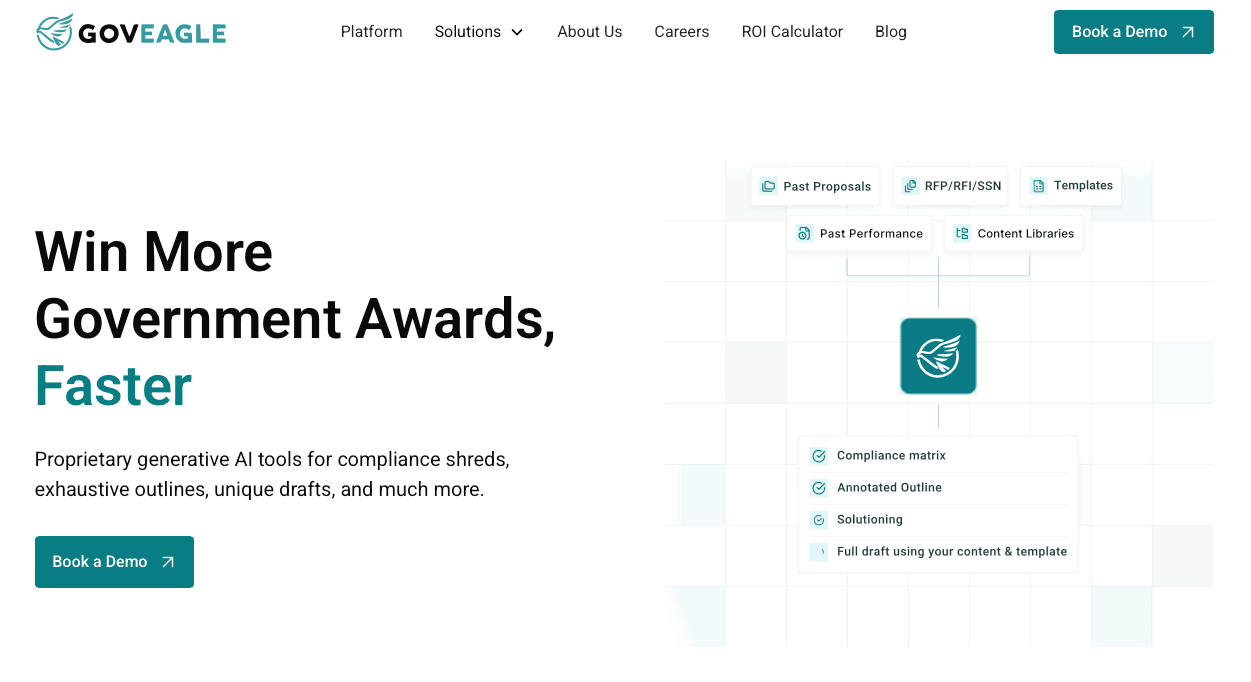
The tool pulls together contract requirements, historical pricing data, and cost build-up logic into a structured workflow so your pricing team isn't rebuilding from scratch on every pursuit. Teams work from a single environment where cost volume components stay connected to their source requirements, without toggling between spreadsheets, Section L instructions, and prior submissions.
On the compliance side, GovEagle maps cost volume elements against RFP-specified requirements and FAR-mandated disclosures, flagging gaps before they reach the evaluator. For submissions subject to TINA or cost realism review, that traceability matters.
FAQs
Can I build a cost volume without certified cost or pricing data if I'm under the TINA threshold?
Yes, if your proposal is below the certified cost or pricing data threshold set by FAR 15.403-4, you are not required to submit certified cost or pricing data. However, you still need to provide sufficient documentation to support cost reasonableness, and the contracting officer may request a cost breakdown consistent with Table 15-2 format even when certification is not required.
How do I support labor rates when I don't have a forward pricing rate agreement?
Tie your rates to verifiable external sources such as salary surveys, collective bargaining agreements, Bureau of Labor Statistics wage data, or documented internal compensation studies. Evaluators need an audit trail showing how each rate was calculated, so a number without a methodology will draw cost realism scrutiny even if the amount appears competitive.
When does a weak BOE affect scores outside the cost volume?
A poorly documented basis of estimate creates downstream evaluation risk because it signals execution uncertainty to the Source Selection Evaluation Board. If your cost rationale looks thin or unsupported, evaluators may score that gap as performance risk in your technical evaluation and management capability assessment, even when those volumes describe a sound approach.
Final Thoughts on Building Cost Volumes That Survive Evaluation
A well-constructed cost volume does more than support your price. It proves you understand the requirement, can execute the work at the rates proposed, and built your estimate from verifiable assumptions instead of competitive guesswork. When your cost and technical volumes tell the same story and your basis of estimate documentation holds up under DCAA scrutiny, you remove evaluation risk that most teams leave on the table. GovEagle connects cost volume components to RFP requirements and prior submissions in a single workspace, reducing the manual cross-referencing that consumes pricing teams' time and catching compliance gaps before they reach the evaluator.