
Slide Decks and Oral Presentations in GovCon: 11 Proven Strategies for September 2026

The evaluation panel may have reviewed your written technical volumes, or the oral presentation may be part of the evaluation process itself. The oral presentation gives evaluators another way to assess what the written proposal may not fully show: whether your key personnel can speak to their own past performance without coaching, whether your technical approach holds up under direct questioning, and whether the proposed team matches the actual execution team. Slide decks and oral presentations in GovCon fail when they duplicate the written proposal instead of reinforcing discriminators mapped to Section M evaluation factors.
TLDR:
- Agencies often use oral presentations for complex, high-risk, or personnel-heavy acquisitions where evaluators need to verify team depth beyond written proposals.
- FAR 15.102 gives agencies broad discretion over oral presentation format, timing, participant qualifications, written-material limits, and exchanges, so the solicitation instructions are the authoritative source for the specific requirements.
- Map every slide to a Section M evaluation factor and weight slide count to match point allocation; evaluators score only what they can trace to their scoring criteria.
- Presenters should match proposed personnel when the solicitation requires or expects key personnel participation; when your named PM or technical lead is absent, panels flag it as an availability risk that affects scoring.
- Purpose-built proposal software maps Section L oral requirements against existing proposal content, pulls past performance and win themes into structured outlines, and flags uncovered requirements before rehearsals begin.
When Agencies Require Oral Presentations and Why They Matter
Agencies request oral presentations across a range of acquisition types, but they appear most often in high-value, complex procurements where written proposals alone leave too many questions unanswered. Defense contracts, IT services acquisitions, and professional services RFPs under FAR Part 15 frequently include an oral presentation requirement as part of the evaluation scheme. GSA has extended that approach through its oral acquisition plan expansion pilot, covering select categories where evaluators can assess qualifications and price without requiring a full written submission.
The core reason is evaluation fidelity. A panel scoring a written proposal can only assess what the contractor submits on paper. An oral presentation lets the source selection team probe technical approach, test the depth of key personnel knowledge, and gauge whether the team that will actually perform the work is the same team that wrote the proposal.
What Triggers the Requirement
Several conditions tend to drive agencies toward requiring presentations:
- Higher-value or complex acquisitions where personnel qualifications carry substantial evaluation weight, and evaluators want to verify that proposed staff can speak to their own roles without coaching.
- Acquisitions with high execution risk, where the agency needs to assess whether the contractor's technical lead genuinely understands the mission environment, beyond the RFP language.
- Recompetes where the incumbent has a relationship advantage, and the agency uses the oral forum to level the evaluation playing field across offerors.
- IT modernization and advisory services contracts where approach credibility depends on the specific people presenting, not on boilerplate methodology narratives.
Proposal managers who treat the oral presentation as an afterthought to the written volume tend to lose ground precisely where evaluators are paying the most attention, similar to how teams that skip early proposal reviews miss correction opportunities.
Understanding FAR 15.102 Requirements and Solicitation Instructions
FAR 15.102 sets the governing framework for oral presentations in federal source selections, and reading it carefully reveals how much latitude contracting officers actually have in shaping the format.
What FAR 15.102 Actually Permits
Under FAR 15.102, agencies may use oral presentations at any point in the acquisition process. The regulation gives agencies broad discretion over scheduling, duration, format, and participant requirements, subject to the solicitation and applicable acquisition rules.
Key areas solicitation instructions typically define:
- Who from your team is permitted or required to speak, including whether the session includes government-led questions, prepared remarks, or both
- Whether visual aids and slide decks must be submitted in advance, and in what file format
- Recording or transcription rules that affect what becomes part of the official record
- Restrictions on leaving materials behind, which can strip a GovCon proposal team of a key reinforcement tool
Why This Matters in Practice
Evaluation panels score what was presented and documented, not what your team intended to convey. When solicitation instructions specify a 20-minute oral presentation with no leave-behinds, any slide deck or supporting material must do its work entirely within that window. FAR 15.102 allows oral presentations to substitute for or augment written information, but the solicitation controls what must be presented orally and what must still be submitted in writing. Missing that distinction has caused teams to under-document their written volume, leaving evaluators without the record they need to score past the oral round.
Aligning Slide Decks to Section M Evaluation Criteria
Section M functions as the scoring sheet evaluators carry into the room, the same way Gold Team reviewers use it to validate final proposal alignment. Any slide that fails to map to a rated factor is less likely to support the evaluator's scoring rationale.
Pull each rated factor and assign it a dedicated slide or sequence. If staffing qualifications carry 30 points, personnel slides deserve proportional time. Past performance narratives, technical approach, transition plans, and sample task responses each trace back to a scoring line. Generic capability messaging rarely moves a score.
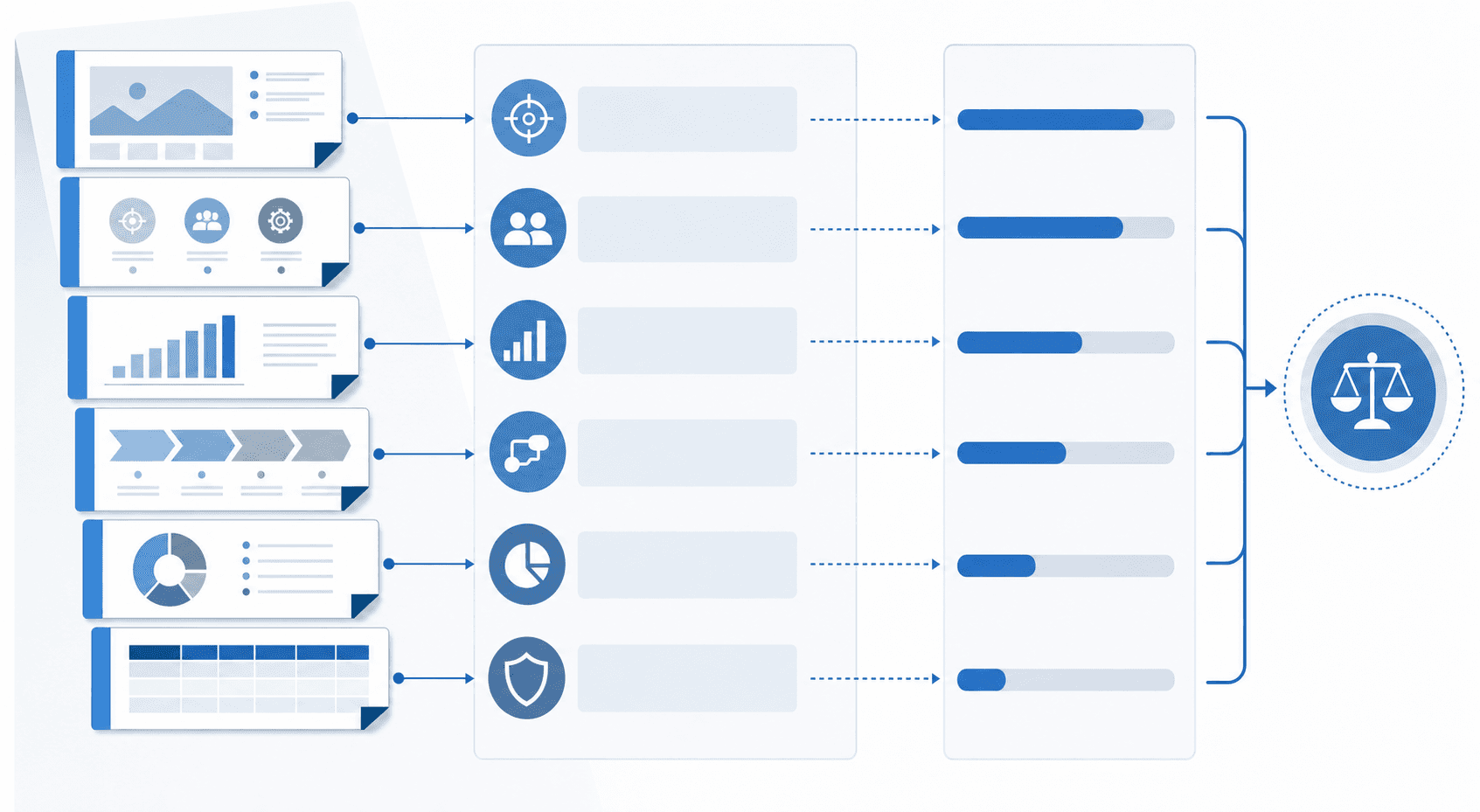
A few practical rules:
- Label slides internally by their Section M factor, not by presentation topic, so the evaluation panel can follow your structure against their own scoring criteria.
- Weight your slide count to match relative point allocation across factors, giving heavier-weighted criteria more real estate in the deck.
- Reserve sample tasks and work plan content for factors that score execution credibility, not stated intent, since evaluators score what you can prove, not what you propose.
Building Slide Decks That Complement Instead of Duplicate Written Volumes
Evaluators reading a GovCon proposal often see slide decks that simply restate what the written volumes already say. That redundancy costs you scoring points because evaluators notice when a presentation adds nothing new to the record.
The slide deck serves a different function: it gives the source selection panel a structured visual reference during oral questioning and reinforces your key discriminators through hierarchy and emphasis instead of dense prose.
Keep each slide mapped to a specific Section M evaluation factor. If a slide cannot be traced to a scoring criterion, cut it.
- Lead each slide with the discriminator, not the process. Evaluators score proven outcome delivery, so open with the result before explaining how you achieved it.
- Use visuals to carry compliance relationships that prose buries. A matrix or timeline showing how your staffing plan meets PWS requirements communicates faster than paragraphs can.
- Reserve slide real estate for items where your team holds a clear advantage. Neutral or weak areas belong in the written volumes where detailed explanation is possible.
Get GovCon capture and proposal insights in your inbox.
Selecting and Preparing Your Presentation Team
Evaluators compare presenters against proposed key personnel. When key staff are absent, agencies may view it as an availability risk. Match presenters to the roles they will perform, prepare backups early, and conduct rehearsal sessions that include live questioning and interruptions.
Rehearsing Under Realistic Conditions
Recording rehearsals catches problems no live review will surface. Proposal teams consistently underestimate how long speaker rotations take between PM, technical lead, and past performance presenters, and how poorly a rushed Section M response lands when the evaluation clock is running, particularly when capture intelligence has not been translated into Section M talking points. Watch the playback with your Section M scoring criteria open, and flag every moment where an evaluator would lose scoring relevance.

Build at least one session around unsolicited Q&A interruptions fired mid-presentation. Timing discipline tends to collapse under that kind of pressure, and the only way to harden it is repetition under conditions that closely resemble the actual evaluation room. Surface those execution risks in rehearsal, not in front of the panel.
Handling Q&A and Evaluator Challenges
Evaluators often learn more from Q&A than from prepared remarks because follow-up questions reveal whether presenters truly understand the solution. Anticipate challenges tied to past performance, staffing, transition, and pricing, then rehearse concise answers supported by specific examples. Assign a designated Q&A lead and route questions to the appropriate SME to avoid hesitation or conflicting responses.
| Prep Area | Key Action | Risk if Skipped |
|---|---|---|
| Section M alignment | Map every slide to a rated evaluation factor | Slides may fail to support the intended scoring factor |
| Personnel matching | Confirm presenters match proposed key staff | Panel flags availability risk against scoring |
| Rehearsal | Record dry runs with live Q&A interruptions | Timing failures surface in front of the panel |
| Format compliance | Verify Section L slide count and file restrictions | Non-compliant materials can create evaluation risk or be excluded from consideration |
| FAR 15.102 review | Confirm whether oral requirements substitute for or supplement written volumes | Missing required written information can weaken the evaluation record |
Accelerating Oral Presentation Development with GovEagle
GovEagle supports the full oral presentation workflow, from initial outline to final slide deck, within the same environment your team already uses for proposal development. When an oral presentation requirement appears in Section L, GovEagle maps it against your existing proposal content so the narrative stays consistent with your written submission instead of drifting into a separate track.
The tool pulls relevant past performance, technical approach sections, and win themes directly into a structured presentation outline, reducing the coordination overhead that typically falls on the proposal manager during the oral presentation preparation window.
Where GovEagle Fits in the Oral Prep Cycle
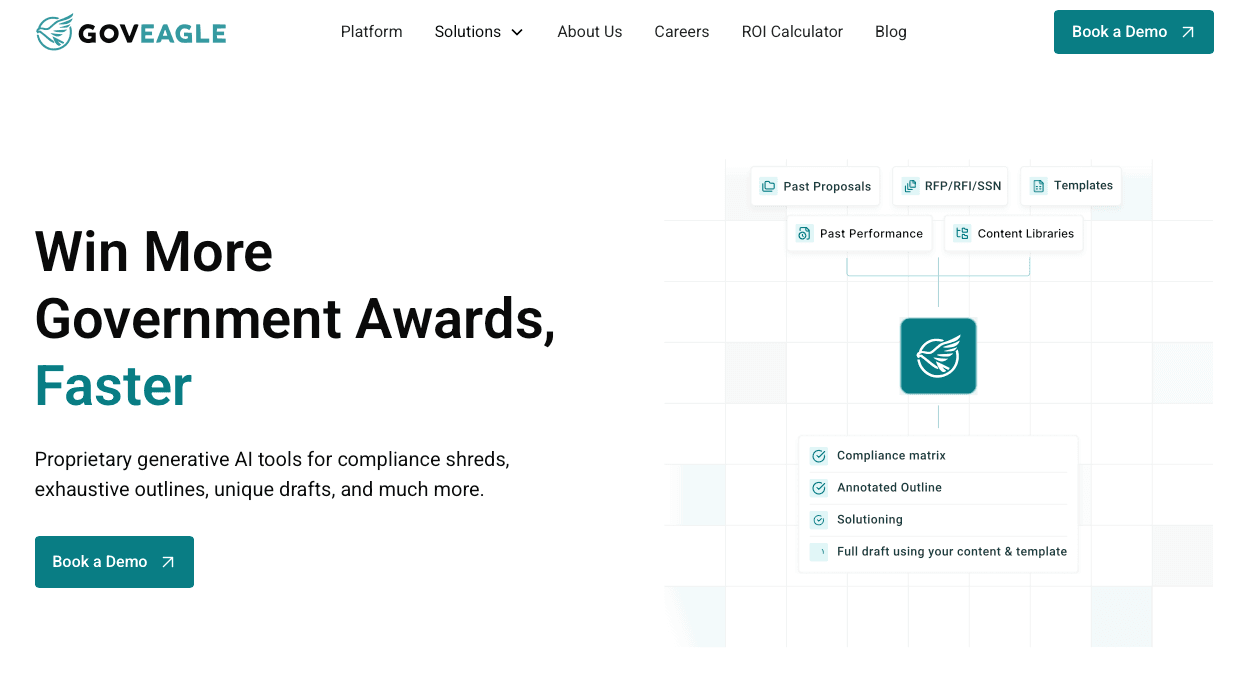
Most teams compress oral presentation development into a narrow window. GovEagle solves that constraint by treating the oral as an artifact of the proposal, not a separate deliverable.
- Slide content is generated from Section C and Section L source material, keeping responses traceable to stated requirements.
- Win themes developed during capture carry through to speaker notes and talking points automatically.
- The compliance view flags any oral presentation requirements that have not been covered in the draft slides, giving the proposal manager a checklist against Section M evaluation criteria before the rehearsal cycle begins.
FAQs
Can I build an oral presentation for a GovCon proposal without completely redrafting my written volumes?
Yes. Your oral presentation should reference and reinforce your written submission without duplicating it. Map each slide to a Section M evaluation factor, lead with discriminators instead of process narratives, and use visuals to surface compliance relationships that prose buries in your technical volumes.
What triggers agencies to require oral presentations in federal acquisitions?
Agencies often use oral presentations in complex, higher-value, personnel-heavy, or high-risk acquisitions where evaluators need to verify technical depth beyond written narratives, including IT modernization and professional services RFPs where approach credibility depends on the specific people presenting.
How do I prepare presenters when key personnel availability is flagged as a risk?
Match presenters directly to the personnel listed in your staffing volume so evaluators can verify availability during the oral session. Identify a backup for each key personnel slot before the presentation date is set, and brief every presenter on questions likely to surface from your staffing and transition risk areas documented in the RFP.
Final Thoughts on Federal Oral Presentation Strategy
Winning slide decks and oral presentations in GovCon treat the oral as a continuation of the proposal workflow: slides map to evaluation factors, presenters trace to proposed key personnel, and rehearsals surface the execution risks evaluators will probe during Q&A. When your deck reinforces discriminators instead of restating prose, and your technical lead can answer follow-up questions without deflecting, the oral becomes proof of capability, not a formality. GovEagle maps oral content to proposal sections so the narrative holds together from written submission through presentation day.