
Enterprise AI Tools for Government Contractors: Top 6 in September

Akash Mandavilli
CEO and Co-Founder of GovEagle
About the author
Akash is a 2x founder with previous experience in AI from Meta and federal sales from IBM. Akash holds a dual-degree from Johns Hopkins University in Economics and Computer Science.
GovEagle is not affiliated with, sponsored by, certified by, or otherwise associated with Shipley Associates.
Your BD and proposal teams are running under deadline pressure that leaves no room for toolchains that only cover part of the workflow. The compliance matrix still needs to get built, the RFP amendments still need to get tracked, and the drafts still need to map back to Section M criteria. These six enterprise AI tools for government contractors are the ones GovCon teams are actively assessing in 2026, with the trade-offs laid out clearly.
TLDR:
- Purpose-built GovCon AI tools cover Section L/M compliance matrices, RFP-aligned drafting, and pre-RFP capture intelligence; general-purpose tools miss these entirely.
- Review the deployment environment alongside features: tools handling CUI should align with FedRAMP, NIST 800-171, or CMMC depending on agency and contract type.
- CMMC Phase II C3PAO audit requirements are currently suspended as of July 13, 2026; NIST 800-171 obligations and Phase I self-assessments remain in force.
- Most tools in this roundup cover only part of the proposal lifecycle; fragmented toolchains create version-control risk and compliance gaps under deadline pressure.
- Some modern solutions can cover all five proposal lifecycle stages in a single FedRAMP Authorized environment with native Word and Excel integration; Precise Software cut SME time on early-stage proposals by 80% using it.
What Are Enterprise AI Tools for Government Contractors?
Enterprise AI tools for government contractors are software applications that use AI to automate, accelerate, or improve workflows specific to federal procurement. In the GovCon context, that means proposal writing, compliance matrix generation, opportunity identification, past performance documentation, and contract analysis, not generic business productivity tasks.
The distinction matters because federal contracting imposes constraints that commercial AI tools are not built to handle. Section L and Section M requirements, FAR compliance, CUI handling obligations, and agency-specific evaluation criteria create a compliance surface that general-purpose tools often miss entirely.
Purpose-built enterprise AI tools for government contractors typically cover several functional areas:
- Proposal drafting and content generation grounded in RFP requirements, so output maps to evaluation criteria instead of generic best practices
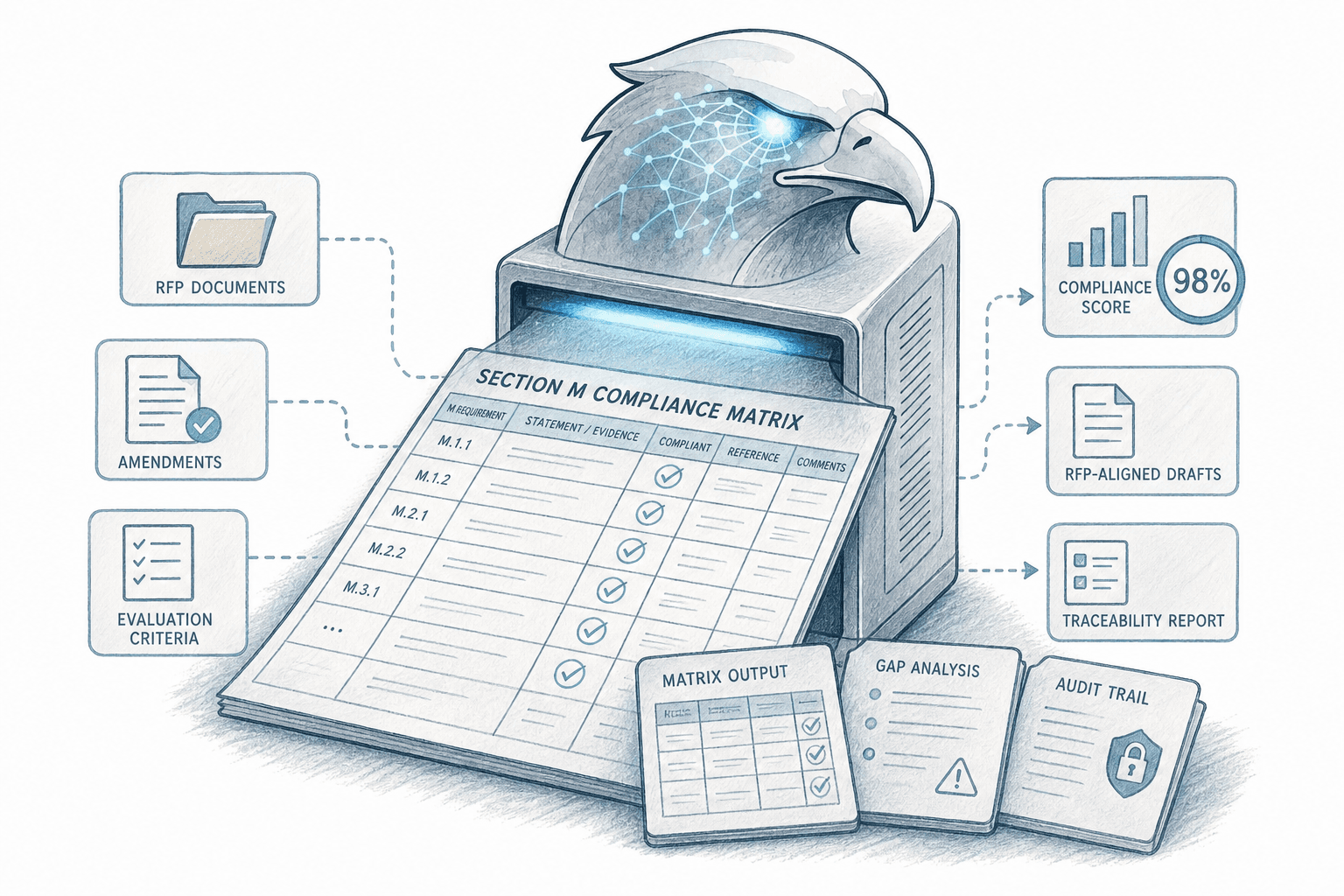
- Compliance matrix generation that traces Section L instructions to corresponding response sections, reducing the manual effort that consumes BD and proposal teams in the early stages of a pursuit. Chevo, a federal management consulting firm, cut proposal prep time by 40% after automating this stage of the workflow
- Opportunity identification and pipeline intelligence that surfaces relevant solicitations and pre-solicitation activity across SAM.gov and agency forecasts
- Contract and document analysis that flags risk clauses, teaming agreement gaps, or incumbent performance data relevant to a capture decision
Federal proposal workflows frequently involve controlled unclassified information, which means the deployment environment and the feature set both determine whether a tool is viable on a given contract. Security certifications such as FedRAMP and NIST SP 800-171 alignment may be required depending on agency and contract type, so reviewing a tool's hosting environment alongside its capabilities is part of the procurement decision, not an afterthought.
Best Overall Enterprise AI Tool: GovEagle
GovEagle is purpose-built for the federal proposal workflow, which separates it from general-purpose AI writing tools that happen to get pointed at RFPs. Where most enterprise AI tools require contractors to adapt their process to the software, GovEagle fits into how proposal teams already work: inside Microsoft Word and Excel, against Section L and M requirements, with compliance traceability built in from the start.
The core workflow begins at RFP ingestion. GovEagle parses the solicitation, maps requirements to Section L and M, and generates a compliance matrix in Excel automatically. That matrix becomes the foundation for the entire pursuit, not an afterthought assembled under deadline pressure. From there, AI-assisted drafting produces Section-aligned first drafts that proposal managers can review, revise, and route through color team cycles without rebuilding the compliance thread.
Where GovEagle Fits in the GovCon Workflow
For capture and proposal teams in particular, a few capabilities matter more than the general feature list:
- The compliance matrix generation works in Excel natively, so teams with customized templates do not have to rebuild their formats or export into an unfamiliar interface to get usable output.
- AI drafting operates inside Microsoft Word, meaning writers stay in the environment where proposals actually get written, edited, and tracked. There is no context-switching to a separate web editor mid-pursuit.
- The system supports pre-RFP capture activities, giving BD leads structured intelligence earlier in the pipeline before a solicitation is ever published.
Security and Compliance Posture
For contractors handling controlled unclassified information, the deployment environment matters as much as the feature set. GovEagle is FedRAMP Authorized and supports deployment in AWS GovCloud and Azure self-hosted configurations. CMMC Level 2 and NIST 800-171 alignment are built into the architecture, not layered on afterward.
One note on CMMC: as of July 13, 2026, the Department of War suspended the CMMC Phase II rollout. The C3PAO third-party audit requirement is currently on hold pending a 60-day CMMC Reform Task Force review. Phase I self-assessment obligations remain in force, and NIST SP 800-171 still applies to any system touching CUI. The practical takeaway is that the audit deadline moved, not the underlying obligation. Tools handling CUI should still align with NIST 800-171 requirements regardless of the Phase II pause.
How GovEagle Performs Against the Field
Precise Software, using GovEagle, cut SME time on early-stage proposals by 80%. That result reflects a workflow change, beyond faster typing: when compliance scaffolding is built automatically from the RFP, subject matter experts spend time on technical differentiation instead of matrix construction and cross-referencing. To see automated compliance matrix generation and Word-native drafting running against a live RFP, Book a Demo. Teams new to proposal automation can find a full breakdown of how these workflows operate in practice.
| Capability | GovEagle |
|---|---|
| Compliance Matrix Generation | Excel-native, auto-generated from RFP |
| AI Drafting Environment | Microsoft Word (native) |
| Pre-RFP Capture Support | Yes |
| Deployment Options | AWS GovCloud, Azure self-hosted |
| FedRAMP Status | Authorized |
| NIST 800-171 Alignment | Yes |
| CMMC Level 2 Support | Yes (Phase II C3PAO audit currently suspended; self-assessment obligations remain) |
GovEagle fits best for mid-to-large GovCon firms running multiple concurrent pursuits where compliance coverage and drafting throughput are the binding constraints, and where the proposal workflow lives in Microsoft Office, not a browser.
AskSage
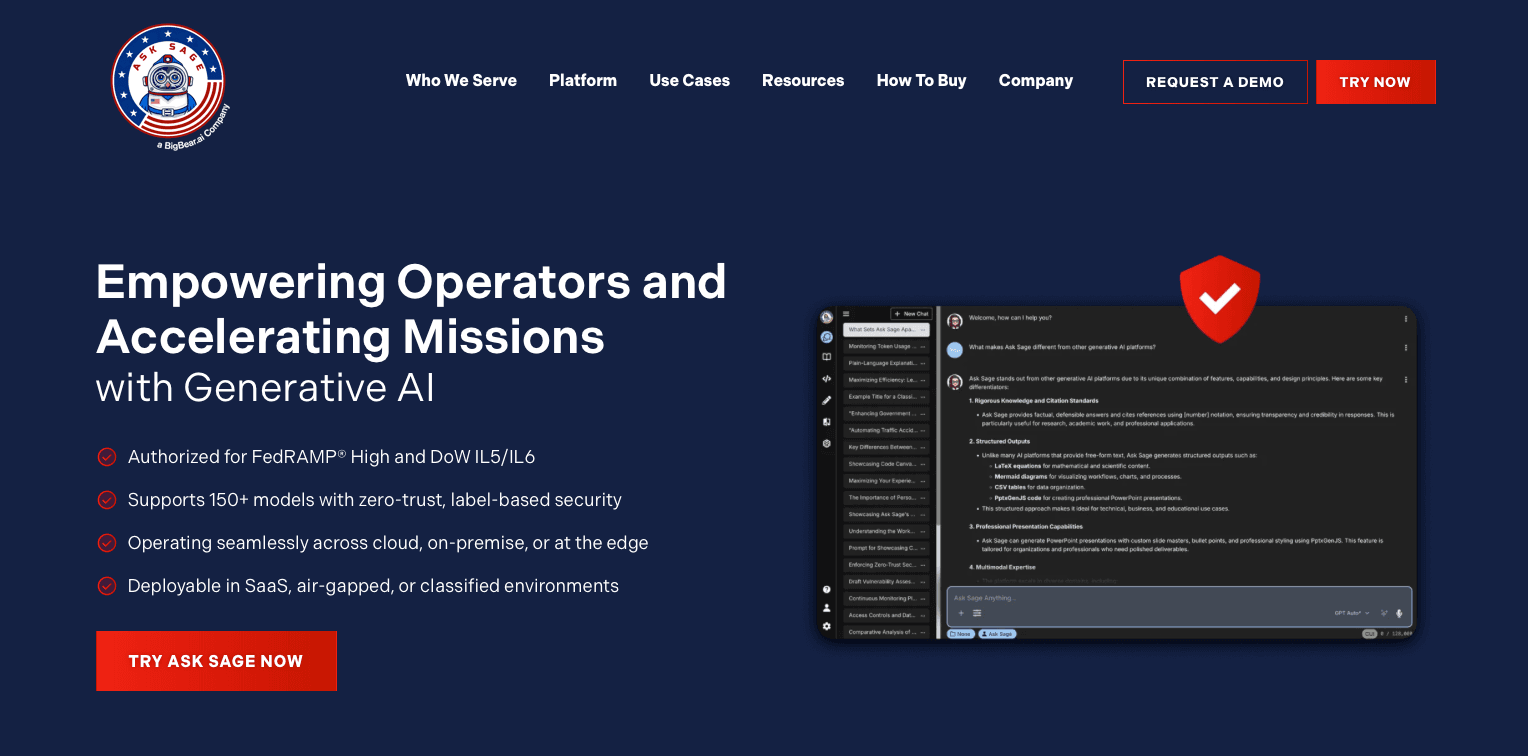
AskSage is a cloud-based AI assistant built exclusively for the federal government and defense communities. It runs on AWS GovCloud and supports GCC High deployments, making it one of the more security-conscious options in this category for contractors working on sensitive or classified programs.
The tool connects to a wide range of underlying AI models and lets users switch between them depending on the task. For proposal teams working across multiple volumes, that flexibility can matter when the drafting requirements for a technical approach volume differ from those for a management or past performance narrative under Section L instructions.
Vultron
Vultron is an AI-powered proposal development tool built for federal contractors, covering the workflow from capture planning through submission using proprietary AI models.
Larger BD teams managing concurrent proposals across multiple authors tend to get the most from Vultron. The browser-based editor, though, creates friction for teams whose color team review cycles run on Word tracked changes and Word-native comments. Publicly available security documentation for CUI handling is also limited, which can extend IT security review timelines for contractors with strict data governance requirements.
GovSignals
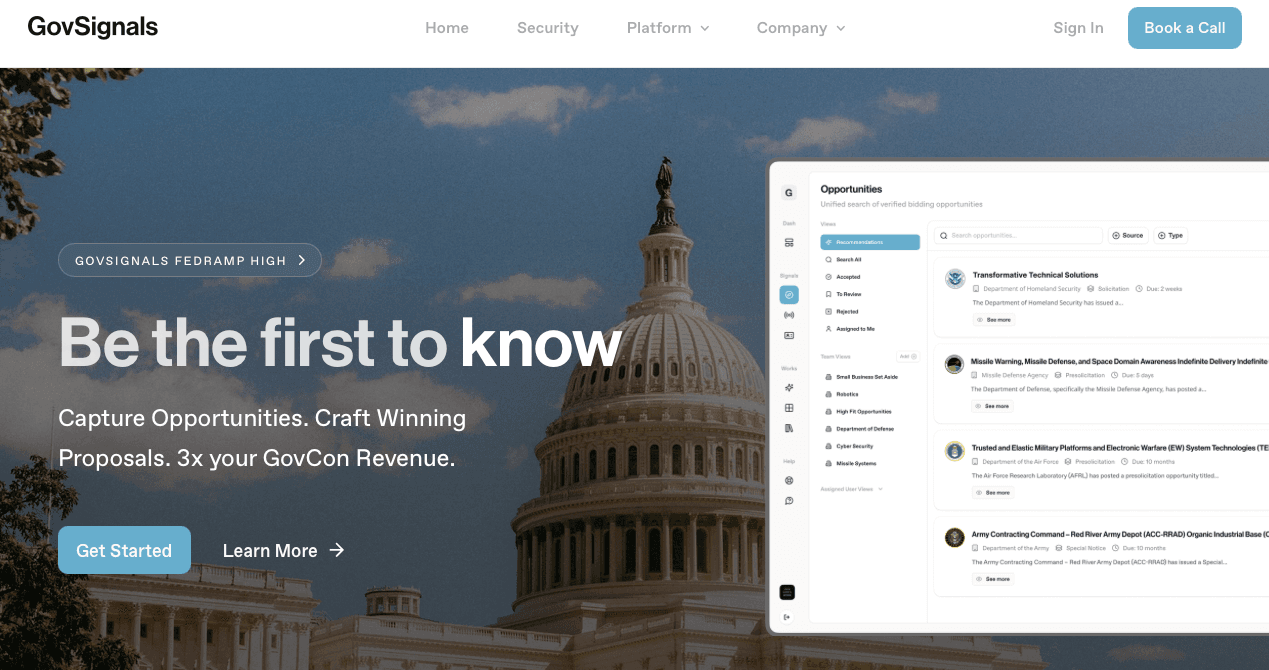
GovSignals positions itself as an intelligence and capture management tool built expressly for government contractors. It pulls opportunity data from SAM.gov, USASpending, and other federal sources to give BD teams earlier visibility into upcoming awards and agency spending patterns.
Where GovSignals earns attention is pre-RFP research. Teams can track incumbent contracts, monitor agency budgets, and identify recompetes well before a solicitation drops. For firms running high-volume pipeline development, that kind of early signal can sharpen bid/no-bid decisions before substantial pursuit resources are committed, particularly when Section M evaluation factors are already known from prior solicitations.
VisibleThread
VisibleThread analyzes proposal drafts against RFP requirements, fitting into post-draft review stages instead of driving content creation from the start. For a broader look at RFP automation for federal contractors, the mechanics of how these tools differ becomes clearer in context.
Based on publicly available information, the Word add-in is the primary integration point; Excel cost volume and PowerPoint briefing workflows do not have native support. Teams that need compliance matrix generation, annotated outlines, and first-draft production beginning at RFP ingestion will find GovEagle's end-to-end workflow a stronger fit.
pWin.ai
pWin.ai builds Shipley Associates methodology directly into its drafting and compliance workflows, which separates it from general-purpose AI writing tools that require teams to manually structure responses around Shipley principles. RFP requirements feed into Shipley-structured drafts, and prompt generation works from a proposal "vision" artifact instead of requiring writers to engineer prompts from scratch.
Teams already running Shipley-aligned processes may find the workflow alignment accelerates onboarding and review cycles; teams outside that framework should confirm the methodology fits their existing capture process before committing, since it is baked in and not configurable.
Why GovEagle Is a Leading Enterprise AI Tool for Government Contractors
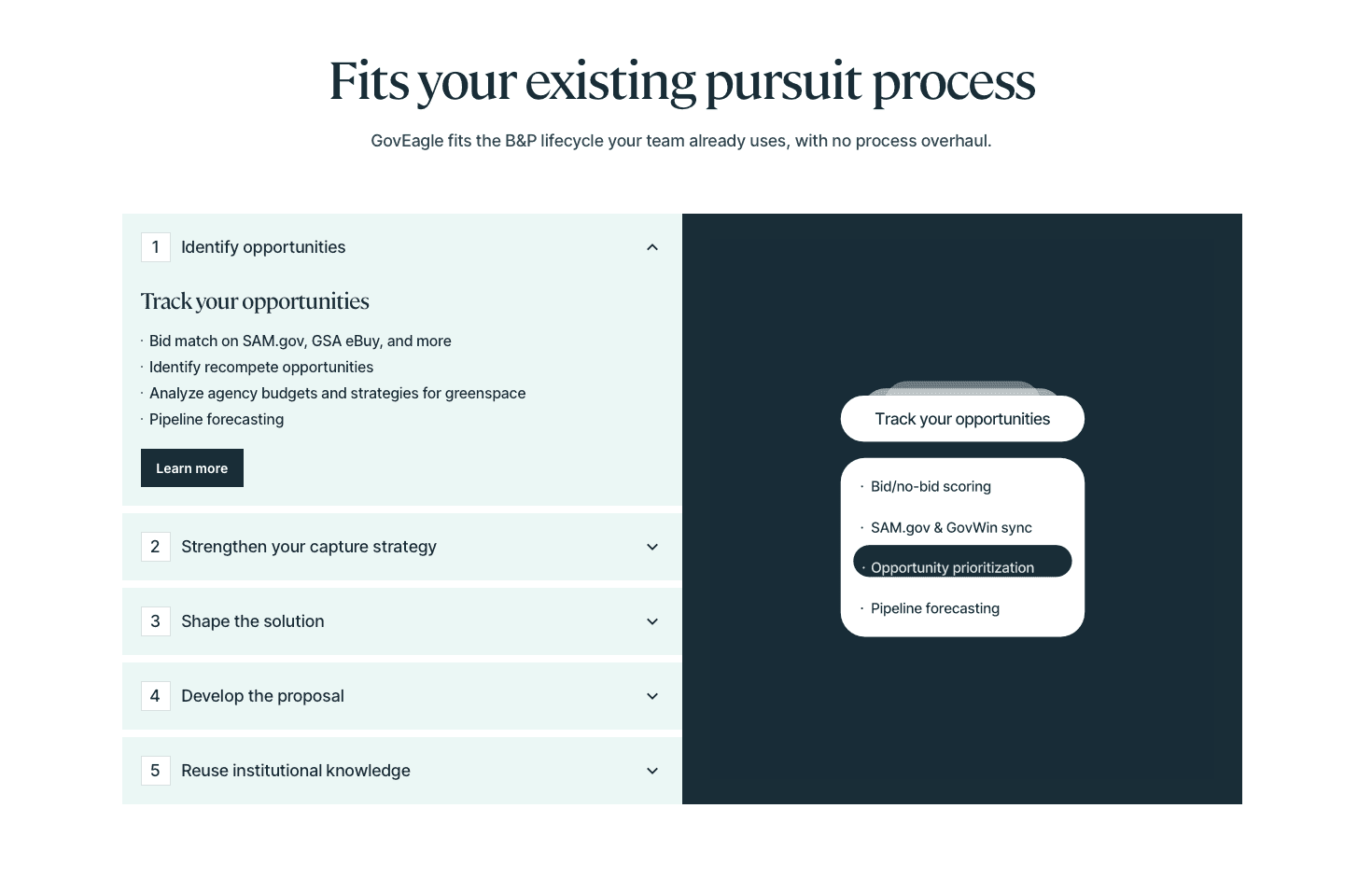
Among the six tools reviewed, GovEagle is the only one covering all five proposal lifecycle stages (bid/no-bid analysis, Excel-native compliance matrix, Word annotated outline, AI-assisted first draft, and color team review automation) within a single documented FedRAMP Authorized environment. Every other tool in this list handles a subset of that workflow, which means teams relying on them still coordinate across disconnected systems for the stages those tools do not cover.
Fragmented toolchains create version-control risk and compliance gaps under deadline pressure. GovEagle's CRM integrations, SharePoint connectivity, and native Microsoft Office presence keep the pursuit traceable from capture intelligence through submission. For proposal managers running multiple concurrent pursuits, that traceability means the compliance matrix, annotated outline, and working draft stay synchronized in one environment instead of spread across shared drives and email threads. When an amendment drops mid-pursuit, the response update traces back through the same document chain, not a separate worksheet opened weeks earlier.
FAQs
How do I choose the right enterprise AI tool for government contractors from this list?
Start with workflow stage: if your team needs full lifecycle coverage from bid/no-bid through color team review, GovEagle is the only tool in this list covering all five stages in a single documented FedRAMP Authorized environment. If your primary need is pre-RFP intelligence and pipeline development, GovSignals fits that stage. If post-draft compliance review is the gap, VisibleThread covers it without replacing your drafting process.
Is GovEagle or pWin.ai a better fit for teams already running Shipley-aligned proposal processes?
Both tools embed Shipley methodology, but in different ways. pWin.ai structures outputs around a centralized proposal vision artifact and Shipley-aligned prompting, which works well for teams whose entire process follows that framework. GovEagle aligns with Shipley color team review cycles and generates the annotated outline in Microsoft Word before drafting begins, fitting teams that want Shipley structure without locking into a methodology-first tool architecture.
When should a growing small GovCon consider AskSage over a purpose-built proposal tool like GovEagle?
AskSage makes sense when the primary requirement is a security-cleared AI assistant for research synthesis and document summarization on sensitive programs, particularly those requiring GCC High or IL4/IL5 environments. Teams that need compliance matrix generation, Section L/M response tracking, and color team review workflows will find AskSage requires substantial supplemental tooling to cover those stages, making a purpose-built proposal tool a stronger practical fit for pursuit execution.
Final Thoughts on Enterprise AI Tools for Government Contractors
The right tool for your team comes down to where the pursuit workflow breaks and how much of that gap a single tool actually closes. A post-draft compliance checker and a full capture-to-submission workflow both get called enterprise AI tools for government contractors, but they solve different problems at different stages. Before committing to any subscription, map your current bottlenecks against the feature comparison table above and see which tools cover those stages natively. Teams pursuing full lifecycle coverage can schedule a GovEagle demo to see the compliance matrix, drafting, and review workflow in a single environment.