
GovCon Capture Management Software Guide (September 2026)

Akash Mandavilli
CEO and Co-Founder of GovEagle
About the author
Akash is a 2x founder with previous experience in AI from Meta and federal sales from IBM. Akash holds a dual-degree from Johns Hopkins University in Economics and Computer Science.
GovEagle is not affiliated with, sponsored by, certified by, or otherwise associated with Shipley Associates.
A lot of BD teams treat capture management as a pre-proposal checklist instead of the process that determines whether a proposal is worth writing at all. By the time you're reading Section L for the first time, firms with active capture programs may have already shaped what Section L says. The question worth asking is what your tool is actually doing to close that gap before a solicitation exists.
TLDR:
- Roughly 80% of a federal buying decision is made before proposals are submitted, making pre-RFP capture the primary driver of win rates.
- Contractors with structured bid/no-bid criteria average a 28% win rate vs. 12% for those without a formal process.
- Teams running structured pre-RFP capture programs win 40-70% of pursued opportunities; those responding cold win around 21%.
- Capture management software earns its place when a proposal manager can open an opportunity record post-RFP and find scored PWin rationale, win themes, and competitive context without scheduling a debrief.
- GovEagle integrates Salesforce and HubSpot capture data directly into the proposal workspace, holding full FedRAMP Authorization and supporting NIST 800-171 and CMMC requirements
What Capture Management Is (and What It Is Not)
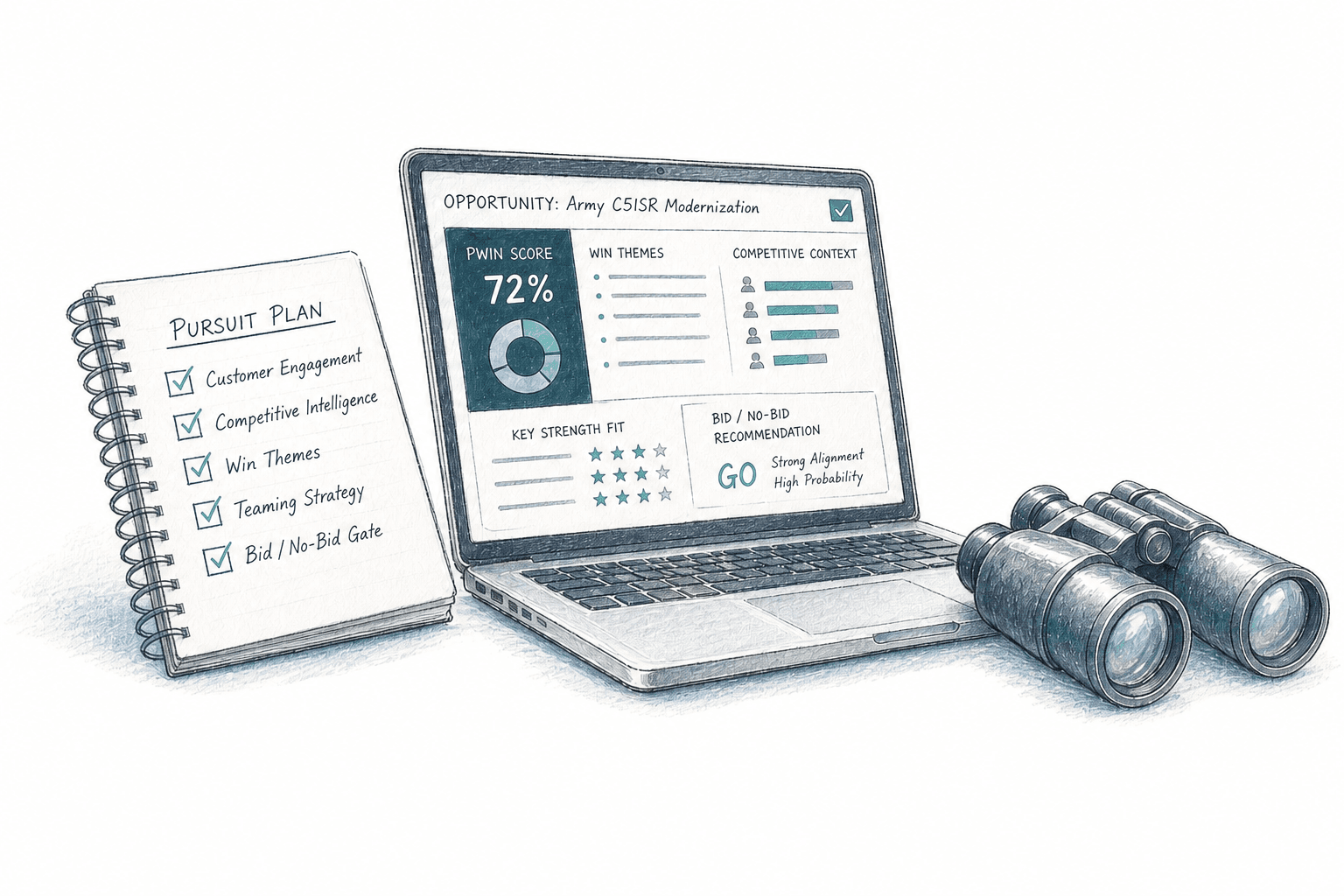
Capture management is the structured, pre-RFP work of identifying a specific federal opportunity, qualifying it against your strengths, and positioning your firm to win before the solicitation drops. It spans customer engagement, competitive intelligence, win theme development, teaming decisions, and the bid/no-bid gate. By the time an RFP is published, a well-run capture effort has already shaped how your firm will respond.
That scope is worth distinguishing from three things it often gets confused with:
- A CRM tracks accounts, contacts, and pipeline activity. It does not structure the pursuit or document competitive positioning against a specific opportunity.
- A pipeline tracker shows what opportunities exist and their status. It does not drive the qualification work or feed intelligence into proposal development.
- Proposal software handles drafting, compliance matrices, and color team reviews. It operates after capture ends, not during it.
Capture management sits between BD and proposal execution. Its job is to convert opportunity awareness into pursuit strategy, so that when the RFP arrives, your team has already done the positioning work that determines whether you can win.
Why the Pre-RFP Window Determines Win Rates
By the time a solicitation appears on SAM.gov, the competitive window has largely closed. Agencies conduct market research, engage vendors through RFIs, and refine requirements based on those conversations long before a formal RFP exists. When your team first sees the solicitation, agency preferences are already shaped.
The data backs this up. According to widely cited industry benchmarks (Shipley, APMP, OST Global Solutions), roughly 80% of a customer's buying decision is made before proposals are submitted. Contractors that maintain win rates above 70% invest approximately 60% of their total bid and proposal budgets in capture over proposal development, per APMP benchmark research. The writing phase is where you document a position you should have already earned.
A reactive, RFP-first workflow puts you behind on relationship access, teaming decisions, requirement shaping, and competitive intelligence. By the time your team reads Section L for the first time, firms with active capture programs may have already influenced what Section L says. Precise Software cut SME time on early-stage proposals by 80% by structuring capture intelligence upstream. That gain came from a direct result of shifting effort into the pre-RFP window instead of scrambling at solicitation drop. The same resource discipline compounds at the pipeline level: The Building People increased the proposal volume it pursued per quarter by 50% without adding headcount.
The pre-RFP window is where win rates are built or forfeited. Capture management is the process that fills it.
The Capture Management Process: Phase by Phase
Capture for a complex federal competition typically runs 12 to 24 months before RFP release. Each phase produces specific outputs the next phase depends on.
| Phase | What the Capture Manager Does | Key Output |
|---|---|---|
| Opportunity Identification | Monitors agency forecasts, RFIs, and incumbent contract expiration dates | Qualified opportunity list |
| Qualification / Bid-No-Bid | Scores PWin against capability fit, competitive exposure, and resource cost | Bid decision memo |
| Customer Intelligence | Conducts agency meetings, RFI responses, and site visits to map requirements and relationships | Contact map and requirement assumptions |
| Competitor Research | Identifies likely offerors, incumbent positioning, and pricing history | Competitor assessment |
| Teaming Assessment | Matches capability gaps against potential partners with relevant past performance | Teaming strategy and NDAs |
| Win Strategy Development | Drafts win themes, discriminators, and ghost strategies tied to evaluation criteria | Capture plan with documented win themes |
| Proposal Readiness Review | Confirms team alignment, resource assignments, and intel currency before RFP drop | Capture-to-proposal handoff package |
Each capture gate is a checkpoint, not a formality. Skipping competitor research before teaming decisions, for instance, means you may partner with a firm that an incumbent already locked up.
Structured Bid/No-Bid: The Gate That Protects Pipeline Discipline
Contractors without a formal bid/no-bid process average a 12% win rate. Those with structured go/no-bid criteria average 28%. That gap has nothing to do with proposal quality. It reflects which pursuits ever reach the writing phase.
The bid/no-bid gate exists to protect pipeline discipline. Without it, teams chase volume, spread resources thin, and produce weaker responses across the board. Capture managers typically score six criteria before committing:
- Incumbent position and re-compete risk, since defending against an entrenched incumbent without a clear displacement strategy rarely warrants the spend
- Depth of customer relationship and access, because pre-RFP engagement shapes evaluator expectations long before Section L is published
- Past performance relevance to the specific requirement, beyond the general domain
- Competitive field and likely offerors, with particular attention to teams already positioned on the vehicle or with the agency
- Internal capacity to staff both the pursuit and the proposal without pulling resources from higher-PWin work
- Realistic PWin given the full picture above, not the optimistic version
A no-bid decision is not a failure. It frees bandwidth for pursuits where your firm has genuine positioning. The contractors compounding win rates over time tend to pursue fewer opportunities, not more.
What a Capture Plan Should Include
A capture plan that describes an opportunity is not the same as one that analyzes it. Listing the agency, NAICS code, and estimated value gets you a summary. A defensible plan tells you whether your firm can win, who will beat you if you can't, and what the agency actually weighs when scoring offerors.
The structural components that separate analysis from description:
- Agency and customer intelligence: decision-makers by name, their stated priorities, any documented requirement shaping from RFI responses or pre-solicitation meetings, and your firm's current relationship depth with each
- Competitive analysis: likely offerors, incumbent positioning, probable team structures, and any pricing history from USASpending that informs your cost approach
- Teaming strategy: capability gaps mapped to specific partner candidates, with notes on exclusivity risk and partner past performance relevance to the PWS
- Win themes and discriminators: three to five differentiators tied directly to Section M evaluation criteria, with evidence for each, not assertions
- PWin scoring with gate thresholds: a scored assessment updated at each phase gate, with a pre-agreed threshold below which the pursuit moves to no-bid
- Accountability framework: named owners for each intelligence gap, with deadlines tied to gate review dates
The plan should be updated at every gate review, not filed after the kickoff call and reopened at RFP drop. By the time the solicitation publishes, a well-maintained capture plan has already flagged which assumptions held and which intelligence gaps remain unresolved.
The Capture-to-Proposal Handoff: Where Intelligence Gets Lost
The capture plan exists. The proposal team just can't find it.
Win themes live in a capture manager's inbox. Competitive intelligence sits in a slide deck that never got shared. Relationship context from six months of agency meetings exists only in someone's memory. When the RFP drops and the proposal team stands up, they spend their first week reconstructing work the capture team already did.
That duplication has a direct cost. It extends proposal cycles, raises labor spend per submission, and produces first drafts disconnected from the agency intelligence that should be shaping every section. The gap between firms running structured capture and those responding cold is not proposal quality. It is whether the proposal team had access to what the capture team knew.
The handoff typically breaks in one of three places:
- Capture notes stored in a CRM that proposal writers can't access, leaving intelligence siloed at the exact moment it should be driving Section L responses.
- Win themes that were verbal strategy instead of documented artifacts, with no traceable record of what was decided or why.
- A kickoff meeting that attempts to compress months of agency relationship context into a two-hour briefing, which rarely transfers enough to matter under deadline. None of those mechanisms move context reliably when a proposal clock is running.
Get GovCon capture and proposal insights in your inbox.
How GovEagle Puts This Into Practice
Every failure mode described above (siloed capture notes, undocumented win themes, a kickoff meeting standing in for months of context) has a specific mechanism inside GovEagle built to close it, not a generic AI layer bolted onto proposal drafting.
- Opportunity identification starts before the RFP, not at it. GovEagle filters through new opportunities daily and identifies the best-fit pursuits with a score and rationale, delivered to relevant team inboxes every morning, so teams see and act on a pursuit long before it reaches SAM.gov. That intelligence pipeline is not limited to posted solicitations: GovEagle is already connected to SAM.gov, eBuy, PIEE, agency forecasts (JBooks, agency strategies, etc.), and many more open-source intelligence tools, and it connects to a GovWin instance to pull in additional intelligence. For competitive and customer research, GovEagle has deep search capabilities to find relevant Black Hat intelligence from social media sites like LinkedIn and YouTube, the same market signals a capture manager would otherwise chase manually across a dozen browser tabs.
- Bid/no-bid becomes a documented, repeatable score instead of a judgment call. GovEagle supports configurable opportunity scoring using BD and capture criteria, enabling consistent, data-informed bid/no-bid evaluations tailored to an organization's priorities, and supports go/no-go and bid/no-bid analyses based on the factors important to your organization. It also creates a mock evaluation with multiple personas to mimic a government evaluation board, giving capture managers a defensible PWin rationale at the gate, not a reconstructed one after the fact.
- Win themes and capture intelligence get a permanent home, not an inbox. GovEagle's activity and references tab enables the team to associate learnings, win themes, and other context to each opportunity, and its AI agent is able to identify and retrieve insights and win themes for previous responses, transcripts, notes, etc., with built-in workflows to proactively suggest more compelling or potentially forgotten win themes and insights. Every one of those claims stays traceable back to source material: GovEagle uses citations to confirm it retrieves accurate experience and capability information from previous responses and content, and within one click, GovEagle can highlight the specific document and paragraph it drew a response from.
- The capture-to-proposal handoff is a built feature, not a meeting. GovEagle has specific capabilities built to help capture teams conduct research, evaluate an opportunity, and properly hand off a pursuit to the proposal team, including automated black hat reviews, gate deck creation, win theme identification, capture plan creation, and much more. Capture artifacts don't sit in a separate system waiting to be rediscovered: any content a capture team creates can be associated to a GovEagle opportunity directly in SharePoint or through simple upload to an opportunity, and once in GovEagle, GovEagle will draw on those associated capture artifacts to suggest strength statements and proof points in an annotated outline. Teams that want formal gates rather than informal handoffs can enforce them: GovEagle's "Process" module allows teams to structure their stages and create structured approvals and handoffs from the capture team to the proposal team.
- CRM data flows in one direction, into the workspace where proposals get written. Beyond the Salesforce and HubSpot integrations already mentioned, GovEagle can connect using GovWin API keys to build a direct integration and supports a custom integration to Salesforce or Technomile, along with other capture and CRM tools including HigherGov. That means the account history, contact notes, and pipeline data a BD team has been maintaining for months doesn't need to be re-typed into a capture plan. It is already sitting inside the opportunity record when the proposal team opens it.
- Leadership gets visibility into pipeline discipline itself. Through GovEagle's opportunity dashboard, teams can visualize staffing assignments across active pursuits, and proposal managers can easily see which opportunities team members are staffed on and if they have too many pursuits on their plate, a direct check against the resource-thinning risk that an undisciplined bid/no-bid process creates.
The result for customers running this workflow end to end has been measurable rather than anecdotal: Precise Software cut SME time on early-stage proposals by 80% after structuring compliance and capture intelligence upstream, and The Building People increased the proposal volume it pursued per quarter by 50% without adding headcount.
What Capture Management Software Should Actually Do
A capture tool earns its place by solving the structural problems that scatter intelligence, leave gate decisions undocumented, and drop context at handoff.
The functional baseline any capture manager should demand:
- GovCon opportunity tracking from SAM.gov and agency forecasts, with tracking against forecast dates and not solely posted solicitations
- Structured PWin scoring with documented criteria, so bid/no-bid calls are reproducible and defensible at gate review, not reconstructed from memory
- Competitive intelligence organized by pursuit, not buried in shared drives
- Win theme and capture note storage that travels with the opportunity record into proposal execution, without manual re-entry
AI genuinely helps with accelerating market research, surfacing relevant past performance against a new requirement, and structuring scattered pursuit notes into a reviewable capture record. The go/no-bid call, positioning decisions, and strategy still require human judgment. A tool that automates those is overstepping.
The test is the handoff. GovEagle's capture deck automation populates planning documents with scored PWin rationale, documented win themes, and competitive context directly from the capture record, with no manual re-entry and no reconstruction at solicitation drop. You can see exactly how that works by visiting Book a Demo.
Security and Compliance Considerations for GovCon Capture Tools
Capture workflows regularly touch data that falls under federal handling requirements. Agency relationship notes, competitive intelligence tied to specific programs, and opportunity data connected to active procurements can all constitute CUI depending on the contract type and agency involved.
Cloud-based tools that process, store, or transmit CUI generally need a FedRAMP Moderate or higher authorized offering, or one that meets DoD FedRAMP Moderate equivalency requirements. Security certifications such as FedRAMP and NIST 800-171 may be required depending on agency and contract type. The applicable standard depends on your specific contract terms, data flows, and whether the tool qualifies as a cloud service provider under your CMMC scoping.
The practical due diligence step is straightforward: verify compliance posture directly with vendors before procurement, not after onboarding. Ask directly whether they hold FedRAMP Authorization or equivalency, how CUI is handled in their environment, and whether they support GCC High if your contract requires it. Vendors that cannot answer those questions precisely are worth flagging before you commit.
How GovEagle Connects Capture Intelligence to Proposal Execution
GovEagle's CRM integrations with Salesforce and HubSpot attack the handoff problem at its source. Capture notes, opportunity data, and account intelligence pull from CRM records directly into the proposal workspace, with no manual re-entry. The capture deck automation feature then populates planning documents with RFP intelligence and win themes, creating a direct link between what the capture team documented pre-RFP and what the proposal team sees when the solicitation drops.
That intelligence carries through GovEagle's five-stage lifecycle: bid/no-bid analysis, compliance matrix generation in Excel, annotated proposal outline creation in Microsoft Word, first draft generation, and color team review automation. Each stage builds on the capture record, never starting from scratch.
For teams with security requirements across capture and proposal workflows, GovEagle holds full FedRAMP Authorization and is listed on the FedRAMP Marketplace, supports NIST 800-171 and CMMC requirements (note: the CMMC Phase II C3PAO third-party assessment requirement is currently suspended pending DoD Reform Task Force review; Phase I self-assessments and DFARS 252.204-7012 obligations remain in force), and has experience with GCC/GCC High and air-gapped environments.
The outcomes reflect what workflow continuity actually produces. Precise Software cut SME time on early-stage proposals by 80%. The Building People increased proposal volume pursued per quarter by 50% without adding headcount. Across GovEagle's customer base, teams report an average of 50%+ time saved and 95% team adoption.
Final Thoughts on Turning Capture Intelligence Into Proposal Wins
The pre-RFP window is where win rates are actually built, and most of the contractors losing them don't realize the competitive window closed before the solicitation posted. Structured bid/no-bid criteria, documented win themes, and a clean capture-to-proposal handoff are the mechanics that separate firms compounding wins from those reacting to solicitations cold. Your capture work only pays off if it reaches the proposal team intact; that structural continuity, from pre-RFP intelligence through proposal execution, is what GovEagle is built to deliver. Book a GovEagle demo to see how that handoff works in practice.
FAQ
What is capture management software and what should it actually do before an RFP drops?
Capture management software structures the pre-RFP work of qualifying opportunities, documenting competitive intelligence, and building win themes before a solicitation is published. The functional baseline includes opportunity ingestion from SAM.gov and agency forecasts, structured bid/no-bid scoring with documented criteria, competitive intelligence organized by pursuit, and win theme storage that travels with the opportunity record into proposal execution without manual re-entry.
What AI tools can help a capture manager work more efficiently on federal pursuits in 2026?
AI genuinely accelerates market research, surfaces relevant past performance against new requirements, and structures scattered pursuit notes into a reviewable capture record, but the bid/no-bid call and positioning decisions still require human judgment. GovEagle's capture deck automation and CRM integrations with Salesforce and HubSpot pull opportunity data and capture notes directly into the proposal workspace, so the intelligence a capture manager builds pre-RFP reaches the proposal team without reconstruction at solicitation drop.
Why does the capture-to-proposal handoff break, and what does govcon capture software need to do to fix it?
The handoff typically fails in one of three places: capture notes siloed in a CRM that proposal writers cannot access, win themes that were verbal strategy instead of documented artifacts, and kickoff meetings that compress months of agency relationship context into a two-hour briefing. Govcon capture software closes this gap structurally when it moves capture intelligence directly into the proposal workspace, so a proposal manager can open the opportunity record after RFP drop and find scored PWin rationale, documented win themes, and competitive context without scheduling a debrief.
GovEagle vs. a standalone CRM like Salesforce or HubSpot for managing federal capture workflows?
Salesforce and HubSpot track accounts, contacts, and pipeline activity well, but they do not structure pursuit qualification, document competitive positioning, or feed capture intelligence into compliance matrices and proposal drafts. GovEagle integrates with both CRMs as a one-way inbound pull, moving capture notes and opportunity data from those records into the proposal workspace, then carries that intelligence through bid/no-bid analysis, compliance matrix generation in Excel, annotated outline creation in Word, first draft generation, and color team review.
What security certifications should I verify before adopting capture management tools that handle CUI?
Cloud-based govcon capture software that processes, stores, or transmits CUI generally needs a FedRAMP Moderate or higher authorized offering, or one that meets DoD FedRAMP Moderate equivalency requirements, with the applicable standard depending on your contract terms, data flows, and CMMC scoping. Verify directly with vendors whether they hold FedRAMP Authorization or equivalency, how CUI is handled in their environment, and whether they support GCC High if your contract requires it before onboarding, not after.