
Writing a High-Scoring Federal Proposal Executive Summary

Akash Mandavilli
CEO and Co-Founder of GovEagle
About the author
Akash is a 2x founder with previous experience in AI from Meta and federal sales from IBM. Akash holds a dual-degree from Johns Hopkins University in Economics and Computer Science.
GovEagle is not affiliated with, sponsored by, certified by, or otherwise associated with Shipley Associates.
If your executive summary doesn't map directly to Section M evaluation factors, the SSA may read it, move on, and never connect your strongest discriminators to what gets scored. That's not a writing problem. It's a sequencing and structure problem, and it starts before a single sentence gets drafted.
TLDR:
- The executive summary may be the one section every decision-maker reads in full, so write to risk and mission alignment, not technical depth.
- Each win theme in your summary must map to a named Section M factor; discriminators that require inference from the evaluator risk going uncredited.
- Five scoring patterns hurt most teams: restating the RFP, omitting discriminators, front-loading company history, passive voice, and unanchored claims without contract-specific evidence.
- Draft a skeletal executive summary before body volumes begin so section authors reinforce the same core argument the SSA reads first.
- GovEagle generates a Section L/M-mapped proposal outline in Microsoft Word before drafting starts, connecting capture-stage win themes to executive summary discriminator language from the outset.
How to Write a Federal Proposal Executive Summary That Scores Well
Depending on the solicitation, the executive summary may be formally scored or may serve as an unscored framing document. Either way, evaluators often read it first. A summary that reads like a cover letter rarely moves the needle. One that maps directly to Section M evaluation factors, surfaces win themes early, and gives the Source Selection Evaluation Team a clear picture of your technical and management approach can shape how reviewers interpret everything that follows.
What a Federal Proposal Executive Summary Is (and What It Isn't)
In federal proposals governed by FAR Part 15, the executive summary is a standalone argument for award. It makes the case that your firm is the lowest-risk, highest-value choice before the evaluator reads a single page of your technical volume.
That job is distinct from a project abstract, an introduction, or a management overview. Those documents describe. An executive summary argues. It synthesizes your win themes, maps your approach to the government's stated objectives, and pre-empts evaluator concerns about capability or risk.
Source selection authorities often read the executive summary in isolation. When the SSEB divides technical review responsibilities across evaluators, the summary may be the only section every member reads in full. If it reads like a table of contents or a company overview, that opportunity is lost.
Where the Executive Summary Fits in the Section L/M Framework
Section L tells you what to submit. Section M tells you how it gets scored. The executive summary sits at the intersection of both, and agencies handle it differently enough that reading the RFP language carefully before assuming either way matters.
Some solicitations list the executive summary as a distinct, scored volume with evaluation criteria assigned directly. Others treat it as a non-scored introductory document with no formal weight in source selection. A few omit it entirely, leaving contractors to decide whether to include one.
The signal is usually in Section L. If instructions specify page limits, required content elements, or a prescribed format, treat the executive summary as scoreable regardless of whether Section M names it explicitly. When Section L is silent, the executive summary still functions as a framing document that shapes how evaluators approach your technical and management volumes, even without a formal score attached.
Who Actually Reads the Executive Summary
Senior reviewers, including the Source Selection Authority, often turn to the executive summary for the big picture. Under FAR 15.303, the contracting officer serves as the SSA unless the agency head appoints another official, which is common on larger acquisitions. They are not scoring granular methodology details. They are assessing whether your firm presents an acceptable level of risk and whether your approach visibly serves the agency's mission.
Technical evaluators score individual volumes. The SSA synthesizes those scores into an award recommendation, and the SSA makes the award decision from the evaluation team's findings against the solicitation's factors (FAR 15.303), so the summary matters most when it makes those findings easy to connect to your discriminators. If it fails to communicate execution confidence clearly, that gap can carry through the entire evaluation.
Contracting officers also review the executive summary, frequently looking for compliance signals before formal evaluation begins. A summary that buries your understanding of agency objectives under company background tells the CO very little about whether your team grasped the requirement.
Write to the SSA's actual concerns: risk, mission alignment, and confidence that your firm can deliver. Technical depth belongs in the technical volume.
The Core Components of a High-Scoring Executive Summary
Each element functions as a standalone argument. Evaluators under time pressure scan for these signals quickly, so structure matters as much as substance.
- Requirement understanding: State the agency's core challenge in their language, not yours. This signals you read the PWS and grasped the mission; the deliverables are table stakes.
- Technical or management approach: One to three sentences on how you solve the problem, specific enough to show rigor but brief enough to pull the evaluator toward your technical volume.
- Quantified past performance: Cite a relevant contract by size, agency, and measurable outcome. Numbers do more work than adjectives here.
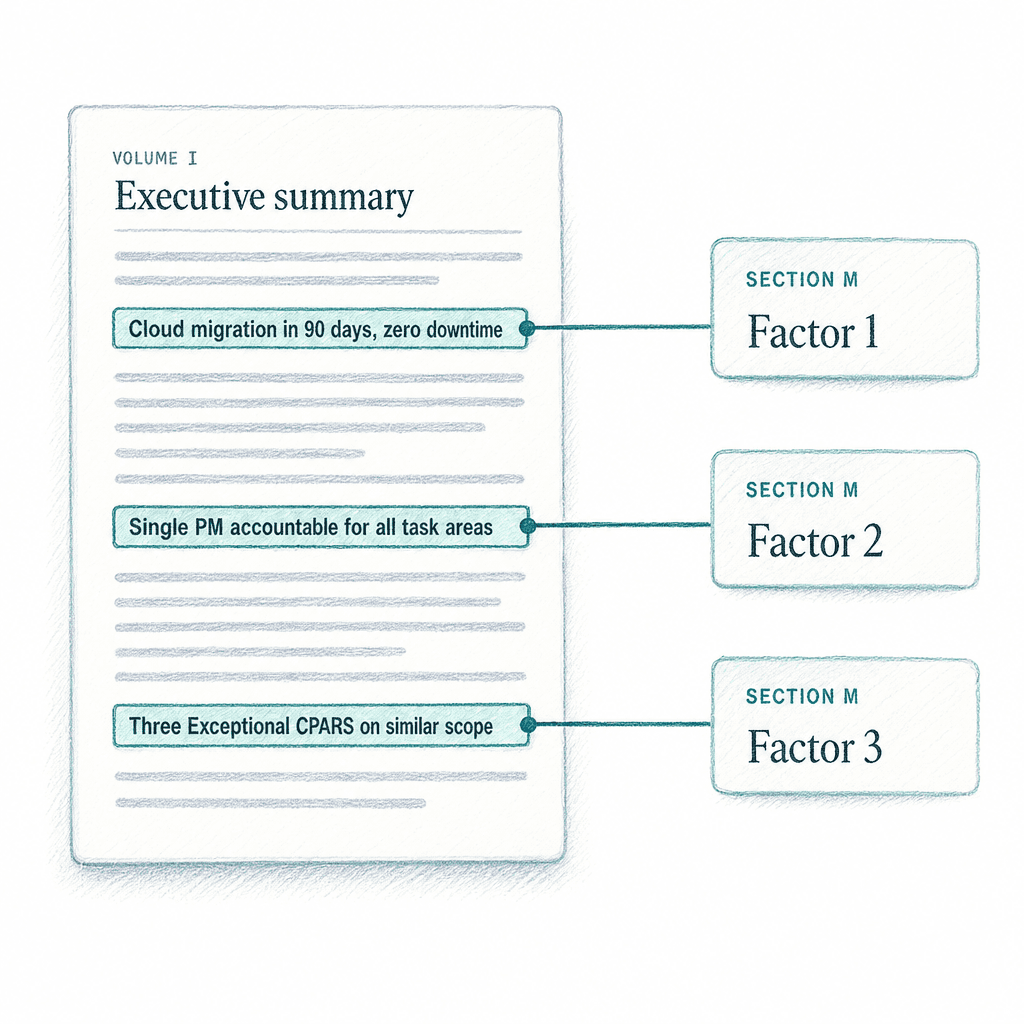
- Win themes tied to evaluation factors: Each discriminator should map to a Section M factor by name. If a win theme cannot be traced to a scored criterion, it does not belong in the summary.
- Risk reduction statement: Name the execution risk the agency is most likely worried about, then state how your approach mitigates it. It's one of the most frequently skipped elements.
How to Connect Win Themes to Evaluation Criteria
Win themes that live in capture decks but never surface in evaluation-aligned language are one of the most common ways strong pursuit teams leave points on the table. The executive summary is where that translation happens, and it requires a deliberate mapping exercise before a single sentence is drafted.
Start with Section M, the same source document used to build your compliance matrix. Pull every evaluation factor and subfactor, then rank them by stated weight or order of importance. Most agencies signal priority through position and point allocation, even when exact weights are not disclosed. That ranking becomes your filter for which discriminators belong in the summary.
From your capture intelligence, identify two or three discriminators that directly target the top-weighted factors. The test is straightforward: can you draw a straight line from the discriminator to a named evaluation criterion? If the line requires inference, the evaluator will not make it for you.
Then rewrite each discriminator in the agency's own language. If Section M scores against "proven experience managing task order workflows across multiple performance sites," your win theme should mirror that phrasing exactly. Evaluators often score against the literal language of the solicitation, and matching that language reduces interpretation friction.
Present these mapped discriminators in the order Section M weights them, not in the order that feels most impressive internally.
Get GovCon capture and proposal insights in your inbox.
How Long a Federal Proposal Executive Summary Should Be
Page limits in Section L are binding. Solicitations typically state that pages beyond the limit will not be evaluated, and some treat overages as noncompliance, so that constraint defines the ceiling before anything else does.
When the RFP specifies a page limit, that number is your answer. When it does not, industry practice generally puts executive summaries at two to five pages for mid-sized acquisitions and up to eight for large, complex RFPs with multiple performance areas, though the right length varies by solicitation. Single-task-order solicitations rarely warrant more than two pages.
Two failure modes appear roughly equally. The first is padding: restating the PWS, inserting company history, or adding boilerplate about values. It typically doesn't score. The second is under-developing the argument: a one-page summary that gestures at win themes without grounding them in specific past performance or mission context gives the Source Selection Authority nothing to anchor confidence to. Length should follow the number of scoreable arguments you can make, not a target page count.
Common Executive Summary Mistakes That Hurt Scores
Evaluators don't downgrade proposals for style alone. Ratings drop when proposals fail to meet evaluation criteria, leave risk unmitigated, or make claims evaluators can't verify. Most executive summary errors fall into one of five patterns.
| Mistake | What It Signals to the Evaluator | The Fix |
|---|---|---|
| Restating the RFP instead of responding to it | Proves you read the solicitation, not that you can execute against it; gives the SSEB nothing to distinguish one offeror from another | Add approach-specific substance: state your solution, not a paraphrase of the PWS |
| Omitting discriminators entirely | Win themes stay buried in the volumes, where time-pressured evaluators may not connect them to scored factors. | Surface every win theme in the summary so the SSA encounters it directly, not buried in Volume II |
| Front-loading company history | Agency age, headcount, and revenue do not map to Section M factors; pushes win themes toward page two where time-pressured evaluators may not follow | Lead with requirement understanding and evaluation-aligned discriminators; move company background to an appendix or later section |
| Passive voice throughout | Obscures accountability; passive constructions blur who is accountable for delivery, which weakens confidence in execution. | Use active, commitment-framed language: "Our PM assigns task leads within 48 hours of task order award" |
| Unanchored claims | "Extensive experience" and "proven track record" are scored as unsupported assertions with no basis for credit during consensus scoring | Tie every claim to a specific contract, measurable outcome, and named agency |
When to Write the Executive Summary: Sequencing Within the Proposal Lifecycle
Two schools of thought divide practitioners here, and both have real merit depending on how your team is structured.
Writing the executive summary after the body volumes are complete gives you the full picture of what was argued and committed to. The risk is that post-draft summaries tend to recapitulate, never lead. When writers pull from finished sections, they extract what was written, not what should be foregrounded for the SSA. Discriminators get buried, and the summary becomes a digest instead of an argument.
Writing a skeletal executive summary before drafting begins forces the team to articulate win themes and evaluation-aligned discriminators before any volume is written. That pre-draft summary functions as a strategic anchor within the Shipley proposal process: section authors know which themes to reinforce, and the proposal develops coherently around the same core argument the SSA will read first.
In a Shipley-aligned review cycle, the executive summary belongs in the Pink Team review package. If it arrives at Red Team for the first time, there is rarely enough runway to restructure it meaningfully. Red Team reviewers, as part of the Pink, Red, and Gold Team review sequence, can pressure-test whether the summary's claims hold up against the body, but rebuilding the argument from scratch under deadline is not a realistic option.
How GovEagle Supports Executive Summary Development
Shared vocabulary and Shipley alignment solve the communication problem. The workflow problem is different: win themes sitting in capture notes, executive summary structure invented from scratch under deadline. That gap requires a structural fix.
GovEagle generates an annotated proposal outline in Microsoft Word, mapped directly to Section L and Section M requirements, before drafting begins. The executive summary appears as a requirement-mapped section in that outline, not as an afterthought assembled after the body volumes are complete. Teams enter the drafting phase with a compliant structure already in place, with capture-stage win themes already connected to the evaluation-aligned sections where they need to land. If your team is still building that structure from scratch under deadline, Book a Demo to see how GovEagle's Section L/M-mapped outline puts the executive summary argument in place before a single volume is drafted.
Win themes developed during capture flow into executive summary discriminator language through the same workflow. Capture-stage win themes and Section M-aligned discriminators are already connected to the proposal workspace when the executive summary section opens, giving writers the strategic argument in front of them instead of a blank page.
Chevo cut prep time 30-40% on RFIs and 15-25% on RFPs after adopting GovEagle, and GovEagle customers report cutting proposal time by 50% or more. Those recovered cycles go toward refining executive summary language and pressure-testing evaluation alignment. GovEagle holds FedRAMP Moderate authorization through its partnership with Knox Systems, supporting teams whose proposals involve CUI and require a security-verified AI tool for executive summary development in the workflow.
Final Thoughts on Scoring Well With Your Federal Proposal Executive Summary
Most executive summaries undersell strong pursuit teams because win themes stay in capture decks instead of reaching the one reader who shapes the award recommendation. Getting the summary right means writing to the SSA's actual concerns, connecting every discriminator to a named evaluation factor, and putting your risk mitigation statement where it belongs. That argument, built before the body volumes are drafted, is what gives reviewers a framework for interpreting everything else.
Teams that build the executive summary structure before body volumes begin, with win themes already mapped to Section M factors, enter the drafting phase with the SSA's argument already in place. GovEagle supports that workflow by generating the Section L/M-mapped outline before drafting starts, connecting capture-stage win themes to executive summary discriminator language from the outset. See the demo to watch how GovEagle builds that structure directly from your Section L and M requirements.
FAQ
How do I write an executive summary for a federal proposal that scores well against Section M evaluation criteria?
Map every win theme directly to a named Section M evaluation factor before drafting a single sentence. Pull each evaluation factor and subfactor from Section M, rank them by stated weight or order of listing, then verify that each discriminator in your summary traces a straight line to one of those criteria. If the connection requires inference, the evaluator will not make it for you.
What should a federal proposal executive summary include versus what belongs in the technical volume?
The executive summary carries your requirement understanding, a brief technical or management approach, quantified past performance, evaluation-aligned win themes, and a risk reduction statement tied to the agency's most likely execution concern. Technical depth, methodology detail, and granular staffing approaches belong in the technical volume: the executive summary argues for award; the volumes substantiate it.
When should I write the executive summary relative to the rest of the proposal: before drafting or after the volumes are complete?
Write a skeletal executive summary before drafting begins, not after. A pre-draft summary forces the team to articulate evaluation-aligned discriminators early, giving section authors a shared strategic anchor: win themes stay consistent across volumes instead of diverging under deadline. In a Shipley-aligned review cycle, the executive summary belongs in the Pink Team package; if it arrives at Red Team for the first time, there is rarely enough runway to rebuild the argument.
GovEagle vs. starting from a blank document for federal proposal executive summary development: what's the structural difference?
Starting from a blank document means win themes developed during capture often stay in capture notes and never reach the proposal workspace in usable form. GovEagle generates an annotated proposal outline in Microsoft Word, mapped to Section L and Section M requirements, so the executive summary appears as a requirement-mapped section before drafting begins; capture-stage win themes and Section M-aligned discriminators are already connected to the workspace when writers open that section.
Can I integrate GovEagle with Salesforce or HubSpot so capture intelligence flows into the executive summary without manual re-entry?
Yes. GovEagle integrates with Salesforce and HubSpot, pulling capture notes, win themes, and competitive intelligence from CRM opportunity records directly into the proposal workspace. The integration is a one-way inbound pull: capture artifacts flow into the proposal workspace instead of remaining siloed in sales tools, so the strategic argument the executive summary needs to make is in front of writers and not buried in a CRM record they may never open during proposal development.