
How Overwhelmed Proposal Teams Speed Up Bid/No-Bid Calls

Akash Mandavilli
CEO and Co-Founder of GovEagle
About the author
Akash is a 2x founder with previous experience in AI from Meta and federal sales from IBM. Akash holds a dual-degree from Johns Hopkins University in Economics and Computer Science.

GovEagle is not affiliated with, sponsored by, certified by, or otherwise associated with Shipley Associates.
If your team keeps ending up in 90-minute debates over whether to pursue an opportunity, the problem isn't the opportunity. It's the process. A few structural fixes to how you score, meet, and document these calls can bring that down to a 30-minute target without leaving anyone guessing about who made the final call or why.
TLDR:
- Shipley Associates' benchmarking puts win rates for teams with ad hoc capture and proposal processes below 35%
- A one-page scorecard with five weighted criteria and pre-defined thresholds (75+ bid, 50-74 conditional, below 50 no-bid) cuts decision time
- A short list of no-bid signals (no prior agency engagement, a strong incumbent with no opening, a sub-five-business-day window with no capture in place) lets teams skip the full scorecard when two or more criteria apply
- A quick USAspending.gov pull on the incumbent contract often surfaces more decision-relevant intelligence than internal deliberation
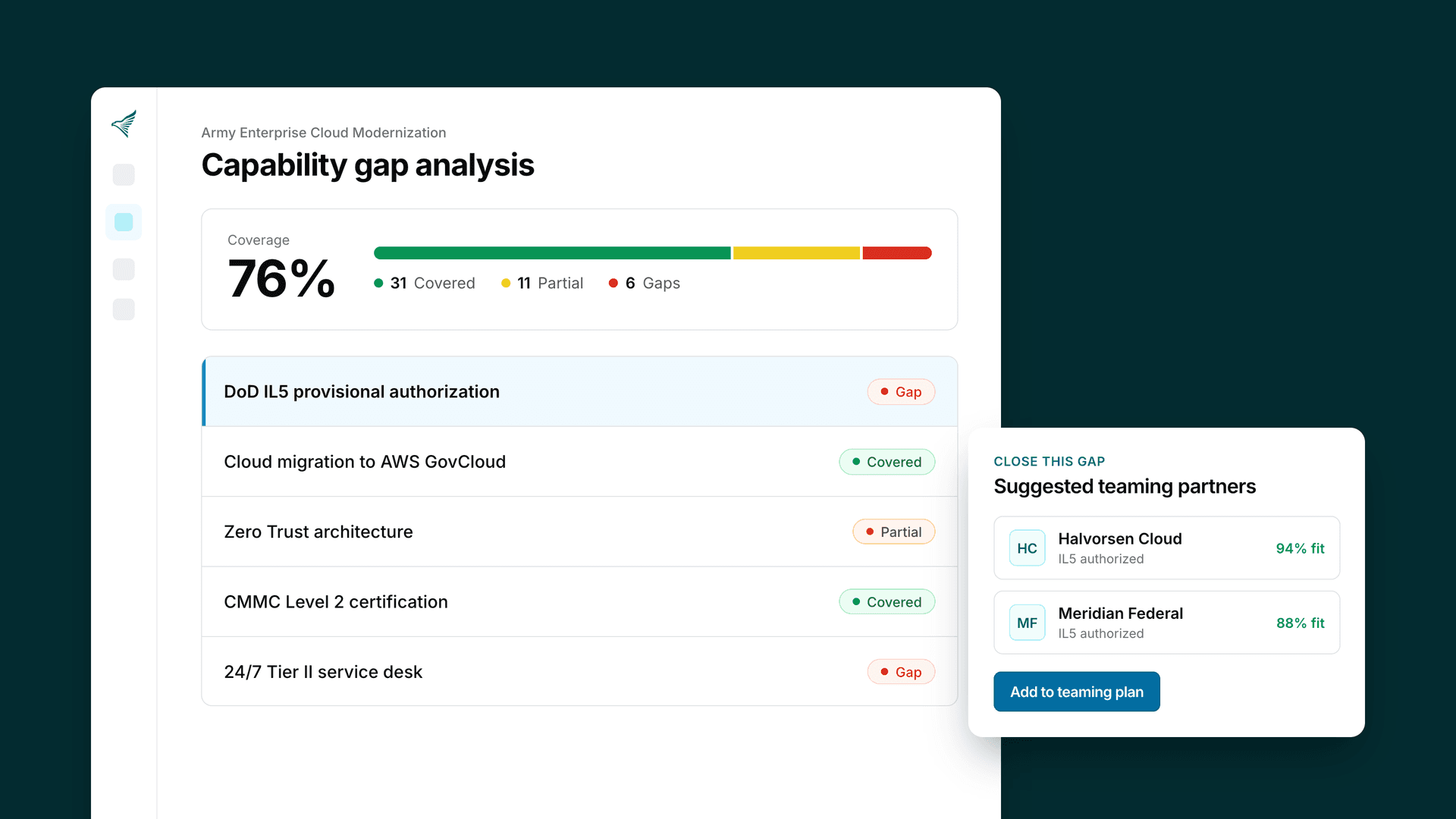
- GovEagle's capability gap analysis scores your past performance against each requirement in the performance work statement (PWS), so the Gate 3 call starts with evidence
Why the Bid/No-Bid Decision Is the Highest-Impact Gate in Federal Pursuit
Most proposal teams treat the bid/no-bid decision as a quick checkbox before the real work begins. But this one decision can make a huge impact on your business' bottom line.
Shipley Associates' benchmarking finds that firms moving from ad hoc to defined capture and proposal processes see win rates rise from below 35% to 51-80%. For every proposal a team writes that results in no award, the outcome is the same: no revenue, just burned bid and proposal (B&P) budget and exhausted staff. That often comes down to pursuing opportunities the team was never positioned to win, which is a pursuit selection problem, not a proposal quality problem.
Every pursuit consumes finite capacity. Writers, subject matter experts (SMEs), reviewers, and proposal managers each have a ceiling, and SME hours are often the first to run out. Chase the wrong mix, and you can degrade performance across the whole pipeline, including bids you might have won. The bid/no-bid decision is where that capacity either gets protected or squandered.
Where the Bid/No-Bid Decision Fits in the Gate Review Sequence
Gate reviews give teams structured checkpoints to reassess a pursuit as intelligence matures. One way to sequence them is in five gates: opportunity qualification, pursuit decision, bid/no-bid, bid validation, and final submission approval. Gate names and numbers vary by firm.
In that sequence, the bid/no-bid sits at Gate 3, and its position matters. Gates 1 and 2 ask whether an opportunity is real and whether early capture investment is warranted. Gate 3 fires at or near final RFP release, when the PWS or SOW, the proposal instructions, and the award criteria (Sections L and M in a uniform-format RFP) are on the table and resource commitment must be locked in. The decision has to be definitive.
Treating Gate 3 as a status update on early capture assumptions is where teams lose time. It is a structured reassessment against real solicitation data, with a binding outcome.
The Core Factors in a Federal Bid/No-Bid Scoring Framework
A reliable scoring framework forces each factor into a concrete question, not a gut call. The five factors below cover the inputs that matter most at Gate 3.
| Factor | The Scoring Question | Intelligence Required |
|---|---|---|
| Strategic fit | Does this align with our NAICS focus, agency relationships, and growth targets? | Pipeline data, agency history |
| PWin (probability of win) | Do we have incumbent advantage, customer access, or a solution the competition can't replicate? | Capture intel, competitor field |
| Resource capacity | Can we staff a competitive proposal without cannibalizing active pursuits? | Current pipeline load, writer availability |
| Financial return | Does the contract value support the B&P spend? | Contract value estimate, cost-of-bid calculation |
| Risk level | Are there teaming gaps, security requirements, or past performance holes? | Requirement analysis, capability assessment |
The financial return factor deserves a hard number. Estimate the B&P cost of this pursuit and set it against the contract's value and expected margin. On a large contract, that pursuit cost adds up quickly. That math belongs in the scorecard before the Gate 3 meeting.
How to Score PWin Quickly When Intelligence Is Incomplete
Most capture teams reach Gate 3 without complete intelligence. The RFP has dropped, the clock is running, and the decision can't wait.
A tiered confidence model helps. Score each PWin input based on what you actually know, then weight your estimate accordingly:
- Incumbent status: known or unknown
- Agency relationship depth: active contact in the last 90 days, cold, or none
- Competitive picture: identified competitors with known strengths, or blind
- Past performance alignment: strong match, partial, or gap
- Time to deadline vs. team capacity: adequate, tight, or critical
Where intelligence is confirmed, score with conviction. Where it's missing, default to the conservative end and flag it explicitly. A PWin of "35%, low confidence" is a decision-useful number. A PWin of "maybe 50%" is not.
If you can't answer at least three of those five inputs with real data, your PWin estimate is a guess dressed as analysis. At that point, the real question becomes: does this opportunity warrant the capture investment to find out?
Competitive Intelligence Inputs for the Bid/No-Bid Decision
A quick USAspending.gov search on the incumbent contract (or SAM.gov's contract data search, which replaced FPDS.gov's public search) can tell you more than a week of internal deliberation. Pull the current contract's start date, obligated and potential value, and recipient, then check that recipient's other awards from the same agency. If they've held the contract for two or more terms and the same contracting office keeps making awards to that firm, you may be looking at an uphill fight. If your admin has turned on the USAspending connector, you can also ask GovEagle to look up the incumbent's past awards.
Signals that suggest a wired opportunity over an open competition:
- Sole-source history on the same requirement
- RFP language that maps to the incumbent's specific certifications or team structure
- Short proposal turnaround paired with a long, detailed PWS written by someone who knows the work
- No pre-solicitation engagement period despite contract complexity
If a well-resourced prime holds the incumbent position, the threshold question moves from "can we write a competitive proposal" to "do we have a relationship or solution angle they can't replicate," which is often where teams need to move their PWin score before the RFP ever drops. Absent that, the B&P spend is funding a loss.
No-Bid Signals: When to Walk Away Without a Full Scorecard
Some opportunities don't need a scorecard. They need a fast exit.
When teams are underwater, running every opportunity through a full Gate 3 process burns the capacity it's supposed to protect. Certain signals, visible in a first read of the RFP or a quick check of your own pipeline, should trigger a fast no-bid review:
- No prior engagement with the agency on this requirement
- A strong incumbent with no known performance problems and no relationship or solution angle on your side
- PWS language that maps precisely to a specific contractor's certifications, team structure, or prior deliverables
- Submission window under five business days with no active capture in place
- Capability gaps with no viable teaming path available before the deadline
Any one of these should trigger a hard conversation. Two or more should usually end it. A full scoring exercise takes time your team could spend on a winnable pursuit, and these signals let you make the call early without running it.
Get GovCon capture and proposal insights in your inbox.
Building a Bid/No-Bid Decision Template Your Team Will Actually Use
A bid/no-bid template only works if it's fast enough to complete before the decision window closes. Keep it to one page with five scored criteria, a weighted total, and three outcome tiers: bid, conditional bid, no-bid. A simple starting split on a 100-point scale: PWin up to 30 points, strategic fit up to 20, resource capacity up to 20, financial return up to 15, and risk level up to 15, with more points for lower risk. Adjust the weights to your business, then hold them steady so scores stay comparable across pursuits.
Pre-define the thresholds before any opportunity hits the table:
- 75+ points: bid
- 50 to 74 points: conditional bid, meaning you identify the gap, assign a resolution owner, and set a deadline
- Below 50: no-bid, document the reason, and move on
Two rules make this stick. First, assign final decision authority to a named role, typically the Capture Director or VP of BD. Consensus-based decisions invite delay. Second, build in a pre-approved override field for strategic exceptions like a must-win recompete or a new agency relationship worth protecting, but require the override to be signed and documented, not assumed. On a smaller team where one BD lead also runs proposals, that person holds the decision, and a second leader signs off on any override.
Include a single documentation field: the primary reason for the decision, in one sentence. That field feeds your post-decision review process and stops the same losing opportunity profile from resurfacing next quarter.
How to Run the Bid/No-Bid Decision Meeting in 30 Minutes
Send the scorecard out before the meeting. If reviewers are reading the opportunity summary at the table, you've already lost 15 minutes and turned a decision into a briefing.
The 30-minute format only works with pre-read discipline enforced. Distribute the scored template, the opportunity summary, and any relevant award-data pull at least 24 hours out. Reviewers arrive with scores already assigned. The meeting opens with a quick tally of where scores diverge, not a summary of the opportunity.
A useful agenda:
- Minutes 0 to 5: Tally scores and identify delta items only, meaning factors where reviewers' scores are far apart
- Minutes 5 to 20: Discuss delta items with the relevant intelligence owner speaking first
- Minutes 20 to 25: Decision authority calls the outcome and documents the rationale in one sentence
- Minutes 25 to 30: Assign follow-up owners if the outcome is a conditional bid, or assign the no-bid letter if applicable
Three cognitive traps tend to collapse 30-minute meetings into 90-minute debates:
Sunk cost bias appears when someone cites weeks of capture investment as a reason to bid despite a weak scorecard.
Relationship pressure surfaces when a BD lead argues that a no-bid will damage an agency contact, absent any concrete evidence of that risk.
Recency bias shows up after a recent loss, pushing teams toward over-caution on otherwise viable pursuits, or the reverse. The decision authority's job is to recognize these in real time and redirect to the scored criteria.
How to Document and Learn From No-Bid Decisions
A no-bid decision that isn't documented is lost institutional memory. Six months later, when the same agency posts a similar requirement, someone will advocate for bidding with no record of why you walked away before.
The no-bid record should capture four things: the final scorecard with weights applied, the primary reason for the no-bid in one sentence, who held decision authority, and what changed between initial qualification and Gate 3. That last field matters most. If your Gate 1 assessment showed strong PWin and Gate 3 reversed it, something broke in the intelligence-gathering process baked into the capture plan.
A brief no-bid letter to the customer contact, where a relationship exists, is worth the ten minutes it takes. Keep it factual: you reviewed the requirement carefully and current portfolio commitments prevent a competitive response. A no-bid letter can keep a relationship from going dark by default.
The quarterly review is where documentation pays off, and it should feed directly back into your federal capture planning process. Pull every no-bid from the prior quarter and look for patterns: recurring past-performance gaps, repeated no-bids on a specific agency, or a consistent mismatch between Gate 1 optimism and Gate 3 reality. If the same factor keeps driving no-bids, adjust its weight in your scoring template. A framework that never updates on its own data is just a form.
How GovEagle Supports Faster Bid/No-Bid Decisions for Overwhelmed Proposal Teams
A scorecard and a meeting format fix the decision process. They don't fix the workflow problem, where intelligence sits in CRM notes, past performance lives in someone's head, and the Gate 3 clock is already running.
Ask GovEagle to run a bid/no-bid analysis on a solicitation and it checks the certification and set-aside requirements against your content library, reviews contract type and capability fit, researches the incumbent and likely competitors when web search is turned on, and lists red flags, then gives a pursue recommendation your decision authority can weigh against the scorecard.
GovEagle's capability gap analysis scores your past performance from 1 to 5 against each PWS or SOW requirement and recommends where teaming or mitigation is needed.
On one RFI, Chevo's president asked GovEagle to rank the firm's top 10 past performance contracts against 12 PWS task areas. It finished in under a minute and surfaced a contract the president hadn't considered. Precise Software reduced SME time on early-stage proposals by 80% after adopting GovEagle.
For teams managing multiple active pursuits, GovEagle checks the original posting every morning for opportunities you added to your pipeline from SAM.gov or PIEE through opportunity search.
When a new amendment is published, its files are added to the opportunity's solicitation documents and logged in the activity feed, so nobody has to re-download the posting before the Gate 3 call. Click Regenerate to update the opportunity's summary from the new files.
GovEagle's Continuous Monitoring also re-scores the opportunities you add on a schedule and shows how scores such as PWin and compliance change over time.
Final Thoughts on Building a Bid/No-Bid Decision Framework That Holds
A bid/no-bid framework only works when it's fast enough to use under deadline pressure and consistent enough that the same losing opportunity profile doesn't resurface next quarter. The scoring criteria, decision thresholds, and documentation habits covered here are not complicated, but they do require someone to own them. Start with the no-bid signals, build the one-page scorecard around your five core factors, and let the quarterly review do the calibration work. GovEagle's BD and capture workflow is built to assemble the right intelligence before Gate 3 closes, so teams spend decision time on strategy instead of data retrieval.
FAQ
How do I pull competitive intelligence on an incumbent contractor before making a bid/no-bid call?
Search the current contract number on USAspending.gov (or SAM.gov's contract data search, which replaced FPDS.gov's public search) to pull the start date, obligated and potential value, and recipient, then check that firm's other awards from the same agency. If the same contractor has held the contract for two or more terms and the same contracting office keeps making awards to that firm, you have a data point (not a gut call) that changes your PWin estimate before you open the RFP.
What no-bid signals should end a federal pursuit before a full Gate 3 scorecard is run?
Five signals should trigger a fast no-bid review: no prior engagement with the agency on that requirement, a strong incumbent with no known performance problems and no opening for you, PWS language mapped precisely to a specific contractor's certifications or team structure, a submission window under five business days with no active capture in place, and capability gaps with no viable teaming path before the deadline. Any one should prompt a hard conversation; two or more should usually close it without a full scoring exercise.
How does GovEagle's capability gap analysis speed up the bid/no-bid decision for overwhelmed proposal teams?
GovEagle's capability gap analysis scores the past performance documents in your content library, including synced SharePoint and Google Drive folders, from 1 to 5 against each PWS or SOW requirement, so the Gate 3 discussion starts with evidence instead of a search through shared drives.
What should a one-page bid/no-bid scoring template include, and what decision thresholds actually hold up under deadline pressure?
A reliable template covers five scored criteria (strategic fit, PWin, resource capacity, financial return, and risk level) with a weighted total mapped to three outcome tiers: bid at 75 or above, conditional bid between 50 and 74 with a named resolution owner and deadline, and no-bid below 50 with a one-sentence rationale documented. Pre-defining these thresholds before any opportunity hits the table, and assigning final decision authority to a named role instead of a consensus group, is what keeps the process from collapsing into a 90-minute debate when the clock is running.
What's the fastest way to score PWin when your capture team reaches Gate 3 with incomplete intelligence?
Use a tiered confidence model: score each PWin input (incumbent status, agency relationship depth, competitive field, past performance alignment, and time-to-deadline versus team capacity) based on what you actually know, and default to the conservative end where data is missing. A PWin of "35%, low confidence" is decision-useful; if you can't answer at least three of those five inputs with real data, the more useful question is whether the opportunity warrants the capture investment to find out before committing B&P budget.