How to Move Your PWin Score During Capture (September 2026)

Akash Mandavilli
CEO and Co-Founder of GovEagle
About the author
Akash is a 2x founder with previous experience in AI from Meta and federal sales from IBM. Akash holds a dual-degree from Johns Hopkins University in Economics and Computer Science.
GovEagle is not affiliated with, sponsored by, certified by, or otherwise associated with Shipley Associates.
A lot of pursuit teams treat PWin as a proposal-phase calculation. By that point, the variables that actually drive it, how deep your customer relationships are, how well your past performance maps to the requirement, how the competitive field looks, are already baked in. Moving that number means working it during capture, not estimating it when the RFP lands.
TLDR:
- PWin is movable during capture and largely fixed by RFP release; score it as a running metric, not a Gate 0 estimate.
- Build stakeholder access across PM, COR, and technical evaluator levels 12 to 18 months out. Pre-RFP intimacy is what competitors cannot replicate in a proposal cycle.
- Incumbents win roughly 72% of recompetes, but documented CPARS performance issues drop that rate; challengers who map those gaps early have a credible opening.
- Most mid-sized contractors set a minimum PWin threshold of 50% to 65% before committing B&P dollars. Disciplined no-bids raise portfolio win rate without writing a single better proposal.
- GovEagle connects CRM capture intelligence directly to the proposal workspace, keeping win themes traceable from BD through drafting without manual re-entry.
What PWin Is and Why It Belongs in Capture, Not Proposals
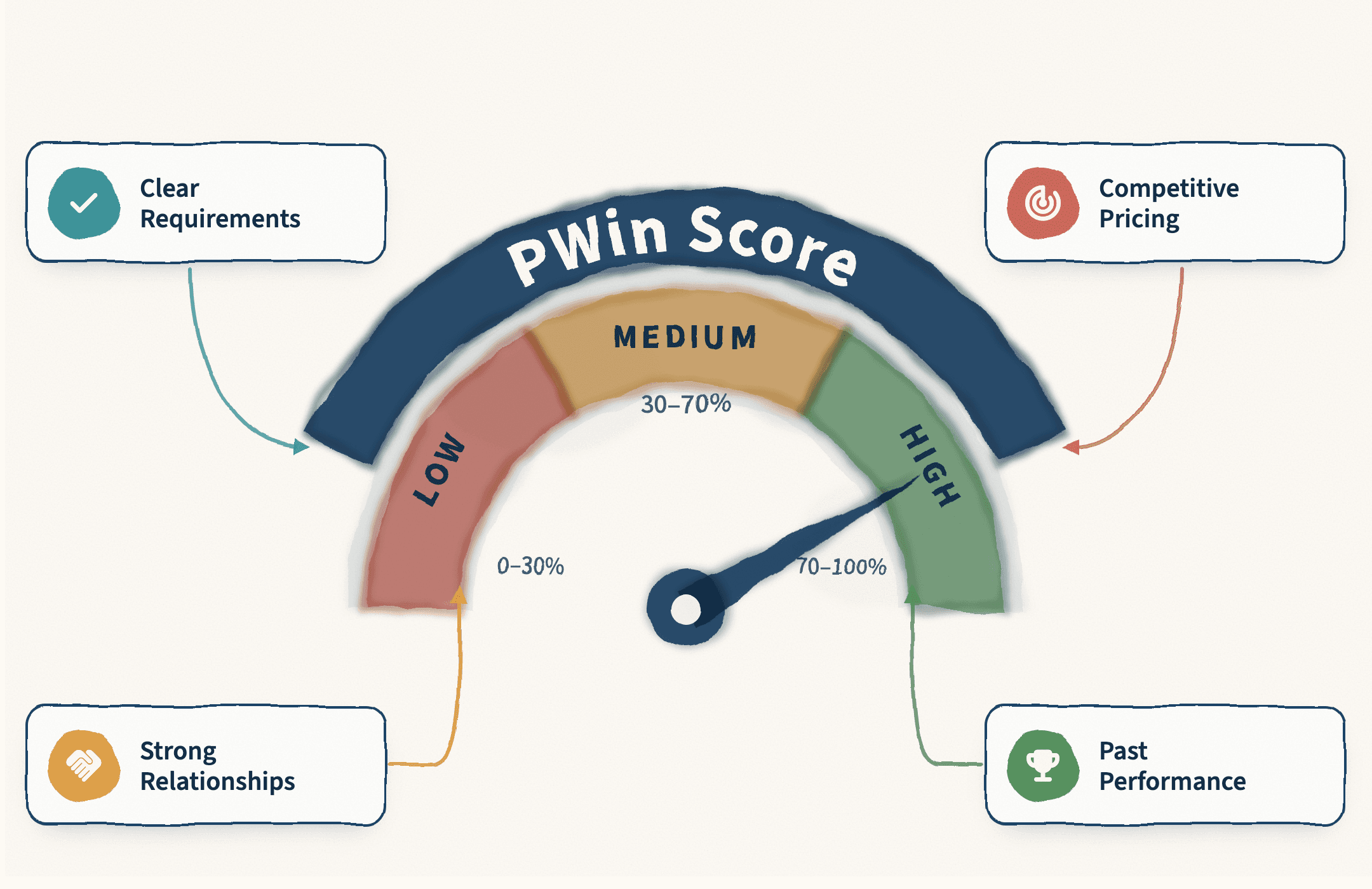
PWin is a percentage score representing your likelihood of winning a specific contract. Most teams treat it as something to calculate when the RFP lands. That's the wrong moment.
By the time a solicitation is published, the factors that actually move PWin (customer access, past performance alignment, competitive positioning, teaming) are largely locked in. A score assigned at RFP release is mostly a snapshot of work that either happened or didn't during capture.
Improving PWin means treating it as a running metric across the BD lifecycle, updated as you gather intel, build relationships, and qualify the opportunity. The sections below focus on what actually moves the number.
The Key Factors That Drive Your PWin Score
The six variables below drive most PWin models, and each one is movable during capture but largely fixed by RFP release.
| Factor | What raises it | What lowers it |
|---|---|---|
| Customer relationship depth | Multiple contacts across PM, COR, and end-user levels | Single point of contact or no pre-RFP engagement |
| Past performance relevance | Contract history that mirrors the PWS scope and dollar range | Adjacent experience with no clear tie to requirements |
| Competitive field | Few qualified incumbents; fragmented field | Strong incumbent with documented ratings |
| Technical capability fit | Internal capability covering most task areas | Gaps requiring teaming to meet minimum requirements |
| Pricing position | Should-cost analysis completed before RFP | Pricing built reactively from the RFP alone |
| Solution readiness | Approach defined and validated with the customer | Approach developed during proposal writing |
The sections below work through each factor. Improving your PWin means moving these numbers during capture, not estimating them at Gate 0.
Build Customer Intimacy Before the RFP Drops
Pre-RFP conversations shape requirements long before a solicitation posts. Capture managers who wait for industry day are showing up after the real competition has already played out.
Meaningful pre-RFP access requires building across the full stakeholder map: program managers own the requirement, CORs monitor performance, technical evaluators score proposals, and contracting officers control the vehicle. A single PM contact is a single point of failure.
In practice, that translates to attending agency forums, responding to RFIs, requesting informational meetings, and submitting capability statements that give the program office concrete language to reference when drafting the PWS. That last point is what "shaping the requirement" looks like in action. FAR 15.201 explicitly encourages pre-solicitation exchanges between agencies and industry, provided any acquisition-specific information disclosed to one offeror is made publicly available to avoid unfair competitive advantage, consistent with procurement integrity requirements at FAR 3.104.
Customer intimacy built over 12 to 18 months is what competitors cannot replicate in a proposal cycle. For lean teams stretched across BD, capture, and proposal work simultaneously, that sustained engagement is also where bandwidth runs out first. Integrity Defense Solutions found that cutting RFI response time by 3-4x freed up the capacity to pursue more qualifying opportunities without adding headcount.
Position Past Performance as a Capture Asset, Not a Proposal Section
Most teams treat past performance as a proposal writing task. References get pulled the week the RFP drops, recycled from the last submission, and inserted without much thought about fit.
That approach costs points. FAR Subpart 42.15 requires agencies to collect contractor performance information and use it in source selection evaluations. Your CPARS record is already influencing how evaluators see you before your proposal arrives.
The capture activity that matters: map your contract history to the PWS task areas of the pursuit you're chasing, identify which references score highest on scope, complexity, and recency, and flag any CPARS ratings that could surface as weaknesses. As Miller Chevalier notes, contractors can formally respond to or dispute unfavorable ratings, but that window closes well before a recompete cycle begins. Start this work 12 months out, not at RFP release.
Conduct a Competitive Assessment and Ghost the Competition
Knowing who you're competing against shapes every section of a winning proposal. Contractors who skip this work write generic responses; those who do it build their entire narrative around gaps the competition cannot close.
Start with USASpending.gov and FPDS to identify who has held this contract or similar work at the agency. Review award history, contract sizes, and NAICS codes. Cross-reference likely offerors against their CPARS records where accessible, and scan LinkedIn and GovWin for teaming announcements signaling who is organizing around this pursuit.
From that research, build a competitor matrix covering each likely offeror's incumbent status, relevant past performance, known capability gaps, and probable pricing position. The goal is identifying where your strengths land directly against their weaknesses, because that intersection is where win themes come from.
Ghosting means writing proposal language that surfaces a differentiator so precisely that evaluators mentally eliminate a competitor without ever seeing them named. That only works if the assessment happened during capture, not reverse-engineered from the RFP on day three.
Fill Capability Gaps With the Right Teaming Strategy
Gap analysis during capture reveals where a bid breaks down under evaluation. When those gaps are real, teaming is the structural fix, not a last-resort move made during proposal writing.
The right partner brings more than capability. Look for:
- Complementary CPARS records that cover task areas you cannot credibly claim on your own
- Set-aside eligibility that improves your competitive position under Section M evaluation criteria
- Incumbent relationships at the target agency that reduce past performance risk for evaluators
- Workshare scope that both parties can credibly execute under scrutiny
Teaming decisions made early in capture shape the Section M response before the outline exists. Waiting until after RFP release compresses the due diligence window and often produces agreements that neither party can defend at Red Team.
Sharpen Win Themes Before the Outline Exists
Win themes written after the outline exists are retrofits. They get threaded into sections that weren't designed to carry them, and evaluators feel the seams.
The Shipley methodology puts win theme development upstream of the outline for a reason: themes should determine structure, not the other way around. A theme like "lowest total cost of ownership" implies a different proposal architecture than "mission continuity through incumbent knowledge retention." Getting that sequencing right requires capture intelligence, not proposal instinct.
Build win themes from three inputs:
- Customer hot buttons: the priorities the program office has repeated across industry days, RFI responses, and informational meetings.
- Your competitive gaps: where your differentiators land against a likely competitor's weaknesses.
- Section M evaluation criteria, which tell you exactly how the government is going to weight what you claim.
A win theme has to clear two tests. It must be provable with past performance or a specific technical approach, and it must map directly to a stated evaluation factor. A theme that fails either test is marketing copy, not a discriminator.
Before the outline exists, each theme should already have an owner, a supporting reference contract, and a home in the compliance matrix.
Use the Bid/No-Bid Gate to Protect Win Rate
Chasing every viable-looking opportunity is how teams end up with a low win rate and burned-out proposal staff. The bid/no-bid analysis gate exists to prevent that, but it only works if PWin scoring drives the decision instead of optimism or pipeline pressure.
Many mid-sized contractors use a minimum PWin threshold in the 50% to 65% range as a rule of thumb before committing B&P dollars, though teams calibrate that number based on their portfolio and cost structure. Below that line, a no-bid recovers bandwidth for a pursuit you can actually win. That spread in win rates across the industry reflects pipeline selection as much as proposal quality.
Disciplined no-bids compound over time. Each removed low-PWin pursuit concentrates resources on winnable work, raising the portfolio win rate without writing a single better proposal.
Use Win/Loss Debriefs to Recalibrate Your Scoring Model
Post-award debriefs are free competitive intelligence, and most contractors request them inconsistently or skip them entirely.
FAR 15.506 gives unsuccessful offerors the right to request a debrief within three days of receiving the award notice, with agencies directed to schedule it within five days of the request where practicable. Miss that window, and the right to a timely debrief lapses.
When you get in the room, ask directly:
- How did your technical volume score against the competitive range?
- Where did past performance evaluators flag scope or recency gaps?
- Were there weaknesses noted in your management or staffing approach?
- How did your price compare to the awardee's?
Those answers reveal which PWin factors your team is systematically overweighting. If you scored past performance at a 7 out of 10 and evaluators flagged recency gaps, your scoring model has a calibration problem. Feed that finding back into your factor weights before the next pursuit. Win debriefs matter too: understanding which sections scored highest and whether the margin was close or decisive tells you where your model is accurate versus where a weak field masked a real gap.
Understand the Incumbent Advantage and How to Overcome It
Incumbents win roughly 72% of recompetes. New competitors entering against them win about 18%. That gap closes in the 18 to 24 months before RFP release, or not at all.
Start by diagnosing where the incumbent is vulnerable. CPARS records are public after award and often reveal performance trends the program office has already noticed. An incumbent with documented delivery issues, schedule slippage, or staffing turnover is beatable, but only if you surface those weaknesses before the PWS is written so you can position your approach directly against them. Fed-Spend's analysis of 250,000 federal contract awards found that incumbents with documented performance issues drop well below that 72% baseline. That is the opening.
Beyond CPARS, watch for access signals. If the program office is scheduling informational meetings, issuing RFIs, or running industry days with substantive technical questions, the customer is often shopping for alternatives without saying so. A challenger who shows up early and submits a capability statement targeting the agency's known gaps starts building the relationship an incumbent is squandering.
The capture activities that move the number over 18 to 24 months:
- Map the incumbent's CPARS record against the likely recompete PWS task areas to identify where performance gaps align with evaluable requirements.
- Request informational meetings focused on the agency's evolving requirements, not your own capabilities, to build credibility with the program office before any solicitation exists.
- Submit RFI responses that show technical differentiation in the precise areas where the incumbent has documented gaps.
- Build relationships at the COR and end-user level, where incumbent complacency tends to surface before the contracting office acknowledges it formally.
How GovEagle Supports PWin Improvement Across the Capture Lifecycle
GovEagle's CRM integrations with Salesforce and HubSpot pull opportunity data, capture notes, and account intel directly into the proposal workspace, so win themes developed during BD don't have to be reconstructed from scratch at kickoff. Capture intelligence has a habit of staying exactly where it was collected: buried in CRM notes, shared drives, and the heads of two senior people who were on every call. By the time the RFP drops, that context rarely reaches the proposal team in a usable form, a gap the capture-to-proposal handoff process is designed to close.
The bid/no-bid analysis capability structures Gate 0 decisions against RFP details, past performance data, and competitor insights. The capture deck automation module connects that intelligence forward into the annotated outline in Word, keeping win themes traceable from capture through drafting. If your team is losing that thread between BD and proposal execution, Book a Demo to see how that handoff works in practice. The capability and gap analysis feature cross-matches your contract history against solicitation task areas, surfacing teaming needs before the solicitation posts.
Precise Software cut SME time on early-stage proposals by 80% running this workflow. Integrity Defense Solutions hit 3 to 4x faster proposal throughput. Both outcomes follow from the same structural change: capture intelligence reaching proposal execution without manual re-entry.
GovEagle's GovCon capture management software guide covers the full path from opportunity qualification through proposal delivery, purpose-built for FAR-governed pursuits where the continuity gap costs points.
Final Thoughts on PWin Strategy Across the Capture Lifecycle
Capture is where win rates are built, and the six factors covered here are all movable during that window. Once the RFP drops, you're scoring what you already did. Disciplined PWin tracking, rigorous bid/no-bid decisions, and debrief-driven recalibration compound over time in ways no single proposal improvement can match. Teams that close that loop, keeping capture intelligence flowing to execution without loss, are the ones that compound win rate over time.
FAQ
How does PWin scoring actually work in government contracting, and when should you update it?
PWin is a percentage estimate of your likelihood of winning a specific contract, scored across factors like customer relationship depth, past performance relevance, competitive positioning, technical fit, pricing readiness, and solution maturity. Update it as a running metric across the capture lifecycle, not a one-time calculation at RFP release, because most of the variables that move it are locked in by the time a solicitation posts.
What factors separate contractors with 70%+ win rates from those stuck at 25% in federal contracting?
Top-performing contractors make bid/no-bid decisions based on PWin thresholds (typically 50 to 65% minimum before committing B&P dollars) and concentrate resources on pursuits where capture work (customer access, past performance mapping, competitive assessment) was done 12 to 18 months out. That spread in win rates across the industry reflects pipeline discipline as much as proposal quality.
How can small government contracting firms improve PWin without expanding their proposal team headcount?
Focus capture investment on fewer, higher-probability pursuits by running disciplined bid/no-bid gates, mapping contract history against solicitation task areas before RFP release, and building customer relationships across the full stakeholder map instead of relying on a single PM contact. Tools like GovEagle can cut SME time on early-stage proposals by 80%, as Precise Software found, by pulling capture intelligence directly into the proposal workspace so it reaches the writing team without manual re-entry.
GovEagle vs. GovDash for capture-to-proposal continuity in federal contracting?
GovEagle connects CRM data from Salesforce and HubSpot directly into the proposal workspace, so win themes and competitive intelligence gathered during BD flow into the annotated outline in Word without manual reconstruction. GovDash targets early-stage government contracting teams and builds compliance matrices within its web interface; teams running mature Excel-based matrix workflows should test export compatibility before committing. For firms where capture-to-proposal continuity is the core breakdown, with intelligence staying buried in CRM notes and never reaching the proposal team, GovEagle's end-to-end workflow from capture deck automation through color team review is the more direct structural fix.
How do I use win/loss debriefs to recalibrate my PWin model in government contracting?
FAR 15.506 gives unsuccessful offerors the right to request a debrief within three days of receiving the award notice; agencies must schedule it within five days of the request. In the debrief, ask directly where your technical volume scored against the competitive range, which past performance gaps evaluators flagged, and how your price compared to the awardee's. Feed those findings back into your PWin factor weights before the next pursuit so your scoring model reflects how evaluators actually scored you, not how you hoped they would.