
Technical Volume Scoring and Structure Explained

Akash Mandavilli
CEO and Co-Founder of GovEagle
About the author
Akash is a 2x founder with previous experience in AI from Meta and federal sales from IBM. Akash holds a dual-degree from Johns Hopkins University in Economics and Computer Science.
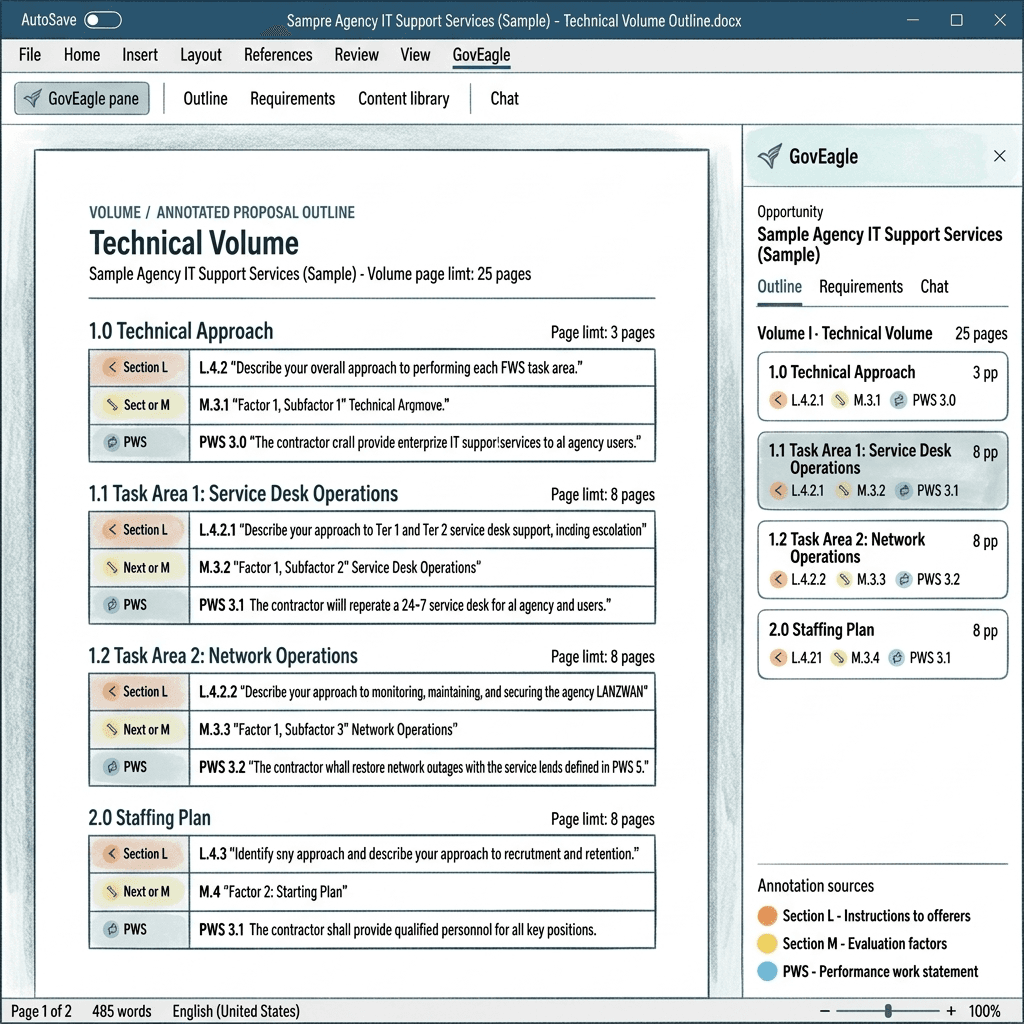
The government's evaluation team (in DoD, the Source Selection Evaluation Board) rates your technical volume against Section M criteria, not against how well-written it reads. A lot of teams write to Section L and stop there, which means the proposal clears the compliance bar and stalls at Acceptable. Closing that gap is a structure problem, not a writing problem.
TLDR:
- Under LPTA, the technical volume is a pass/fail threshold; under a best-value tradeoff, it drives documented strengths that can justify a higher price; under the FAR overhaul's highest technically rated approach, it decides who wins, as long as the price is fair and reasonable.
- Build your outline from Section L first, then layer Section M subfactors over it so every evaluation criterion has a response location before writing begins.
- On cost-reimbursement contracts, cost realism analysis checks your cost volume against your technical approach, and mismatches can pull otherwise strong evaluations down.
- Many technical volumes lose points to avoidable drafting failures: restating the SOW, ignoring Section M subfactors, and making claims evaluators cannot document as strengths.
- GovEagle generates a compliance matrix and annotated outline from Sections L and M and the PWS, so teams draft against evaluation criteria from the start.
What the Technical Volume Is and Where It Fits
The technical volume is the section of a federal proposal where your team describes how it will perform the work outlined in the Statement of Work or Performance Work Statement. It covers your approach, methodology, staffing, tools, and how you'll manage execution risk against the government's stated requirements.
In a FAR Part 15 negotiated acquisition, evaluators rate each Section M factor separately, and the volumes usually map to those factors. Cost or price is evaluated for reasonableness, and for realism where required, but typically doesn't get an adjectival rating. Don't count on evaluators finding technical content in another volume; each volume needs to stand on its own.
How the Technical Volume Is Scored
Evaluators rate the technical volume against the criteria in Section M. FAR Part 15 lets agencies choose their rating method, and DoD's Source Selection Procedures use an adjectival scale: Outstanding, Good, Acceptable, Marginal, or Unacceptable. On that scale, Acceptable means an adequate approach, Good requires at least one strength, and Outstanding requires multiple strengths or a major one, judged against the evaluation factors and subfactors the RFP states.
Compliant and competitive are not the same rating. A compliant technical volume meets Section L requirements and avoids disqualification. A competitive one earns high adjectival marks by showing meaningful strengths against Section M criteria with enough specificity that evaluators can document them. The gap between Acceptable and Outstanding often determines whether a proposal survives source selection tradeoffs or gets traded away for a lower-priced offer.
LPTA vs. Best Value: How Source Selection Method Changes What You Write
Source selection method determines how much technical narrative actually matters. Under LPTA, the technical volume functions as a pass/fail threshold. Once evaluators determine your proposal is technically acceptable, additional depth, differentiators, and compelling methodology earn no additional credit, though the volume still needs enough detail to be found acceptable.
A best-value tradeoff changes the calculus entirely. Documented technical strengths can justify a higher price when their benefits merit the extra cost, and evaluators document specific strengths that feed directly into the source selection decision. Proposal teams writing under best value need to invest in differentiators, specificity, and proof points that give evaluators something to record.
The FAR overhaul adds a third approach: highest technically rated with a fair and reasonable price. The award goes to the top-rated technical proposal as long as its price is fair and reasonable, and price is never traded off against technical merit. DoD has used the overhauled Part 15 since March 2026, and a proposed rule to codify it was published on September 18, 2026. Under this approach, technical depth matters more than under any other. This post reflects the rules as of October 2026; we’ll update it when the final rule is published.
Read Section M before you write a word. If it states LPTA, write clearly to the acceptability threshold. If it describes tradeoff criteria with varying weights, calibrate narrative depth to how heavily each factor is weighted relative to cost. If it uses highest technically rated, invest in technical depth across every factor.
Required Sections Inside a Technical Volume
Most technical volumes share a common internal structure, though Section L sets the exact requirements for any given RFP.
| Subsection | What Evaluators Expect |
|---|---|
| Technical Approach | How you'll perform each PWS task, going beyond simply confirming that you can |
| Staffing Plan | Named key personnel, roles, qualifications, and availability |
| Tools and Technologies | Specific tech tied to tasks, not a general capabilities list |
| Quality Assurance | Measurable QA processes with feedback loops |
| Risk Mitigation | Identified risks with probability, impact, and specific mitigations |
These subsections feed each other. A staffing plan that never references the technical approach leaves evaluators questioning whether the team can execute the described methodology. A risk section that ignores the approach's complexity reads as boilerplate. Write them as a connected argument, not independent chapters.
How to Structure Your Technical Approach
Mirror the PWS or SOW task areas in your technical approach structure. Each task area gets its own response describing in detail how your team will perform that work, not a generic capabilities statement lifted from marketing materials.
Within each task area, follow this sequence:
- State your understanding of what the government actually needs from that task
- Describe your specific methodology, with named processes, tools, and decision points
- Tie staffing to execution so evaluators see who does what
- Weave in a discriminator or win theme where it fits naturally
That last step is where compliant proposals become competitive ones. Evaluators document strengths, so give them something concrete to write down. A differentiator buried in passive voice or abstracted into a category ("we use proven processes") won't make it into the findings.
Keep win themes tied to the task, not floating as standalone assertions. If your key differentiator is low attrition on comparable contracts, connect it to the staffing risk for that specific task area instead of stating it once in the executive summary and hoping it carries forward.
Aligning the Technical Volume with the Cost Volume
On cost-reimbursement contracts, FAR Part 15 requires a cost realism analysis, which checks whether your proposed costs are consistent with what your technical proposal describes. On fixed-price contracts, agencies run one only in limited cases, and the results feed the performance risk assessment. A senior-heavy technical approach priced at mid-level labor rates raises an immediate question: which volume reflects reality?
Evaluators may not resolve that question in your favor. They can flag it as a risk, and that risk can pull an otherwise strong technical evaluation down during tradeoff deliberations.
Keep the two volumes tethered from the start. As task areas are written, the labor categories and hours assigned to each task should travel alongside them into the cost build. If the technical approach calls for a dedicated QA lead on a specific deliverable, that role needs to appear in the basis of estimate with hours that match the described workload. Mismatches caught through structured Pink, Red, and Gold Team reviews are expensive to fix; mismatches surfaced by evaluators are worse.
Common Gaps That Weaken Technical Volumes
Many technical volumes lose points to avoidable drafting failures, not weak technical merit. The most common gaps include restating the SOW without explaining how your team will actually perform it, ignoring Section M subfactors entirely, and making vague claims without proof points evaluators can document as strengths, a pattern worth reviewing through a dedicated RFP compliance gap review. Staffing sections that contradict the technical approach and formatting violations that breach Section L page limits round out the list. That last one is fully avoidable and still eliminates otherwise strong proposals.
Get GovCon capture and proposal insights in your inbox.
Using Section L and Section M as Your Writing Blueprint
Section L tells you what to write. Section M tells you what gets scored. Used together before drafting begins, they replace every generic template with a structure built directly for this solicitation.
Start with Section L. Extract every instruction, page limit, font requirement, and subsection heading, mapping each one to a location in your outline. Then layer Section M over it: for every evaluation factor and subfactor, confirm there is a corresponding response location in the structure you just built. If a subfactor has no home in the outline, add one.
The annotated outline that results is the best writing blueprint you have. It shows writers which evaluation criteria their section must cover, what Section L requires in terms of format and length, and where win themes belong relative to the factors being scored. Proposals built from generic templates often miss subfactors entirely because the template was never designed around this RFP's Section M. Hand-building that cross-reference is where subfactors most often drop out. GovEagle can build the annotated outline in Word and the compliance matrix in Excel from Sections L and M and the PWS, listing each section's requirements and page limits word for word with citations. Book a Demo to see it applied to a live solicitation.
A compliant technical volume meets Section L requirements. A competitive one earns high marks against Section M criteria. The difference between the two often decides who wins.
Run that cross-reference before a single section goes to a writer. Any gap between what Section L requires and what Section M scores is a weakness waiting to surface at Red Team.
The Role of the Technical Volume Lead
The Technical Volume Lead owns the document from annotated outline through final color team submission: coordinating SME inputs, holding writers to the Section L structure, catching compliance drift between drafts, and defending every section's alignment to Section M criteria at Red Team.
In practice, the role splits across three responsibilities:
- Translating the annotated outline into a proposal storyboard structure with clear instructions on which evaluation subfactors each writer must respond to
- Pulling SME knowledge out of conversations and into prose, then checking that prose against the PWS task areas it claims to support
- Running compliance checks after each draft iteration, not waiting until Red Team
That last point is where most proposals lose ground. When compliance review waits until Red Team, gaps that could have been fixed in a day become emergency rewrites under deadline pressure. Each draft handoff should function as a mini-review, verifying Section L requirements are met before the document moves forward.
On SME coordination: SMEs know the technical content but rarely write to evaluation criteria. The Lead's job is to ask the right questions, extract the proof points evaluators need, and shape that material into language that maps to Section M subfactors. A discriminator locked inside a SME's head does nothing for the score.
Visuals, Formatting, and Page Constraints
Page limits in Section L are hard stops. A proposal that exceeds them can be found unacceptable regardless of technical merit, and evaluators may stop reading at the limit even when they don't disqualify the submission outright.
Every graphic, table, and callout box needs to carry weight that prose cannot. A process flow diagram that compresses three paragraphs of methodology into one clear visual earns its page real estate. A decorative org chart that duplicates what the staffing section already says does not. Before inserting any exhibit, ask whether an evaluator skimming under time pressure would extract something they couldn't get from the surrounding text.
A few formatting disciplines that protect you under tight limits:
- Confirm whether exhibits count against page limits. Section L sometimes excludes labeled appendices, but assuming exclusion without checking is a common compliance error.
- Match font, margin, and header requirements exactly. Formatting violations are easy for evaluators to spot and fully avoidable.
- Use callout boxes and shaded sidebars to surface discriminators, not to repeat body text. If the callout restates a sentence from the paragraph above it, cut it.
Heavily visual submissions can also backfire. Evaluators documenting strengths need quotable language tied to Section M subfactors. A proposal that buries its methodology inside graphics and leaves evaluators searching for prose to cite may score lower than a cleaner, text-forward response that answered the same question directly.
How Color Team Reviews Apply to the Technical Volume
Each color team targets a different failure mode in the technical volume.
A Pink Team review validates structure before writing gets too far: does the outline match Section L, are Section M subfactors assigned to the right sections, and are win themes placed where they can support a documented strength? Catching a missing subfactor at Pink Team costs an hour; catching it at Red Team costs a night.
For the technical volume, Red Team should surface methodology gaps, staffing contradictions, and proof points that are asserted but not substantiated. GovEagle's proposal review supports Pink, Red, and Gold Team reviews, checking drafts against Section L, M, and PWS requirements, rating compliance, and scoring how compelling the writing is.
A Gold Team review confirms the final volume is production-ready: compliant with every Section L formatting requirement, internally consistent with the cost volume, and free of last-minute edits that introduced new gaps.
How GovEagle Supports Technical Volume Development
Many of the friction points in this post start upstream, with no requirement-mapped structure before writing begins. GovEagle generates an Excel compliance matrix and an annotated outline in Microsoft Word from Sections L and M and the PWS, so technical volume leads start drafting against a structure already tied to evaluation criteria.
One proposal consultant cut outline time for a standard 15 to 20 page small business proposal from an eight-hour workday to about five minutes. Both outcomes trace back to eliminating the blank-page problem before a single section was assigned.
Teams looking to apply this workflow to their next pursuit can review GovEagle's proposal solutions.
Final Thoughts on What Makes a Technical Volume Score
Source selection decisions come down to what evaluators can actually document, and that documentation starts with how well your technical volume maps to Section M subfactors. Mirror the PWS structure, tie staffing to execution, keep your cost volume aligned, and run compliance checks early. Teams that do this consistently give evaluators the documented strengths that move a volume from Acceptable toward Outstanding. GovEagle generates an outline that maps Section L, M, and PWS requirements to each section before your team writes a word, so requirements are part of the structure from day one, not retrofitted at Red Team. To see how the workflow applies to your next pursuit, explore GovEagle's proposal solutions.
FAQ
How do you structure a technical volume when Section L and Section M point to different organizational logic?
Section L governs format (what to write and where) while Section M governs scoring, defining what evaluators document as strengths. Build your annotated outline from Section L first, then layer Section M subfactors onto each section to confirm every evaluation criterion has a response location. Any subfactor without a home in the outline is a compliance gap waiting to surface at Red Team.
What is the difference between a compliant and a competitive technical volume in a FAR Part 15 source selection?
Compliance clears the bar; competitiveness wins the award. In DoD source selections, adjectival ratings from Acceptable to Outstanding reflect how well a proposal substantiates strengths against Section M criteria, beyond simply meeting Section L requirements. That gap often determines whether a proposal survives trade-off deliberations or gets set aside for a lower-priced offer.
Does writing depth in the technical volume matter under LPTA, or should I save the effort for best value pursuits?
The source selection method determines how much narrative investment is worth making. Under LPTA the technical volume is a pass/fail threshold. Under a best-value tradeoff, documented strengths can justify a higher price. Under highest technically rated with a fair and reasonable price, the top technical proposal wins as long as its price is fair and reasonable.
How do I build a compliance matrix for a government RFP without missing requirements?
Parse Sections C, L, and M line by line, extracting every instruction, task requirement, and evaluation criterion into a structured matrix before the annotated outline is built. Keyword-only scanning misses obligations phrased as instructions or preferences instead of "shall/will/must" statements; a manual or AI-assisted review against all three sections catches what automated keyword matching leaves behind. GovEagle builds this matrix directly in Excel through its add-in, including in your own template, quoting each Section L, Section M, and PWS requirement word for word with its source, so technical volume leads start drafting against a requirement-mapped structure instead of reconstructing it mid-pursuit.
How should cost volume alignment factor into technical volume drafting, and what happens if the two diverge?
On cost-reimbursement contracts, cost realism analysis under FAR Part 15 checks whether proposed costs are consistent with what the technical proposal describes. Mismatches between the two can be assessed as risk during source selection. As covered in the cost volume alignment section above, keep labor categories and hours traveling alongside the technical approach as task areas are written so those gaps surface during internal review, not at source selection.