
4 Top Proposal Automation Software Platforms for Government Contractors in September 2026

Akash Mandavilli
CEO and Co-Founder of GovEagle
About the author
Akash is a 2x founder with previous experience in AI from Meta and federal sales from IBM. Akash holds a dual-degree from Johns Hopkins University in Economics and Computer Science.

The bid/no-bid decision is supposed to happen before resources get committed, but when your proposal team is already stretched across active pursuits, 'decide early' becomes 'start drafting and hope.' Proposal automation software platforms don't fix BD capacity by magic, but they do compress the parts of the workflow that eat the most time: compliance matrix generation, first-draft production, and Section M traceability. Here's how four of the current options stack up for government contractors.
TLDR:
- AI-assisted drafting can reduce federal proposal first-draft time by roughly 50 to 70 percent compared to manual authoring.
- Compliance matrix generation separates purpose-built GovCon tools from tools not designed around FAR-structured federal acquisition workflows, which do not auto-generate a Section L/M matrix.
- FedRAMP Moderate Authorization and FedRAMP Moderate Equivalency are not the same designation; confirm which your CUI environment requires before selecting a tool.
- Tools in this category split across two workflow positions: creation-first drafting and post-draft analysis, each covering a different phase of the response process.
- Some purpose-built GovCon tools cover capture through submission in a single environment, with native Word integration and FedRAMP Moderate Equivalency with deployment options including AWS GovCloud and Azure Government.
Best Overall Proposal Automation Software: GovEagle

GovEagle is purpose-built for government contractors, covering the full capture-to-submission workflow in a single environment. GovEagle generates the compliance matrix automatically from the RFP, mapping Section L and Section M requirements to corresponding proposal sections in Excel, giving proposal managers a traceable structure before drafting begins.
The AI drafting layer pulls from past proposals, past-performance write-ups, and boilerplate repositories to generate first drafts that reflect your firm's voice and prior win themes. Some contractors report being able to pursue more opportunities with the same BD staff after automating parts of the proposal workflow. For contractors handling Controlled Unclassified Information, GovEagle supports FedRAMP Moderate Equivalency with deployment options including AWS GovCloud, Azure Government, and self-hosted configurations. Security frameworks and compliance requirements such as FedRAMP and NIST SP 800-171 help protect CUI and may be required depending on the agency, contract, and deployment environment. GovEagle integrates directly with Microsoft Word, pushing generated content into documents that follow your firm's existing templates with no proprietary editor required.
VisibleThread
Teams typically bring it in after a draft exists to check for compliance gaps against Section L requirements and flag evaluator-facing language issues, such as passive voice density and jargon that can lower technical evaluation scores.
It ingests a draft and maps content against RFP requirements, giving proposal managers a structured view of where coverage is thin or missing. For GovCon shops running high-volume federal proposal pipelines with dedicated writing staff, that post-draft audit function has real value.
Where VisibleThread runs into friction is workflow positioning. Teams still need separate tools to produce the first draft, and that handoff adds pressure points under tight deadlines.
A few trade-offs worth noting for GovCon teams considering it:
- The readability and compliance-gap features work well for Section L traceability checks, but the tool is not built around the capture-to-submission workflow that spans pre-RFP through final submission.
- Content reuse from a past-performance library or boilerplate repository requires external management; VisibleThread does not serve as the content source of record.
- Teams whose drafting process lives inside Microsoft Word will need to plan around the import/export cycle, since VisibleThread operates as a separate analysis environment, not a native Word integration.
For shops that already have a strong drafting workflow and want a dedicated compliance review layer on top of it, GovEagle vs. VisibleThread is worth reviewing to understand where VisibleThread fills that role. For teams looking for proposal automation that covers earlier stages of the process, the post-draft positioning may leave gaps that need to be accounted for elsewhere in the stack.
Rohirrim
Rohirrim is an AI-powered proposal automation software built for government contractors, with a focus on speed and compliance across complex, multi-volume RFP responses.
What Rohirrim Does Well
Rohirrim is built around a creation-first workflow, meaning the tool generates draft proposal content directly from RFP requirements; it does not wait to analyze content after it has already been written. This positions it well for teams that need to move quickly from solicitation release to first draft.
- The tool can ingest RFP documents and generate section-level draft responses mapped to Section L and Section M requirements, reducing the time BD and proposal teams spend on initial outline and narrative development, a core use case for AI federal government proposal writing.
- Rohirrim supports multi-author proposal coordination, allowing distributed federal proposal teams to work concurrently across sections without version conflicts.
- Rohirrim integrates with Word and standard federal proposal document formats, which matters for teams whose review and submission workflows depend on Word-based artifacts.
Where Rohirrim Has Limitations
Rohirrim is a strong fit for teams that put rapid first-draft generation first, but there are trade-offs worth weighing before committing.
- Teams reviewing past-performance library and boilerplate reuse capabilities should compare Rohirrim's functionality against their own workflow requirements.
- Compliance matrix generation and requirement traceability features are present but may require more manual validation than compliance matrix automation tools purpose-built around FAR-structured compliance workflows.
- Security documentation for CUI handling is not widely published, which can extend IT security review timelines at contractors with stricter data governance requirements.
Rohirrim is worth a close look for federal proposal teams that put AI-assisted draft generation speed first and have proposal managers who can handle downstream compliance validation manually.
Get GovCon capture and proposal insights in your inbox.
Vultron
Vultron positions itself as an AI-powered proposal workspace built around collaborative drafting, with features that include AI-assisted proposal section drafting, a centralized past-performance and boilerplate content library, and multi-author editing workflows. The tool targets larger federal BD teams that need structured collaboration across writers, SMEs, and reviewers working on concurrent federal proposals.
What Vultron Does Well
Vultron's knowledge library is one of its more practical features for teams with deep content repositories. The system can pull from past proposals, capability statements, and technical write-ups to generate section drafts, which reduces the time SMEs spend answering the same questions across multiple pursuits.
- Multi-user editing and role-based access give proposal managers visibility into who is working on which sections, reducing the coordination friction that tends to surface during Pink Team prep.
- The AI drafting layer ingests RFP requirements and generates initial content against Section L compliance structures, giving writers a structured starting point instead of a blank page.
- Version control and audit trails help teams track changes across review cycles, which matters when you are sorting through Red Team comments across a document with dozens of sections.
Where Vultron Has Limitations
Vultron's browser-based workflow creates friction for teams whose drafting and review processes live in Microsoft Word, and the tool leaves some gaps for GovCon-specific workflows.
- The browser-based editor adds steps for proposal managers who rely on Word-native markup, tracked changes, and comments during review cycles.
- Teams should assess how Vultron's compliance matrix capabilities align with their Section M evaluation workflow requirements.
- Federal procurement data integration and opportunity pipeline tracking are outside the tool's scope, which can require additional workflow layers for teams managing active pursuit pipelines.
Vultron fits larger federal BD teams where multi-user collaboration management is the primary pain point and where compliance matrix generation and federal procurement data management are handled separately in the stack.
Feature Comparison Table of Proposal Automation Software
The table below maps the four tools across the variables that matter most to proposal teams: AI drafting capability, compliance matrix generation, Microsoft Office integration, security posture, and pricing transparency. Use it to frame your comparison before reading the individual tool write-ups.
| Tool | AI Drafting | Compliance Matrix | MS Office Integration | Pricing Transparency |
|---|---|---|---|---|
| GovEagle | Yes | Auto-generated in Excel | Native Word + Excel | Contact for pricing |
| VisibleThread | Post-draft analysis | No | Word add-in | Contact for pricing |
| Rohirrim | Yes, creation-first drafting | Present; manual validation recommended | Common document formats | Contact for pricing |
| Vultron | Yes | Supports compliance matrix workflows; review for Section M needs | Browser-based; common document formats | Contact for pricing |
Compliance matrix generation separates purpose-built GovCon tools from tools not designed around FAR-structured federal acquisition workflows, which do not auto-generate a Section L/M matrix. FedRAMP Moderate Authorization and FedRAMP Moderate Equivalency are not the same designation; teams working on contracts that handle CUI should confirm which their environment requires. Verify each vendor's current security posture directly before selecting a tool.
Why GovEagle Is a Strong Fit for Federal Proposal Teams
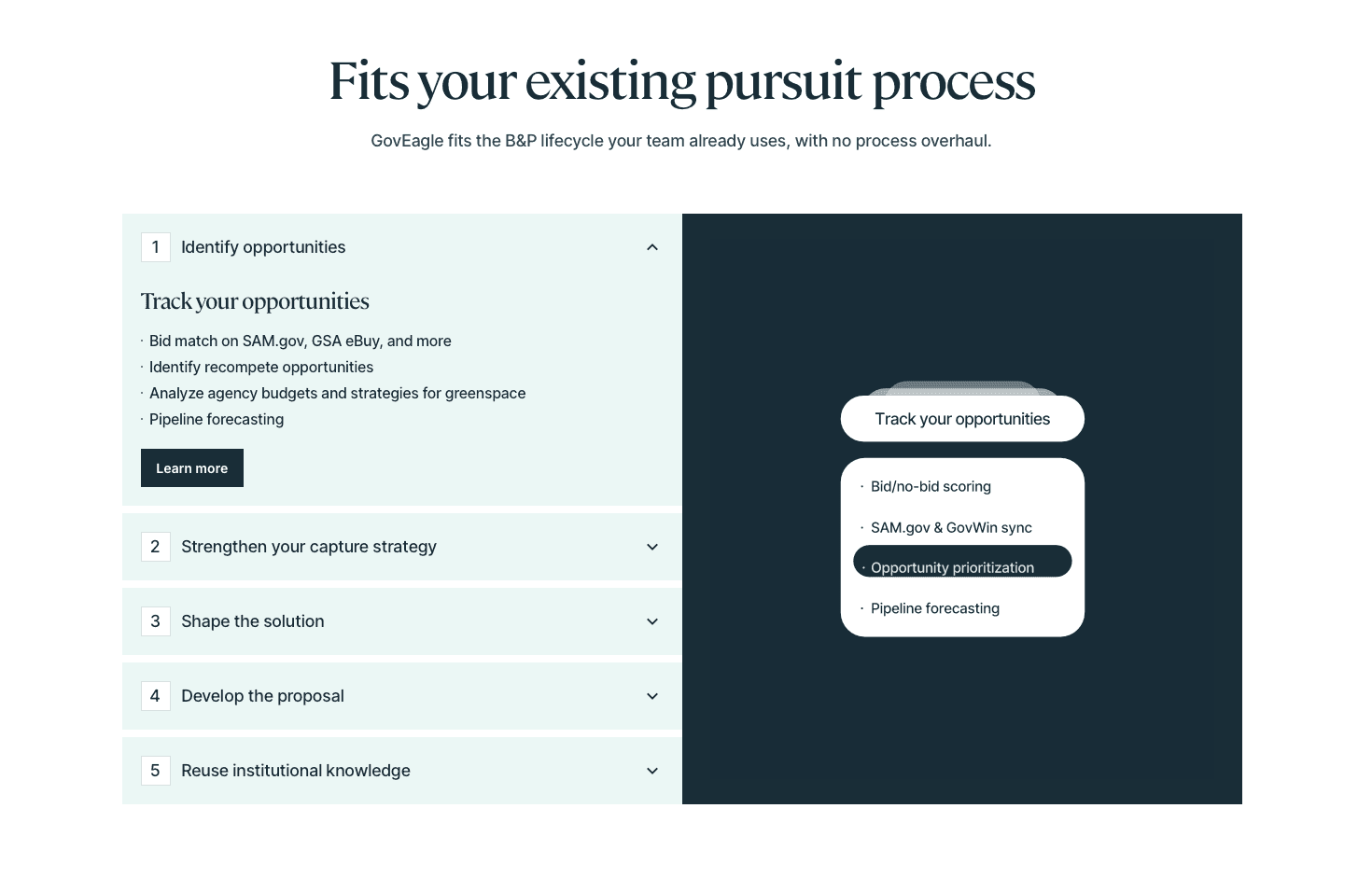
Most proposal teams in this category face a sequencing problem: win themes from BD stay in CRM notes, and the team rebuilds from scratch once the solicitation drops. GovEagle connects capture inputs to RFP parsing, compliance matrix generation, and first-draft production in one traceable workflow. The proposal automation guide covers how this maps to the full proposal lifecycle.
GovEagle generates the Section L/M compliance matrix in Excel and produces an annotated Word outline before drafting begins, so writers enter the drafting phase with requirements already mapped. Some GovEagle customers report reducing portions of the RFP response process from weeks to hours through workflow automation. GovEagle's government proposal software guide details how that timeline compresses in practice.
For contractors handling CUI, GovEagle supports FedRAMP Moderate Equivalency deployments with options including AWS GovCloud, Azure Government, and self-hosted environments. For a broader view of the category, the AI proposal writing tools comparison covers how GovEagle positions across the market.
FAQs
How do I choose between GovEagle, Rohirrim, and Vultron for federal proposal drafting?
The decision turns on where your workflow breaks down first. If your team loses time in compliance matrix creation and capture-to-proposal handoffs, GovEagle covers that full lifecycle in a single environment with native Word and Excel integration. Rohirrim suits teams that put rapid first-draft speed above all else and can handle compliance validation manually downstream. Vultron fits larger teams whose primary pain point is multi-user collaboration management, not RFP parsing or compliance traceability.
When should a GovCon firm use VisibleThread instead of a purpose-built proposal automation tool like GovEagle?
VisibleThread fits shops that already have a strong drafting process in place and want a dedicated compliance review layer applied after a draft exists. It does not cover the full capture-to-submission workflow, so teams that need RFP parsing, compliance matrix generation, and AI drafting in one environment will need a purpose-built proposal automation solution.
How do I assess which proposal automation tools on this list can handle CUI and meet federal security requirements?
Start by confirming whether your contract requires FedRAMP Moderate Authorization, FedRAMP Moderate Equivalency, or NIST 800-171 alignment, since these are not interchangeable designations and the applicable requirement varies by agency and contract type. GovEagle supports a FedRAMP Moderate Equivalency deployment model with AWS GovCloud and Azure Government deployment options. Before selecting any tool, verify the vendor's current security posture against your specific program's data handling requirements, not category-level claims.
Final Thoughts on Selecting Proposal Automation Software
Workflow coverage, more than any single feature, is what separates proposal automation software platforms. Some tools cover the drafting layer, some cover the review layer, and some sit earlier in the capture cycle before a solicitation drops. Knowing where your team loses the most time, whether at first draft, compliance tracking, or bid prioritization, makes the evaluation clear. If your team is losing proposal cycles to manual compliance matrix creation and disconnected capture-to-submission handoffs, GovEagle's automated compliance matrix generation and single-environment workflow directly close that gap.