
Government Proposal Software: How GovCon Teams Cut RFP Response from Weeks to Hours (September 2026)

GovEagle is not affiliated with, sponsored by, certified by, or otherwise associated with Shipley Associates.
Manual compliance matrix builds can consume a substantial share of the response timeline before proposal content even starts. That front-loaded delay forces your SMEs into compressed drafting schedules and makes multi-pursuit pipelines nearly impossible to staff. Government contractors using RFP software with automated requirement parsing and sample request for proposal templates are cutting that initial phase to under an hour, which fundamentally changes how many opportunities a BD team can realistically pursue at once.
TLDR:
- RFP software maps responses to Section L/M requirements: generic tools fail when traceability breaks down.
- AI automates compliance matrix builds (days to under an hour) and first-draft generation from past performance.
- Manual compliance matrix creation on complex RFPs can take 2-3 days before writing begins.
- Security posture (FedRAMP, GCC High support) often disqualifies tools before feature comparison matters.
- Purpose-built proposal automation software automates Section L/M matrix generation and pulls from your past performance library for drafts.
What Is RFP Software and Why Government Contractors Need It
RFP software refers to purpose-built tech that helps government contractors manage the full proposal lifecycle, from initial opportunity identification through final submission. Unlike generic document editors or shared drives, dedicated RFP management software is architected around the structured, compliance-heavy workflow that federal solicitations demand.
For GovCon teams, the stakes of a disorganized response process go well beyond missed deadlines. Section L defines exactly what your response must include, and Section M defines how proposals will be reviewed and scored, consistent with FAR 15.304 source-selection evaluation factors. Proposal management software that maps content directly to those requirements gives BD and capture teams a defensible, auditable response structure instead of a document assembled under deadline pressure.
Why Generic Tools Fall Short in Federal Procurement
- Requirement traceability breaks down when writers work in isolated files with no connection to Section L line items, creating gaps that only surface during Red Team reviews.
- Version control failures are common when multiple SMEs contribute asynchronously without a centralized content repository tied to specific proposal sections.
- Reuse of past-performance write-ups and boilerplate is manual and error-prone, forcing proposal managers to reconstruct content that already exists somewhere in a file share.
Types of RFP Software for Government Proposals
Government proposal software generally falls into a few distinct categories, each built around a different phase of the pursuit lifecycle. Understanding where a tool fits helps BD and proposal teams decide what gaps they actually need to fill.
Category Breakdown
- Document and template management tools give teams a structured library for reusing past proposal sections, boilerplate language, and Section L/M response frameworks. They reduce duplication but typically require writers to do the heavy lifting.
- Compliance matrix and requirements tracking tools parse RFP documents and map each requirement to a response section. Many proposal managers build these manually in Excel, which can take several days on a complex solicitation.
- AI proposal generators automate first-draft content by pulling from a content library and applying RFP requirements. These tools can cut initial drafting time from days to hours, though output quality depends heavily on how well the underlying content library is maintained.
- End-to-end proposal management software ties together requirements tracking, content generation, collaboration, and review workflows in a single environment. This category targets teams managing multiple concurrent pursuits who need visibility across the full pipeline.
Core Features That Define RFP Response Management Software

Compliance Matrix Generation
Shredding an RFP and building a compliance matrix manually can consume days of a proposal manager's time before a single response section gets written. Purpose-built tools parse Section L requirements automatically and map them against response obligations, flagging gaps before the writing phase begins.
Content Library and Reuse
Past-performance narratives, technical approach sections, and management methodology write-ups represent substantial institutional value. Without a structured content library, teams rewrite the same material repeatedly or pull from stale, unreviewed versions buried in SharePoint.
AI-Assisted Drafting
Many tools now include AI drafting capabilities that generate first-pass section responses from RFP requirements and stored content. The quality and compliance-alignment of those drafts varies considerably across tools, so teams should test output against actual Section M evaluation criteria, beyond readability alone.
Workflow and Review Tracking
Color team reviews (Pink, Red, Gold) require structured handoffs, version control, and comment resolution. Tools that lack built-in review workflows push those processes into email threads and shared drives, where accountability breaks down at exactly the wrong moment.
How AI Is Changing RFP Response Automation
AI has shifted RFP response from a writing exercise into a compliance-engineering workflow. Where teams once spent days manually parsing Section L requirements and cross-referencing Section M evaluation criteria, AI-assisted tools can now map requirements to draft responses in a fraction of the time, pulling from a firm's past performance library, boilerplate repositories, and win themes. For BD teams managing concurrent federal pursuits, that compression changes how many solicitations a fixed-size capture team can realistically respond to.
| Proposal Task | Manual Approach | AI-Assisted Approach |
|---|---|---|
| Compliance matrix build | 2-3 days (line-by-line extraction into Excel) | Under 1 hour (auto-parsed from Section L/M) |
| First-draft generation | SMEs draft from scratch per pursuit | Pulled from past performance library and mapped to requirements |
| Requirement traceability | Tracked in disconnected files; gaps surface at Red Team | Mapped in real time with compliance status per section |
| Content reuse | Manual search through SharePoint or file shares | Retrieved automatically from a structured content library |
| Review handoffs | Managed via email and shared drives | Tracked within the tool with version control and comment resolution |
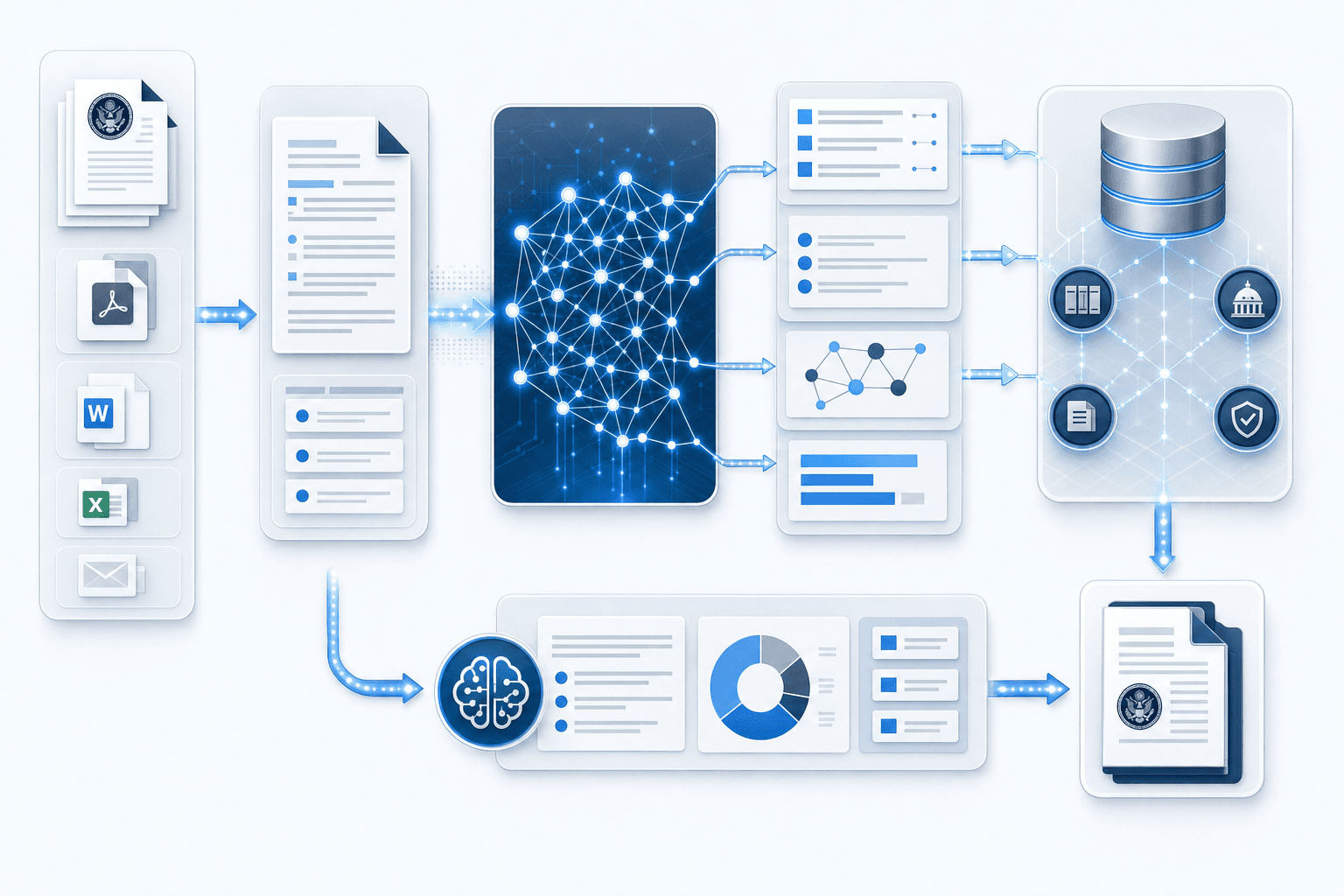
Building a Compliance Matrix: The Foundation of Government RFP Responses
A compliance matrix maps every Section L instruction and Section M evaluation criterion to a specific proposal section, owner, and page reference. Without one, even experienced pursuit teams miss requirements buried in amendment attachments or cross-referenced PWS clauses, and evaluators flag those gaps as execution risk.
The process of building one manually is where response timelines bleed out. A proposal manager typically works through the RFP line by line, copying requirements into a spreadsheet, tagging each to a volume and subsection, and then distributing ownership across SMEs. On a complex IDIQ or full-and-open requirement, manual compliance matrix builds take 10-18 hours before a single word of proposal content is written.
AI-assisted proposal software has changed how many teams approach this stage. Tools that auto-extract RFP requirements against Section L/M can collapse that initial build from days to under an hour, though output quality varies by solicitation structure and how cleanly the government formatted the source document.
What a Well-Built Matrix Tracks
A compliance matrix that actually holds up through Gold Team review covers more than a simple requirement checklist. Capture teams that skip these fields tend to rebuild the matrix mid-color-review under deadline pressure.
- Page and volume reference for each requirement, so reviewers can cross-check during red team without hunting through the narrative
- Assigned owner by name, beyond department level, so accountability is clear when a section comes back incomplete
- Compliance status updated in real time as drafts move through color team gates
- Cross-references to PWS, CDRL, and amendment attachments that modify or qualify base requirements
Assessing RFP Software: What Government Contractors Should Consider First
Government contractors assessing RFP software operate under constraints that don't apply to most other buying decisions. In federal contracting, compliance, security, and proposal structure are non-negotiable requirements, and the evaluation process starts well before a single feature gets reviewed.
Several factors deserve close attention when assessing options:
- Security and data handling should be the first filter. Federal proposal data may include CUI, past-performance details, and pricing strategies that should not be stored in consumer-grade SaaS environments without appropriate security controls. Look for clear documentation of FedRAMP authorization or FedRAMP Moderate equivalency where required, support for appropriate government cloud environments, and clear data residency policies before assessing any other feature.
- Compliance with Section L and Section M is a structural requirement, not a nice-to-have. The software needs to map RFP requirements to response sections and flag gaps, beyond helping write prose.
- Integration with the tools your team already uses matters more than standalone capability. If the tool does not connect to your existing content library or work inside Microsoft Word, adoption will stall under deadline pressure.
- AI capability should be assessed on federal-specific output quality. Generic AI writing tools produce generic output. The relevant question is whether the system understands FAR-structured solicitations, evaluation factor weighting, and compliance matrix generation.
- Scalability across pursuit volume is worth testing early. A tool that handles one proposal well may create bottlenecks when BD teams are running multiple simultaneous responses.
How GovEagle Helps Government Contractors Automate Proposal Responses from Capture to Submission

GovEagle is built for GovCon teams managing capture through final submission. Where most proposal tools focus on a single phase, GovEagle covers the entire workflow: opportunity identification, compliance matrix generation, content development, and color team review coordination.
The compliance matrix generation alone removes one of the more time-consuming pain points in RFP response. GovEagle reads Section L and Section M requirements and produces a structured matrix in Excel, mapping every requirement to a response location without manual extraction. For a 200-page RFP, that work typically takes a proposal team several days to complete by hand.
On the content side, GovEagle draws from your organization's past performance library, prior proposals, and approved boilerplate to generate draft responses that reflect your actual capabilities, not generic filler. SMEs spend less time on early-stage write-ups as a result. Precise Software cut SME time by 80%.
For teams operating in classified or sensitive environments, GovEagle supports deployment on AWS GovCloud and Azure self-hosted configurations, with documented FedRAMP Moderate Equivalency and CMMC-aligned security controls for teams handling sensitive federal proposal data.
FAQs
Can you build a compliant federal proposal without dedicated RFP software?
Yes, though the manual process introduces substantial risk and timeline pressure. Without purpose-built tools, proposal managers typically spend 2 to 3 days building compliance matrices in Excel, tracking Section L/M requirements across scattered files, and manually cross-referencing content libraries for reusable material. Teams working in shared drives or generic document editors face version-control failures and requirement gaps that surface during Red Team reviews when corrective time is limited.
What's the main difference between AI proposal generators and traditional proposal management software?
Traditional proposal management software provides content libraries, templates, and collaboration tracking but requires writers to draft from scratch. AI proposal generators automate first-draft section creation by pulling from past-performance libraries and mapping content to RFP requirements, collapsing initial drafting time from days to hours. The distinction matters most when SME availability is limited or pursuit volume exceeds manual capacity.
How does RFP software handle Section L compliance tracking?
Purpose-built RFP management software parses Section L instructions and Section M evaluation criteria to build a requirements matrix automatically, mapping each obligation to a response section, assigned owner, and compliance status. This replaces the manual line-by-line extraction process that typically consumes several days of proposal manager time on complex solicitations. The matrix then tracks page references, cross-references to PWS attachments, and real-time status updates as drafts move through color team gates.
Final Thoughts on RFP Software for Government Contractors
Government contractors competing for federal work face a structural reality: teams that respond to more opportunities with greater compliance precision tend to win more work over time. Purpose-built RFP software removes the manual overhead (compliance matrix builds, content reconstruction, version-control failures) that keeps pursuit volume lower than it could be. GovEagle gives BD and proposal teams the automation and traceability infrastructure to close that gap, from initial capture through final submission, without adding headcount to absorb the load.
