
GovEagle vs. pWin.ai: Which Is Better? (September 2026)
GovEagle is not affiliated with, sponsored by, certified by, or otherwise associated with Shipley Associates.
When comparing GovEagle vs. pWin.ai, the real question is not which tool drafts faster, but which one fits the way your capture and proposal team actually works. Many AI tools focus on generating RFP responses after a bid decision is made, while others support the entire lifecycle from early capture planning through compliance review and submission. Deployment requirements also matter, especially for contractors handling CUI or working in GCC High environments. In this breakdown, we compare pWin.ai with GovEagle across workflow integration, capture support, repository connectivity, and security posture so you can align the technology with your contracting requirements.
TLDR:
- GovEagle works inside Microsoft Word and Excel with your existing templates and workflows.
- pWin.ai operates through a web interface that requires adapting your current processes.
- GovEagle covers capture planning through submission; pWin.ai focuses on proposal writing.
- pWin.ai embeds Shipley-based proposal methodology directly into AI-generated drafts, appealing to teams standardized on Shipley processes.
- GovEagle supports FedRAMP Moderate Equivalency and GCC/GCC High for defense contractors handling CUI.
Get GovCon capture and proposal insights in your inbox.
What Is pWin.ai?
pWin.ai is an AI copilot for government proposal teams focused on RFI and RFP response generation. Built around a partnership with Shipley Associates, the tool integrates existing proposal writing methodologies directly into its AI-generated drafts to help teams produce compliant, well-structured responses.
The product operates in Azure Commercial and Azure Government environments and states alignment with CMMC Level 2 requirements, making it accessible to government contractors working with sensitive but unclassified information.
pWin.ai's core differentiator is embedding Shipley's methodologies into the drafting process. Instead of requiring teams to engage in prompt engineering or manually structure every response, the tool applies these frameworks automatically to reduce initial drafting time while maintaining quality standards that proposal evaluators expect.
What Is GovEagle?
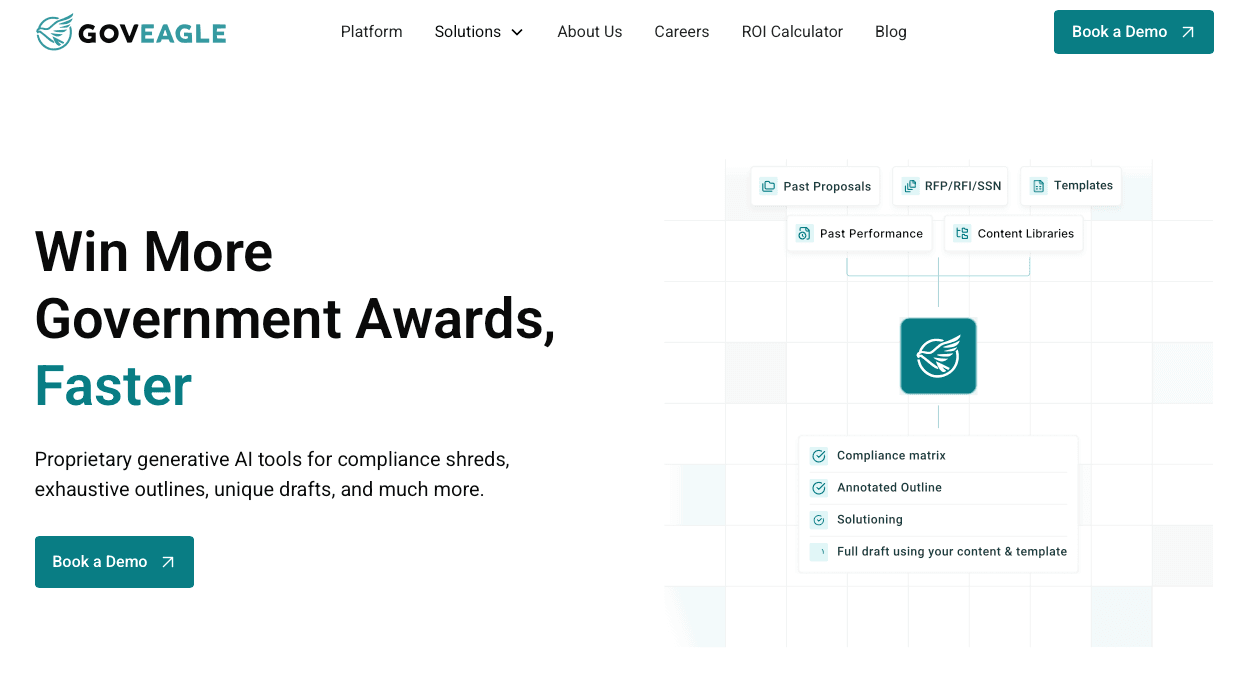
GovEagle is an AI-driven proposal automation suite built for government contractors responding to compliance-heavy federal RFPs. The product covers the full proposal lifecycle, from capture planning and bid/no-bid analysis through final submission and compliance review.
The core difference is how we integrate into your existing workflow. GovEagle operates directly inside Microsoft Word and Excel through native add-ins. Your team can draft, edit, and collaborate using the same tools and templates you already have. There's no template reworking, no separate web portal for document management, and no learning curve for basic document tasks.
We built GovEagle with security as a baseline requirement. The system supports deployment in AWS GovCloud with FedRAMP Moderate Equivalency, NIST 800-171, and CMMC compliance. We also support air-gapped environments and GCC/GCC High configurations for defense contractors handling CUI. All client data follows a zero-retention policy.
Workflow Integration and Adoption
pWin.ai’s materials describe interoperability with Microsoft 365 tools and a web-based drafting workflow. The product operates primarily through a web-based interface with integration into Microsoft Word for drafting and editing. This may require teams to adapt their existing processes before seeing productivity gains.
GovEagle functions as a native add-in for Microsoft Word and Excel. Your team works directly in the same documents and templates you're already using. There's no template reworking, no reformatting after export, and no switching between web portals and desktop applications.
The add-in preserves all Word functionality: tracked changes, comments, formatting, and multi-author collaboration all work as they did before. We pull compliance matrices, past performance content, and AI-generated drafts directly into your document without disrupting your existing workflow.
| Feature | GovEagle | pWin.ai |
|---|---|---|
| Primary Interface | Native Microsoft Word and Excel add-ins - work directly in your existing documents and templates | Web-based interface with Microsoft Office interoperability |
| Template Compatibility | Works with existing Word templates without modification - preserves all formatting, tracked changes, and comments | May require template adaptation to work within web-based drafting environment |
| Proposal Lifecycle Coverage | Full lifecycle from capture planning and bid/no-bid analysis through compliance review and submission | Focused on proposal writing phase after bid decision is made |
| Capture Planning Tools | Built-in bid/no-bid analysis, automated capture deck generation, capability gap analysis, and teaming partner identification | Public materials primarily accentuate proposal drafting capabilities instead of pre-RFP capture workflows. |
| Content Repository Integration | Native connections to SharePoint, Box, Egnyte, Dropbox, Google Drive, Salesforce, and HubSpot - no data migration required | Public documentation does not clearly detail the depth of native repository integrations. |
| Search Capabilities | Semantic search with context-aware retrieval and source citations pointing to exact document sections | AI-powered search capabilities within uploaded content |
| Methodology Integration | Flexible framework supporting various proposal methodologies within the native Office environment | Shipley Associates methodology embedded directly into AI-generated drafts |
| Security and Compliance | AWS GovCloud deployment, FedRAMP Moderate Equivalency, NIST 800-53, NIST 800-171, CMMC compliance, GCC/GCC High support, air-gapped environments | Azure Commercial and Azure Government, CMMC Level 2 compliance |
| Data Protection | Zero-retention policy - client data never used to train AI models, supports SCIF and classified environments | Designed to support contractors handling sensitive but unclassified information under CMMC Level 2 requirements |
| Adoption Time | Chevo reported full team adoption within one week. No learning curve for basic document tasks. | Requires team adaptation to web-based workflow before productivity gains |
| Best For | Defense contractors handling CUI, teams with existing Word templates, firms needing full capture-to-submission support, organizations requiring GCC High deployment | Teams using Shipley methodology, contractors comfortable with web-based drafting, organizations working in Azure Government without GCC High requirements |
This integration eliminates adoption friction. Chevo's proposal team reached full adoption in one week because there was no new system to learn.
Capture Planning and Early-Stage Analysis
pWin.ai focuses on the proposal writing phase after a bid decision has been made. The tool offers compliance-focused features for RFP response, but there is limited public information about built-in capture workflows or pre-RFP intelligence gathering capabilities.
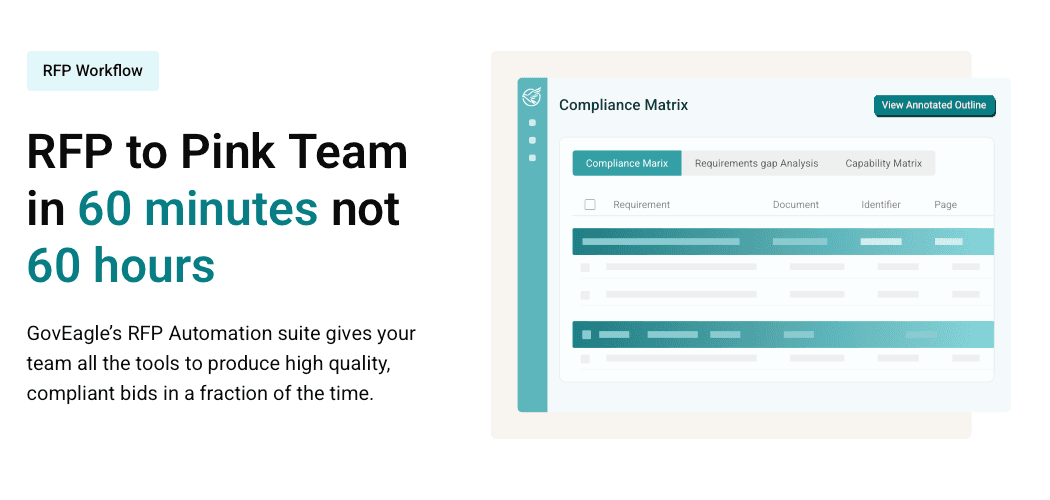
GovEagle covers the full capture lifecycle before proposal kickoff. The bid/no-bid analysis feature assesses opportunity fit by analyzing RFP details, past performance data, and competitor intelligence to determine pursuit viability. Our automated capture deck generation populates planning documents with relevant information from the RFP and your knowledge base, allowing teams to add win themes and capture intelligence that flows directly into proposal development.
The capability and gap analysis reviews each task area in the solicitation and cross-matches it with your past performance to identify strengths and coverage gaps. When gaps appear, the teaming partner identification feature suggests potential subcontractors with the right experience. Chevo uses this to rank past performance contracts against PWS task areas in under a minute. The Building People gets to Pink Team review twice as fast. Precise Software cut SME involvement at early stages by 80%.
Data Integration and Knowledge Management
pWin.ai mentions integration with common office software, but publicly available information doesn't confirm native connections to enterprise content repositories like SharePoint, Box, or Egnyte. Depending on the deployment and integration configuration, teams may rely on uploads or configured connectors to make content available for drafting and retrieval.
GovEagle connects directly to your existing content storage systems: SharePoint, Box, Egnyte, Dropbox, Google Drive, Salesforce, and HubSpot. The system indexes these repositories in place, so proposal libraries, past performance records, and reference materials remain where they are. No data migration required.

The semantic search feature retrieves relevant proposal content using context instead of simple keyword matching. You can ask for "cloud migration experience for DHS" and the system will surface applicable content even if the original documents used different phrasing. The AI chat interface returns results with source citations, pointing to the exact document and section where the information originated.
Chevo's team was functional within one week with no content migration because GovEagle worked with their existing file structure from day one.
Security, Compliance, and Data Protection
pWin.ai operates in Azure Commercial and Azure Government environments and states alignment with CMMC Level 2 requirements, supporting contractors working with sensitive but unclassified information. Publicly available information does not confirm FedRAMP Moderate Equivalency or support for GCC/GCC High environments, which may limit deployment options for defense contractors handling CUI.
GovEagle supports deployment in AWS GovCloud with FedRAMP Moderate Equivalent controls and aligns with NIST 800-53 and NIST 800-171 controls and supports CMMC requirements. We also support GCC/GCC High environments, which became a deciding factor for defense contractors like Integrity Defense Solutions. For a detailed comparison of secure AI platforms for government proposal data, our guide covers compliance requirements and deployment options across multiple tools.
Our zero-retention policy prevents proprietary client data from being used to train shared AI models. We also have experience deploying in air-gapped environments and SCIF facilities for contractors working with classified or compartmented information, making GovEagle suitable for federal civilian agencies, defense, and intelligence sectors.
Why GovEagle Is the Better Choice
pWin.ai offers AI drafting and works well for teams using Shipley methodology and web-based workflows. GovEagle delivers better value for most government contractors by supporting the full lifecycle from capture through submission without changing your existing processes.
We work inside Microsoft Office with your current templates, which removes the learning curve. Our capture workflows cover the entire lifecycle, on top of writing. Native content repository integrations avoid data migration.
For defense contractors, our FedRAMP Moderate Equivalency and GCC/GCC High support solve deployment requirements that many tools do not tackle. The result is faster implementation and stronger ROI for growing and existing contracting firms.
FAQs
How do I decide between pWin.ai and GovEagle for my proposal team?
Your decision depends on where your bottlenecks are. If you need only AI-assisted drafting after your capture work is done, pWin.ai may work. If you need support from bid/no-bid analysis through final compliance review, GovEagle covers the full lifecycle. Consider GovEagle if you use Microsoft Word templates you can't easily change or if you need deployment in GovCloud or GCC High environments.
What's the main difference between pWin.ai's web interface and GovEagle's Microsoft Office integration?
pWin.ai operates through a web-first system where you draft in the browser and export to Word for final edits. GovEagle works directly inside Microsoft Word and Excel as a native add-in, so you draft and collaborate in the same environment with your existing templates. The GovEagle approach preserves tracked changes, comments, and formatting without switching between systems.
Who is GovEagle best suited for compared to pWin.ai?
GovEagle fits government contractors handling sensitive information who need FedRAMP Moderate Equivalency or GCC High support, teams that can't rework their existing Word templates, and firms that need capture planning tools before proposal kickoff. pWin.ai works for teams comfortable with web-based drafting who want Shipley methodology embedded in their AI outputs and don't need advanced security configurations.
Final Thoughts on Selecting the Right Proposal AI Tool
When deciding between GovEagle vs. pWin.ai, the right choice depends on how your team runs capture, how tightly you rely on Microsoft Office, and what your security environment requires. If your workflow lives in Word and Excel, your content sits in SharePoint or Box, and your contracts involve CUI or GCC High constraints, those factors should guide your decision. GovEagle was built to support the full capture-to-submission lifecycle inside the tools your team already uses, without forcing template redesigns or process changes. For contractors that need lifecycle coverage and secure deployment options, GovEagle fits into your existing approach.