
Best Secure AI Platforms for Government Proposal Data (August 2026)

Akash Mandavilli
CEO and Co-Founder of GovEagle
About the author
Akash is a 2x founder with previous experience in AI from Meta and federal sales from IBM. Akash holds a dual-degree from Johns Hopkins University in Economics and Computer Science.
Tight proposal deadlines push many government contractors to consider consumer AI tools, and the risks extend well beyond simple data exposure. A covered cyber incident involving CUI can trigger DFARS 252.204-7012's 72-hour reporting requirement, disrupt active contract performance, and invite agency scrutiny that puts future awards at risk. Consumer AI services introduce vulnerabilities specific to that exposure: content submitted for drafting can be used for model training, data residency controls are often absent, and audit logging is typically insufficient for the federal compliance reviews that follow a CUI incident. This guide ranks secure AI tools for government proposals that operate in government cloud environments like AWS GovCloud and support federal compliance standards, giving proposal teams a way to use AI without exposing sensitive data, jeopardizing contracts, or weakening their compliance posture.
TLDR:
- Systems processing CUI for government proposals should align with applicable security requirements depending on contract type and agency environment.
- Secure AI tools should encrypt data at rest and in transit and avoid using customer content for model training.
- Certain solutions operate in government cloud environments like AWS GovCloud and align with security requirements for compliant CUI processing.
- Many proposal AI tools lack security certifications needed for defense contractor compliance.
- Some modern tools provide Microsoft Office integration that works within existing proposal workflows.
What Are Secure AI Tools for Government Proposal Data?
Secure AI tools for government proposal data handle Controlled Unclassified Information (CUI) and sensitive contracting materials while maintaining strict compliance standards. These systems process bid documents, proposal drafts, past performance records, and confidential pricing information through AI capabilities like document analysis, content generation, and semantic search.
Unlike consumer AI services, these tools operate within controlled environments that meet federal security requirements. They follow NIST 800-171/800-53 guidelines, support CMMC compliance Level 2+, and hold FedRAMP authorization or equivalency. Your proprietary proposal content stays encrypted both in transit and at rest, access is logged and controlled, and data isn't used to train external AI models.
Government contractors face real consequences for security lapses. A CUI incident can result in contract termination, exclusion from future competitions, debarment proceedings, or referral to the agency Inspector General. DFARS 252.204-7012 requires contractors to report covered cyber incidents within 72 hours of discovery, a window that most teams relying on consumer AI tools are not positioned to meet. Secure AI tools provide proposal acceleration without compromising your data's confidentiality or your organization's compliance posture.
How We Ranked Secure AI Tools for Government Proposals
We assessed each tool across four critical dimensions that matter most to government contractors handling sensitive proposal data.
- Security Compliance: We focused on tools with FedRAMP Moderate Equivalency or higher. FedRAMP Moderate is based on the NIST 800-53 Moderate baseline, which includes hundreds of security controls for protecting sensitive federal information. We also assessed CMMC alignment and NIST 800-171 support. Using AI systems that do not meet NIST SP 800-171 security requirements to manage CUI can place contractors out of compliance with DFARS 252.204-7012 and increase regulatory and contractual risk.
- Data Handling Practices: We assessed whether each tool trains AI models on customer data, enforces encryption at rest and in transit, and maintains data residency controls.
- Deployment Flexibility: We considered government cloud hosting options (AWS GovCloud, Azure Government), on-premises deployment, and air-gapped configurations. Tools without these options may create data residency gaps for certain contract types.
- GovCon-Specific Capabilities: We assessed functional fit for proposal workflows, including compliance matrix generation, RFP analysis, and proposal drafting features tailored to government contracting processes.
Rankings reflect publicly available security certifications, compliance documentation, and vendor-published capabilities as of August 2026.
GovEagle

GovEagle manages the complete proposal lifecycle for government contractors, from bid/no-bid analysis through final compliance review. We operate in AWS GovCloud with full FedRAMP Authorization, meeting the security controls required to process CUI.
Our Microsoft Office integration lets proposal teams work directly in Word, PowerPoint, and Excel without changing existing workflows. The Word add-in provides AI-assisted drafting, compliance checking, and content insertion while preserving your formatting and collaboration processes. We connect to SharePoint, Box, Egnyte, and other document libraries so your current proposal libraries remain your source of truth.
We enforce a zero data retention policy. Your proposal content, past performance records, and proprietary information stay within your controlled environment. We don't use customer data to train AI models or retain it after processing.
Our customer success team includes former proposal executives from major GovCon firms who understand Section L/M compliance, color team reviews, and proposal management under tight deadlines.
Pro: Full FedRAMP Authorization in AWS GovCloud, zero data retention policy, and native Microsoft Office integration (Word, PowerPoint, Excel, SharePoint, Box, Egnyte) covering the complete proposal lifecycle from bid/no-bid through submission.
Con: Focused on proposal workflow depth, teams that also need standalone opportunity discovery may want a separate BD pipeline tool alongside it.
GovDash
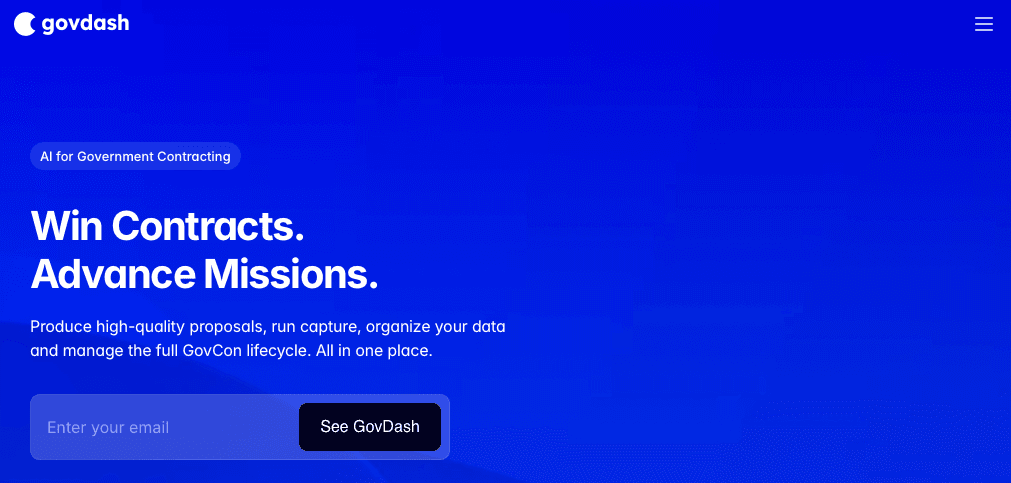
GovDash provides AI-assisted business development and proposal support in a single system, with FedRAMP Moderate Equivalency for teams handling CUI. GovDash holds FedRAMP Moderate Equivalency, providing a documented government cloud security baseline for teams handling CUI.
What They Offer
- Opportunity tracking with pipeline and CRM-style management
- AI-assisted proposal drafting based on stored content libraries
- Basic requirement checks tied to solicitation language
- Centralized storage for reusable proposal sections
Pro: Smaller government contractors seeking a single system that combines business development tracking with basic proposal support and are willing to accept limited integration capabilities.
Con: Lacks deep Microsoft Office integration beyond Word and operates as an all-in-one system instead of a focused proposal tool.
Bottom line: GovDash offers convenience through consolidation but sacrifices specialized proposal workflow depth.
Procurement Sciences
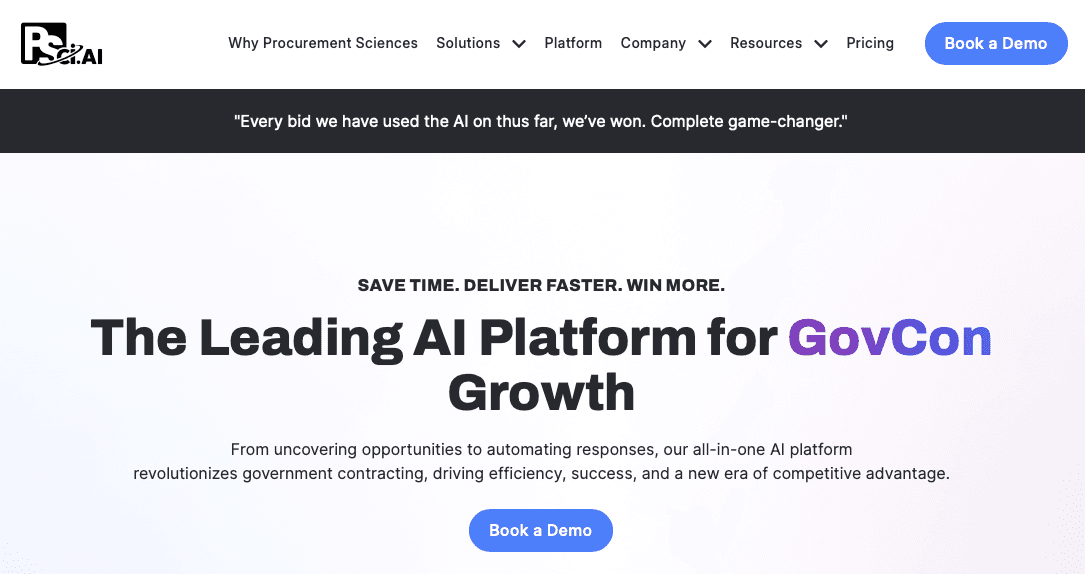
Procurement Sciences delivers AI-powered contracting intelligence and proposal support within their business development suite. Their Awarded AI product holds FedRAMP Moderate Authorization and SOC 2 Type 2 certification.
What They Offer
- Opportunity matching through AI algorithms that analyze solicitation requirements against company capabilities
- Content recommendations generated from solicitation text analysis to guide proposal responses
- Searchable historical content library for past performance references and proposal recycling
- Team collaboration tools for managing distributed proposal contributors across locations
Pro: Contractors who need opportunity discovery as their primary function and can work with basic proposal features as a supporting capability.
Con: Built as a business development system instead of a proposal creation tool, and requires manual export/import between systems due to no Microsoft Suite integration.
Bottom line: Strong for opportunity identification and pipeline management but missing the proposal-specific workflow tools needed for comprehensive bid response execution.
Get GovCon capture and proposal insights in your inbox.
GovSignals
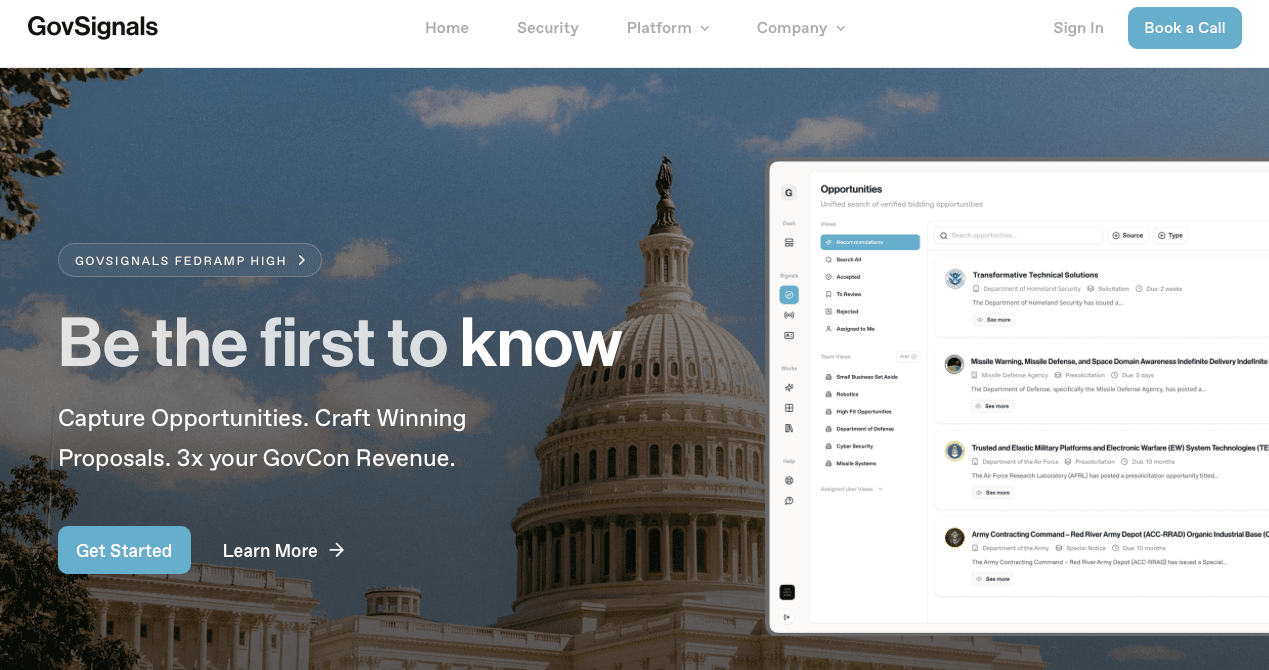
GovSignals delivers AI-powered capture and proposal intelligence for federal contracting opportunities. GovSignals is FedRAMP High Authorized with additional certifications including IL5, SOC 2 Type II, and ITAR compliance.
What They Offer
- AI analysis of solicitation documents to identify requirements
- Competitor intelligence and strategic positioning recommendations
- Automated capture planning templates
- Win probability scoring based on historical data
Pro: Federal contractors conducting detailed capture planning who need strategic intelligence as a standalone analysis tool.
Con: End-to-end capabilities may be complex for teams focused on proposal workflows.
Bottom line: GovSignals provides strategic insights but can be complex for GovCons focused on proposal workflows.
Rohirrim
Rohirrim provides chat-based AI for government contracting documents with question-answering capabilities.
What They Offer
- Conversational interface for querying RFP documents and generating summaries
- Basic content generation from uploaded materials without structured proposal workflows
- Simple document upload and retrieval system
Pro: Individual proposal managers who need quick document reviews through chat interfaces and don't require proposal-specific workflows.
Con: Operates as a general-purpose chatbot without dedicated proposal agents, offers no Microsoft Office or SharePoint integration (requires manual copy-paste), and lacks publicly available FedRAMP Moderate authorization and clear documentation of controls and configurations needed for handling CUI under NIST SP 800-171/800-53.
Vultron
Vultron offers AI-based proposal support for government contracting teams focused on draft creation and requirement coverage.
What They Offer
- Automated requirement extraction and matrix creation from solicitation documents
- AI-assisted drafting based on stored proposal content
- Version-controlled content libraries for reuse across proposals
- Web-based workspace for coordinating distributed proposal teams
Pro: Government contracting teams seeking basic proposal automation who work primarily in web-based environments and have limited Microsoft Office workflow requirements.
Con: Lacks native Microsoft Suite integration beyond basic Word support, provides no SharePoint integration, and does not provide publicly available FedRAMP Moderate authorization information or clear documentation of government-cloud deployment and NIST SP 800-171-aligned controls, which may increase compliance risk for organizations handling CUI.
Platform Comparison at a Glance
The table below maps each platform against the security and workflow criteria that matter most for government proposal teams handling CUI.
| Platform | FedRAMP Status | Government Cloud Deployment | No Training on Customer Data | Microsoft Office Integration | Proposal-Specific Workflows | Best For |
|---|---|---|---|---|---|---|
| GovEagle | FedRAMP Authorized (Full) | AWS GovCloud | Yes (zero data retention policy) | Yes (Word, PowerPoint, Excel, SharePoint, Box, Egnyte) | Yes (full lifecycle: bid/no-bid through submission) | Defense, intel, and civilian contractors needing end-to-end proposal automation |
| GovDash | FedRAMP Moderate Equivalency | Yes (government cloud) | Not publicly specified | Limited (Word only) | Basic (BD tracking + proposal support) | Smaller GovCons wanting BD tracking and basic proposal support in one system |
| Procurement Sciences (Awarded AI) | FedRAMP Moderate Authorization; SOC 2 Type 2 | Yes (government cloud) | Not publicly specified | No (manual export/import required) | Limited (BD-focused; basic proposal features) | Contractors prioritizing opportunity discovery and pipeline management |
| GovSignals | FedRAMP High Authorized; IL5; SOC 2 Type II; ITAR | Yes (government cloud) | Not publicly specified | No (standalone analysis tool) | Capture planning and strategic intelligence | Federal contractors focused on detailed capture planning |
| Rohirrim | No publicly available FedRAMP Moderate authorization | Not publicly specified | Not publicly specified | No (manual copy-paste required) | No (general-purpose chatbot) | Individual proposal managers needing quick document review |
| Vultron | No publicly available FedRAMP Moderate authorization | Not publicly specified | Not publicly specified | Limited (basic Word support; no SharePoint) | Basic (web-based workflow only) | Teams in web-based environments with limited Microsoft Office requirements |
Why GovEagle Is the Best Secure AI Tool for Government Proposal Data
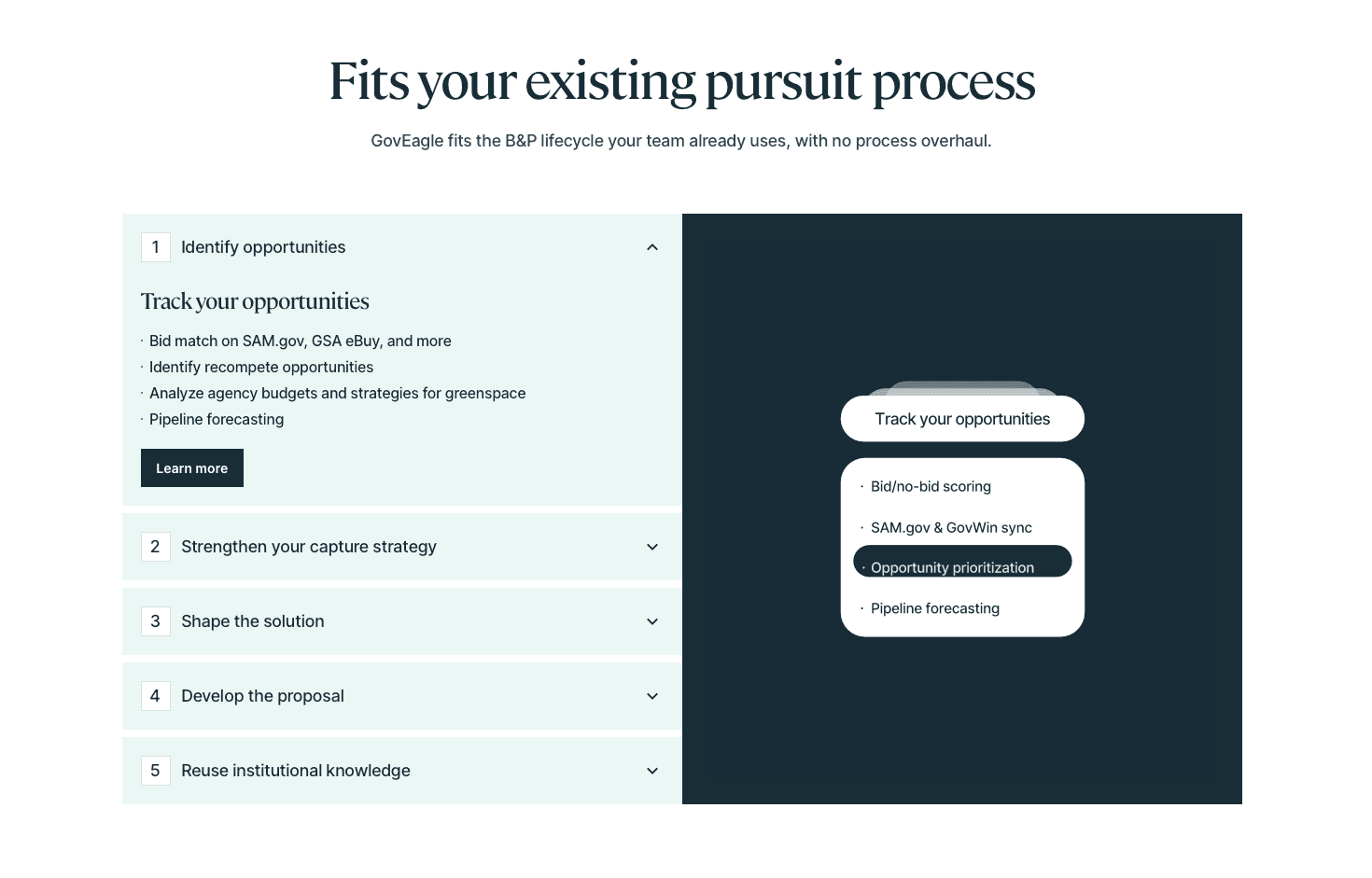
GovEagle was built to handle CUI data within actual proposal workflows. Our full FedRAMP Authorization runs in AWS GovCloud today, processing bid data for defense, intelligence, and civilian contractors. The Microsoft Office integration works within your existing review cycles, color teams, and compliance matrix development without requiring workflow changes.
Our customer success team includes former proposal directors who have managed hard deadlines and source selection requirements firsthand.
FAQs
How do I choose the right secure AI tool for my proposal team?
Start by verifying that the tool and its deployment can support NIST SP 800-171 requirements for handling CUI under DFARS 252.204-7012. If the tool is a vendor-operated cloud service, additional assurances like FedRAMP authorization and government-cloud deployment can further reduce risk. Then assess whether the tool integrates with your existing Microsoft Office workflows or requires you to change processes. Finally, confirm the vendor enforces zero data retention policies and doesn't train AI models on your proprietary proposal content.
Which secure AI tool works best for contractors new to proposal automation?
Tools with native Microsoft Office integration like GovEagle require minimal training because your team continues working in Word, PowerPoint, and Excel. Web-based platforms like Vultron require learning new interfaces and manual export/import steps. If your team already follows color team review processes, choose a solution that layers AI onto those workflows instead of replacing them.
Can AI proposal tools be used on ITAR-controlled programs?
ITAR-controlled programs carry additional restrictions on where technical data can be stored and who can access it. Not all AI proposal tools publish their ITAR compliance posture. GovSignals holds explicit ITAR compliance certification alongside FedRAMP High Authorization. For any program involving ITAR-controlled technical data, verify the vendor's data residency controls, access restrictions for non-US persons, and whether their government cloud environment meets your program's specific handling requirements before use.
Final Thoughts on Selecting Secure AI Tools for Proposal Data
Selecting secure AI platforms for proposal data comes down to one requirement: your CUI must stay protected while your team meets aggressive submission timelines. Government cloud AI solutions let contractors use advanced drafting, analysis, and compliance support without exposing sensitive bid information or putting future awards at risk. GovEagle combines CUI-safe processing with proposal-specific capabilities, letting teams move faster inside approved environments while maintaining eligibility for federal opportunities.