
AI for CMMC Assessments in September 2026: Realistic Applications and Hard Limits

If you're scoping a CMMC Level 2 assessment in 2026, AI tools can cut weeks of manual work by scanning System Security Plans against NIST 800-171 practices, flagging documentation gaps, and organizing evidence packages before your C3PAO review. CMMC AI tools won't replace the assessor's judgment on whether your control implementations meet the requirement, but they do let teams start from a structured draft instead of a blank page.
TLDR:
- AI cuts CMMC documentation work by automating SSP mapping and gap identification across 110 practices, but human assessors still make final compliance calls.
- Any AI tool that processes, stores, or transmits CUI or Security Protection Data must be considered in CMMC scoping, and the applicable security requirements depend on its role, data flows, and whether it is a cloud service provider or other external service provider.
- Deployment architecture matters more than features: for cloud tools that process, store, or transmit CUI, contractors generally need a FedRAMP Moderate or higher authorized offering, or a cloud service offering that meets DoD FedRAMP Moderate equivalency requirements.
- C3PAOs may ask how AI tools that touch CUI are governed, approved, configured, and monitored, especially if those tools are inside the assessment boundary.
- For proposal teams handling CUI while mapping CMMC requirements to Section L/M responses, the right fit is an AI tool whose deployment model, data handling, and cloud authorization or equivalency match the contractor’s CMMC scope.
Why AI Matters for CMMC Assessments in 2026
The CMMC 2.0 assessment process generates an enormous documentation burden. A Level 2 assessment alone covers 110 practices tied to NIST SP 800-171, and assessors routinely spend weeks cross-referencing System Security Plans, policies, and control implementations before forming a defensible opinion on compliance posture.
The Compliance Risk: How AI Tools Expand Your CMMC Assessment Boundary
When you bring an AI tool into your CMMC assessment workflow, that tool becomes part of your contractor information system. Depending on how it handles CUI, it may fall inside your CMMC assessment boundary, meaning every NIST 800-171 control that applies to your environment applies to that tool as well.
The boundary question hinges on data flow. If your AI tool processes, stores, or transmits CUI during gap analysis or evidence review, it inherits the full scope of your assessment. Even tools marketed as "CMMC-ready" may lack the FedRAMP authorization or data handling controls required to stay outside that boundary.
Compliant AI Architectures: GCC High, Air-Gapped, and FedRAMP Options
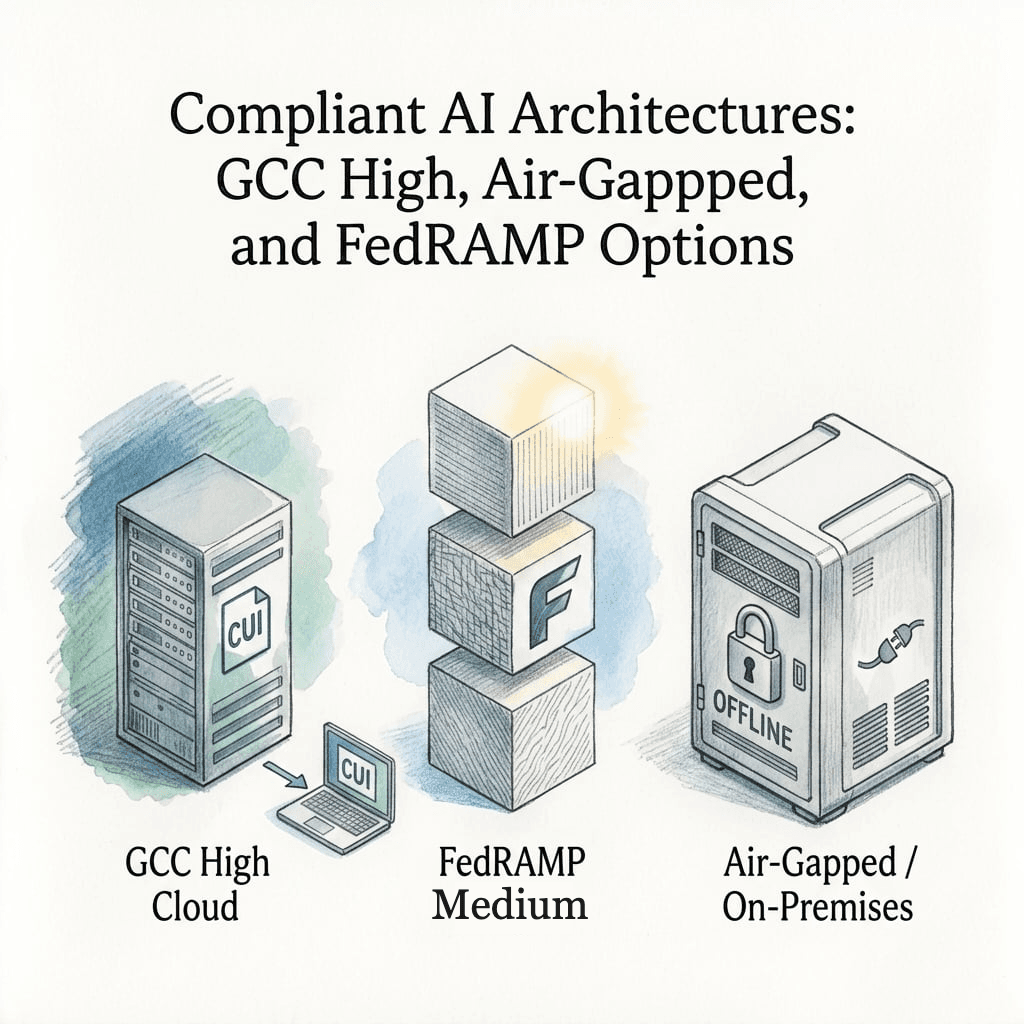
There are three realistic options for contractors who need AI support in controlled environments:
- GCC High hosted tools are built for CUI and operate within Microsoft's government cloud boundary, making them a natural fit for organizations already in that ecosystem. Many contractors use GCC High for CUI workflows, but the required architecture depends on contract requirements, CUI data flows, and the assessed environment.
- Air-gapped or on-premises deployments go further, keeping all data and model inference entirely offline. These may be used for highly sensitive environments or programs with strict isolation requirements, but classified work involves additional requirements outside standard CMMC Level 2 scoping.
- For cloud tools that process, store, or transmit CUI, FedRAMP Moderate authorization or DoD-recognized FedRAMP Moderate equivalency is the baseline to verify. GovEagle operates at this equivalency level, keeping assessment prep data out of commercial cloud infrastructure.
| Deployment Option | Typical Use Case | CUI Handling | Compliant For |
|---|---|---|---|
| GCC High | Level 2 and Level 3 contractors in Microsoft ecosystem | CUI within government cloud boundary | Most CMMC unclassified CUI work |
| Air-Gapped / On-Premises | Highly sensitive programs requiring isolated environments | All data and model inference stays offline | Highly sensitive or isolated contractor environments |
| FedRAMP Moderate Equivalent | Unclassified CUI environments without a GCC High requirement | No commercial cloud routing | Floor for unclassified CMMC assessment prep |
AI-Assisted SSP Generation and Compliance Documentation
AI tools can accelerate SSP development by mapping existing documentation against NIST SP 800-171 requirements and generating structured draft content. The output still requires SME review, but teams start from a structured draft with gaps flagged.
- Control-to-evidence mapping: AI can parse uploaded documentation and cross-reference it against the 110 practices, identifying which controls have supporting evidence and which are undocumented.
- Draft narrative generation: LLMs trained on CMMC and NIST 800-171 language can produce initial control implementation descriptions that assessors can review and score without writing from scratch. Teams considering compliance matrix automation tools should confirm that draft outputs map directly to control families instead of generic policy language.
- Gap identification: instead of waiting for a C3PAO to surface deficiencies, teams can run pre-assessment gap analysis against their SSP to catch documentation weaknesses early.
The realistic limitation here is data sensitivity. SSPs for defense contractors often contain CUI, which means the AI tool processing that documentation needs to operate in an environment that meets the same data handling requirements the SSP itself describes. That rules out most commercial SaaS AI offerings and pushes teams toward FedRAMP-scoped or self-hosted deployments.
The Human Verification Requirement: Why AI Output Still Needs Expert Review
For CMMC certification assessments, authorized assessors look at the evidence and determine whether requirements are MET, NOT MET, or NOT APPLICABLE. That accountability doesn't transfer to an AI tool, regardless of how accurately it maps controls. C3PAOs expect contractors to own their evidence narratives, and assessors will probe the reasoning behind any AI-generated gap analysis during the assessment itself.
- AI can misclassify ambiguous CMMC controls, particularly in domains like Incident Response (IR) or Configuration Management (CM) where implementation evidence varies widely across environments.
- Reviewers need to verify that AI-mapped practices reflect actual system behavior; documentation language that happens to match NIST 800-171 control wording is insufficient on its own.
- Any AI-assisted scoping decision, especially around CUI boundaries, carries audit exposure if a qualified practitioner has not validated the logic.
The defensible approach is to use AI for initial mapping and evidence tagging, with a senior compliance lead reviewing every finding before it enters the assessment record. That keeps the speed benefit while placing human judgment where C3PAOs and the Cyber AB expect it.
AI Governance Policies: What C3PAOs Will Ask During Your Assessment
AI governance documentation can become relevant during a CMMC assessment when AI tools process, store, or transmit CUI or support systems inside the assessment boundary. C3PAOs will look for evidence that your organization has thought through how AI interacts with CUI, which tools are approved, and under what conditions they can be used.
What Assessors Typically Want to See
Governance documentation requirements vary by assessor. Here are some thigns
- A written AI acceptable use policy that covers which tools are approved for use within the CMMC assessment scope, with explicit guidance on whether those tools can process or store CUI.
- Evidence that employees handling CUI have received training on AI tool restrictions; general security awareness training may not be enough if employees are allowed to use AI tools with CUI or assessment artifacts.
- Configuration documentation showing that any AI tools operating near CUI are deployed in environments that meet your CMMC boundary requirements, such as GCC High or an air-gapped setup.
- Incident response procedures that account for AI-related data exposure scenarios, including what happens if an employee routes CUI through an unapproved tool.
Common AI Compliance Pitfalls Defense Contractors Should Avoid
Contractors running CMMC assessments with AI tools often run into the same process failures, and most trace back to misplaced trust in AI outputs instead of flawed AI itself.
- Accepting AI gap analysis without human review: AI can scan policy documents and flag potential control gaps, but it cannot independently verify whether a control is actually implemented in your environment. Treating AI output as a final determination instead of a starting point creates audit exposure.
- Using general-purpose AI for controlled data: Running CUI through consumer-grade AI tools can create CMMC compliance risk if the tool is not authorized, controlled, or scoped appropriately. Any AI tool touching controlled information needs to operate within a compliant boundary.
- Over-relying on AI for evidence mapping: AI can suggest which artifacts map to which practices, but evidence sufficiency is a judgment call that C3PAOs make. Contractors who let AI do that mapping without reviewing the logic often submit incomplete evidence packages. For teams assessing secure AI platforms for government proposal data, the evidence handling architecture matters as much as the feature set.
- Ignoring AI model versioning and traceability: When assessors ask how a gap finding was identified or how evidence was categorized, "the AI said so" is not an acceptable audit trail. Your process needs to document what tool was used, when, and who reviewed the output.
AI for Proposal Development: GovEagle's Approach to Compliant Automation

GovEagle approaches CMMC-related proposal work differently than generic AI writing tools, building compliance into the automation layer and operating at FedRAMP Moderate Equivalency with GCC and GCC High support where CMMC-sensitive work lives.
For capture teams responding to DoD solicitations with CMMC requirements, the friction typically shows up in three places: mapping Section L and M requirements against CMMC control language, surfacing relevant past performance that speaks to cybersecurity posture, and keeping compliance traceability intact across multiple revision cycles. GovEagle's automation targets those specific handoff points, not generic writing assistance.
The practical difference shows up in how the tool handles requirement traceability. GovEagle generates compliance matrices that connect solicitation requirements directly to response content, which keeps CMMC-related requirements visible throughout the drafting process so teams are not manually sorting through them at the end of a color team cycle.
Teams working in environments where data handling is a hard constraint, including air-gapped and SCIF settings, can deploy GovEagle in configurations that keep proposal content within controlled boundaries. For contractors pursuing Level 2 or Level 3 certifications, that deployment posture often matters as much as the AI capability itself.
FAQs
Can I use AI for CMMC assessments without expanding my assessment boundary?
Yes, if the AI tool never processes, stores, or transmits CUI. Lower-risk use cases include drafting policy language, preparing assessment Q&A, and organizing non-CUI evidence, provided the tool does not process, store, or transmit CUI or otherwise connect to systems in the assessment boundary.
What's the best AI deployment model for CMMC Level 2 work?
GCC High is a common option for contractors handling CUI, but the required environment depends on contract terms, data flows, and CMMC scope. Air-gapped deployments may be used for highly sensitive or isolated environments, but they are not the default requirement for CMMC Level 2 work, while FedRAMP Moderate Equivalent tools (like GovEagle) meet the floor for unclassified CUI environments without routing data through commercial infrastructure.
What AI governance documentation will C3PAOs ask for during my assessment?
C3PAOs look for a written AI acceptable use policy defining which tools can process CUI, employee training records on AI tool restrictions, configuration documentation showing compliant deployment (GCC High or equivalent), and incident response procedures covering AI-related data exposure scenarios. Informal norms without written policy create findings.
Final Thoughts on How AI Deployment Architecture Determines Assessment Exposure
CMMC AI tools speed up the documentation and gap analysis phases of assessment prep, but deployment architecture determines whether that acceleration creates new assessment scope. C3PAOs will assess how AI tools were used if those tools touched CUI, Security Protection Data, or systems inside the assessment boundary, and any tool that touched controlled data without the right authorization expands your boundary. The practical constraint for contractors pursuing Level 2 or Level 3 certification is not whether to use CMMC AI tools but where to run them. Tools that operate at FedRAMP Moderate Equivalency with GCC/GCC High support, like GovEagle, keep CMMC readiness work within controlled boundaries without creating findings that delay certification.