
DoD Fixed-Price Profit Policy: Keep the Savings If Your Price Holds Up (2027)

Akash Mandavilli
CEO and Co-Founder of GovEagle
About the author
Akash is a 2x founder with previous experience in AI from Meta and federal sales from IBM. Akash holds a dual-degree from Johns Hopkins University in Economics and Computer Science.
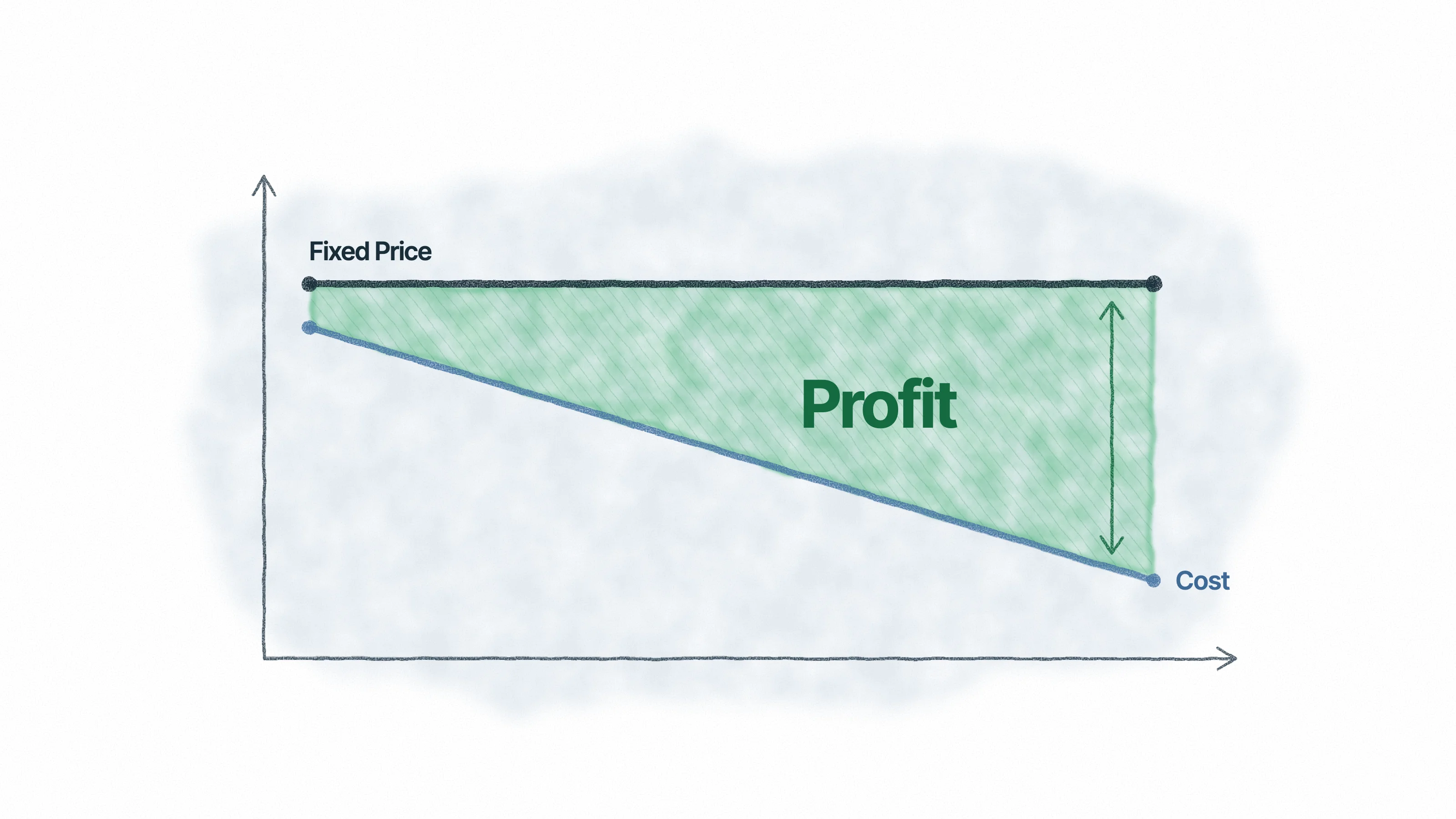
DoD is making its position on fixed-price profit clearer. The message from the government side is: If you negotiate a fair price and then get more efficient, you get to keep the savings.
That sounds like how fixed-price contracting is supposed to work. But for contractors, especially on sole-source work, unusually high margins can also invite questions about whether the original price was reasonable.
A series of four DoD pricing memos issued between August and October 2026 tries to resolve that tension.
Taken together, the message is:
DoD wants better visibility into the data behind your starting price. But once that price is set as fair, better execution and lower costs should benefit the contractor.
For capture and pricing teams, that affects three things in particular:
- how you assess fixed-price pursuits
- how you model follow-on and multi-lot work
- what you preserve in the pricing file to support the original price
There’s another change coming. DoD has also directed a rewrite of its profit policy, with rulemaking expected to begin around December 13, 2026.
This post is intended to inform about DoD messaging. There’s no guarantee about how this will play out, and we encourage you to keep an eye on how this develops just as you consider how it might apply to you.
TLDR:
- DoD's October 2026 Efficiency Assurance memo states post-award savings are "rightfully retained by industry" when the starting price was fair and reasonable.
- Efficiencies protect your margin on the current contract, but DoD may use your actual costs to reset pricing on sole-source follow-ons and multi-lot work.
- Your pricing file and BOE are your defense: the memo is a policy statement, not a safe harbor from defective-pricing or CAS exposure.
- IT and services contractors should watch for sector-specific profit benchmarks expected through the upcoming DFARS profit-policy rulemaking, targeted to begin around December 13, 2026.
- GovEagle's bid/no-bid and price-to-win analysis draw on SAM.gov and USASpending data to help capture teams assess fixed-price pursuit economics before award.
What changed?
On October 27, DoD’s pricing policy office and the Defense Contract Audit Agency issued an “Savings Assurance” memo covering fixed-price contracts and Other Transactions.
The most important line for contractors: savings generated through better execution, productivity improvements or private investment are “rightfully retained by industry” when the government negotiated a fair price to begin with.
In other words:
If you price a fixed-price contract at $100 million, deliver it for $85 million and the original $100 million price was properly negotiated, DoD does not want the $15 million difference treated as evidence of waste simply because your margin was higher than expected.
The memo is the latest piece of a broader DoD pricing push:
| Date | Policy | What matters |
|---|---|---|
| Aug. 18 | Supplier Cost and Pricing Transparency | DoD pushed for more cost visibility on large negotiations. |
| Sept. 14 | Building One Strong Industrial Base | DoD called for less reliance on CAS, a cost-saving assurance policy and new profit rules. |
| Oct. 1 | Implementation of Supplier Cost and Pricing Transparency | DoD clarified that price information should come first, with cost information requested when needed. |
| Oct. 27 | Efficiency Assurance | Contractors can retain savings earned against a fair fixed price. |
The policies are more consistent than they first appear.
DoD wants confidence in the starting price. Once that price is set, it wants contractors to have a reason to become more efficient.
Even the August memo said DoD did not intend to limit contractor profitability when efficiencies are achieved after negotiating a fair and reasonable price.
The October 1 guidance also narrowed some of the more aggressive interpretations of the August policy:
- Contracting officers may request cost data when they determine it is necessary.
- Commercial products and services remain subject to the pricing rules that already apply to them.
- Automated government access to contractor financial systems would be voluntary and could not be a condition of award or an evaluation factor.
DCAA’s director then co-signed the October 27 cost-saving memo.
Why high fixed-price margins can still attract attention
On a firm-fixed-price contract, the basic bargain is straightforward.
If your costs go over, you absorb the loss.
If your costs come in below plan, you keep the upside.
The complication comes on negotiated and particularly sole-source work.
Suppose you price a job based on an expected cost of $90 million. After award, your actual cost is only $75 million.
That could mean you executed extremely well.
But it can also lead the government to ask whether information available before the price agreement should have produced a lower starting price.
For example:
- Was a cheaper supplier quote already available?
- Had you already planned a process improvement that would materially reduce cost?
- Did certified cost or pricing data omit information that would have affected the negotiated price?
When certified cost or pricing data is required, omissions like those can support a defective-pricing claim under the Truth in Negotiations Act.
That created an awkward incentive: the better a contractor performed, the more scrutiny a large margin could potentially attract.
The October 27 memo directly speaks to that concern.
It says profit resulting from superior execution, productivity gains or private investment is an intended result of risk-based contracting and is not, on its own, evidence of waste.
The policy applies where contractors carry cost risk, including fixed-price contracts, fixed-price incentive contracts and Other Transactions.
That includes fixed-price services, not merely hardware.
What makes the starting price defensible?
Everything hinges on whether the original price was fair and reasonable.
The memo points to three basic ways the government can confirm that.
1. Competition
Multiple qualified bidders compete and the market sets the price.
This generally gives contractors the cleanest support for the resulting price.
2. Commercial price analysis
The government compares the proposed price with commercial or market pricing.
The analysis focuses on price instead of opening up the contractor’s underlying cost structure.
3. Cost analysis
When competition or market pricing cannot confirm a reasonable price, the government may look at the contractor’s underlying costs.
For applicable sole-source DoD prime contracts, that can include certified cost or pricing data under TINA.
When certified data is not required, the October 1 memo tells contracting officers to start with price information and move to cost information only when necessary to confirm a fair price.
And when cost information is requested, DoD generally wants contractors to provide it in the form they already maintain, such as ERP data, instead of creating a new accounting system for the government.
The practical takeaway for capture teams is simple:
How the price gets set affects how easy it will be to defend later.
A competitively set price is difficult to second-guess. A negotiated sole-source price depends much more heavily on the quality and completeness of the data behind it.
Get GovCon capture and proposal insights in your inbox.
What this signals for capture and pricing teams
1. Fixed-price pursuits have more upside, but the risk is still yours
Fixed-price contracting is becoming more important across DoD.
Executive Order 14402 made fixed-price contracts the default and requires additional justification for cost-reimbursement, time-and-materials and labor-hour contracts.
That means more services contractors may find themselves bidding fixed-price work whether or not that has historically been their preferred model.
The new cost-saving policy strengthens the upside.
If you can lower delivery costs after award through:
- automation
- a better labor mix
- process improvements
- supply-chain changes
- contractor-funded tooling or technology
DoD's position is that the resulting margin belongs to you, assuming the starting price was properly set.
For companies already winning competed fixed-price work, that may not feel dramatically different. The bigger implication is likely on sole-source awards, follow-ons and bridges, where the government has more reason to compare actual costs with the price it previously paid.
The risk side hasn't changed.
If your cost-saving plan works, you keep more margin.
If it fails and costs run over, you take the hit.
That makes the cost-saving plan itself worth weighing during bid/no-bid and your probability of win assessment.
Ask:
- Are the requirements defined well enough to price confidently?
- Where do we believe costs will come down after award?
- How confident are we in those savings?
- Are we funding automation, tooling or another improvement ourselves?
- How much overrun can we absorb if the plan doesn't work?
A fixed-price opportunity with credible cost-saving upside can be a fundamentally different business case from one where the only way to win is to squeeze margin at award.
2. Don't assume today's margin survives the next negotiation
The policy protects efficiencies on the contract where you earn them.
It does not promise that DoD will ignore those efficiencies when pricing the next contract.
That distinction matters most for sole-source follow-ons and multi-lot programs. You can track upcoming opportunities in the Federal Recompete Outlook.
The September guidance said contractors should keep efficiencies on the current contract, while the government captures those efficiencies prospectively during the next negotiation.
The October 27 memo is slightly less specific, but says prior efficiencies should inform future procurements such as follow-on production lots.
A simplified example:
- Lot 1: Price = $100M. Estimated cost = $90M. Planned profit = $10M.
- Your team improves execution and actual cost falls to $82M.
- You keep the resulting $18M margin on Lot 1.
- When Lot 2 is negotiated, DoD now knows the work cost $82M and may expect additional learning or savings.
- If the new projected cost is $78M, the next negotiated price could be substantially below $100M.
So the lesson isn't simply “higher output per dollar means higher long-term margin.”
It's:
You can retain the benefit of beating your cost plan on the current work, but future prices may reset around the new cost reality.
Model that reset when you're weighing the total economics of a multi-year or multi-lot program.
The October guidance also points to two mechanisms contractors should watch:
Tiered profit sharing. DoD is encouraging structures where contractors earn additional profit from realized efficiencies while some of the value flows back to the government through things like future price reductions or additional deliverables.
Fixed-price incentive share lines. These already divide underruns between the government and contractor according to a negotiated formula. On a 70/30 government-contractor share line, for example, the contractor keeps 30 cents of each dollar saved below target cost.
3. Your pricing file matters more, not less
The cost-saving memo is not a safe harbor.
It doesn't eliminate defective-pricing remedies, CAS adjustments, audits or other existing requirements.
The government's position is essentially:
We won't punish you for becoming more efficient after agreeing to a fair price. But you still need to show that the price was fair when we agreed to it.
That makes your basis of estimate and pricing file important evidence.
Capture and pricing teams should:
- Preserve the final BOE, including hours, labor rates, supplier quotes and major assumptions.
- Separate efficiencies that were known and planned before award from improvements found afterward.
- Keep supplier quotes and other pricing data current through the price-agreement date when certified data is required.
- Maintain support for meaningful year-over-year price increases.
- Make sure the record explains what you knew when the price was negotiated.
That distinction between planned savings and post-award savings is especially important.
If you already knew before negotiations that a change would materially reduce your cost, leaving that information out of required certified data can create a defective-pricing problem.
If your team invents a better process six months after award, that is exactly the kind of cost saving the October memo is trying to encourage.
4. Services and software contractors should watch the new profit benchmarks
There is another piece of the October 1 guidance that deserves attention from IT and services contractors.
DoD wants contracting officers to use sector-specific profit benchmarks when setting negotiation objectives.
Those benchmarks are supposed to inform negotiations and not function as hard caps.
For software and IT services, DoD says margins should reflect things like commercial SaaS economics, R&D investment, company maturity and the scale of the software, not simply importing traditional hardware profit structures.
For services and sustainment, DoD points toward commercial logistics and third-party maintenance benchmarks tied to performance.
The important part: DoD hasn't published the actual benchmark numbers yet.
Those details are expected to develop through the upcoming DFARS profit-policy rulemaking.
Depending on what commercial comparisons DoD eventually adopts, profit objectives for some services and software businesses could move up or down.
What happens next?
The September guidance directs DoD to begin a DFARS rulemaking on profit policy within 90 days, putting the target around December 13, 2026.
The stated goal is to make negotiated margins better reflect:
- value delivered
- risk carried
- private capital invested
and not simply the amount of cost incurred.
Today, when certified cost or pricing data is obtained, DoD generally uses the weighted guidelines method to develop its profit objective.
The coming rulemaking could change how that calculation treats efficiency, investment and different industry sectors.
December 13 should be treated as a target, not a guaranteed publication date. As of DoD's November 6 list of open DFARS cases, no profit-policy case had been posted.
And beginning a rulemaking is not the same as completing one.
Until the rules change, contractors are still operating under today's DFARS profit framework alongside the new October guidance.
In the meantime:
- Identify who will review and potentially comment on the proposed rule.
- Pull margin and actual-cost data from recent fixed-price work.
- Flag fixed-price, sole-source follow-on and multi-lot opportunities in your pipeline.
- Revisit the economics of pursuits where contractor-funded efficiencies could materially change margin after award.
FAQ
Is the efficiency assurance memo a safe harbor?
No.
It is a policy statement about how DoD views legitimate savings gains. It does not override existing law, eliminate audit findings or waive defective-pricing and CAS remedies.
Does it apply to cost-plus contracts?
No.
The memo focuses on arrangements where the contractor carries cost risk, including fixed-price contracts, fixed-price incentive contracts and Other Transactions.
Cost-reimbursement work remains subject to its existing cost and audit rules.
Will DoD lower my price on the next lot?
Possibly, especially on a negotiated sole-source follow-on.
You keep efficiencies earned against the current fixed price. But DoD says those efficiencies can inform future negotiations, including learning curves and other expected cost reductions.
When will DoD change its profit rules?
DoD has been directed to begin a DFARS profit-policy rulemaking around December 13, 2026.
As of November 6, no corresponding open DFARS case had been posted.
Where GovEagle fits
Policy changes like this show up first in pursuit decisions.
A fixed-price opportunity can look very different depending on how much confidence you have in the requirements, your cost assumptions, the competitive environment and your ability to create efficiencies after award.
GovEagle's bid/no-bid analysis weighs factors including contract type, capability fit, incumbents, competitors and pursuit risks to help teams decide where to spend capture resources.
For opportunities you pursue, GovEagle's price-to-win analysis uses SAM.gov, USASpending and web sources to build a target price, competitor labor-rate estimates and sensitivity analysis, with the underlying figures sourced.
The goal is the same one this policy increasingly puts on contractors: know what supports your price before you commit to it.